You have likely met the word as a joke, in a meme, a comment thread or a friend’s group chat. Gooning is, underneath the humor, an adult slang term. In plain language, it names a sexual practice built on prolonged edging. That means long sessions of deliberately delayed climax, usually involving large amounts of pornography. The goal is a trance-like state of heightened arousal. The person doing it is called a gooner.
This guide explains the word in dictionary fashion. It sets out the core definition first, then the small family of terms around it, such as goon cave and goon state. From there, it traces the word’s path from early forum posts in 2005 to features in mainstream magazines two decades later. It also covers the softened joke sense common on TikTok. And it covers the serious conversations about compulsion that have grown up around the practice. The tone stays clinical throughout, because the subject needs clarity more than it needs color.
What Does Gooning Mean?
At its core, gooning describes both an activity and the subculture that formed around it. The activity is a prolonged session of edging, stretched far beyond the usual few minutes. Sessions are measured in hours rather than minutes, at least in the community’s own accounts. Large volumes of pornography are normally part of the picture, often on more than one screen. The aim is not simply a delayed finish. The aim is the state itself, an absorbed, trance-like plateau that participants call the goon state.
The Dictionary Version
Dictionaries have started to catch up with the word. Merriam-Webster now lists a verb sense of goon, labeled vulgar slang. It covers masturbating over a prolonged period without reaching climax, in order to stay aroused. The dictionary dates that verb sense to about 2005. Know Your Meme, which documents internet vocabulary, gives a matching summary. It describes gooning as prolonged masturbation to pornography without climaxing. The method is edging, and the goal is a numbed, dissociated high that users call “the goon.”
One building block needs a plain definition of its own. Edging is a technique with a simple pattern. A person repeatedly approaches climax, then stops or eases off, holding arousal high while delaying or preventing orgasm. Gooning takes that single technique and stretches it into a marathon. In short, edging is the method, and gooning is the prolonged, immersive practice built on top of it.
The Goon State
The goon state is the goal that gives the practice its shape. Participants describe it as trance-like, euphoric and oddly meditative, a point where attention narrows to sensation alone. Sexuality researcher Jason Armstrong, quoted in reference coverage, describes it as the moment when the content itself stops being necessary. The description matters for vocabulary reasons. Almost every other term in the glossary below exists to name some part of reaching, extending or recovering from that state.
A Social Subculture, Not Just a Solo Act
One detail surprises many readers. Although the stereotype is a person alone in a dark room, gooning has a social layer. Wikipedia’s account describes communities on Reddit with millions of members, and Discord servers hosting tens of thousands. Members share memes, vocabulary and, in some cases, company. Group sessions over video calls are part of the documented picture, and some couples fold mutual edging into their own sex lives. The word names a scene as much as a solo habit.
Where Definitions Differ
Definitions inside the community are not perfectly tidy. Some users reserve gooning for sessions that avoid climax altogether, so the delayed finish never arrives. Others use the word for the session itself, including its ending, as long as the trance-like absorption was the point. A few accounts also stress that pornography, while typical, is not strictly required. For a reader meeting the word in the wild, the safest summary is this. If the context involves hours of absorbed, deliberately prolonged arousal, gooning is almost certainly the intended sense.
Usage labels help here, too. Dictionaries mark the adult sense as vulgar slang, which is a warning about setting rather than meaning. The word is unremarkable in meme pages, group chats and adult forums. It would be out of place in a workplace message, a classroom or a family chat. There, most hearers would either miss the joke or mind it.
The Words Around It: A Small Glossary
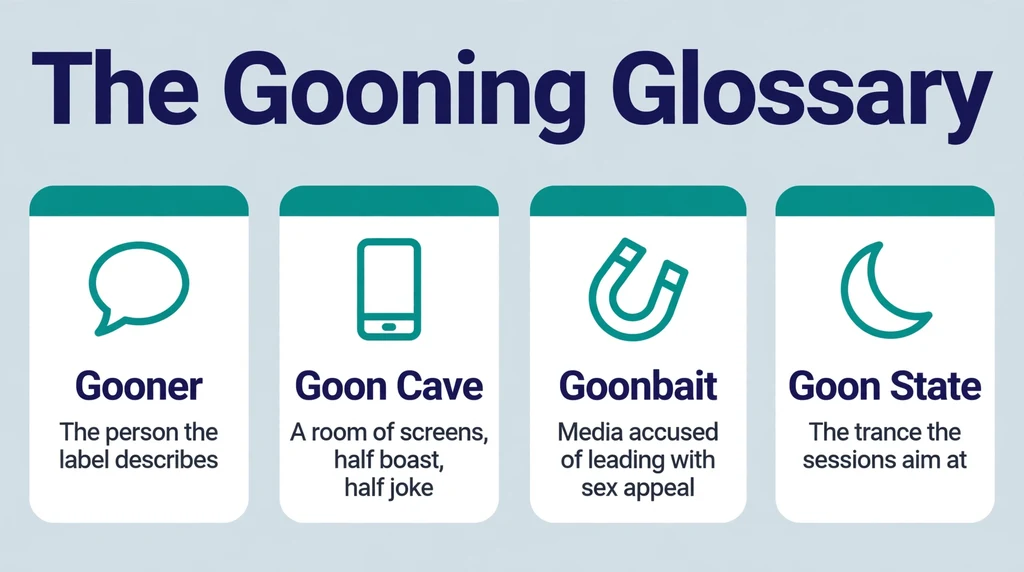
Gooning travels with a cluster of related terms. Most of them are jokes, labels or pieces of set dressing coined inside the same communities. The table below gives each term a short, clinical gloss. None of these words appears in polite conversation, and several of them double as insults, so tone matters when you repeat them. The glossary also shows how the community talks to itself. A shared vocabulary is what turns a private habit into a subculture with in-jokes, status games and folklore. Most entries below began as jokes and stayed jokes, even when the topics around them turned serious.
| Term | What it means |
|---|---|
| Gooner | A person who goons. Used as a self-label inside the subculture, and as a mocking label outside it. |
| Goonette | The community term for a female gooner. It signals that the subculture, while mostly male, is not exclusively so. |
| Goon cave | A room set up for long sessions, typically with several screens showing content at once. Often photographed and shown off as a joke. |
| Goon state | The trance-like, euphoric plateau that long sessions aim at. Some definitions shorten the name to “the goon.” |
The Wider Vocabulary
| Term | What it means |
|---|---|
| Goon face | The vacant, slack expression jokingly linked to deep absorption. It is the visual punchline behind many gooning memes, including the True Goon Stare. |
| Gooning kit | The equipment gathered for a long session, screens included. The phrase appears in meme coverage alongside goon caves from the early 2020s. |
| Edging | The underlying technique: repeatedly nearing climax and backing off, so arousal stays high and climax is delayed or avoided. |
| Goonbait | Media accused of using sex appeal as its main hook. Applied to games, shows and social posts, usually as criticism or as a joke. |
| Pornsexual | A self-mocking label some gooners use for preferring pornography to partnered sex. It appears in community definitions from early on. |
Two patterns run through the glossary. First, the vocabulary treats the habit as an identity, not just an act. Second, almost every term works in two directions at once. Inside the group, the words are badges worn with deliberate exaggeration. Outside it, the same words are shorthand for someone seen as hopelessly absorbed. That double life explains most of the word’s modern career.
New terms are still being coined, and most die within a year. The ones in this table have survived because each names something the others do not. Together they let insiders describe a whole evening in four or five words. That economy of language is the real engine of the word’s spread.
Where the Word Came From
The Older Word: Goon Before the Internet
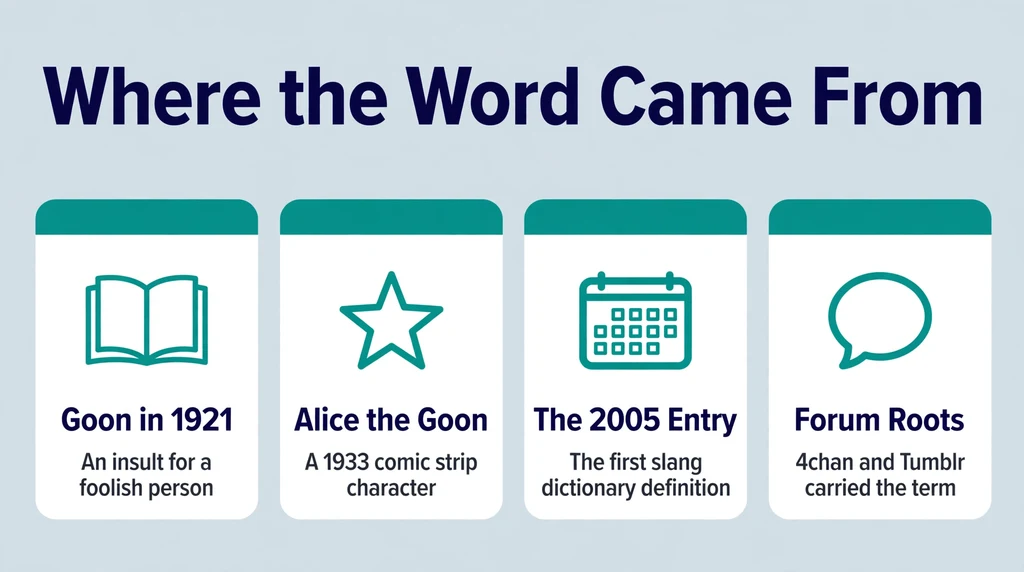
The slang sense sits on top of a much older word. Merriam-Webster records the noun goon from 1921, in the sense of a stupid person. It is probably a shortening of the dialect word gooney, meaning a simpleton. Dictionary.com traces a longer line back to an obsolete word, gony, with the same meaning. In other words, goon began life as a plain insult for someone seen as slow or foolish.
Pop culture then made the word familiar. Alice the Goon, a large and simple character in E. C. Segar’s Thimble Theatre, the strip that gave the world Popeye, appeared in 1933. By about 1938, goon had gained a second sense: a hired thug, especially one used against strikers and unions. That pairing, muscle without much mind, is how most people still meet the word in films and crime writing.
Print gave the insult an early boost, too. In December 1921, Harper’s Monthly ran Frederick L. Allen’s essay “The Goon and His Style.” It treated the goon as a recognizable social type, heavy-handed and hard to reason with. The essay is one reason dictionaries date the modern noun to that year.
The Word at War and at Play
The foolish sense never went away, either. In Britain, the BBC radio comedy The Goon Show kept it in front of audiences through the 1950s. In North America, hockey fans adopted goon for the enforcer whose real job was fighting. Both uses keep the same flavor. A goon is a person reduced, fairly or not, to a single blunt function.
War added one more niche sense. British and American prisoners used goon for German camp guards during the Second World War. The word fit because the guards matched both halves of its meaning. They were hired muscle, and they were men the prisoners considered fools.
The Slang Sense Arrives: 2005
The adult sense grew out of the first meaning, not the thug. Know Your Meme dates the earliest Urban Dictionary definition of gooning to August 2005. Its author described someone becoming so absorbed in masturbation that he turns into, in the entry’s framing, a total goon. The joke is the etymology in miniature. Prolonged absorption makes you vacant, and vacant is what a goon has always been.
A 2012 Urban Dictionary entry, again quoted by Know Your Meme, sharpened the definition. It described gooning as the state reached after a prolonged edging session, when a person feels completely hypnotized by the sensation. Wikipedia’s account adds two more early landmarks. The practice seems to have circulated on 4chan in the early 2000s. It then crossed over with pornography addiction fetish communities on Tumblr in the late 2000s. From there, dedicated spaces on Reddit and later Discord gave the subculture a permanent home.
The community infrastructure arrived a few years later. Know Your Meme’s timeline records the creation of the subreddit r/GOONED in May 2019. A second space, r/GoonCaves, followed within weeks, built for the setup photographs. Dedicated forums mattered more than any single definition. They gave the vocabulary a place to be used daily, which is how slang either settles or evaporates.
One feature of this history deserves emphasis. Print reference works lagged the forums by years, which is normal for vulgar slang. Anyone reconstructing the timeline therefore leans on dated posts and dated dictionary entries. That is exactly the trail this section has followed.
How Gooning Spread Online
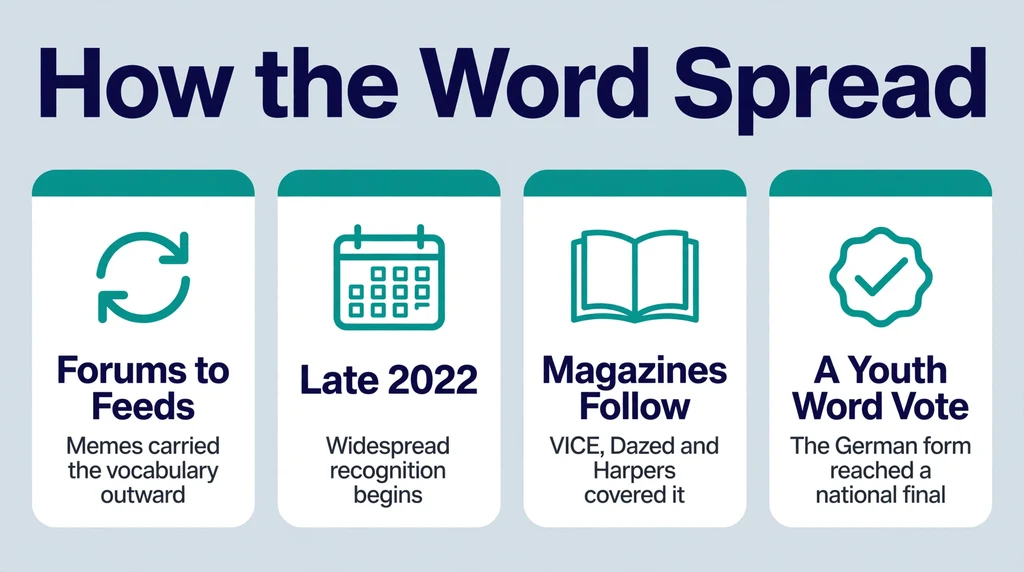
For roughly fifteen years, gooning stayed inside its own corners of the internet. That changed in the early 2020s. Know Your Meme notes that the practice began gaining widespread recognition from late 2022. Wikipedia, drawing on magazine reporting, records a sharp rise in search interest in 2023. Growth during the COVID-19 lockdown years is often credited as well, although that link is plausible rather than proven.
Lockdowns form the backdrop to that timeline. With social life pushed indoors and online from 2020, screen-based subcultures of every kind grew quickly. Reference coverage of gooning treats the pandemic period as an accelerant rather than a cause. The practice existed long before, and its vocabulary was already a decade old. What changed was the size of the audience sitting at home, bored, and ready to adopt new slang.
From Forums to Feeds
The mechanics of the spread were ordinary. Screenshots of goon caves made the habit visual, and visual habits travel well. Short videos turned the vocabulary into punchlines that needed no context. Meanwhile, the memes were self-deprecating enough to share without much embarrassment. As a result, words that once signaled membership in a niche community became general slang for a glazed, screen-locked state. Gen Z and Gen Alpha users, in particular, picked the terms up and ran with them.
The audience grew with the jokes. Dazed reported that one major gooning community grew from roughly 3,000 members in 2020 to about 2.3 million by June 2025. A membership count is not a census of practitioners, and many members arrive for the memes alone. Still, the direction of travel is not in doubt. A vocabulary that needs a 5,000-word explainer was once confined to a handful of forum threads.
By 2024, teachers and parents were meeting the word in a new bundle. Lifehacker grouped gooning with mewing and similar so-called brain rot terms that younger users trade as jokes. The label says more about adult anxiety than about the words themselves. Each term in the bundle sounds alarming out of context. In context, each is mostly a shibboleth, a way for young users to recognize one another.
The Mainstream Moment
Mainstream coverage followed the memes. VICE explored goon caves in 2023. Dazed asked what happens when a fetish goes mainstream in 2025, and Harper’s Magazine published a long feature on the subculture the same year. Vox treated the community as a case study in where internet culture might be heading. Each outlet faced the same editorial problem. The subject was too widespread to ignore, yet too explicit to describe in detail. Most coverage therefore focused on the sociology rather than the act.
Two honors mark how far the word traveled. An adult content platform named gooning its 2026 Fetish of the Year. It cited a large rise in related sales since 2023, a figure best read as marketing. In Germany, the loanword Goonen reached the final of the 2025 Youth Word of the Year vote. Deutsche Welle reported that it lost to “das crazy” by a fraction of a percentage point. A slang term does not get much more established than a national youth vote.
Explainers aimed at the confused multiplied alongside the features. Them asked, in 2024, whether anyone was actually doing it. Lifehacker included gooning in a decoder of Gen Z and Gen Alpha slang the same year. Men’s Health and Cosmopolitan both ran explainers in 2025. When a word needs this many guides, it has crossed from slang into the general vocabulary of the internet.
Gooning as a Joke: The Meme Sense
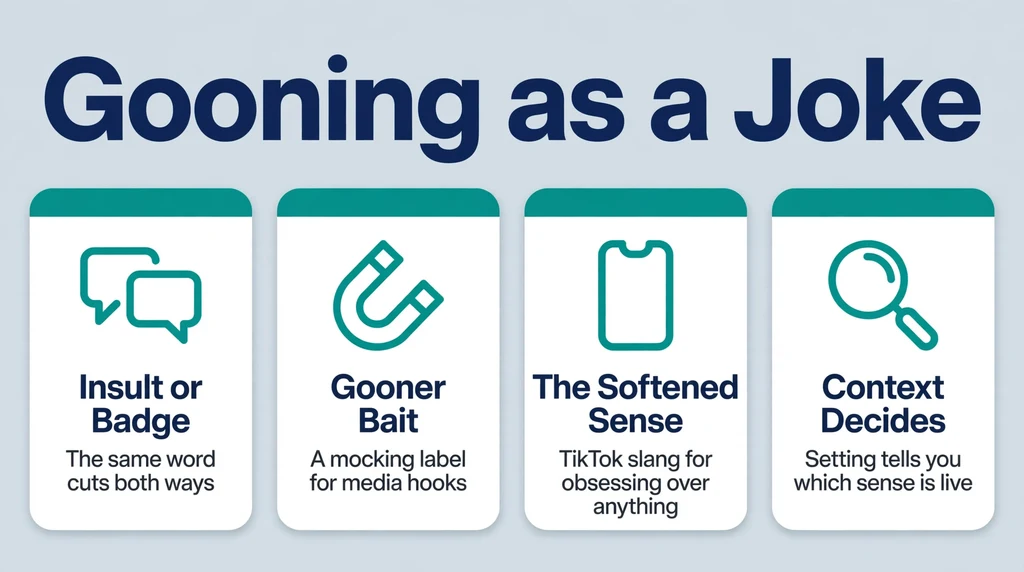
Most people who use the word today are joking. The humor is built into the subculture itself, whose members describe their own habit in deliberately overblown terms. Some call themselves pornosexuals, presenting pornography as if it were an orientation. Others post photographs of elaborate multi-screen setups with mock pride. The joke only works because everyone involved agrees the behavior sounds excessive.
The jokes also protect the jokers. Calling yourself a gooner before anyone else can is a standard move, and it turns embarrassment into material. Outsiders borrowed the move quickly. That is one reason the insult lost its sting so fast.
Gooner: Insult, Badge, or Both
Called a gooner by a stranger, the word is an insult. It suggests someone whose attention has been captured completely by adult content. Claimed by the person themselves, it becomes a badge of ironic honesty. Gaming culture added a third use. There, gooner is often aimed at players or audiences assumed to care about a character’s appearance more than the game itself. Context decides which meaning is live, and the tone of voice usually gives it away.
Not every spin-off stays verbal. The Goon Corner, a meme format that spread across Instagram and TikTok in 2025, adds a small labeled video layer to an already crowded clip. The label pretends the extra layer exists to hold a wandering viewer’s attention. Like most of the vocabulary, it is a joke about overstimulation told through more stimulation.
The joke format has a standard grammar. A screenshot shows someone staring at a screen, captioned with a claim about how long they have been there. Friends tag each other as the gooner of the group. Nobody in the exchange needs the adult definition explained, because the humor runs on recognition. It is the same recognition that made coomer a hit years earlier, updated for a more self-aware generation of posters.
Gooner Bait and the Spin-Off Vocabulary
The spin-off term goonbait works the same way. It labels a game, show or post that the speaker believes is using sex appeal as its main selling point. Know Your Meme traces the phrase’s rise to spring 2024, when debate around the game Stellar Blade filled gaming feeds. Other memes keep the vocabulary in circulation. The True Goon Stare copypasta, documented by Know Your Meme from 2023, pairs the word with a blank, fixed expression played for laughs.
The Softened Sense on TikTok
On TikTok, the word has drifted further from its source. Wikipedia notes that its definition has broadened to cover elevated excitement of any kind. In practice, teenagers call themselves gooners for obsessing over a singer, a game or a series of videos, with no adult meaning intended at all. The sexual sense has not disappeared, and it remains the primary meaning in adult spaces. However, a growing share of everyday uses are pure hyperbole, closer to “I am obsessed” than to anything in this article’s first section.
Context clues are reliable. Adult sites, late-night chats and the company of words like edging point to the original sense. School corridors, fan accounts and daylight joking point to the soft one. When in doubt, assume the speaker means the joke. That assumption is right far more often than it is wrong, and it avoids the most embarrassing misreading available.
The Sober Side: Compulsion, Recovery and Health Claims
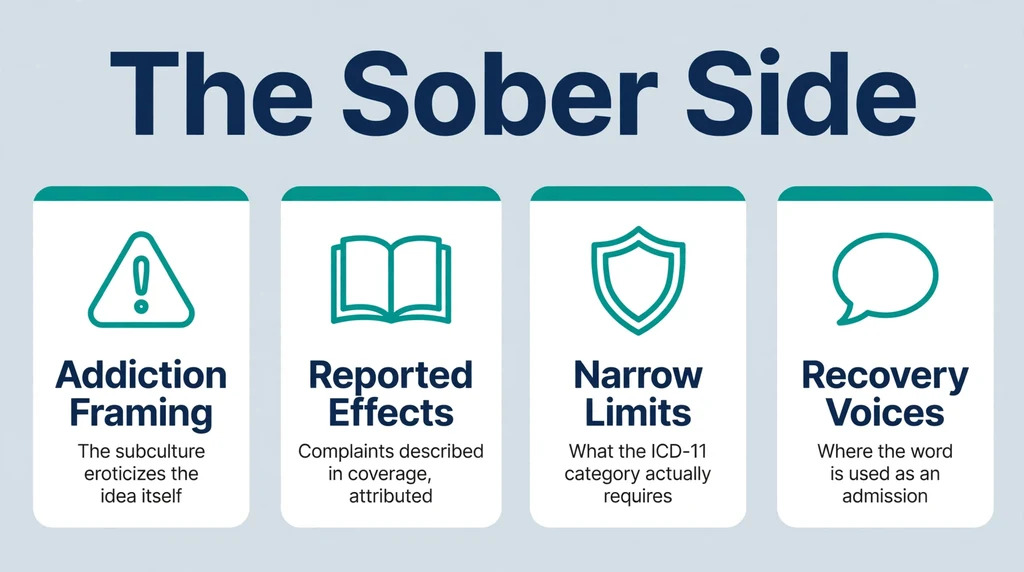
A word can be a joke and a warning label at the same time. Part of the gooning subculture openly eroticizes the idea of addiction itself. Some reference sources describe the practice as a fetishization of pornography addiction. That is where outside concern begins. Clinicians and journalists who cover the scene tend to ask a narrower question. At what point does a marathon habit stop being a hobby and start costing someone their work, relationships or health? The honest answer is that the evidence is still thin, and claims should be read with care.
What Critics and Therapists Point To
Coverage of heavy users describes a familiar cluster of complaints. These include relying on pornography to become aroused, finding ordinary partnered sex less stimulating, and struggling to date. Wikipedia’s summary of the literature lists erectile difficulties during partnered sex among the reported outcomes. Family psychotherapist Fiona Yassin, quoted in HuffPost UK, raised particular concern about younger users and social development. None of this amounts to proof that the practice causes these outcomes. It does show why professionals take the pattern seriously.
A useful correction comes from inside the scene’s own coverage. Harper’s writer Daniel Kolitz checked the stereotype of the eight-to-twelve-hour session against answers from gooners themselves. Most respondents, he reported, do not regularly go anywhere near that long. Marathon numbers make better headlines than typical behavior. Similarly, a widely shared survey by a telehealth company claimed a quarter of American adults had gooned at some point. That figure rests on loose self-definition in a commercial poll, and it should not be treated as a measured rate.
What the ICD-11 Actually Says
Medicine has a category for sexual behavior that feels out of control, and it is narrower than the slang. The World Health Organization’s ICD-11 lists compulsive sexual behaviour disorder, code 6C72, among the impulse control disorders. Its definition requires a persistent failure to control intense, repetitive sexual impulses. That pattern must be shown over an extended period, six months or more as a guide. The behavior must cause marked distress or real impairment in areas such as work, family or social life.
Two limits in that definition matter here. First, distress caused purely by moral disapproval of one’s own behavior does not qualify on its own. Second, the category describes a pattern of lost control, not a pastime, however unusual that pastime may be. Gooning is a slang word, not a diagnosis, and no glossary entry can say whether the category fits a particular reader. A long pattern of failed attempts to cut down is simply the kind of thing clinicians are trained to assess.
Why the Science Lags Behind
Readers looking for hard numbers will mostly find fog. No clinical study has examined gooning as a named practice, because the word is younger than the research cycle. The best-known demographic snapshot comes from polls run inside gooner Discord servers, published in a 2025 conference paper. About three quarters of respondents were cisgender men, and almost all who gave an age were between 18 and 25. Those polls were self-selected, so they describe the people who answered, not the wider public.
A Note for Parents and Teachers
The worry has a second audience: parents and teachers. HuffPost UK ran a therapist’s guide for parents who hear the word at home. The honest answer in such pieces is reassuring and limited at once. Most teenagers using the word are repeating a meme, not reporting a habit. The slang travels much further than the practice it names. That is exactly why context matters more than the word itself.
Why Recovery Communities Use the Word
The word also appears in rooms where people are trying to stop. Abstinence communities such as NoFap discuss marathon sessions as the core pattern members want to break. NoFap was founded in 2011 as a support group for people giving up pornography. In those spaces, calling yourself a gooner is not a badge. It is an admission, and often the first sentence of a recovery journal. The same vocabulary thus serves two opposite projects. One community uses it to celebrate excess, and the other uses it to name what excess cost them.
Words It Is Not: Goon, Gooners and Other Mix-Ups
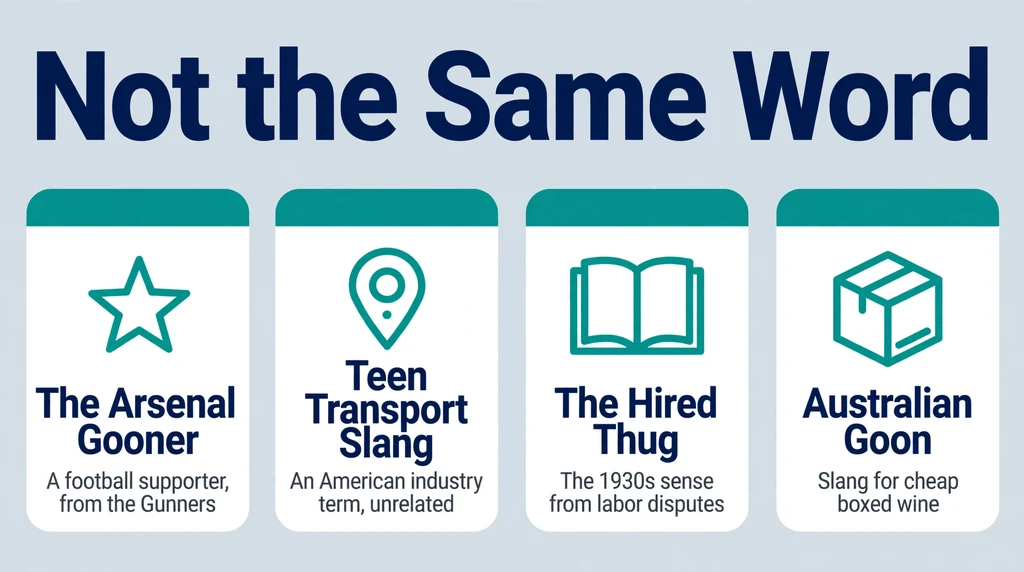
Because goon is an old word with several lives, search results mix together topics that share only a spelling. Three mix-ups account for most of the confusion. Each one below is a genuinely different subject, and each one still turns up next to the slang sense in feeds and dictionaries.
The Arsenal Gooner
In British football, a Gooner is a supporter of Arsenal. The nickname comes from the club’s own nickname, the Gunners, and it has been in use for decades. A supporters’ fanzine called The Gooner has been sold outside Arsenal grounds since 1987. When British fans call themselves Gooners, nothing adult is meant, although the newer slang sense now guarantees occasional double takes. Reference pages for the word now record both the football sense and the internet sense, in that order.
A Different “Gooning” Entirely
American readers may meet gooning in the news with no sexual meaning at all. In the troubled teen industry, the word is slang for the forced transport of teenagers to boot camps, boarding schools or wilderness programs. The work is carried out by hired transporters, the so-called goons. The New York Times used the term in 2016, in coverage touching on the practice. In 2022, Congressman Ro Khanna pushed for rules governing it, as the Mercury News reported. Wiktionary lists this transport sense separately, and it shares nothing with the subject of this article beyond the word goon.
Smaller traps exist, too. In Australian slang, goon also names cheap cask wine, sold in a box. None of these uses connects to any other. They are separate branches that happen to share four letters and a long history of sounding slightly ridiculous.
One more relative deserves a line. A goon squad is a group of hired enforcers, a term rooted in the labor violence of the early twentieth century. American politics still reaches for it whenever a campaign or an agency is accused of sending in heavies. It belongs to the thug branch of the family, not to anything in this article.
Gooning Versus Edging, Once More
The closest everyday confusion is with edging itself. Every gooning session involves edging, but most edging is not gooning. A couple delaying a finish for a few minutes are edging in the ordinary sense. Gooning adds duration, immersion and usually a screen filled with content, plus a community that treats the state as the goal. Older readers may also remember coomer, the 2019 meme figure for a compulsive pornography user. Gooner largely inherited that character’s role in the joke economy.
Frequently Asked Questions
Short answers to the questions readers ask most about this word.
What does gooning mean in simple terms?
It is adult slang for long, deliberately drawn-out sessions of arousal, built on edging and usually pornography, aimed at a trance-like state. A session is measured in hours, not minutes, at least in the community’s telling. The word is a joke in most settings and a serious label in a few. If you only remember one thing, remember that split.
What is a gooner?
A gooner is a person who goons. Inside the subculture, it is a self-mocking badge. Outside it, the word is usually an insult for someone seen as obsessed with adult content. In British football, a Gooner is something else entirely: an Arsenal supporter. The capital letter matters there, because the football sense works almost like a proper noun.
What is a goon cave?
A goon cave is a room arranged for long sessions. The stereotype involves several monitors showing content at once, low light and no interruptions. Photographs of such setups circulate as memes, half boast and half confession. The term is documented by Know Your Meme alongside its main entry for gooning. VICE devoted a whole report to such rooms in 2023, which is one sign of how visual the term has become.
Is gooning the same thing as edging?
No. Edging is a single technique, repeatedly nearing climax and backing off to delay it. Gooning is the marathon practice built from that technique, with far longer sessions, heavy use of pornography and a trance-like goal state. All gooning involves edging, but most edging is not gooning.
Where did the word come from?
It grew from goon, the old insult for a foolish person, recorded from 1921 and probably shortened from gooney, meaning a simpleton. The adult slang sense is documented from 2005, when the earliest Urban Dictionary definition appeared. It spread through forums and Tumblr before reaching Reddit, Discord and TikTok.
Is gooning in the dictionary?
Partly. Merriam-Webster lists a verb sense of goon, labeled vulgar slang and dated to about 2005, that matches the practice described here. The noun gooning itself still lives mostly in slang dictionaries and usage guides. Collins’ word-suggestion pages, meanwhile, record gooner with both its football and internet senses. Dictionary coverage of fast-moving internet terms often arrives years after the usage, so absence from a dictionary proves little.
Why do people joke about gooning so much?
The humor is self-deprecation. Members of the subculture exaggerate their own habit until it sounds absurd. Outsiders repeat the joke because it names a recognizable modern state: total absorption in a screen. The softened TikTok sense, where gooning just means obsessing over something, grew directly out of that joking use.
Is gooning a medical problem?
Not as such. Gooning is slang, not a diagnosis. Medicine does recognize a related category, compulsive sexual behaviour disorder, in the ICD-11. It covers patterns of sexual behavior that a person cannot control over many months, causing real harm or distress. Whether any individual fits that description is a question for a clinician, not for a slang guide.
Final Thoughts
Gooning is a useful word to understand precisely because it refuses to sit still. It began as a forum joke about losing yourself in arousal until your face went vacant. The joke carried the old meaning of goon inside it. Two decades on, it is a subculture’s badge and a mainstream magazine topic. It is also a recovery community’s warning label, and a playground insult that means little more than obsession. Each sense keeps the others alive, which is why the word shows no sign of fading.
There is a practical lesson in the word’s travels. Slang now moves from a forum’s inside joke to a national youth vote faster than a dictionary revision cycle can turn. Anyone meeting an unfamiliar term today is meeting it mid-journey. Checking which sense a speaker means is no longer pedantry. It is basic literacy.
Read in context, the word will tell you which of those it is being. Adult spaces mean the practice, while meme pages usually mean the joke. For the documentary record of the memes themselves, see Know Your Meme’s entry on gooning and goon caves. It tracks the major examples with dates. For anyone who met this word in a recovery forum rather than a meme, the sober sections above matter most.