Two people can read the same job offer or hear the same confident pitch. One walks away impressed. The other walks away uneasy, and weeks later the unease proves justified. The difference between them is usually discernment.
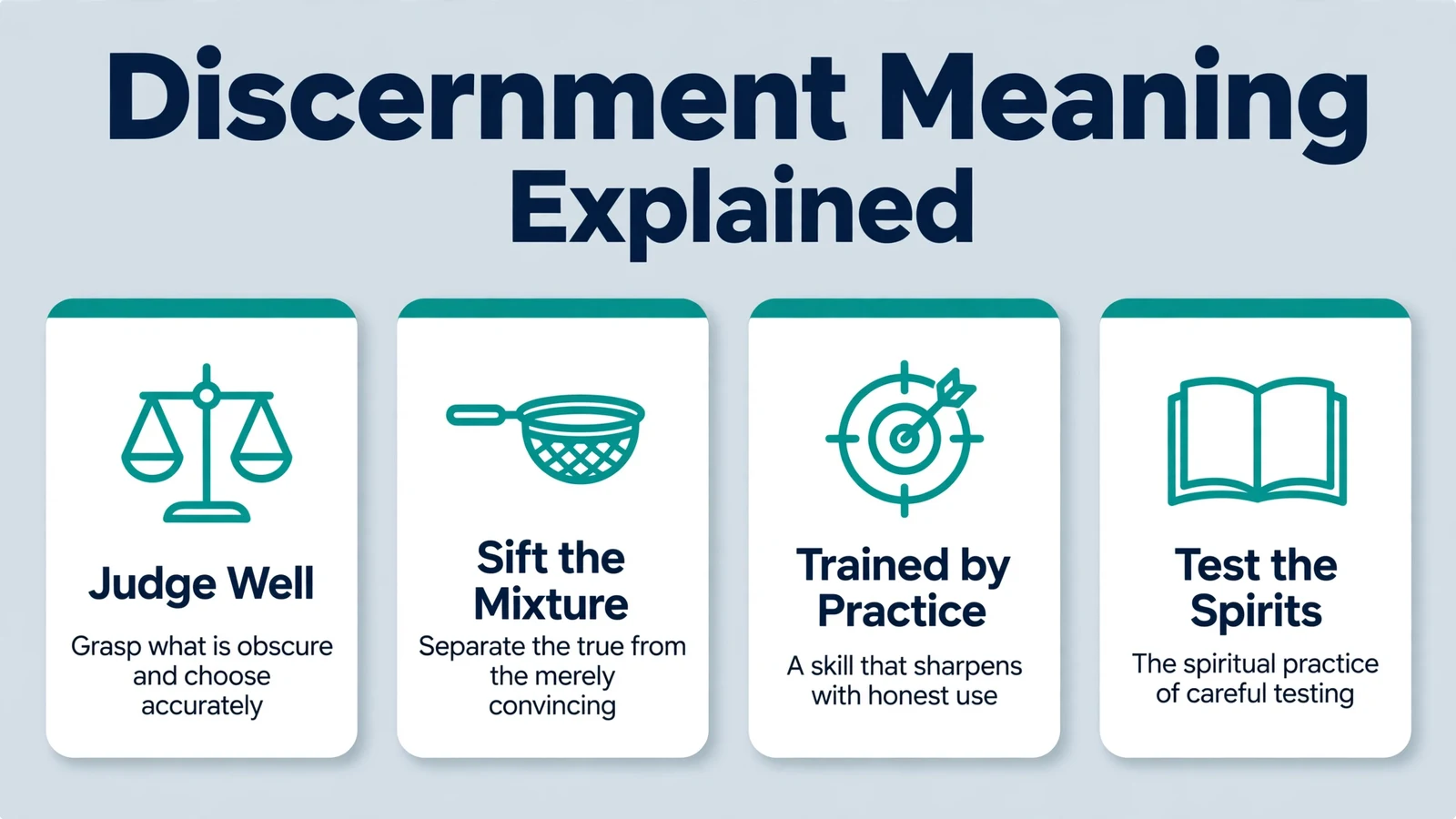
Discernment means the ability to judge well. It is the skill of grasping what is obscure and telling the true from the merely convincing. Merriam-Webster defines it as “the quality of being able to grasp and comprehend what is obscure.”
This guide follows the word through both of its lives. First comes the dictionary meaning and the Latin root. Then comes the spiritual sense that fills sermons and retreat houses. Along the way, you will find practical steps, sharp distinctions, and one therapy that borrowed the name.
What Does Discernment Mean?
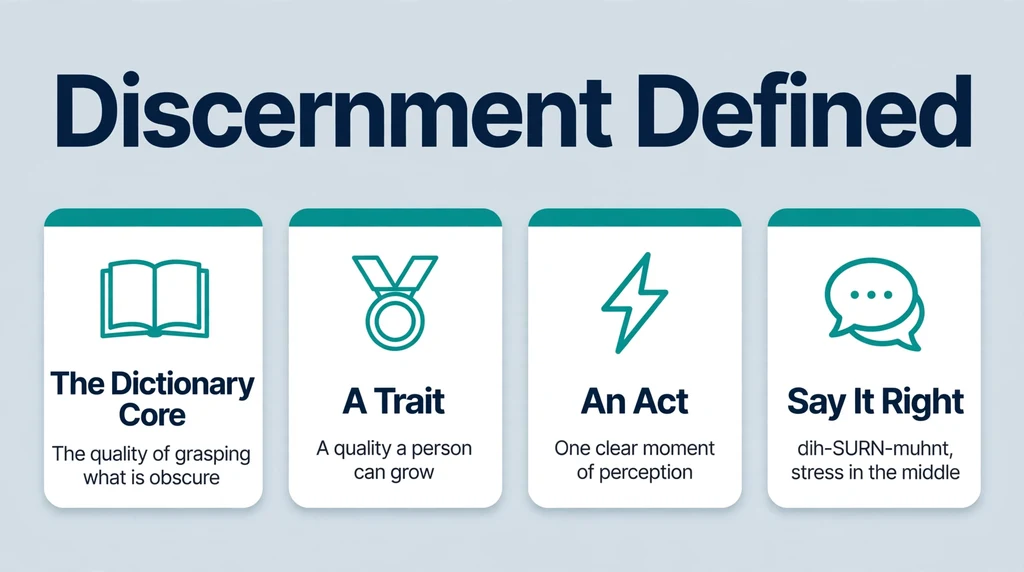
The major dictionaries agree closely on this word. Dictionary.com calls discernment “the faculty of discerning,” marked by “acuteness of judgment and understanding.” Its British definition is even shorter: “keen perception or judgment.”
That agreement hides two separate senses. The first sense is a quality, a trait a person can have in large or small measure. The second sense is an act, one single moment of perceiving something clearly.
Merriam-Webster shows both senses at work in its examples. Its first example reads, “decisions that require careful discernment.” Its second is quicker and sharper: “the quick discernment of an opponent’s weaknesses.”
So discernment can be a habit of mind or a flash of it. A judge shows the habit across a whole career. A chess player shows the flash in one accurate move.
Notice Merriam-Webster’s key word: obscure. Discernment is not needed where things are obvious. Nobody needs discernment to tell noon from midnight. The word exists for the grey hours, where quality, truth and motive hide inside convincing packaging. That is why it pairs so often with words like careful, keen and quiet. Discernment is precision equipment for unclear situations.
How to Say It, and the Words Around It
Discernment is pronounced dih-SURN-muhnt, with the stress on the second syllable. It belongs to a small, hardworking word family. The verb is discern, as in “she could discern a pattern.” The adjective is discerning, as in “a discerning reader.”
One phrase deserves special notice. English speakers often describe someone as “a person of discernment.” The phrase praises taste and judgment together. Its cousins work the same way: a discerning eye for art, a discerning palate for wine.
Notice what all these uses share. Each one involves material that arrives mixed together. Signals come bundled with noise, and quality hides beside imitation. Discernment is the sorting that follows, and its root word says exactly that.
Where the Word Comes From: A Sifting Root
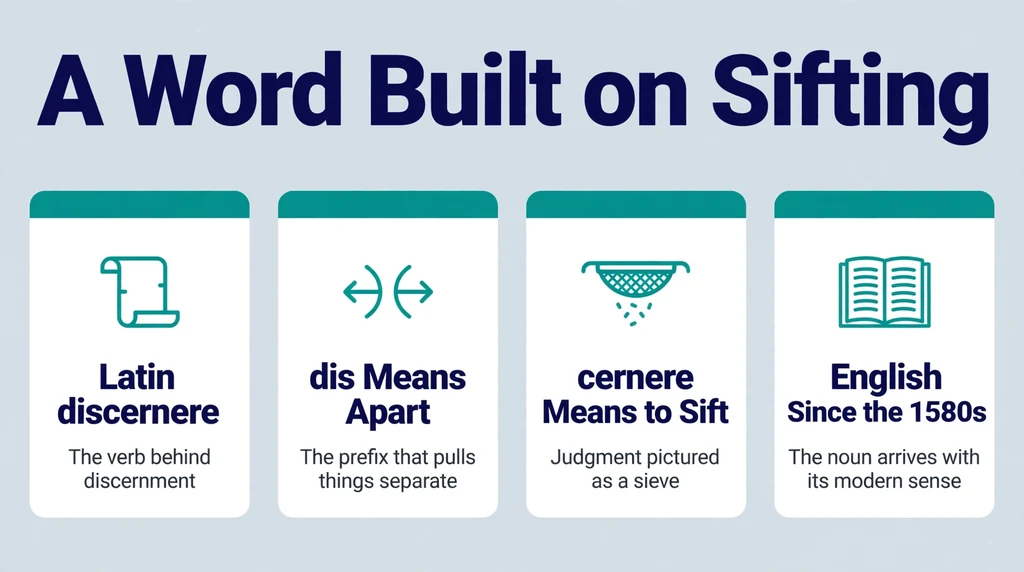
Discernment descends from the Latin verb discernere. That verb joins dis-, meaning apart, to cernere, meaning to sift. So to discern was, at the root, to sift apart.
The image is a kitchen and farmyard one. A cook sifts flour to remove lumps before baking. A farmer sifts grain to separate seed from chaff and stones. In each case, the valuable part and the worthless part start out mixed.
Judgment, in this picture, is not a gavel coming down. Instead, judgment is a sieve at work. You shake the mixture patiently until unlike things separate. Only then can you keep one pile and discard the other.
The verb discern entered English in the 1300s, travelling through French. The noun discernment followed much later, in the 1580s. From the start, it named keenness of perception and acuteness of judgment.
The root cernere left other children in English too. Certain comes from being sifted until sure. Secret comes from what is sifted out and set apart. Concern also grows from the same root. Discernment, in short, belongs to a family of words about sorting and settling.
Linguists trace cernere further back, to a root meaning simply “to sieve.” The Greek verb krinein, to judge or decide, grows from the same family. That is a satisfying coincidence for this word’s story. In both Latin and Greek, the road to judgment runs through a kitchen tool.
Discernment in Everyday Life
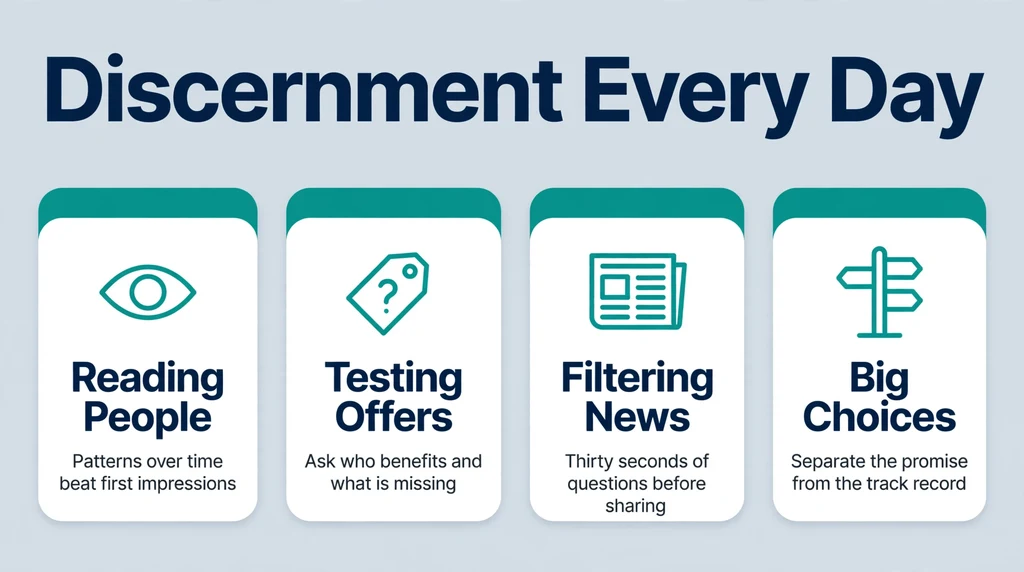
Most discernment never gets called by its name. It shows up as the pause before signing, the second look at a photograph, the quiet question in a meeting. Still, its hunting grounds are easy to list.
It works on health claims and investment tips alike. It works on new friendships and old habits. Wherever a mixture arrives wearing a confident label, discernment asks to see the contents.
Reading People and Character
Character rarely announces itself in speeches. Instead, it leaks out in small, unguarded consistencies. A discerning person watches what someone does when nothing is at stake.
For example, notice how a candidate treats the receptionist, not just the panel. Notice whether the charming friend keeps small promises. Merriam-Webster’s own example involves hiring: a manager showed “a lack of discernment in selecting suitable job candidates.”
None of this requires suspicion. In fact, it requires the opposite of suspicion, which is patience. Discernment waits for a pattern, because one act can mislead and ten rarely do.
Watch especially for the gap between words and costs. Anyone can promise; fewer people pay. The colleague who volunteers for the dull task, repeatedly, is telling the truth about character. So is the one whose generosity always needs an audience.
Offers, News and Noise
Modern discernment spends much of its life online. An offer promises returns that no honest market pays. A headline is built to make you angry before it makes you informed. A screenshot travels everywhere with its context stripped away.
The discerning response is rarely dramatic. It is a set of small questions asked in order. Who benefits if I believe this? What is missing from this picture? Does any independent source say the same thing?
Asking those questions takes thirty seconds. Skipping them can cost money, friendships or a reputation. As a result, teachers now treat media discernment as a basic civic skill.
Choices in Love, Money and Work
Big decisions compress the same skill into one moment. A partner, a loan, a new job: each arrives as a mixture. Each contains real value, real risk and skilled presentation.
Discernment slows the mixture down. It separates the salary from the manager, the romance from the reliability, the promise from the track record. However, it does not demand certainty. It only asks that each part be seen for what it is before the choice is made.
Discernment and Taste
One older home of the word is the world of taste. Critics, editors and collectors built careers on being “discerning.” A discerning collector can cross a flea market and stop at the one genuine piece. A discerning editor can read a page and find the sentence that does not belong.
This use is not snobbery, though snobbery borrows its clothes. Real taste is trained perception in a narrow field. The wine taster’s palate and the proofreader’s eye work alike. Each has handled thousands of examples, so each sifts a new one almost on sight.
Taste also explains why discernment can look effortless. The expert’s quick verdict rests on slow years. What appears as instinct is usually inventory.
Discernment or Wisdom? A Useful Difference
People often use discernment and wisdom as twins. The words are close, and the Bible itself pairs them. Still, a working difference helps in daily speech.
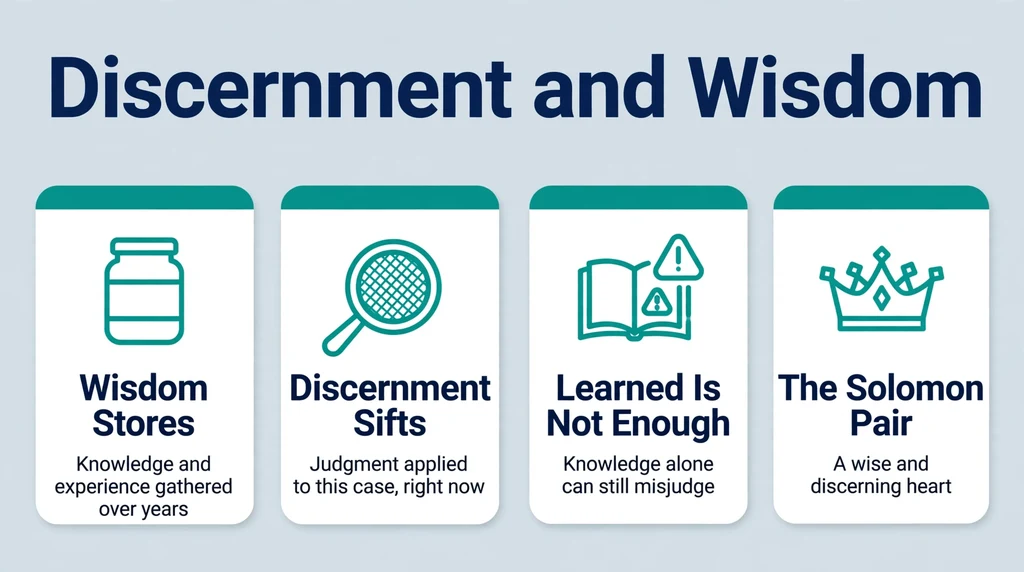
Wisdom is the wide reservoir. It is knowledge, experience and intuition stored over years. It answers the question, what is true in general?
Discernment is the act of drawing on that reservoir accurately, here and now. It answers a narrower question. Which of these two similar things is the real one?
A learned person can therefore lack discernment. Knowledge alone does not guarantee a clean sift in a live case. Meanwhile, a young person may show startling discernment inside one narrow field. A teenage musician, for instance, may hear flaws that a professor of literature walks straight past.
Solomon’s famous request joins the words neatly. In the biblical account, he asks for a heart able to discern between good and evil. The reply praises him for receiving “a wise and discerning heart.” Wisdom names the gift as a whole. Discernment names the edge of it that cuts between lookalikes.
Picture two senior doctors looking at the same scan. Both carry decades of wisdom. One, however, notices the shadow that does not fit the story. That noticing is discernment, and it cannot be downloaded from the other’s knowledge. It has to happen fresh, in a person, at a moment. Wisdom fills the storehouse over a lifetime. Discernment is the hand that still picks correctly in the dark.
The Spiritual Meaning of Discernment
In church usage, discernment grows a second trunk. It stops being only a talent and becomes a practice. Believers use it for the slow work of testing impressions, teachings and decisions against their faith.
Discernment in the Bible
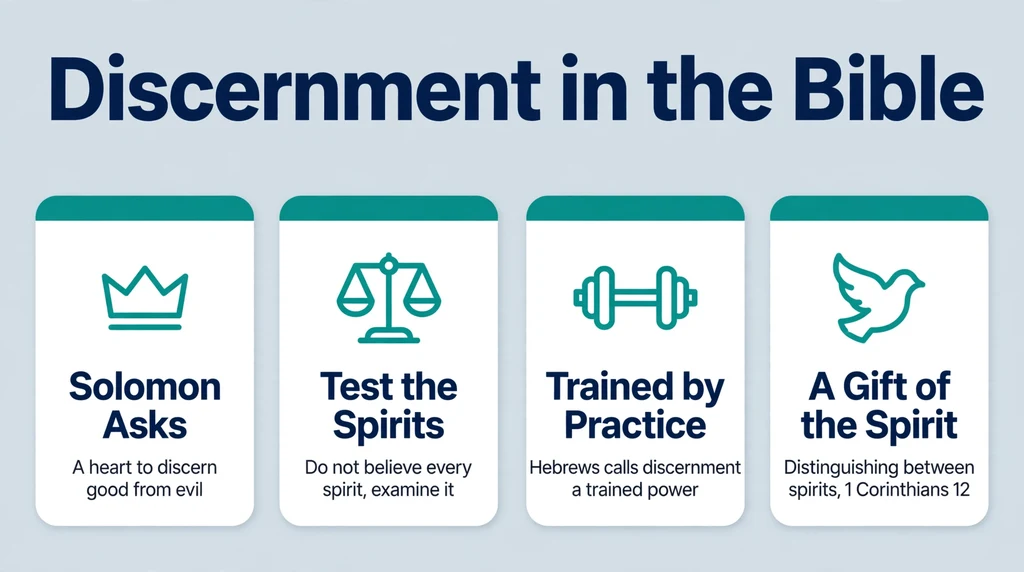
Three passages anchor most teaching on the subject. First, Solomon asks God for “an understanding heart,” able “to discern between good and evil” (1 Kings 3:9). His request frames discernment as something received, not manufactured.
Second, Paul prays that the Philippians’ love “may abound more and more, with knowledge and all discernment” (Philippians 1:9-10). Here discernment grows inside love and knowledge, not outside them. Its purpose follows at once: “so that you may approve what is excellent.”
Third, Hebrews describes mature people as those whose “powers of discernment” are “trained by constant practice to distinguish good from evil” (Hebrews 5:14). That verse matters for a practical reason. It presents discernment as trainable, more like a palate than a lightning strike.
A fourth passage adds the testing note. “Do not believe every spirit, but test the spirits” (1 John 4:1). In short, the biblical picture mixes gift, growth and examination.
Paul uses the same testing language for ordinary decisions. Transformed minds, he writes, can “test and approve what is the good, pleasing, and perfect will of God.” The image is of metal or coinage being assayed. A claim is not accepted at face value; it is rubbed, weighed and checked.
That testing instinct still structures church life. Sermons get weighed rather than merely applauded. Viral teachings get checked against older sources. Even private impressions, a sense that God is saying something, are expected to survive questions. Discernment, in this tradition, is faith’s quality control.
The Gift Called Discernment of Spirits
One list in the New Testament gives the phrase its capital letters. In 1 Corinthians 12, Paul catalogues gifts of the Spirit: wisdom, knowledge, faith, healing, prophecy and others. Among them sits the ability older translations call “discerning of spirits” (1 Corinthians 12:10).
Modern translations render the Greek as “distinguishing between spirits.” The underlying word, diakrisis, is built on a verb for separating and judging. Even here, the sifting root is doing the work.
Within Christian teaching, this gift names a specific sensitivity. It is the capacity to tell whether a message, impulse or atmosphere is genuinely spiritual, merely human, or actively deceptive. Teachers differ on how the gift operates today. However, they generally agree on its purpose: protection against counterfeits, not curiosity about people.
Context matters here. Paul introduces the whole list by saying each gift is given “for the common good.” So even this most private-seeming gift is described as community equipment. It exists, in his framing, so that a group is not easily fooled.
Ignatian Discernment: Reading the Inner Weather
The most influential system of spiritual discernment comes from a wounded soldier. Ignatius of Loyola (1491-1556) was a Spanish nobleman turned pilgrim. A cannonball shattered his leg at the Siege of Pamplona, and his long convalescence changed his life.
During his recovery, Ignatius noticed something he never forgot. Daydreams of worldly glory left him dry and restless afterwards. Thoughts of a devoted life left him quietly glad. He began, carefully, to track the aftertaste of his own thoughts.
Those observations, made at Manresa in Spain, grew into his Spiritual Exercises. He composed the Exercises between 1522 and 1524, and they were first published in 1548. The book shapes a retreat of about thirty days, and Jesuits still guide people through it.
Notably, the Exercises were never meant to be read alone like a novel. A retreatant prays through the material and meets regularly with a director. The director listens, asks questions and helps test what surfaces. Discernment, from its most famous source onward, is designed as a two-person craft.
Consolation and Desolation
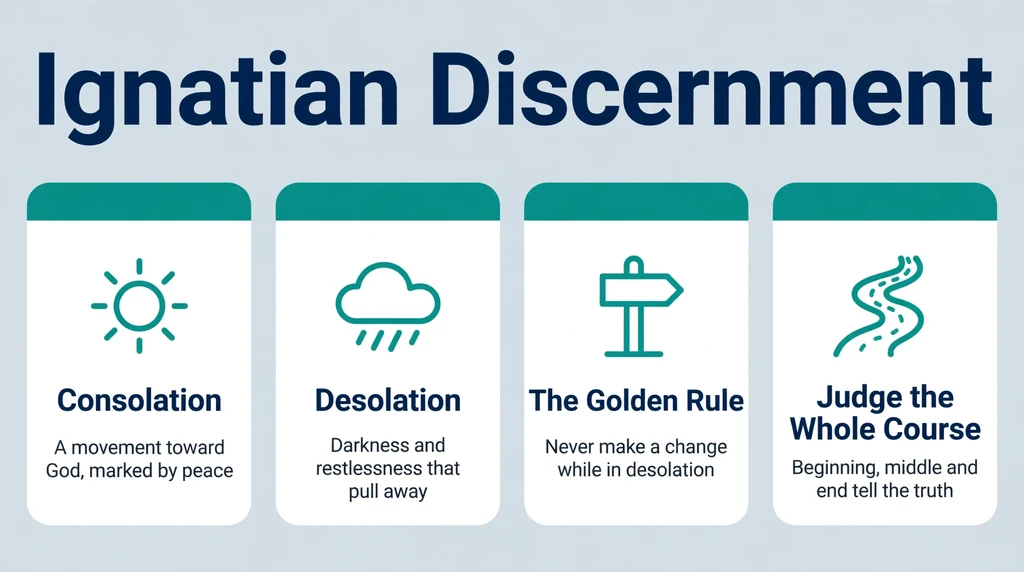
At the centre of the Exercises stand two weather words. Consolation is any inner movement that draws a person toward God. Ignatius describes it through increases in faith, hope and love, and through peace, joy and tears of gratitude.
Desolation is the opposite movement. He lists darkness of soul, turmoil and restlessness. In desolation, a person feels pulled toward low and earthly things, and strangely cut off from God.
Neither state is a mood to obey blindly. Instead, each is information to read. Consolation is a season for gratitude and for storing strength. Desolation is a season for holding position.
The Rule Everyone Quotes
From those definitions flows Ignatius’s most repeated rule. In desolation, never make a change. A resolution formed in clarity should not be reversed in the fog.
The reasoning is pastoral, not mystical. Desolation distorts proportion, so decisions made inside it inherit the distortion. Wait, keep the earlier course, and let the weather pass.
Ignatius also taught readers to examine a whole movement, not a moment. His later rules ask about a thought’s beginning, middle and end. A movement that starts sweetly can still end in agitation and pride.
That is why he warned about an enemy appearing “as an angel of light.” The test of a spirit, in his system, is its full trajectory. Genuine consolation leaves peace behind it. Counterfeit comfort tends to unravel by its end.
The Daily Examen: Discernment in Miniature
Ignatius also left a practice small enough for a Tuesday. The Examen is a short prayer of review, traditionally made at day’s end. A person replays the hours, noticing where consolation and desolation appeared.
Five quiet minutes are enough for the basic motion. Where did I feel drawn toward life and love today? Where did I shrink, harden or hide? No verdicts are passed on other people. The review simply trains the eye on one’s own weather.
Over months, the habit compounds. Patterns emerge that a single day would never show. The Exercises built discernment across thirty days of retreat. The Examen keeps the same sift running, in miniature, for life.
Vocational Discernment: Testing a Calling
Ask a Catholic seminarian what he is doing, and he will likely say he is “discerning.” In that world, the verb has a technical home. Vocational discernment is the extended process of testing whether God is calling a person to a state of life.
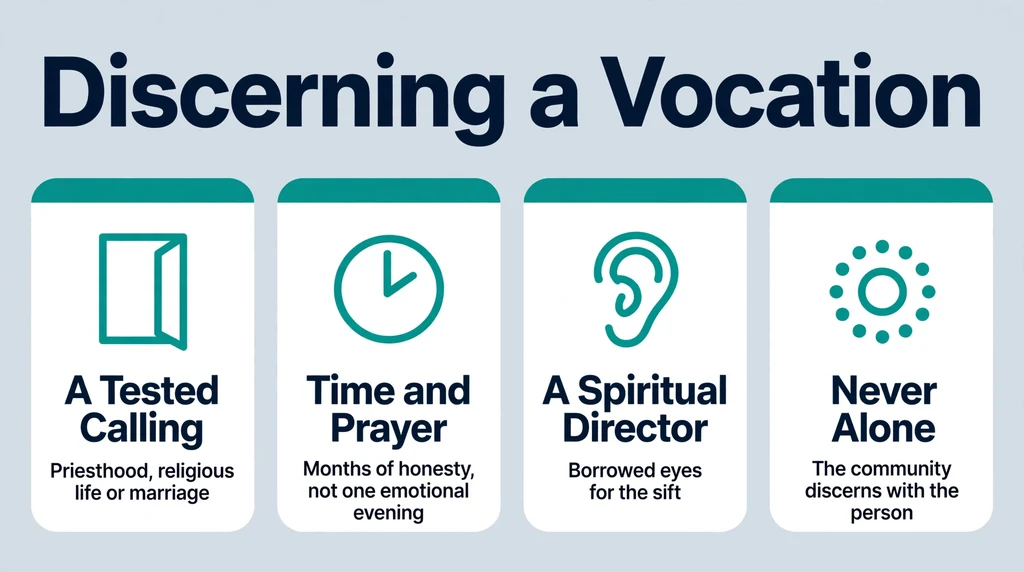
The states in question are usually priesthood, religious life or marriage. The process, however, matters more than the list. Nobody treats one emotional evening as a verdict.
In practice, discernment stretches across months or years. It includes regular prayer and honest self-examination. Almost always, it includes a spiritual director, a trained listener who helps separate signal from noise. A vocations director adds the Church’s own sift, because the community discerns alongside the person.
Diocesan guidance repeats one line in many forms: no one discerns alone. A candidate applies to seminary only after this shared testing. Even then, formation continues the discernment rather than ending it.
Beyond the Seminary Walls
The grammar of the word has spread beyond the seminary. People now speak of discerning a career change or a move abroad. The borrowings keep the original shape: a big choice, examined slowly, with help.
Couples preparing for marriage often use the word the same way. Engaged pairs are encouraged to discern marriage rather than drift toward it. Protestant Christians, too, speak of discerning God’s will for a job, a city or a season of life. The settings differ, but the skeleton holds. A calling is a claim, and claims get tested before they get obeyed.
One feature stays constant across all these uses. Vocational discernment is allowed to end in a no. The process that cannot refuse a path is not discernment at all. It is merely delay wearing a holy name.
Discernment vs Judgment: Not the Same Thing
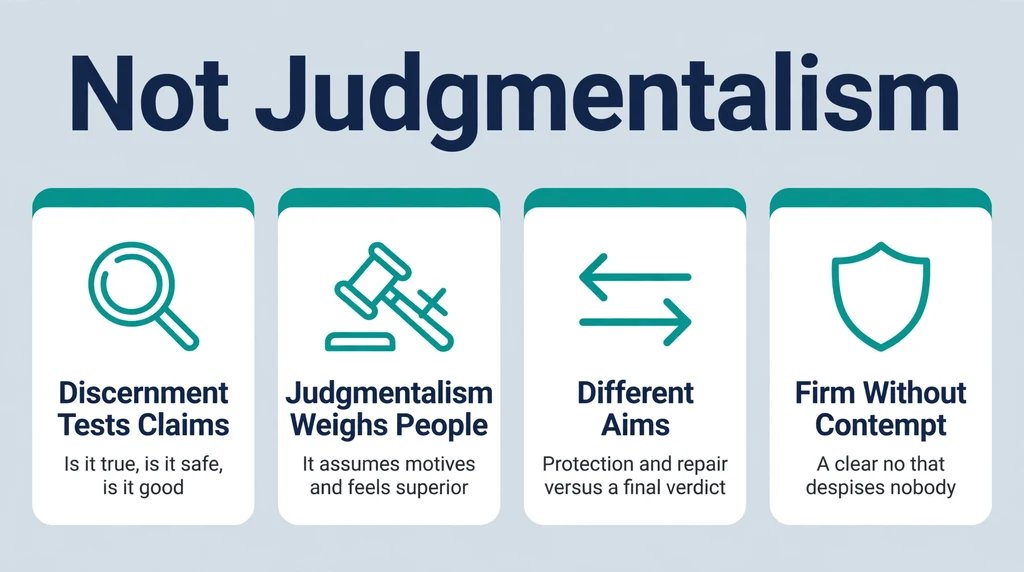
Few distinctions around this word cause more confusion. Many people hear every evaluation as “judging,” and judging as a fault. So discernment gets mistaken for a polite disguise for condemnation.
Christian teachers usually draw the line in a consistent place. Discernment, they say, tests claims, words and behaviour. It asks whether something is true, safe and good. Its aim is protection, and often restoration.
Judgmentalism does something else entirely. It weighs the person rather than the claim. It assumes motives it cannot know, enjoys its own superiority, and delivers a final verdict. One widely quoted sermon line puts it crisply: judgment condemns, while discernment seeks to understand.
The dictionaries quietly support the distinction. Judgment itself is a neutral word in English, and discernment is even defined using it. The pejorative term is judgmentalism, which names a habit of harsh, hasty verdicts.
So discernment can include a firm refusal without contempt. A parent can reject a situation as unsafe for a child. No condemnation of any person’s worth is required. The sift separates the mixture; it does not spit on the chaff.
Two small tests expose the difference in daily life. First, ask what the verdict is for. Discernment aims at protection, clarity or repair. Judgmentalism aims at the pleasure of being above someone. Second, watch what happens to the person judged. Discernment can stay silent for years, simply steering its owner away. Judgmentalism almost always needs an audience.
In fact, the quietest discernment often says nothing at all. It declines the invitation, skips the investment, leaves the friendship to cool. The verdict is real, but it was never a performance.
Discernment Counseling: A Therapy With the Same Name
The word also names a specific form of therapy. Discernment counseling was developed by Dr William J. Doherty, a family therapist at the University of Minnesota. He built the model with Steven M. Harris, and they set it out in a 2017 book, Helping Couples on the Brink of Divorce.
The model exists for a painful stalemate. In a “mixed-agenda” couple, one partner is leaning out toward divorce. The other is leaning in, hoping to save the marriage. Ordinary couples therapy assumes both partners want repair, so it stalls with such couples.
Discernment counseling therefore refuses to fix anything at first. It runs for one to five sessions only. Each session mixes time together with individual conversations, because each partner needs room to think aloud.
The goal is clarity and confidence about a direction. Couples leave by one of three paths. They can keep the status quo, move toward divorce, or commit to six months of couples therapy with divorce taken off the table.
How the Sessions Work
The method protects that goal with unusual discipline. A discernment counselor sets no homework and teaches no communication skills. Nobody is coached to reconnect, because reconnection is not the assignment. Instead, each partner spends individual time with the counselor. Each is asked what they themselves brought to the marriage’s troubles. Then, in the joint time, each shares one thing they learned.
That structure surprises couples expecting a referee. There is no verdict to win, because the counselor refuses the judge’s chair. The only verdict sought is the couple’s own, reached slowly enough to trust.
Notice how faithfully the therapy keeps the word’s root sense. Nothing is repaired yet, and nothing is condemned. Two people simply sift a shared life carefully, before choosing what happens to it.
How to Practise Discernment
Discernment sounds lofty, but its practice is mostly unglamorous. Hebrews called it a power “trained by constant practice,” and that remains the best summary. The steps below suit a purchase, a partnership or a prayer.
Slow Down and Gather the Facts
First, buy time wherever time can be bought. Urgency is the natural enemy of sifting. Most bad decisions were not stupid; they were rushed.
Next, separate what you know from what you feel. Write the options down in plain words. Then ask a bracing question: what evidence would change my mind? If nothing could, you are not discerning. You are defending.
A decision journal sharpens this step further. Record what you chose, why you chose it, and what you expect to happen. Months later, the page will grade your judgment without flattery. Few habits expose self-deception faster, and few build calibration more honestly.
Check Your Motives and Borrow Other Eyes
Desire and fear both tilt the sieve. A flattering opportunity can feel like a calling. A frightening one can feel like a warning. Naming your stake in the outcome does not remove it, but it does discount it.
Then borrow other eyes. Ignatius required a director for the Exercises, and therapists build counsel into their model for a reason. Choose someone who knows the territory and owes you honesty, not comfort. Ask them what you might be refusing to see.
Add one more borrowed question, the pre-mortem. Imagine the decision has failed badly, one year from now. Then ask what most likely went wrong. The exercise licenses doubts that optimism had banned from the room. Often, the first answer names the very fact your discernment was avoiding.
Above all, respect the old rule about weather. Do not sign, send, resign or propose at an emotional low point. A decision that survives a night’s sleep and a calm morning has passed its first real sift.
Test the Outcome Over Time
Finally, prefer steps that can be tested. Take the smaller commitment before the larger one. Watch what the choice produces over weeks, not hours.
Then close the loop with your own record. That decision journal from the first step now becomes a teacher. Some entries will embarrass you, and that is their value. Reviewed honestly, your history shows which of your instincts deserve promotion.
Ignatius told retreatants to judge a movement by its beginning, middle and end. The same test works on landlords, investments and ideologies. Discernment, practised this way, becomes less a talent and more a craft. The sieve gets finer with use.
Discernment in Sentences
Examples fix a word in the memory better than definitions do. Read how naturally discernment moves between the office, the kitchen and the chapel.
“The committee thanked her for her discernment in rejecting the cheaper bid.” Here the word praises practical judgment about quality and risk.
“Investors showed little discernment during the boom, buying anything with a story.” The sentence uses discernment as its absence, a failure to sift.
“A discerning palate can separate the four chillies in that sauce.” The adjective form celebrates trained, fine-grained perception.
“After a year of discernment, he applied to the seminary.” In Catholic usage, the noun names the whole testing process itself.
“The editor’s discernment kept two weak chapters out of the book.” Publishing gives the word a home in taste and standards.
“Use discernment before forwarding that video to the family chat.” Everyday speech borrows the word for media choices and small courtesies.
“The jury relied on its discernment of the witness’s shifting story.” Courtrooms give the word its most formal register: weighed credibility.
“Her discernment in friendship spared her years of drama.” Here the praise is social and protective at once.
“Customers with discernment will notice the cheaper stitching.” Advertising loves the adjective, because it flatters the buyer into the discerning class.
Words Close to Discernment
Merriam-Webster’s synonym essay draws the finest lines in this neighbourhood. Working through it is a short education in the word itself.
Perception implies quick and often sympathetic discernment, especially of shades of feeling. The novelist of keen perception notices a trembling lip. Perception is discernment at its fastest and warmest.
Penetration implies a searching mind that goes beyond the obvious. Where perception catches the surface quickly, penetration digs. It is discernment with a drill.
Insight suggests depth of discernment coupled with understanding sympathy. Insight lands with a small click of recognition. It is the moment the mixture suddenly makes sense.
Acumen adds practical judgment to penetration. Business writers love it for that reason. Acumen is discernment that has learned to count costs.
Discrimination once meant the power to distinguish and select what is excellent. A discriminating listener was high praise. Today the word mostly names unfair treatment of people, so discernment has inherited its positive work.
Two cousins deserve a caution each. Shrewdness is practical and sharp, but it can serve only its owner. Sagacity is discernment aged into wisdom, though the word now sounds antique. Neither quite matches the clean, other-regarding sift of discernment itself.
What about the opposite direction? English has no common noun for the missing quality. Writers reach for phrases instead: “a lack of discernment,” borrowed from Merriam-Webster’s own example sentence. Gullibility names the trusting failure, and rashness names the hasty one. Discernment sits between those two ditches, which is precisely where good judgment usually lives.
Frequently Asked Questions
What is discernment in simple words?
Discernment is the ability to judge well. It means looking at people, offers or ideas and telling the good from the bad, and the true from the false. A discerning person notices small details that others miss. Then they choose carefully, instead of grabbing the first shiny option. Think of it as sifting: everything arrives mixed, and discernment does the sorting.
How do you pronounce discernment?
Say dih-SURN-muhnt, in three syllables. The stress falls on the second syllable: dis-CERN-ment. The adjective discerning follows the same pattern. Both words keep the soft, buzzing middle sound of the verb discern.
What does discernment mean in the Bible?
In the Bible, discernment means telling good from evil and truth from error, with God’s help. Solomon asks for a heart to discern between good and evil. Paul prays that believers grow in “all discernment.” Hebrews adds that this ability is trained by constant practice.
What is the gift of discernment of spirits?
In 1 Corinthians 12:10, Paul lists “discerning of spirits” among the gifts of the Spirit. Christian teaching understands it as a sensitivity to the source of a message or impulse. Is it genuinely from God, merely human, or deceptive? Its traditional purpose is protection against spiritual counterfeits.
Is discernment a gift or a skill you can learn?
Different traditions weight the answer differently. The Bible calls discernment of spirits a gift, given by the Spirit. The same Bible describes discernment as trained by practice, like a sense exercised daily. Most teachers hold both together: a capacity received, and a craft sharpened by use.
What is a discerning person like?
A discerning person is observant, patient and hard to rush. They ask what is missing, not only what is shown. They watch patterns over time before trusting impressions. Crucially, they can reject an idea firmly without despising the person who offered it. Flattery does not move them much, and neither does a crowd.
What is the difference between discernment and intuition?
Intuition is fast and wordless. It is a conclusion the mind delivers before it shows its workings. Discernment is slower and more deliberate. It tests the intuitive flash against facts, motives and outcomes. Many people use intuition as the first signal, then discernment as the audit.
What is discernment counseling?
Discernment counseling is a short therapy for couples split over divorce. One partner leans out; the other leans in. Developed by Dr William Doherty and Steven Harris, it lasts one to five sessions. Its goal is a clear, confident decision, not immediate repair of the marriage. Despite the similar name, it is a clinical model, not a religious service.
Final Thoughts
Discernment began as a farmer’s motion: shaking a sieve until grain and chaff part company. Five centuries of English have widened the word, but never replaced that picture. To discern is still to sort a mixture honestly.
The sorting now happens everywhere. It happens over contracts and headlines, sermons and second dates. Wherever presentation is smooth and reality is mixed, the old skill earns its keep.
You can read the full dictionary treatment in Merriam-Webster’s entry on discernment. Then practise the word the way Hebrews suggests: constantly, and on everything.
That is why “a person of discernment” remains such durable praise. It does not compliment wealth, speed or certainty. It compliments the rarest equipment of all: a well-kept sieve.