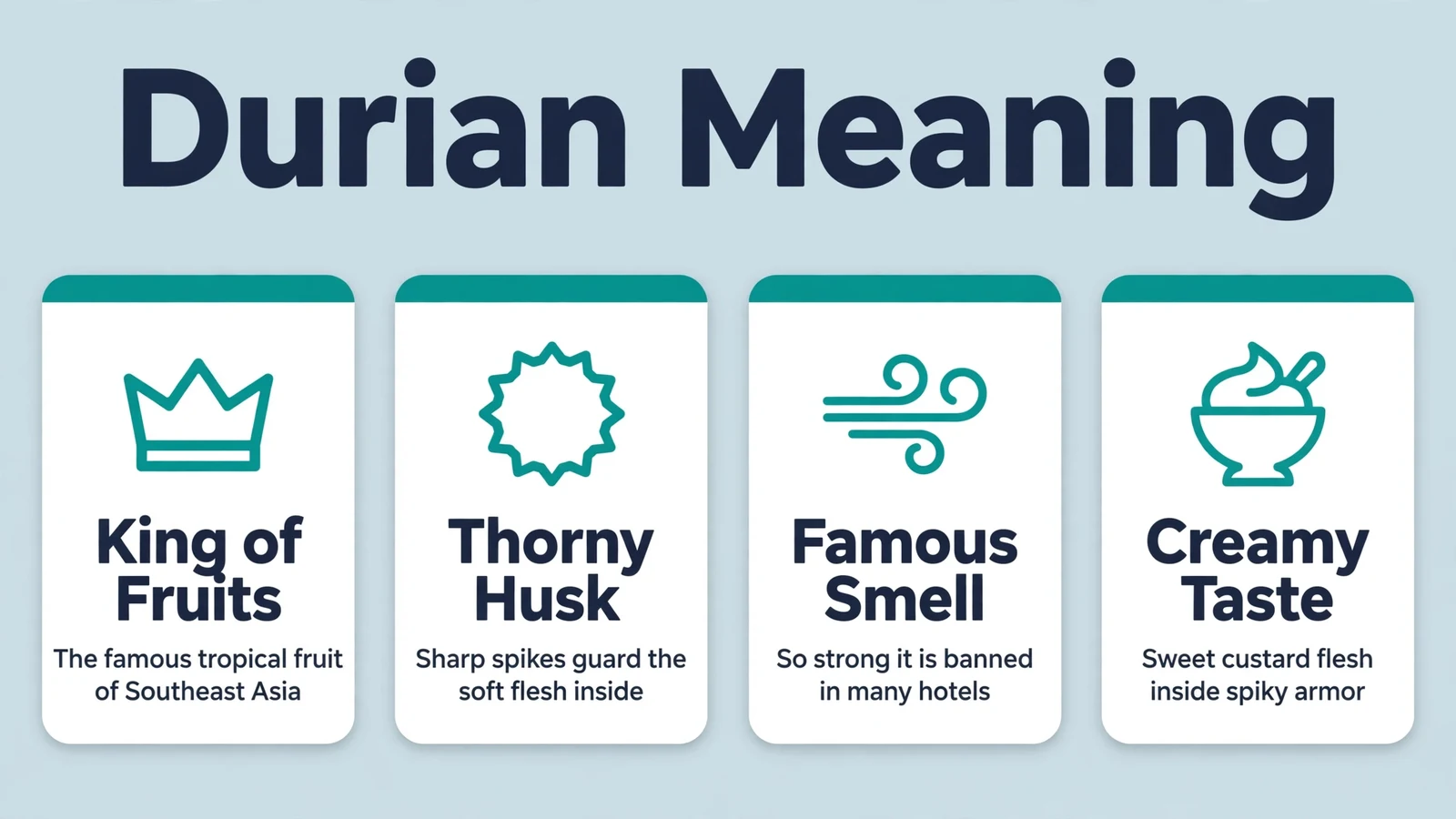
Few fruits start an argument faster than the durian. It is banned from hotels, barred from subway trains, and still worshipped across Southeast Asia. Fans plan whole trips around its short season. First-timers, meanwhile, often meet it as a smell before they ever see the fruit.
So what is it, exactly? Durian is a large tropical fruit from Southeast Asia. It grows inside a hard shell covered with sharp thorns. Inside that armor sit soft pods of creamy, golden flesh. The flesh tastes rich and sweet, yet the fruit smells astonishingly strong. That contrast explains both its royal nickname and its many bans.
This guide draws on botanical references, nutrition data, and published research. It covers the word itself, the smell, the taste, and the famous varieties. It also shows you how to choose and open one with confidence.
What Does Durian Mean?
People usually meet the word before the fruit. They see it on a menu, a market sign, or a “no durian” hotel notice. A clear definition helps everything else fall into place.
The Word Durian
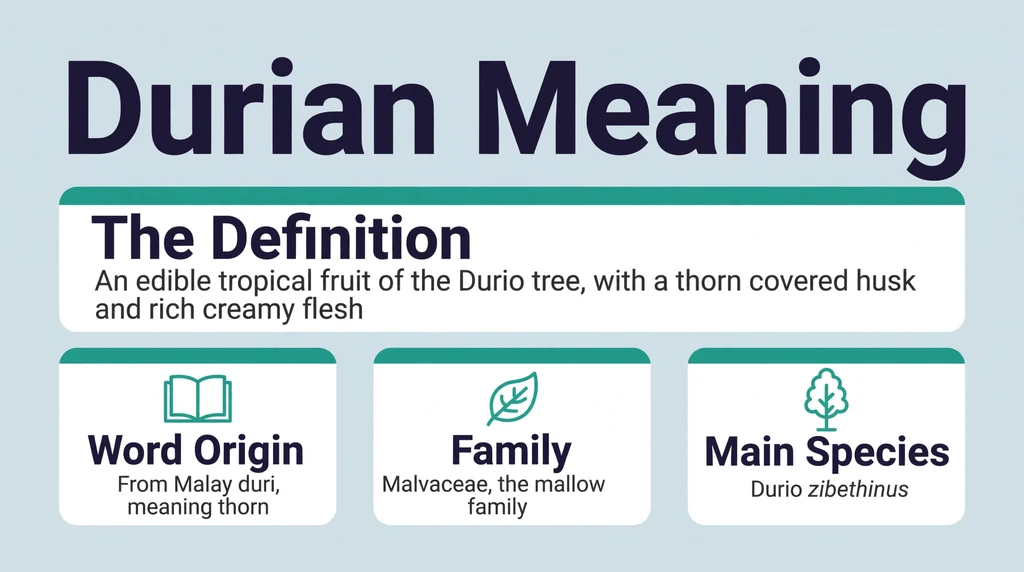
The name comes from Malay, the language of the region where the fruit is native. The word *duri* means “thorn,” and the ending *-an* builds it into a noun. Put together, durian means roughly “the thorny one.” One look at the spiky husk shows how honest that name is.
English picked the word up centuries ago. The Oxford English Dictionary first cites it in 1588. Travelers carried it home from Southeast Asian ports, along with the fruit’s reputation. Most English speakers today say it as DOOR-ee-un, in three relaxed syllables.
The Simple Definition
In plain terms, durian is the edible fruit of trees in the genus *Durio*. The genus sits inside the mallow family, Malvaceae, alongside hibiscus and okra. About thirty *Durio* species are known to science. Only eight or nine of them produce fruit that people eat.
One species does almost all of the commercial work. *Durio zibethinus* is the durian of markets, exports, and frozen packs abroad. The other edible species stay local, sold near the forests where they grow. When a recipe, label, or menu just says “durian,” it almost always means this one species.
The scientific name carries a joke of its own. *Zibethinus* refers to the civet, a small, musky-smelling mammal. Botanists still debate whether the name nods to the fruit’s pungent odor. Either way, the naming theme is consistent: thorns outside, strong smells within.
What Is a Durian Fruit Like?
A durian looks like something a medieval armorer might have designed. It is heavy, oval or round, and studded with hard, pointed spikes. Yet nearly everything about it, from tree to flesh, serves the soft center.
The Tree and the Husk
Durian trees grow tall, reaching 25 to 50 meters in good conditions. Their large flowers open at night and give off a sour, buttery scent. Bats do much of the pollination work, sipping nectar and moving pollen between trees. A healthy tree can start bearing fruit after about four or five years. Once a flower is pollinated, the fruit needs roughly three months to mature.
The fruit itself grows up to about 30 centimeters long. A typical one weighs between 1 and 3 kilograms. Its husk starts green and shifts toward brown as it ripens. The spikes are genuinely sharp, so handlers use gloves or thick cloth.
Inside the Fruit
Cut the husk open and the picture changes completely. The shell splits into sections, usually five neat compartments. Each compartment holds soft pods of flesh wrapped around large seeds. The flesh color runs from pale cream to deep golden yellow. Some rare types blush pink, orange, or even red.
The texture is the real surprise. Good durian flesh feels like custard or soft cheese, smooth and pudding-like. It coats the tongue instead of crunching or snapping. That contrast, weapon-like shell and dessert-like center, defines the whole experience.
The seeds are not waste, either. People boil or roast them and eat them like a starchy snack. The flesh gets eaten at several ripeness stages, from firm to melting. Each stage has its loyal fans in different countries.
Why Is Durian Called the King of Fruits?
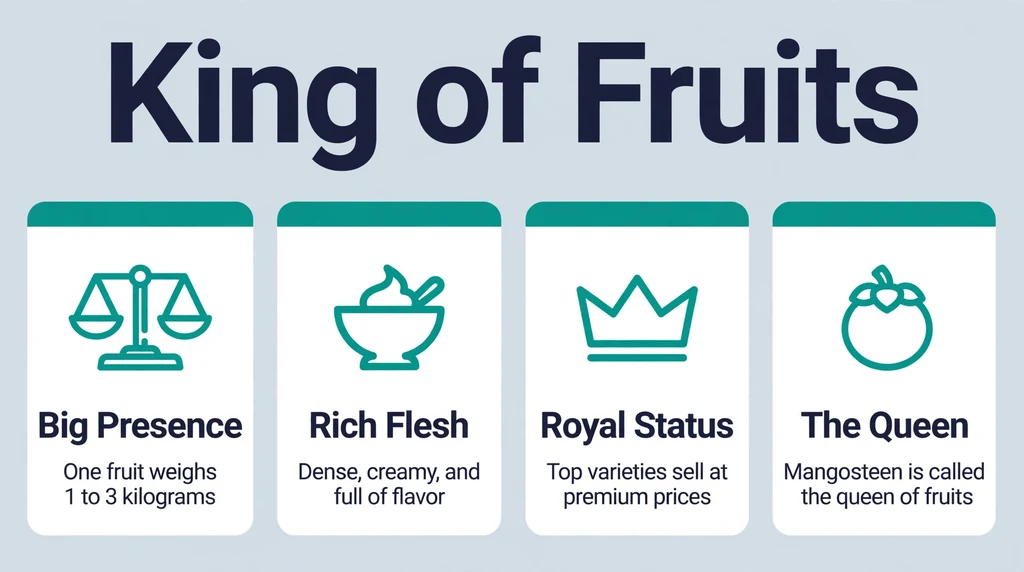
The title is informal, but nobody in the region disputes it. Several qualities earn durian its crown at the same time.
First, there is sheer presence. A durian is big, heavy, fragrant, and impossible to ignore. It perfumes a whole market stall before you even spot it. Second, there is richness. The flesh is dense with flavor, fat, and natural sugars. It eats more like a dessert than a snack fruit.
Third, there is status. The fruit is sharply seasonal, and the finest varieties sell for high prices. Growers enter competitions, and whole festivals form around peak harvest weeks. A gift of top-grade durian carries real social weight in Malaysia and Singapore.
The monarchy has a queen, too. The mangosteen, a small purple fruit with snowy white segments, is widely called the queen of fruits. Its season overlaps with durian season, so stalls often sell both together. Tradition describes mangosteen as cooling, a gentle balance to durian’s rich, “heaty” nature. That pairing says a lot about how the region thinks about food: bold flavors, kept in balance.
Towns compete openly for bragging rights each season, too. Raub in Pahang trades on Musang King, and Balik Pulau in Penang is famed for its orchards. Thailand’s Chanthaburi province anchors the eastern harvest. Growers enter champion fruits in agricultural competitions, where judges grade flesh, aroma, and balance. A winning title can lift an orchard’s reputation, and its prices, for years.
Why Does Durian Smell So Strong?

The smell is the most famous thing about durian. People compare it to onions, garlic, rotten eggs, and gym socks. Others catch sweet, fruity notes hiding underneath. Both camps are describing the same chemistry.
The Chemistry Behind the Odor
Durian flesh releases a cocktail of volatile sulfur compounds. Sulfur chemicals are nature’s loudest smells. They give garlic, onions, and rotten eggs their punch. Durian simply produces far more of them than most foods.
In 2017, researchers in Singapore mapped the durian genome. The team, based at the National Cancer Centre Singapore and Duke-NUS Medical School, published in *Nature Genetics*. They found roughly 46,000 genes in the Musang King variety. That is nearly twice the human gene count.
More importantly, they found the smell machinery. A family of genes called MGLs controls production of those sulfur compounds. Most plants carry one or two copies of these genes. Durian carries four, and they switch on hard as the fruit ripens. The lead researchers described the output as “turbocharged.”
The study also noted why the smell exists at all. A powerful aroma advertises ripe fruit across the forest. Hungry animals follow the scent, eat the flesh, and spread the seeds. The smell, in other words, is the fruit doing its job very well.
Why the Smell Leads to Bans
The problem is not just strength. It is stamina. Durian odor seeps into fabrics, air conditioning systems, and enclosed rooms. It can linger for days after the fruit is gone. One opened durian can perfume an entire hotel corridor.
As a result, many hotels across Southeast Asia ban it outright. Public transport systems in cities like Singapore and Bangkok do the same. Subway stations display the famous sign: a durian crossed out in red. Airlines often refuse it in cabins and checked baggage alike.
Sellers respect the rule without resentment. Shops often seal portions in layers of plastic and vacuum packs. Even so, experienced fans eat durian outdoors or at open-air stalls. It keeps the peace, and honestly, the fruit tastes better in fresh air.
What Does Durian Taste Like?
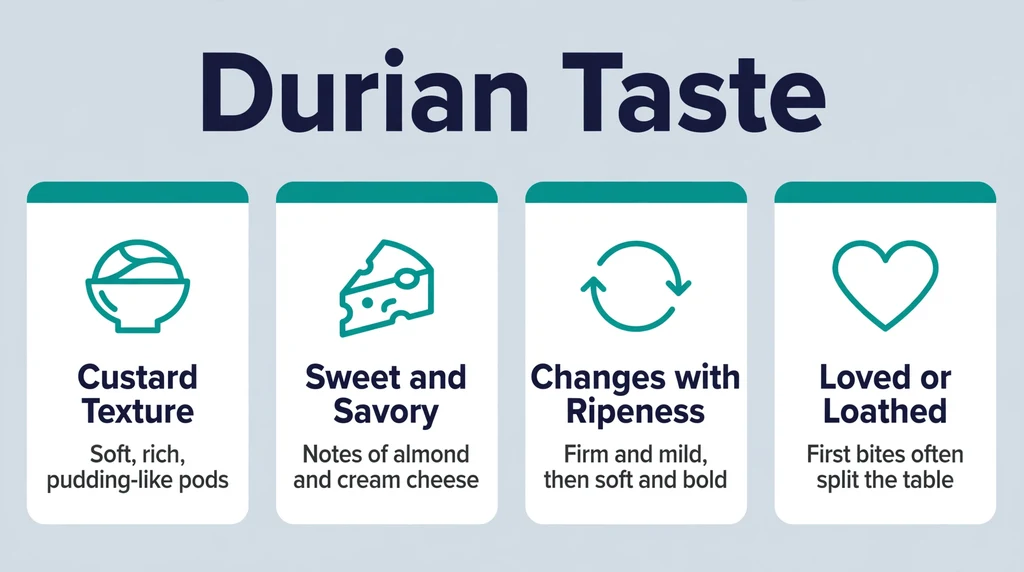
Here is the surprise that converts people: the taste barely resembles the smell. The flesh is sweet, rich, and deeply creamy. Imagine vanilla custard crossed with whipped cream cheese. Then add a gentle sweetness and a soft, savory depth.
The British naturalist Alfred Russel Wallace described it in 1856. He wrote that “a rich custard highly flavoured with almonds gives the best general idea of it.” Then he noticed stranger wafts beneath: cream cheese, onion sauce, and sherry wine. He concluded that eating durian was “a new sensation worth a voyage to the East to experience.”
Modern tasters land in similar places. Common descriptions include caramel, vanilla, almond, and banana. Savory eaters mention garlic, onion, and even blue cheese. The balance shifts with variety and ripeness. A firmer fruit tastes milder and sweeter. A very ripe one turns intense, bitter-edged, and almost boozy.
Texture matters as much as flavor. Thai buyers often prefer flesh that is firm and slightly chewy. Malaysian and Singaporean fans usually want it soft and custardy. Neither side is wrong. They are simply eating the same fruit at different points in its short life.
First-timers should start small and fresh. Choose a mild variety, breathe through your mouth, and take one bite. Many people dislike the first taste and love the third. Wallace himself admitted he was reluctant at first, because of the aroma. One outdoor tasting in Borneo made him, in his words, a confirmed durian eater.
Why Some People Never Get Past the Smell
For some visitors, the nose votes before the tongue can. Sensitivity to sulfur smells varies widely from person to person. What smells like sweet onions to one eater smells like a gas leak to another. Neither reaction is wrong; noses genuinely differ.
Context matters, too. A whiff in a sealed hotel corridor feels aggressive. The same aroma at an open-air stall reads as appetite and anticipation. Experienced fans suggest eating outdoors, starting with chilled flesh, and pairing bites with mangosteen. Cold softens the aroma, and fresh air keeps it moving. Give the fruit those fair conditions before you judge it.
Where Do Durians Grow?
Durian is a true child of equatorial Southeast Asia. Botanists trace its wild origins to Borneo and Sumatra. The Malay Peninsula is its other ancient home. Borneo still holds the widest diversity of wild *Durio* species.
Today the fruit grows across the whole region. Thailand, Malaysia, and Indonesia are the big three producers. Vietnam and the Philippines grow large amounts as well. Smaller plantings thrive in Brunei, Cambodia, Laos, and Myanmar. The trees demand heat, humidity, and heavy seasonal rain. Frost is fatal, which is why durian stays stubbornly tropical.
Thailand is the world’s leading exporter by a wide margin. Its orchards, especially in the east and south, ship fruit across Asia. Malaysia exports less volume but wins on premium fame. Its top varieties command the region’s highest prices.
Meanwhile, demand keeps climbing. In the early 2020s, a durian craze swept China. Imports surged, and orchards from Vietnam to Malaysia expanded fast. China now stands as the fruit’s most important foreign market. Fresh fruit even reaches North America, Europe, and Australia, usually frozen. Freezing tames the smell a little, which airlines quietly appreciate.
Singapore shows the trade in miniature. The city grows almost no durian of its own. Yet its appetite is legendary across the region. In season, trucks roll in from Malaysian orchards every single day. Stalls in neighborhoods like Geylang fill by evening and empty by night. It is a neat lesson in durian economics: the fruit travels fast, sells fast, and rarely waits until morning.
A Short History of the Durian
Durian is no newcomer to the region’s tables. People in Southeast Asia have eaten it since prehistoric times. Wild trees fed forest communities long before orchards existed. Cultivation at village level likely stretches back centuries.
Europe met the fruit late, and through travelers. The earliest known European reference comes from the 1400s. Venetian traveler Niccolò de’ Conti described a big green fruit in Sumatra. He compared its thick, buttery contents to elongated oranges. In 1563, the Portuguese physician Garcia de Orta published another description, gathered along India trade routes.
The most careful early account arrived in 1741. German botanist Georg Rumphius detailed the durian in his *Herbarium Amboinense*. His work stayed the standard reference for over a century. Later, botanical gardens spread seeds cautiously around the tropics. Kew Gardens sent seedlings to Dominica in 1884, for example. Outside Asia, though, the tree mostly stayed a botanical garden curiosity.
Commercial farming is surprisingly recent. Village cultivation grew through the 1700s and 1800s. Large orchards only expanded from the mid-1900s onward. Demand across Southeast Asia climbed sharply during the 1990s. Then China’s durian craze, in the early 2020s, turned a regional favorite into a global trade story.
Durian Season: When Is It Available?
Durian is a seasonal fruit, and the calendar rules everything. Trees flower and fruit once or twice a year. The main harvest in Peninsular Malaysia runs roughly from June to August. Peak weeks usually land in July, when prices drop and choice explodes. A smaller second season follows around December to February.
Thailand’s eastern orchards harvest a little earlier, mainly from April into July. Southern Thailand and northern Malaysia run on slightly different clocks. East Malaysia, the Philippines, and Indonesia each follow local rains. So somewhere in the region, a harvest is almost always near.
Season shapes quality as much as supply. In season, fruit is fresher, cheaper, and more varied. Mid-season glut days are a gift to buyers. Sellers stack fruit high, open samples freely, and bargain with a smile. Off-season, expect frozen flesh, imported fruit, and higher prices. Frozen durian is better than its reputation, especially for desserts. Still, nothing matches a tree-ripened fruit cracked open at a roadside stall.
If you are planning a durian trip, aim for peak season. Stay flexible by a week or two, since weather shifts flowering. Then eat like a local: little and often, outdoors, with friends.
Popular Durian Varieties
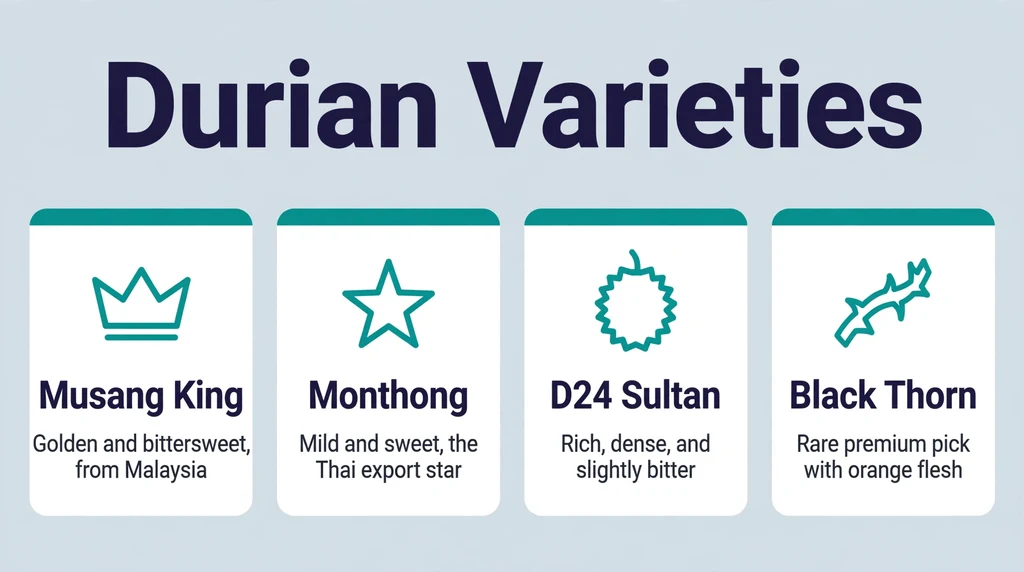
“Durian” is only the beginning of the story. Growers have bred hundreds of named varieties over the centuries. Nearly all of them are clones, grafted from a single prized mother tree. Malaysia alone has registered more than two hundred, each with a code. The code starts with the letter D, a system kept since 1934. Here are the names you will meet most often.
Musang King (D197)
Musang King is the superstar of the durian world. Malaysians also call it Mao Shan Wang. The variety surfaced in the 1980s near Gua Musang, in Kelantan. A grower named Tan Lai Fook carried grafting material back to Raub, Pahang. Raub is now famous as Musang King country.
The flesh is a deep, glowing golden yellow. Its flavor is intense and famously bittersweet. The texture feels silky, dense, and almost sticky. Fans look for the pale five-pointed star on the fruit’s base. Among premium durians, Musang King usually sets the price ceiling.
Monthong, the Golden Pillow
Monthong is Thailand’s gift to beginners. Its Thai name translates as “golden pillow,” a nod to its plump pods. The variety dominates Thai orchards and Thai exports. Most frozen durian sold worldwide is Monthong.
Its flesh is thick, pale yellow, and gently sweet. The smell is moderate by durian standards. The texture stays firmer and less custardy than Malaysian styles. Newcomers often find it friendly, then graduate to stronger types. Exporters love it because the pods are large and the seeds are small.
D24, Black Thorn, and Red Prawn
D24, nicknamed Sultan, was Malaysia’s premium standard before Musang King rose. Its golden flesh tastes rich, dense, and pleasantly bitter. Many older fans still swear by it. It also tends to cost less than the current champion.
Black Thorn (D200) is the modern challenger. The fruit is rounder, with a dark thorn tip that gives it its name. Inside, the flesh glows orange-yellow and tastes very rich. Supplies are limited, so prices rival or beat Musang King.
Red Prawn (D175) offers something softer. Grown mainly in Pahang and Johor, it has sweet, yielding flesh. A faint pink blush sometimes colors the pods. It suits people who want sweetness without heavy bitterness.
Beyond these stars, every region guards local favorites. Kampung durians, grown from seed in villages, vary fruit to fruit. Chasing them at roadside stalls is half the fun of the season.
How to Choose and Open a Durian

Buying a whole durian feels like a gamble at first. Sellers in Southeast Asia use a few time-tested checks. Learn them, and your odds improve fast.
Choosing a Good One
Start with the smell. Bring the fruit close and sniff along the seams. A ripe durian smells strong but sweet through the shell. Little or no smell means it is underripe. A sour, alcoholic edge means it has fermented too far.
Next, knock and shake. Tap the husk with a knife handle or your knuckles. A hollow, loose sound suggests the flesh has pulled from the shell. Then shake the fruit gently beside your ear. You want a faint, dull movement, not silence and not sloshing.
Check the stem as well. A thick, firm, fresh-looking stem signals a fresh fruit. A shriveled or missing stem suggests age. Rounder fruits often carry more flesh for their size. Finally, skip any fruit with wet spots, leaks, or deep cracks.
Whenever possible, let the seller open it on the spot. Good stalls replace a bad fruit without argument. That single habit protects beginners better than any test. Price can guide you a little, too. In season, honest stalls price clearly by variety and grade. Mystery pricing is a reason to walk to the next stall.
Opening It Safely
Respect the thorns first. Wear thick gloves or wrap the fruit in a heavy towel. Place it on a stable board, stem side up or down. Look for the seam lines that run along the husk. These are the natural fault lines between compartments.
Push a sturdy knife tip into a seam near the base. Twist gently, and the husk will start to split. Work along the seam rather than sawing through spikes. Then pry the sections apart with your hands. The pods lift out in neat, creamy lobes.
Eat the flesh fresh, ideally within a few hours. Peel it from each seed with your fingers or a spoon. Keep leftovers in an airtight container in the fridge. Expect the fridge to smell of durian anyway. For longer storage, freeze the pods; they keep well for desserts.
One last orchard note: ripe durians drop from tall trees on their own. Falling fruit is a real hazard under a tree. Many farms string nets below the branches to catch the harvest. If a stall fruit fell naturally, that is a good sign, not a flaw.
Durian Nutrition Facts
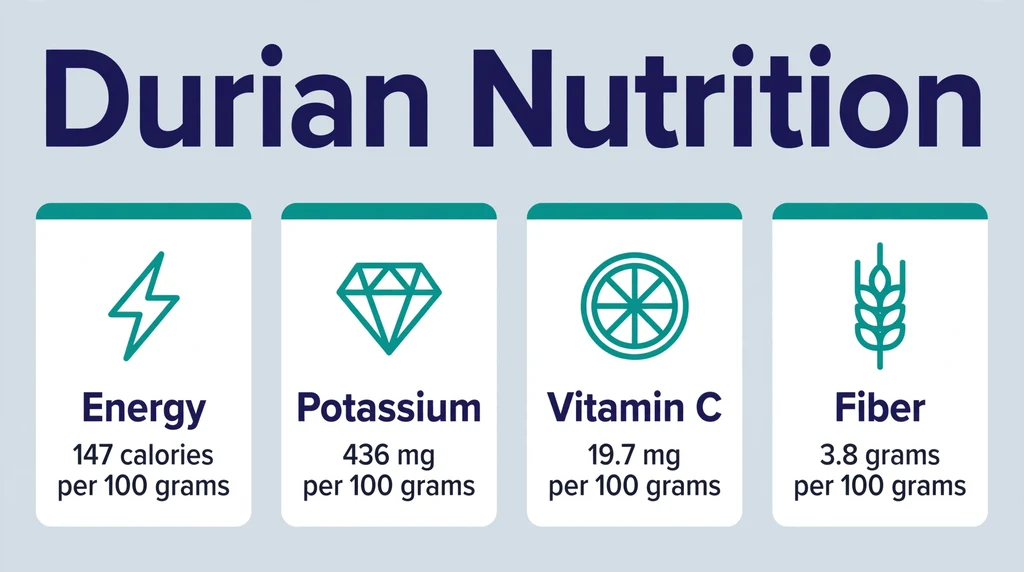
Durian is unusually rich for a fruit. It carries real fat, solid fiber, and a broad mineral spread. The figures below come from USDA data for raw durian flesh. They describe a 100 gram portion, roughly two small pods.
That portion provides about 147 calories. It contains 27 grams of carbohydrate and 3.8 grams of fiber. It also carries 5.3 grams of fat and 1.5 grams of protein. A full cup of flesh, around 243 grams, lands near 357 calories.
The Numbers That Matter
The mineral headline is potassium: about 436 milligrams per 100 grams. Durian also supplies about 19.7 milligrams of vitamin C. That covers roughly a fifth of an adult’s daily target. Thiamin stands out too, at about 31 percent of the daily value. Folate, vitamin B6, copper, and magnesium all appear in useful amounts. Separate research has found durian flesh to be a notably rich folate source, though levels vary by variety.
Portions and Cautions
Two cautions keep the picture honest. First, the natural sugars and calories add up quickly. People managing diabetes usually treat durian as an occasional dessert, in small portions. Second, its high potassium matters for some kidney patients, who often limit potassium-rich foods. If either applies to you, a quick word with your doctor is wise.
Otherwise, enjoy the balance. Durian delivers energy, fiber, and micronutrients in one package. Zero cholesterol, too, as the USDA data confirms. Just remember that “king” portions are bigger than they look.
For comparison, most familiar fruits are far lighter. Apples and mangoes sit near 50 to 60 calories per 100 grams in USDA data. Durian delivers more than double that energy in the same weight. Only the avocado keeps it company among common fruits. That density is exactly why fans treat a few pods as a full dessert.
Durian in Food and Desserts
Fresh flesh is the classic way to eat durian. But Southeast Asian kitchens fold it into far more. Sweet dishes lead the list across the region.
In Thailand, durian sticky rice mirrors the famous mango version. Coconut-sweetened rice meets soft durian and rich coconut cream. Malaysia and Indonesia make dodol, a slow-cooked durian candy with a fudge texture. Durian ice cream, cakes, puffs, and pancakes fill bakery cases in season. Even coffee shops launch limited durian drinks each harvest.
Savory cooking claims a share as well. Fermented durian paste, called tempoyak, is a Malay and Indonesian staple. Cooks stir it into fish curries and chili sambals. The flavor turns tangy, funky, and deeply savory. It divides people even more than the fresh fruit does.
The seeds join in too, boiled or roasted as a starchy snack. Nothing about this fruit is wasted in its home region. If fresh durian overwhelms you, a dessert is a gentle doorway. Start there, then work toward the real thing.
Packaged snacks stretch the season even further. Thai shops sell crisp durian chips and freeze-dried chunks all year. Bakeries fold durian paste into mooncakes, puffs, and layered cakes. These gentler forms carry the flavor with far less aroma. Many first-timers meet durian this way, then work upward.
Durian vs Jackfruit: What Is the Difference?
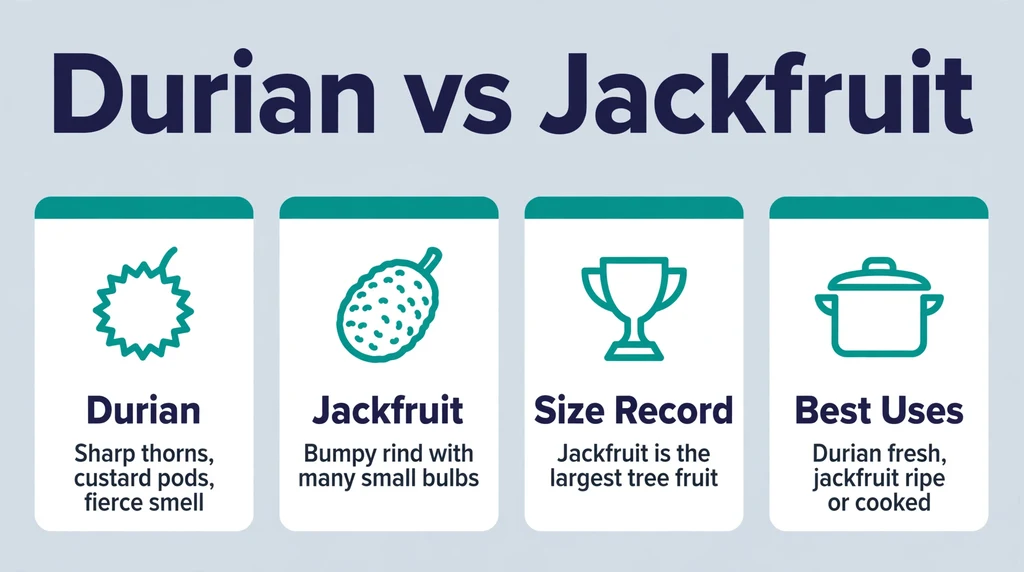
People mix these two up constantly. Both are large tropical fruits with yellow, pod-like flesh. Both grow on trees across Southeast Asia. That is roughly where the resemblance ends.
Jackfruit belongs to the mulberry family, Moraceae. Durian sits in the mallow family instead. Jackfruit is also much bigger. In fact, Britannica calls it the largest tree-borne fruit in the world. A jackfruit can reach 60 centimeters long and weigh up to 18 kilograms. A durian rarely passes 3 kilograms.
The skins differ at a glance. Durian wears true spikes, sharp enough to demand gloves. Jackfruit wears bumps: a pebbly, rubbery rind that hands can grip. Inside, jackfruit hides dozens of small bulbs around a central core. Durian hides a few large custard pods in separate chambers.
Flavor separates them most. Ripe jackfruit tastes sweet and mild, like banana mixed with pineapple. Its smell is fruity but modest. Durian is louder in every way: richer, fattier, more savory, and far more pungent. Cooks also use unripe jackfruit as a vegetable and meat substitute. Nobody cooks unripe durian that way.
Think of it this way. Jackfruit is the friendly giant of the fruit market. Durian is the giant with a bodyguard of thorns and a reputation. Both are worth trying, ideally side by side in season.
Durian Myths and Safety Questions
Few fruits attract folklore like durian does. Some stories hold a grain of science. Others collapse under a quick fact check. Here are the claims you will hear most.
The Alcohol Question
Myth one: durian plus alcohol can kill you. This belief is old across Asia. In 2009, researchers at the University of Tsukuba tested it in the lab. Their *Food Chemistry* study found that durian extract slowed a key alcohol-processing enzyme. In test conditions, the enzyme’s activity dropped by up to 70 percent. Later studies in rats showed flushing and discomfort, similar to a disulfiram reaction.
That is real science, but it is not proof of the deadly claim. The lab work used concentrated extracts and yeast enzymes, not dinner portions. No solid human evidence shows that normal servings of durian with drinks are fatal. Headlines in 2009 ran far ahead of the data. The sensible takeaway is narrower: mixing the two may make alcohol hit harder. Many drinkers simply avoid the combination, and that caution costs nothing.
Cholesterol, Smell, and “Heaty” Beliefs
Myth two: durian is loaded with cholesterol. It is not. Durian is a plant food, and the USDA lists its cholesterol at zero milligrams. The fruit does contain fat and plenty of calories. That is a portion question, not a cholesterol problem.
Myth three: if it smells awful, it must taste awful. The chemistry explains the confusion. Sulfur compounds dominate the aroma, but the flesh leans sweet and creamy. Smell and taste travel different paths here. Most converts say the first bite rewrote their expectations completely.
One traditional belief deserves respect rather than a verdict. Regional food culture calls durian “heaty” and mangosteen “cooling.” Fans eat them together to feel balanced after a rich feast. Science has not confirmed the framework, but the custom is centuries old. Treat it as culture, not medicine, and it harms no one.
Frequently Asked Questions
Why is durian banned in hotels and on public transport?
The smell is powerful and extremely persistent. It seeps into fabrics, carpets, and air conditioning systems. A single fruit can scent a corridor for days. Hotels, airlines, and transit systems in Southeast Asia ban it to protect other guests. Outdoor stalls and sealed packaging are the usual workarounds.
Does durian taste as bad as it smells?
No, and the gap surprises most first-timers. The aroma leans sulfurous, like onions and garlic. The flesh tastes sweet, creamy, and custard-like. Many people who brace for the worst end up converted. Starting with a mild variety makes the first taste easier.
Which durian variety is best for beginners?
Monthong from Thailand is the friendliest starting point. Its flavor is mild, sweet, and only moderately smelly. Its firm texture also feels familiar to new eaters. From there, D24 offers a richer step up. Save Musang King for when you want the full intensity.
How many calories are in durian?
USDA data lists about 147 calories per 100 grams of flesh. That is roughly two small pods. A full cup of flesh contains about 357 calories. Durian is one of the most energy-dense fruits, so portions matter. Think of it as dessert, not a light snack.
Is durian good for you?
It offers fiber, potassium, vitamin C, thiamin, and folate. Those are genuine nutritional strengths for a fruit. It is also high in natural sugars and calories. Most people do best enjoying it in moderate amounts. People managing diabetes or kidney issues should ask their doctor first.
Can you eat durian seeds?
Yes, but only after cooking them. People boil or roast the large seeds inside each pod. Cooked seeds turn starchy and mild. Never eat them raw, since the raw seeds are not considered safe food. In durian regions, cooked seeds are a normal snack.
Can I take durian on a plane?
Fresh durian is usually barred from aircraft cabins. Its smell escapes normal wrapping and fills enclosed spaces fast. Some travelers check in frozen or vacuum-sealed durian instead. Rules differ by airline and destination country, though. Check both before you pack, and expect strict limits.
When is the best time of year to eat durian?
Peak season in Malaysia runs roughly from June to August. Thailand’s main harvest starts a little earlier, around April. In season, fruit is fresher, cheaper, and more varied. Off-season, frozen durian fills the gap and still works well for desserts.
Final Thoughts
Durian is a fruit of extremes, and that is its charm. The word itself just means “the thorny one,” which undersells everything inside. Behind the spikes sits the richest, creamiest flesh in the fruit world. Behind the smell sits clever chemistry, tuned by evolution to call every animal in the forest.
You do not have to love it on the first try. Wallace needed one honest tasting to change his mind. Start mild, eat outdoors, and share the fruit with patient friends. Better still, split one fruit with a fan and taste two varieties side by side. Few foods reward curiosity this warmly, or divide a dinner table this cheerfully. If you want to keep exploring the botany, the Singapore National Parks Board’s durian species profile is a solid next read. Then, come season, find a stall at peak harvest. The king is best met in person.