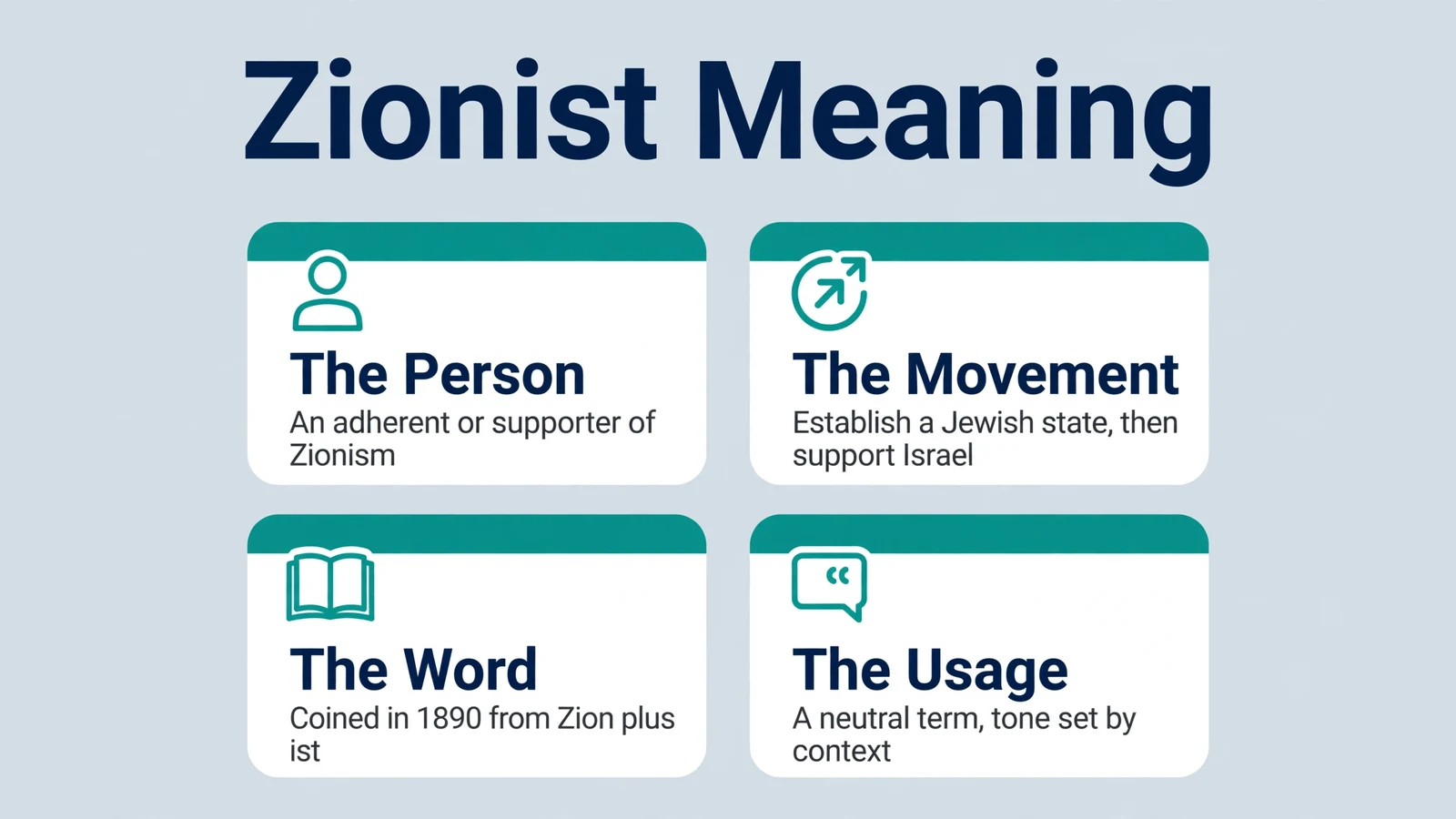
Few everyday words start an argument as quickly as this one. It appears in history books, news reports, and heated online debates, often with strong feelings attached. Yet the dictionary meaning is short, calm, and specific. A Zionist is a person who supports Zionism, the movement that worked to establish a Jewish state in the land of Israel and that now supports the State of Israel.
That single sentence, however, sits on top of a long story. The word is barely 135 years old, but it names a movement that redrew maps. People also use it in sharply different ways today, which is exactly why confusion spreads.
This guide therefore starts with the plain definition. After that, it traces the origin of the word, gives a brief history of the movement, and shows how the term is used now. Along the way, it clears up the most common mix-ups, relying on dictionaries and recorded history rather than opinion.
What Does Zionist Mean?
The dictionary definition
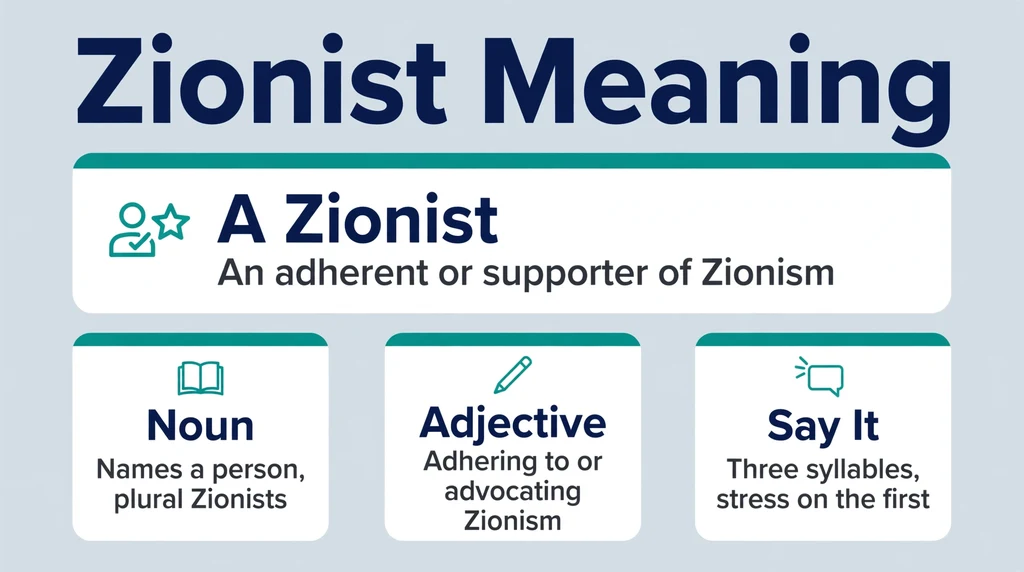
Major dictionaries all give the same core answer. Merriam-Webster defines a Zionist, as a noun, as “an adherent or supporter of Zionism.” Oxford’s learner’s dictionary uses nearly identical wording. Cambridge adds helpful detail, describing a Zionist as someone who belongs to or supports the movement that aimed to create a country for Jewish people and that now supports the state of Israel.
So, in plain words, a Zionist is anyone who backs that project and its continuation. The label describes a position a person holds. Notably, it does not describe a nationality, an ethnicity, or a religion. A person earns the label through support for an idea, not through birth or citizenship.
Dictionaries file the word under politics, and sometimes under religion as well. That double filing makes sense, because the movement mixes national history with deep religious roots. Still, the definition itself stays political: support for a movement.
Zionist as a noun and an adjective
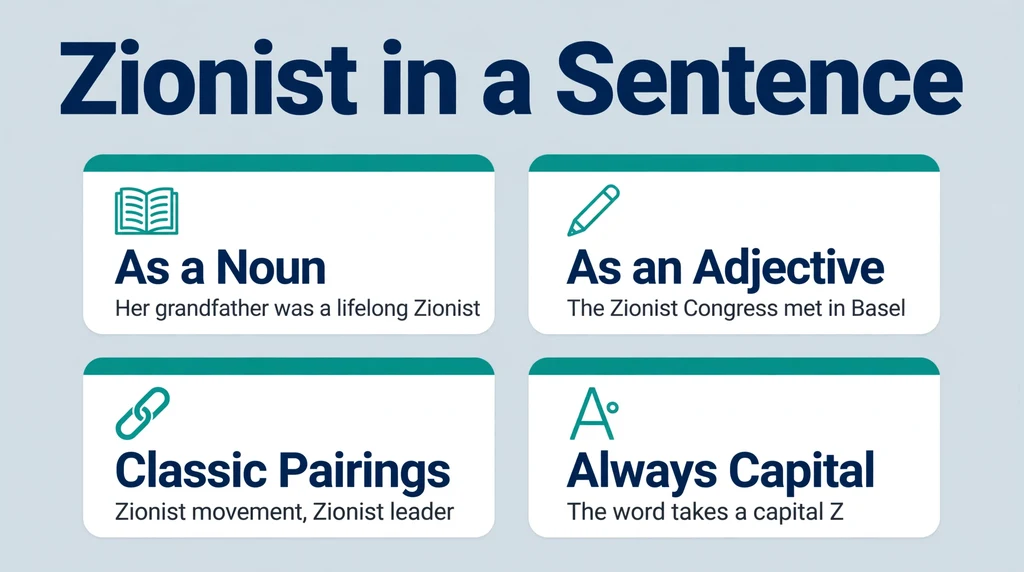
The word does two jobs in English. As a noun, it names a person, and it is countable, so one Zionist can stand beside many Zionists. As an adjective, it means adhering to or advocating Zionism, as in “a Zionist organization” or “the Zionist movement.”
Merriam-Webster also records a less common adjective form, Zionistic. Writers rarely choose it, because the shorter form does both jobs neatly. Meanwhile, the related noun Zionism names the movement itself, and speakers treat it as uncountable, like the word nationalism.
One more detail matters for careful writing. The word always takes a capital Z. It grows out of Zion, a proper name, so a lowercase z is simply a spelling error.
How to pronounce Zionist
Pronunciation is simpler than the spelling suggests. Say it as ZY-uh-nist, in three syllables, with the stress on the first one. Dictionaries write it as /ˈzaɪ.ə.nɪst/, and the opening sound matches the word “lion.”
In practice, listeners understand the word instantly in speech. The stress pattern never moves, whether the word works as a noun or as an adjective. So a learner only needs to master one sound pattern for every use.
What the definition includes, and what it leaves out
The definition is generous about who qualifies. A Zionist might donate, organize, publish, vote, or simply agree with the movement’s aim. Dictionaries set no minimum level of activity. Quiet agreement counts, because the word describes support rather than a job.
Just as usefully, the definition leaves several things out. It does not require a stance on any single policy of any Israeli government. It does not mention political parties at all. It does not even require an opinion about the movement’s internal debates, which have run for more than a century.
This breadth explains a puzzle that confuses many readers. Two people can both be Zionists and still disagree about borders, religion, or leadership. The word marks the shared center they hold. Everything beyond that center is personal politics, not dictionary meaning.
Core Meaning of Zionist
Start with Zionism itself
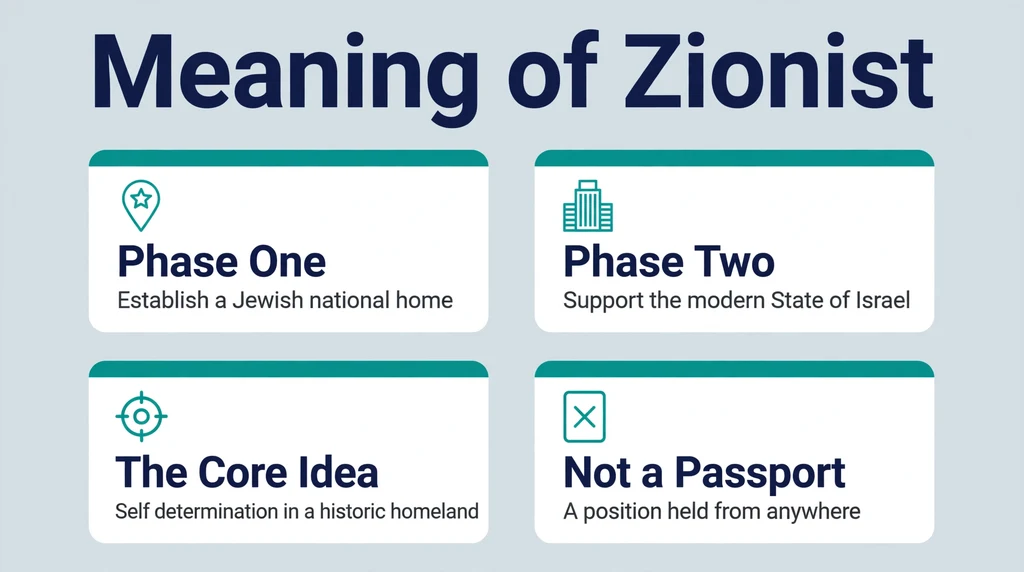
Nobody can define the person without defining the movement. Merriam-Webster calls Zionism an international movement. Originally, it worked for the establishment of a Jewish national or religious community in the historical region of Palestine. Later, after Israel existed, it worked for the support of modern Israel.
A Zionist, then, is a supporter of that movement in either of its two phases. Some supporters joined the first campaign, the building of a state. Others support the second one, the safety and survival of that state. Both count fully as Zionists under the dictionary definition.
Notice, too, that the definition says nothing about political parties. It also says nothing about borders, governments, or policies. Those details have always been argued about inside the movement itself, as the history section below will show.
The idea underneath the label
Supporters usually describe the core idea as self-determination. In their framing, the Jewish people, like other peoples, should rule themselves in their historic homeland. Writers often call Zionism the national movement of the Jewish people for exactly this reason.
Critics, on the other hand, frame the same history very differently. They focus on its effects on the Arab population of the land. This article does not settle that dispute, because a meaning guide has a narrower job. Its job is to report, accurately, what the word claims and how speakers use it.
For a reader, one point is worth holding onto. The dictionary meaning stays fixed even while opinions about the movement swing widely. Confusing those two layers is the source of most arguments about this word.
A position a person can hold from anywhere
Finally, the label is not tied to a map. Zionists have never needed to live in Israel, and most early supporters lived in Europe or the United States. The word measures support, not residence.
For the same reason, Zionist is not a synonym for Israeli. One word reports what a person believes or backs. The other reports a person’s citizenship. Later sections return to that difference, because mixing the two words causes endless confusion in news comments and classroom discussions alike.
Why the definition names two places
Sharp readers notice that definitions mention both Palestine and Israel. The reason is simple chronology. When the movement began, the land was a region called Palestine, ruled by the Ottoman Empire. No state named Israel existed yet.
In 1948, the new state took the name Israel. So the first phase of Zionism aimed at a home in the region of Palestine. The second phase supports the state that resulted, Israel. One definition has to cover both phases, because the movement spans both.
Keeping that timeline in mind prevents a common reading mistake. Older texts that say Palestine are describing the same land under its earlier name. They are not necessarily making a political point at all.
Origin of the Word Zionist
Zion, the hill behind the word
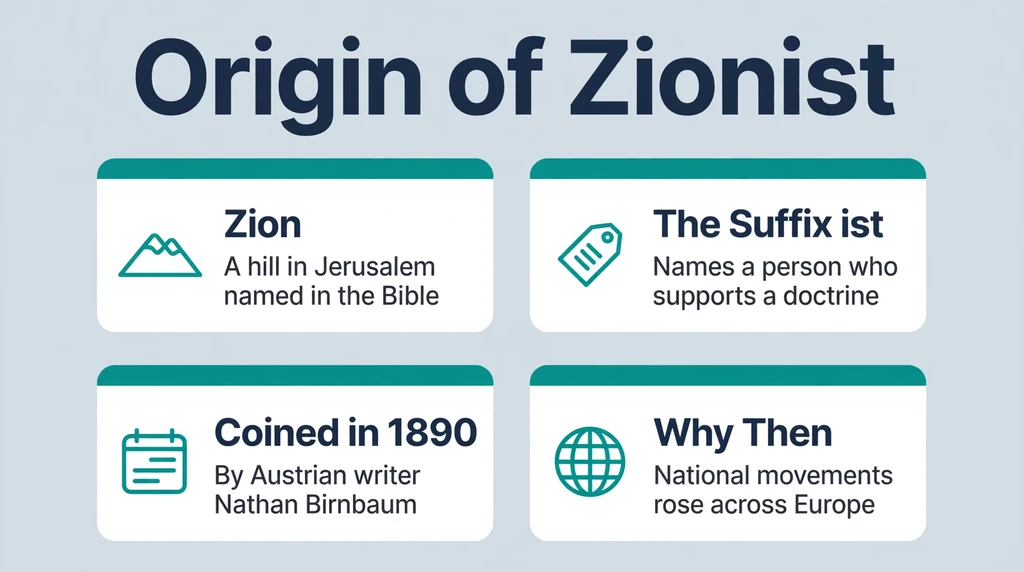
Every part of this word carries history, starting with Zion itself. Zion was originally Mount Zion, a hill in Jerusalem. In the Hebrew Bible, the name widened until it stood for Jerusalem as a whole, and then for the entire Land of Israel.
Poets and prayers kept that wider meaning alive for centuries. Long before politics entered the picture, Zion symbolized the Jewish people’s ancient homeland and their hope of return to it. So when a modern movement needed a name, this old word was the natural choice.
The name also explains the capital letter. Zion is a place name from scripture, and words built from it keep the dignity of a proper noun. English speakers pronounce Zion with the same opening sound as the full word Zionist.
A word coined in 1890
The modern term, surprisingly, is quite young. The Austrian writer Nathan Birnbaum first used the word Zionism in 1890. He printed it in his journal Selbst-Emancipation, and Merriam-Webster independently records 1890 as the word’s first known use.
Building the person-word was then simple grammar. English adds the suffix -ist to name someone who practices or supports a doctrine, as in artist or socialist. Zion plus -ist gives Zionist, a supporter of Zionism. The adjective ending -istic produced the rarer variant Zionistic.
Interestingly, Birnbaum himself later drifted away from the movement he had named. Words, however, do not follow their inventors. His coinage spread across Europe within a few years and has stayed in the language ever since.
Why a new word appeared at that moment
The timing was no accident. Across late nineteenth-century Europe, national movements were rising, and many peoples were demanding states of their own. At the same time, antisemitism remained a daily fact of Jewish life, and pogroms in the Russian Empire drove waves of fear and emigration.
Groups acting on these pressures already existed before the word did. The Hovevei Zion, whose name means “Lovers of Zion,” formed in the 1880s to promote Jewish farming settlement in Palestine. Leon Pinsker’s pamphlet Auto-Emancipation had argued that Jews needed to secure their own future.
Birnbaum’s new word therefore named something real and growing. It gave scattered groups one shared label. Within seven years, that label would headline an international congress.
A Brief History of Zionism
Before Herzl, the longing and the first groups
Jewish attachment to the land long predates any modern movement. Prayers, festivals, and scripture kept the connection alive through centuries of life elsewhere. For most of that time, the hope of return stayed religious rather than political.
The political turn came late in the nineteenth century. Pogroms in the Russian Empire pushed many Jews to search for practical answers. Some emigrated to America, but others looked toward Palestine, then ruled by the Ottoman Empire.
Groups such as the Hovevei Zion began organizing settlers and funds during the 1880s. Their early farming colonies struggled, yet they proved that organized settlement was possible. In short, the movement’s roots were already growing before its most famous leader appeared.
Herzl turns an idea into a movement
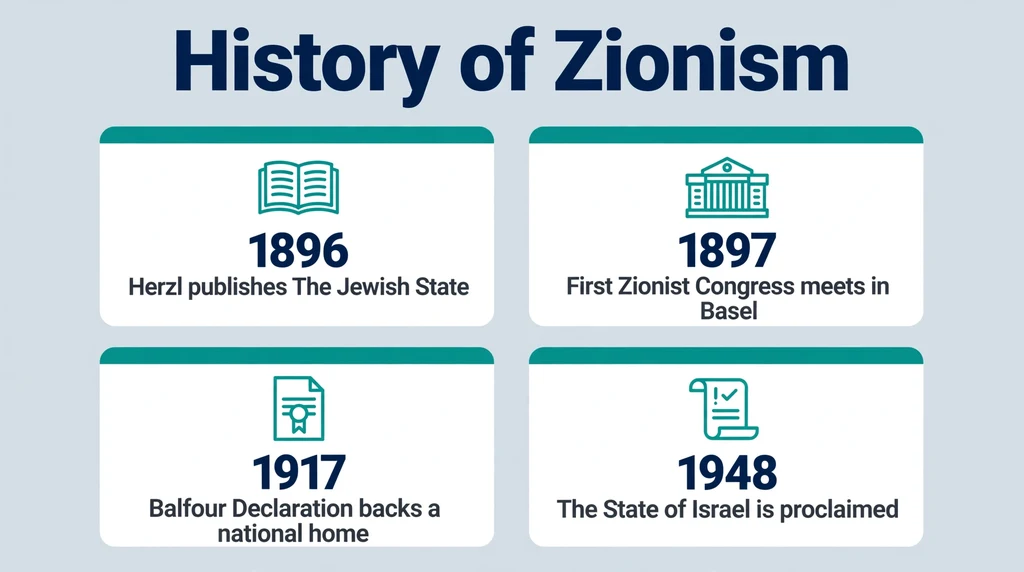
Theodor Herzl changed the scale of everything. Born in 1860, he was an Austrian journalist who watched antisemitism at work in modern Europe. Britannica explains that he came to believe European society would never fully accept Jews as equals.
His response was a short book. In 1896 he published Der Judenstaat, known in English as The Jewish State. In it, he argued that the Jewish question was a political question, and that it needed a political answer agreed by the nations of the world.
Then he built the machine to match the argument. In August 1897, he convened the First Zionist Congress in Basel, Switzerland. The congress founded the Zionist Organization and adopted the Basel Program. Its famous sentence declares that Zionism strives to create for the Jewish people a home in Palestine secured by public law. Herzl became the organization’s first president, and he led it until his death in 1904.
From declaration to statehood
The next breakthrough came during the First World War. On November 2, 1917, Britain issued the Balfour Declaration. It promised British support for a Jewish national home in Palestine. Zionist leaders Chaim Weizmann and Nahum Sokolow had worked hard to win that promise.
After the war, the declaration gained legal weight. Britain’s League of Nations mandate for Palestine, confirmed in 1922, included the declaration’s wording. Jewish immigration then grew, especially as conditions for Jews in Europe worsened during the 1930s.
The growth was never peaceful or uncontested. The Arab population of Palestine resisted the Zionist project, and Britain failed to reconcile the two sides’ demands. Still, the movement’s institutions kept developing. In 1948, the State of Israel was proclaimed, and Britannica’s summary judges that Zionism had achieved its original goal.
The building decades between the wars
Between the two world wars, the movement focused on construction. Immigrants arrived in organized waves, and each wave added farms, towns, and labor unions. Schools, newspapers, and cultural societies followed, and Britannica describes a Jewish renaissance in letters and arts during these years.
Language changed with everything else. The revival of Hebrew as an everyday spoken language advanced across this whole era of settlement. A language used mainly in prayer and study became the speech of markets, buses, and public debate.
This practical work mattered to the word’s meaning. By the 1940s, a Zionist was no longer only a person with an opinion. The term also described builders of real institutions, from agricultural settlements to cultural societies, across the land and in support networks abroad.
After 1948, the word changes jobs
Statehood did not retire the word. Instead, it shifted the word’s center of gravity, exactly as the Merriam-Webster definition records. Before 1948, a Zionist pushed to create a state. After 1948, a Zionist supports, defends, and develops the state that exists.
Much of that support took practical forms. Zionist organizations encouraged immigration to Israel, a movement known in Hebrew as aliyah. They also raised funds, built institutions, and lobbied friendly governments. Supporters abroad remained part of the movement without ever moving.
Meanwhile, argument about the word never stopped. Israel’s politics produced Zionist parties of the left and the right, plus religious and secular camps. The next sections look at who carries the label today, and why one short word can sound so different in different mouths.
Who Counts as a Zionist?
Mainly, it is a self-description
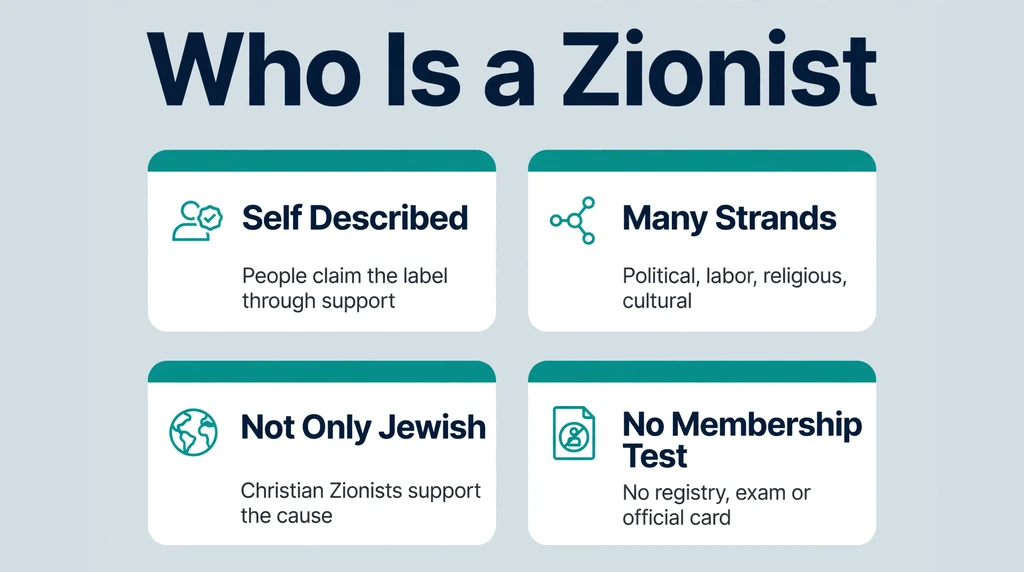
No office issues a Zionist membership card. There is no exam, registry, or official test for the label. In practice, the word works mostly as a self-description: people call themselves Zionists because they support the movement’s core aim, a Jewish state in Israel that endures.
Other people also apply the label from outside. Journalists use it for parties, organizations, and public figures whose platforms support that aim. Both uses follow the dictionary sense, so context usually makes the meaning clear.
One historical fact keeps the picture honest. Britannica notes that before the First World War, Zionism represented only a minority of Jews. Jewish opinion about the movement has never been uniform, at the start or since. Assuming otherwise is one of the most common errors this article will flag again later.
The reverse also happens. Sometimes outsiders pin the label on people who never chose it, usually during arguments. Self-description deserves more trust than name-calling, because only the person holding a position can confirm it. When a source matters, check whether the person has actually claimed the word.
Different strands inside one word
Zionism was never a single, tidy ideology. From its earliest congresses, it contained competing strands that argued fiercely with one another. Reference works commonly list political, labor, religious, and revisionist strands among them.
Political Zionism, Herzl’s strand, chased international recognition and legal guarantees. Labor Zionism blended the national goal with socialist ideas and built collective farms. Religious Zionism read the return as part of a divine plan, while cultural Zionists prized a Hebrew cultural revival above statehood itself.
These camps disagreed about almost everything except the center. All of them supported a Jewish national home in the land. That shared center is what makes one word able to cover people who agree on little else.
Christian Zionists
The label also crosses religious lines, and this surprises many readers. Britannica defines Christian Zionism as a theological and political Christian movement. Its supporters back the return of the Jewish people to a homeland in Palestine, based on their readings of biblical texts.
For many Christian Zionists, prophecy drives the commitment. They believe the Jewish return is a step toward the Second Coming of Jesus. Others emphasize gratitude toward Judaism or simple political support for Israel. Either way, they show clearly that a Zionist need not be Jewish.
The connection is older than most people guess. Herzl himself used the term Christian Zionist in 1896. He applied it to William Hechler, an Anglican chaplain who helped open doors for the young movement in European courts.
How to Use Zionist in a Sentence
Example sentences with Zionist as a noun
Reading real sentences fixes a definition better than any paraphrase. The examples below are written for this guide, and each one uses the word in its standard dictionary sense.
- Her grandfather was a lifelong Zionist who left Poland for Palestine in the 1930s.
- The speaker described herself as a Zionist and then explained what the word meant to her family.
- Early Zionists disagreed about language, religion, and borders, but they shared one central goal.
- The novel follows two brothers, one a committed Zionist and the other deeply skeptical of the whole project.
- After the congress in Basel, Zionists across Europe began organizing local branches.
Notice how the noun always points to a person and a position. It never points to a passport. That habit is the key to using the word accurately in your own writing.
Example sentences with Zionist as an adjective
The adjective form is just as common, especially in history and news writing. It describes organizations, ideas, and events connected with the movement.
- The Zionist Congress met in Basel in 1897 and adopted the Basel Program.
- She joined a Zionist youth movement as a teenager and later moved to a kibbutz.
- The archive holds thousands of Zionist pamphlets printed before the First World War.
- His speech attacked the Zionist project while praising individual Jewish writers.
In each case, the adjective answers a simple question: connected with Zionism in what way? If a phrase cannot answer that question, the word is probably being used loosely. Careful writers check that link before they publish.
Words that pair with Zionist
Certain partners appear again and again. Oxford’s collocations dictionary highlights “Zionist movement” as a classic pairing. Writers also use Zionist leader, Zionist organization, Zionist Congress, and Zionist state.
One of these needs a caution flag. “Zionist state” is used by supporters as a plain description of Israel’s founding idea. Critics, however, often use the same phrase with a negative charge. The pairing is common either way, but its tone depends entirely on the speaker, a pattern the usage section explores below.
Common sentence patterns
A few frames repeat across books and articles. “A leading Zionist” introduces an important figure in the movement. “Zionist leaders decided” reports a collective historical action. “He became a Zionist” marks the moment someone adopted the position.
The indefinite article does quiet work in these frames. Saying “a Zionist” treats the word as one identity among many, like “a socialist” or “a monarchist.” That grammatical habit reinforces the dictionary point: the word names a stance a person takes, not a kind of person someone is born as.
Related Words and Comparisons
Word forms and near terms
A small family of words clusters around the headword. Learning them together prevents most reading mistakes.
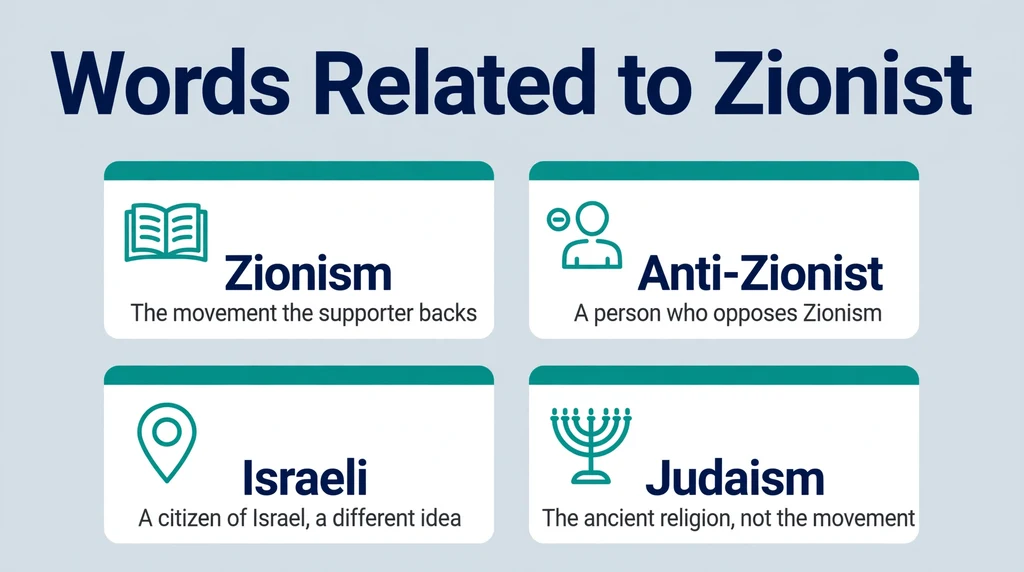
- Zionism: the movement itself; the belief system a Zionist supports.
- Zionistic: a less common adjective form of Zionist.
- Anti-Zionism: opposition to Zionism or to the existence of a Jewish state.
- Anti-Zionist: a person who holds that opposing position.
- Non-Zionist: someone who neither supports nor actively opposes the movement.
- Pro-Zionist: a casual adjective for people or statements supportive of Zionism.
- Aliyah: the Hebrew term for Jewish immigration to Israel, a goal the movement promoted.
- Zion: the biblical name at the root of the whole family, first a hill in Jerusalem, then a symbol of the homeland.
- Diaspora: the dispersion of Jewish people outside the land, the condition Zionism responded to.
Each term is a tool with one job. Swapping them carelessly, for example calling a neutral non-Zionist an anti-Zionist, changes the meaning of a sentence. Precise speakers keep the whole family separate.
Zionist vs Israeli
These two words answer different questions. Israeli answers a question about citizenship: an Israeli is a citizen of the State of Israel. Zionist answers a question about conviction: a Zionist supports the Zionist idea, wherever in the world that person lives.
The two groups overlap heavily, but they are not identical sets. Israel’s citizens include people with many backgrounds and many views about ideology. Meanwhile, millions of Zionists hold other passports entirely, including the Christian Zionists described earlier.
So a headline that swaps one word for the other is making an error. Editors who know the distinction correct it on sight. Readers who know it spot sloppy reporting much faster.
Zionism vs Judaism
Here the difference is one of kind and age. Judaism is a religion, and a wider culture, with roots thousands of years old. Zionism is a political movement that began in the late nineteenth century. One is ancient and primarily faith-based; the other is modern and primarily national.
The two connect, of course, through the land and the texts. Zion is a biblical name, and religious longing fed the movement’s roots. But connection is not identity. A person can be deeply observant and not Zionist, and a completely secular person can be a Zionist.
Keeping the categories separate also protects clear thinking. Criticism or support aimed at a political movement is a different act from attitudes toward a faith and its people. Much public confusion begins when writers blur exactly this line.
How the Word Zionist Is Used Today
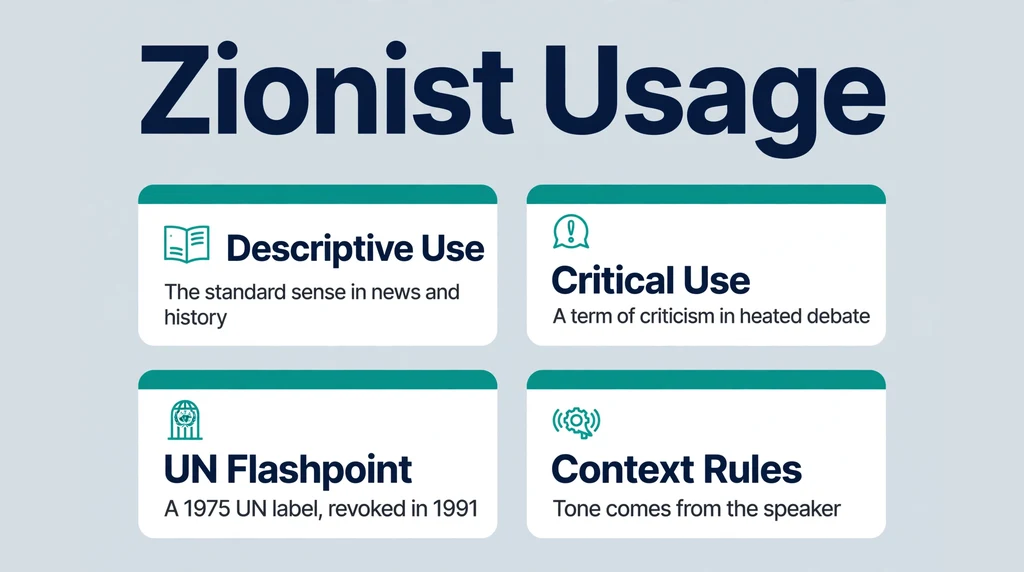
The neutral, descriptive use
In reference books, classrooms, and straight news reporting, the word does plain descriptive work. It labels the supporters, parties, and organizations of a real historical movement. A sentence like “Zionist delegates met in Basel” carries no praise and no attack.
Historians rely on this neutral sense constantly. Without it, they could not describe the congresses, the parties, or the debates of the last century. Style guides at major outlets likewise treat the word as a factual descriptor with a dictionary meaning.
This is the sense to default to as a reader. Unless a writer signals otherwise, assume the word is naming the movement’s supporters, just as the dictionary says.
The critical and contested use
At the same time, honesty requires noting a second pattern. In heated political debate, some speakers use Zionist as a term of criticism. It may target Israeli government policies, or the very idea of a Jewish state. Supporters of Israel often object that such usage stretches the word past its meaning.
The dispute reached the world stage once in a famous vote. In 1975, the United Nations General Assembly passed Resolution 3379, which declared Zionism a form of racism. Sixteen years later, in 1991, the Assembly revoked that declaration. Both events are matters of record, and together they show how contested the word became.
Historians add one further warning. Scholars cited in reference works note that, in some mouths, the label Zionist has served as a stand-in for the word Jew. Jewish organizations describe that substitution as a form of antisemitism. Reporting the observation matters, because it explains why arguments about one word can grow so intense.
Why context decides the tone
So is the word positive or negative? The accurate answer is that the dictionary sense is neutral, while the tone is not built in. Tone arrives with the speaker, the audience, and the sentence around the word.
Readers can protect themselves with two quick checks. First, ask whether the writer means the movement’s actual supporters. Second, ask whether the word seems to be replacing a different word entirely. Those two questions resolve most confusing cases in seconds.
Writers, in turn, should use the word when it is the precise one. Precision is not politeness; it is accuracy. On a word this loaded, accuracy is the whole job.
Common Misconceptions About the Word Zionist
“Zionist is the name of a religion”
It is not. Zionism is a political movement, and a Zionist is its supporter. The religion in this story is Judaism, which existed for millennia before anyone coined the word Zionism.
The confusion is understandable, because the movement’s roots reach into religious texts and hopes. Roots, however, are not the same as identity. Dictionaries classify Zionist as a political term first, and that classification settles the question.
“Every Jewish person is a Zionist”
History says otherwise. Britannica records that the movement spoke for only a minority of Jews before the First World War. Some Jewish communities preferred assimilation, some favored other political movements, and daily life mattered more than ideology for many.
Religious objections existed too. Reference works note that some ultra-Orthodox Jews opposed Zionism on theological grounds, arguing that a return should await the Messiah. Jewish opinion, in other words, has always contained argument. Treating any large group as unanimous is a reading error, whatever the group.
“Only Jewish people can be Zionists”
Christian Zionists disprove this one on sight. Their movement has supported the Zionist cause since the nineteenth century, for reasons rooted in Christian readings of the Bible. A supporter is defined by support, not by ancestry.
The same logic extends further. Political allies of many backgrounds have backed the movement across its history. The dictionary definition never mentions who the supporter must be. It only describes what the supporter supports.
“Zionist is just another word for Israeli”
By now, the answer should feel familiar. Citizenship and conviction are different categories, and the words are not interchangeable. Many Zionists are not Israeli, and the label says nothing about where a person lives or votes.
Writers who respect the difference produce clearer history and clearer news. Readers who learn it gain a small but real advantage. They can hear when a speaker is describing a belief, and when a speaker is describing a nationality.
“A Zionist agrees with every Israeli policy”
No definition says this either. The word covers support for the movement and the state’s existence. It does not function as a blanket endorsement of every decision by every Israeli government.
In fact, Zionists have argued with each other about policy since 1897. The movement’s strands disagreed about socialism, religion, and borders long before the state existed. Expecting agreement on modern policy, on top of that history, misunderstands what the label has ever meant.
Frequently Asked Questions
What is a Zionist in simple words?
A Zionist is a person who supports Zionism. Zionism is the movement that worked to create a Jewish state in the land of Israel and now supports that state. So, in the simplest terms, a Zionist believes the Jewish people should have and keep their own country in Israel.
What is the difference between a Zionist and Zionism?
Zionism is the idea and the movement; a Zionist is a person who supports it. The relationship matches pairs like socialism and socialist. One word names the system of belief. The other names the believer.
Is Zionist a noun or an adjective?
It is both. As a noun, it names a person: “She is a Zionist.” As an adjective, it describes things linked to the movement: “a Zionist congress.” Merriam-Webster also lists Zionistic as a rarer adjective form.
Who coined the word Zionism?
The Austrian writer Nathan Birnbaum coined it in 1890, in his journal Selbst-Emancipation. Theodor Herzl then made the movement famous. Herzl founded its main organization and led the First Zionist Congress in Basel in 1897.
Are all Jewish people Zionists?
No. Jewish views on Zionism have varied since the movement began. Britannica notes that Zionists were a minority among Jews before the First World War. Some Jewish groups supported it passionately, others opposed it, and many stood somewhere between those poles.
Can someone who is not Jewish be a Zionist?
Yes. Christian Zionists are the clearest example. They support the Jewish homeland idea for reasons drawn from their own faith. The definition of Zionist concerns what a person supports, so it sets no requirement about the supporter’s background.
How do you pronounce Zionist?
Say ZY-uh-nist, with three syllables and the stress on the first. Dictionaries write the sounds as /ˈzaɪ.ə.nɪst/. The first syllable rhymes with the word “eye,” which makes the pronunciation easy to remember.
Is the word Zionist positive or negative?
Dictionaries treat it as a neutral, descriptive word. In real life, though, tone depends on who is speaking. Supporters wear the label proudly, while some critics use it as an insult. Checking the context of each use is the reliable way to judge.
Final Thoughts
The meaning of Zionist is steadier than the arguments around it. A Zionist is a supporter of Zionism, the movement born in late nineteenth-century Europe that established a Jewish state in 1948 and now supports that state. That is the definition the dictionaries share, and it has not changed.
Knowing the plain meaning pays off quickly. It helps you read history accurately, follow the news with a cooler head, and notice when a speaker is using a word as a weapon instead of a description. On contested vocabulary, that skill is worth more than any opinion, including the ones shouted loudest online.
For readers who want to go deeper, the Encyclopaedia Britannica maintains a detailed, regularly updated history of the movement at Britannica’s Zionism article. Start there, and the word will never confuse you again.