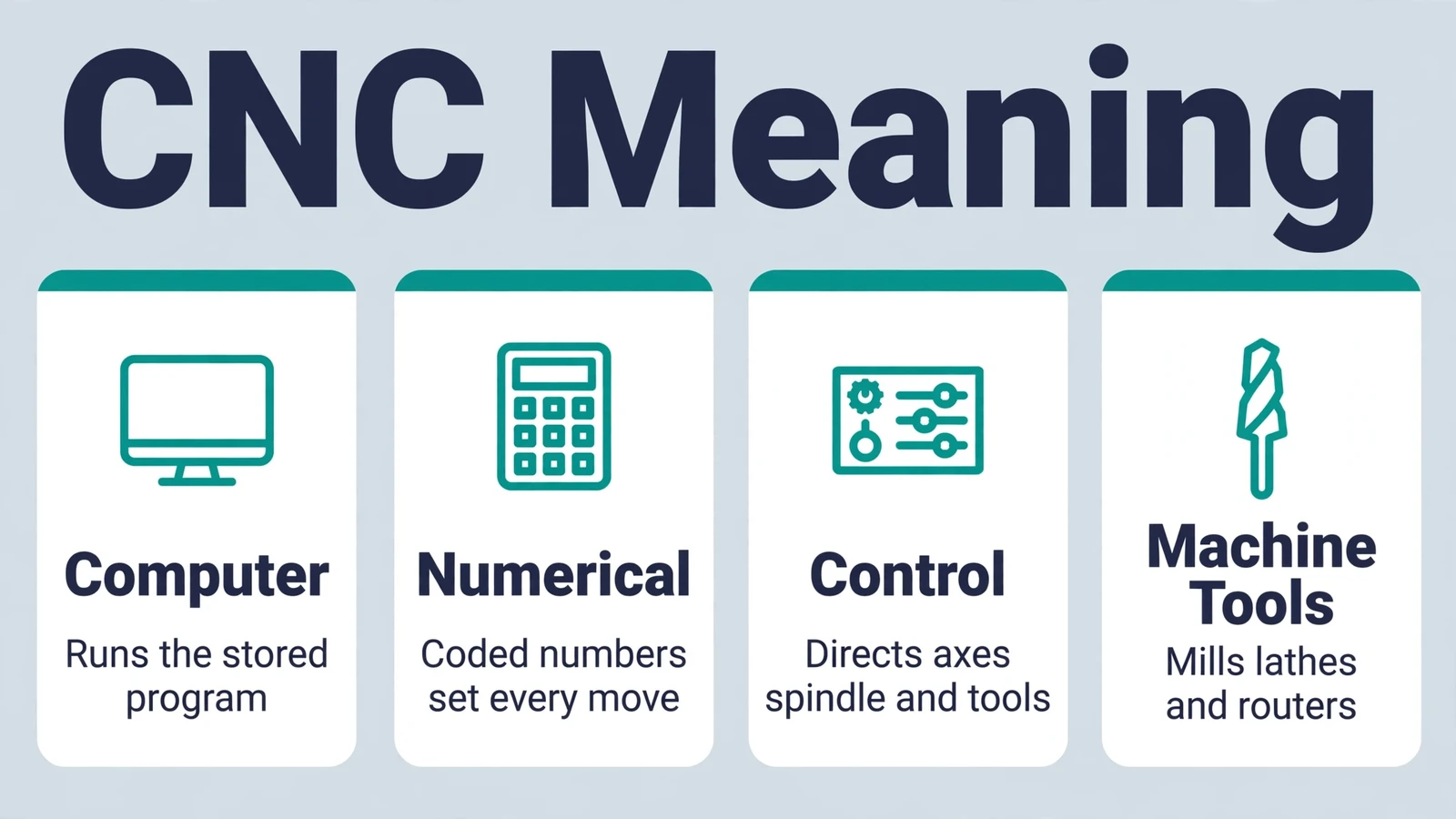
You have probably seen the letters CNC on factory tours, job adverts and workshop videos. But what do those three letters actually mean? CNC stands for Computer Numerical Control. Put simply, it describes machine tools that a computer runs from coded instructions, instead of a person steering every cut by hand. A CNC mill or lathe reads a program, moves its cutting tool along exact paths, and shapes metal, plastic or wood into a finished part.
Today, this technology sits behind aircraft parts, car components, medical implants and countless everyday products. This guide explains the CNC meaning in full. It covers how the machines work, the main types you will meet, the history behind them, and the jobs of the people who run them.
What Does CNC Mean?
The Full Form of CNC
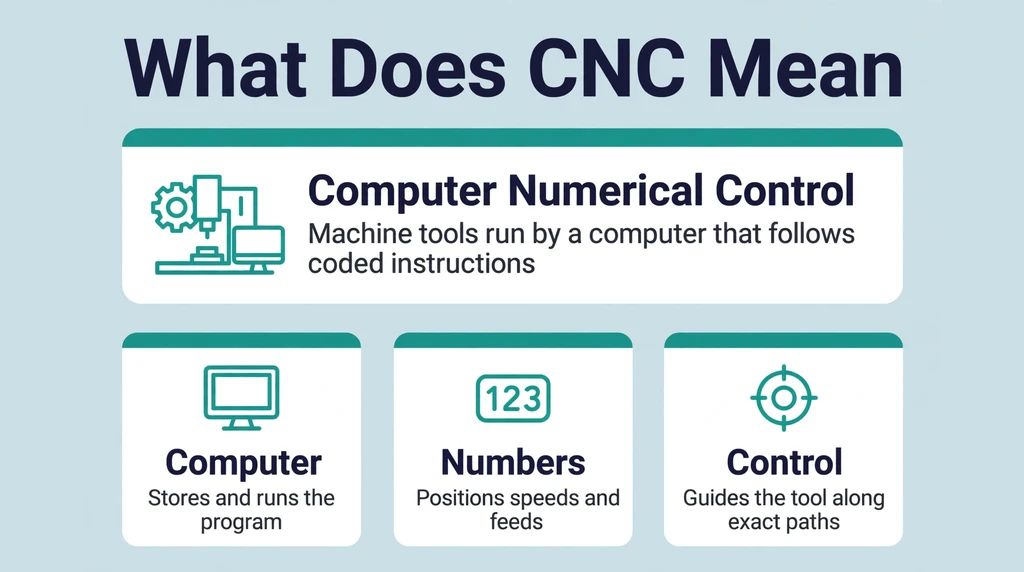
CNC is short for Computer Numerical Control. Each word in the full form points to one part of the idea. The word “computer” tells you that a built-in computer stores the instructions and runs the machine. The word “numerical” tells you that those instructions are numbers. They set positions, distances and speeds for every move the tool makes. Finally, “control” describes the system itself, because the computer directs the machine’s axes, spindle and tool changes from start to finish.
So, the CNC meaning is a method of running machine tools with a computer that follows coded numbers. Traditional dictionaries and engineering references define the older parent term, numerical control, in almost the same way. Encyclopaedia Britannica describes numerical control as a method of controlling machine tool axes by means of numbers coded on punched paper tape or other media. CNC is simply that idea with a computer in charge.
The Machine, the Control and the Process
People use the word CNC in three closely linked ways. First, it names the control system fitted to a machine tool. Second, it names the machine itself, so a workshop might buy “a new CNC” and mean the whole unit. Third, it names the process, which engineers call CNC machining.
That process is subtractive, and the distinction matters. A CNC machine starts with a solid block of material, often called the stock or workpiece. Then the cutting tool removes material bit by bit until only the designed shape remains. This approach is the opposite of 3D printing, which builds a part by adding material layer by layer. Both methods follow digital files, yet they shape material in opposite directions.
CNC and NC: A Quick Distinction
Before CNC, factories used plain NC, short for numerical control. An NC machine read its program from punched paper tape. Its controls were hard-wired circuits, and it had no computer of its own. Changing the program meant punching and loading a different tape.
CNC changed that arrangement completely. The program now lives in the memory of an onboard computer. Operators can view it on a screen, adjust a value, and run it again within minutes. Because of that flexibility, CNC replaced NC as the industry standard once computers became affordable in factories. That is also why older books and manuals still use NC in places where a modern writer would say CNC.
What CNC Is Not
A few common misconceptions are worth clearing up. CNC is not a brand of machine, and it is not one single machine type. It is a control method shared by dozens of machine designs and hundreds of manufacturers. CNC is also not the same as a factory robot. A robot moves objects or tools freely in space, while a CNC machine follows fixed axes and a cutting program. Nor does CNC mean fully automatic from start to finish. People still design the part, write or check the program, set up the machine and inspect the result. Finally, CNC is not limited to metal, despite its factory image. Wood, plastic and composite workshops run on the same principle every day.
How CNC Machines Work
The Main Parts of a CNC Machine
Five systems do most of the work inside a CNC machine. The controller is the brain: a dedicated computer that reads the program and coordinates everything else. Motors and drive screws form the motion system. They push each axis to the position the program demands, while feedback sensors confirm the real position.
The spindle is the powered shaft that spins the cutting tool on a mill, or the workpiece on a lathe. Its speed changes to suit the material and the operation. Tool storage matters on larger machines. A magazine holds spare tools, and an automatic changer swaps them in seconds without stopping the job. Finally, workholding devices such as vises, chucks and fixtures grip the stock. They hold it rigid against cutting forces, because even a tiny slip ruins accuracy.
Around these core systems sit supporting parts. The machine bed absorbs vibration, guards contain the flying chips, and the coolant system controls heat. Each part sounds simple on its own. Together, they let a programmed idea become a precise physical object.
Step 1: The Part Is Designed in CAD
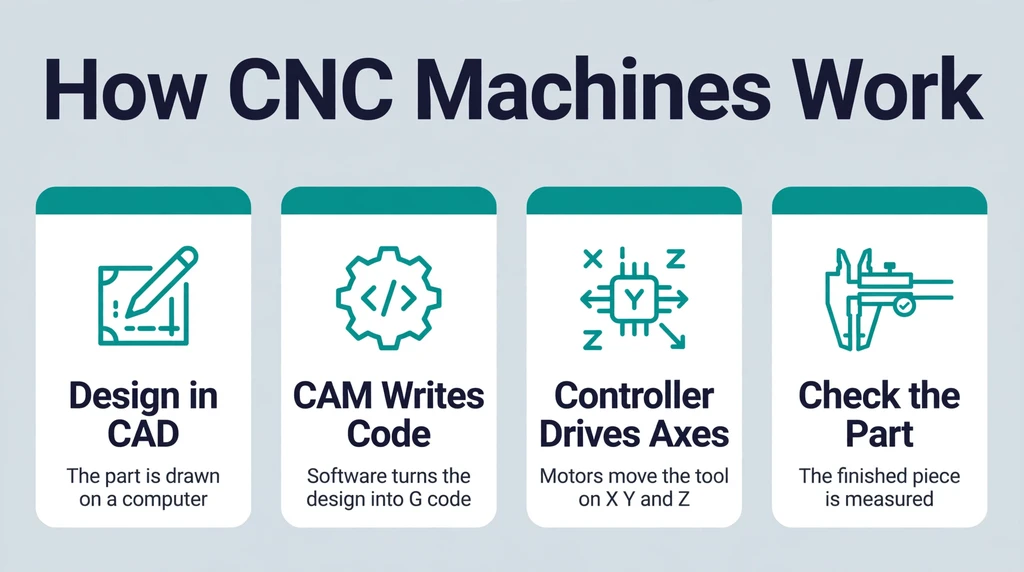
Every CNC job begins as a digital drawing. A designer builds the part in CAD software, short for computer-aided design. The model sets every length, hole and curve with exact numbers. Nothing is left to guesswork at this stage, because the machine will later follow those numbers literally. A loose dimension in the model becomes a wrong dimension in the metal.
Step 2: CAM Software Writes the Program
Next, CAM software, short for computer-aided manufacturing, converts the design into machine instructions. The software plans the toolpath, meaning the route the cutter will travel. It then writes that plan in G-code, the standard programming language of CNC machines. G-code lines mainly control movement, position and feed rate. Alongside them, M-code lines handle auxiliary jobs such as starting the spindle or switching on coolant.
Skilled programmers still review this output before it reaches the floor. They check speeds, tool choices and clearances. After all, the machine will do exactly what the code says, including any mistake the code contains.
A Glimpse of G-Code
G-code looks intimidating, yet a single line is easy to read once you know the pattern. Take a line such as G01 X50 Y25 F200. The opening code, G01, orders a straight cutting move. Next, the X and Y values give the target position on the machine’s coordinate grid. The F value sets the feed rate, meaning how fast the tool advances through the material. Other lines might start the spindle, change the tool or switch the coolant on. Read line by line, a program is simply a numbered journey for the cutter. Each line moves the tool, sets a condition, or pauses for the operator.
Step 3: The Controller Drives the Machine
Inside the machine, a controller unit reads the program line by line. It translates each command into signals for the motors that move the machine’s axes. Most basic machines move along three axes, called X, Y and Z. Together, those axes let the tool travel left and right, forward and back, and up and down.
Meanwhile, feedback devices report the tool’s real position back to the controller. The controller compares that position with the programmed one and corrects any drift. This constant checking is a big reason CNC machines can repeat the same cut accurately, part after part. A five-axis machine adds two rotational axes to the three linear ones. As a result, it can approach complex surfaces from several directions in fewer setups.
Step 4: Setup, Cutting and Checking
Automation does not remove people from the process. An operator first clamps the raw stock firmly in place. Then they fit the required tools and tell the machine where the workpiece sits. Many shops run a cautious first cycle, sometimes with the tool held clear of the metal. During cutting, coolant often flows over the tool to control heat and wash away chips.
Once the cycle ends, the finished part comes out for inspection. Workers measure key dimensions with precision instruments and compare them with the drawing. Only after the part passes those checks does full production begin.
Types of CNC Machines
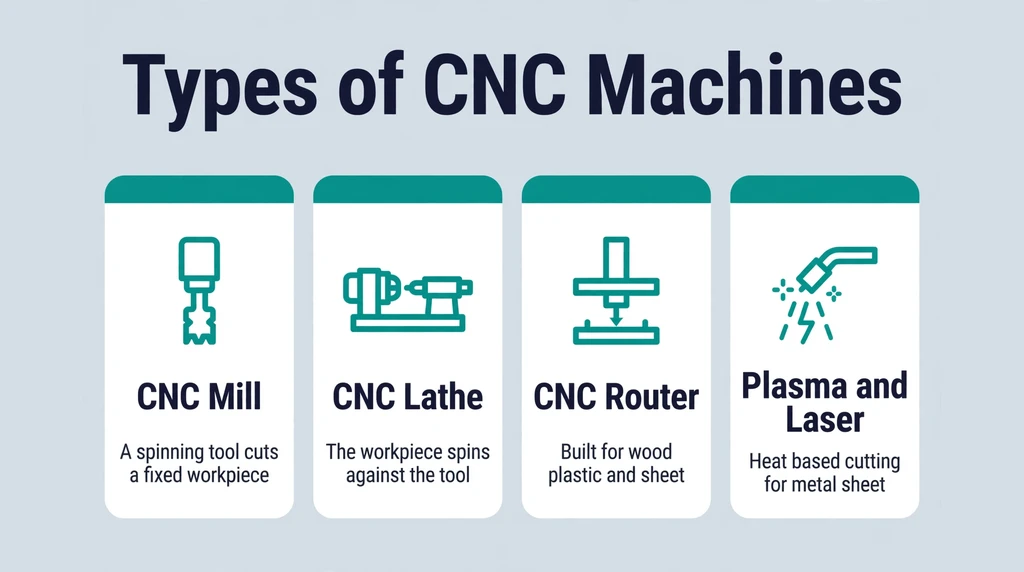
The CNC label covers a whole family of machines. They share the same idea of computer control, yet each type shapes material in its own way. Some are built for heavy metal cutting, while others specialise in light sheet work. Sizes vary just as widely, from benchtop units to machines that fill a room. The types below appear most often in workshops and factories.
CNC Milling Machines
A CNC mill is probably the best known machine in the family. The workpiece stays clamped to a table while a rotating cutting tool moves across it. Mills drill holes, cut slots and pockets, and carve flat or contoured surfaces. Because one machine handles so many operations, mills sit at the heart of most machine shops. Larger mills with several axes can shape highly complex parts in a single setup.
CNC Lathes and Turning Centers
A lathe works in the opposite way to a mill. Here, the workpiece spins at speed while a stationary cutting tool moves against it. This process, called turning, suits round parts such as shafts, pins and bushings. Modern turning centers go further still. Many carry powered tools in a turret, so they can drill and mill features without moving the part to a second machine.
CNC Routers
CNC routers look like mills, but they are built for softer and sheet-like materials. Woodworkers use them for furniture parts, signs and cabinet panels. The same machines also cut plastics and soft metals such as aluminium sheet. Routers usually offer a large flat bed, which makes them ideal for big panels. Their lighter frames trade some rigidity for speed and working area.
CNC Plasma Cutters and Laser Cutters
Some CNC machines cut with heat instead of a spinning tool. A plasma cutter directs a jet of superheated, electrically charged gas through metal. It slices steel plate quickly, which suits structural and fabrication work. A laser cutter focuses a powerful beam for a finer, narrower cut. Lasers handle detailed profiles in metal, plastic and wood, and they leave clean edges on thin sheet.
Other CNC Machines Worth Knowing
Several specialist machines complete the family. CNC grinders finish hardened parts to very smooth, accurate surfaces. CNC drilling machines place precise hole patterns at production speed. Waterjet cutters use a high-pressure stream of water, often mixed with abrasive grit, and they cut without heat. Electrical discharge machines shape very hard metals with controlled sparks.
CNC Machining Centers
A machining center deserves its own mention because it blurs the line between machine types. It is a CNC machine designed to perform several operations, such as milling, drilling and tapping, during one setup. Its defining feature is an automatic tool changer fed by a tool magazine. Vertical machining centers hold the spindle upright, which suits flat parts and plates. Horizontal models turn the spindle sideways and often handle heavier workpieces on rotating tables. In practice, many production lines are built around these versatile machines.
Three-Axis and Five-Axis Machines
Machine types are also sorted by how many axes they control. A three-axis mill moves the tool along X, Y and Z, and it covers most everyday work. Adding a fourth axis lets the part rotate, so features can be machined around a cylinder. A five-axis machine then adds a second rotation. With it, the tool can tilt and approach the part from almost any angle. That freedom suits turbine blades, implants and complex moulds. It also reduces setups, because more faces are reachable in one clamping. The trade-off is cost: five-axis machines and their programming demand bigger budgets and deeper skills.
What CNC Machines Make
Industries That Depend on CNC Parts
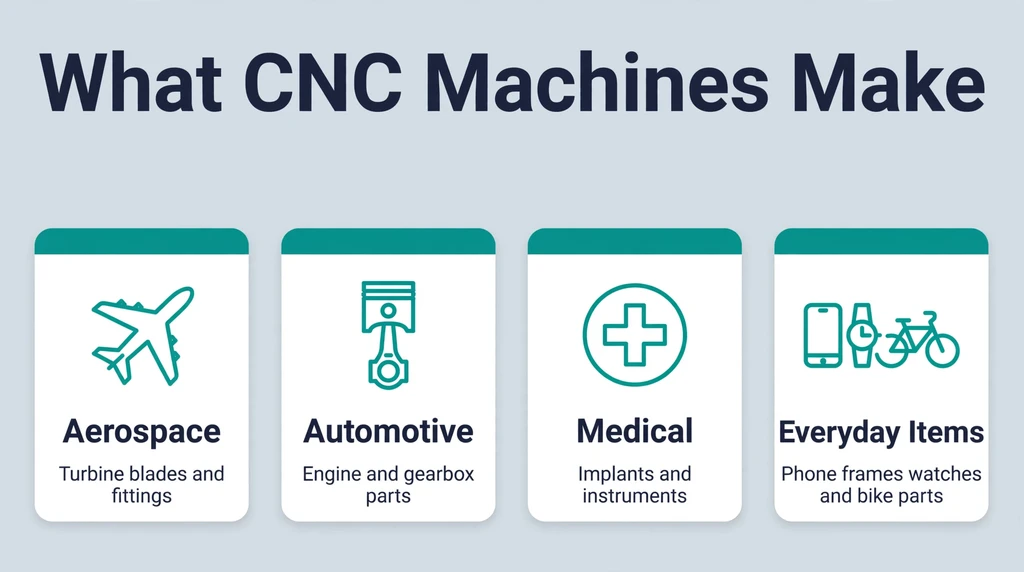
CNC parts hide inside products all around you. The aerospace industry relies on CNC machining for turbine blades, brackets and structural fittings, where accuracy is critical. Car makers use it for engine components, gearbox parts and tooling. In medicine, CNC machines produce surgical instruments and implants shaped to match the human body. Electronics firms need precisely machined enclosures and heat sinks. General manufacturing, from pumps to agricultural equipment, depends on the same technology every day.
Prototyping is another major use. Engineers can machine one test part from the final production material, check it, and revise the design quickly. Once the design is proven, the same program can often scale up to full production runs. The same flexibility also serves low-volume production, where designs change too often to justify dedicated tooling.
Materials a CNC Machine Can Cut
Metals are the classic CNC materials. Shops machine aluminium, steel, stainless steel, brass, copper and titanium on a daily basis. Each metal behaves differently, so programmers adjust speeds and tools to suit it. Plastics such as acrylic, nylon and polycarbonate also machine cleanly under CNC control. Wood remains the home territory of the CNC router, from soft pine to dense hardwoods. Composites, including carbon fibre panels, are machined too, although they demand suitable tools and dust extraction. In short, if a material can be cut, drilled or ground, a CNC machine probably exists for it.
Everyday Products from CNC Machines
Look around a home or office and CNC work is everywhere. The aluminium body of a laptop and the metal frame of a phone are commonly milled on CNC machines. Watch cases, spectacle frames and quality bicycle parts come from the same process. Kitchen equipment, door hardware and lighting fittings often begin as machined blanks or castings finished on CNC machines. Even musical instruments rely on the technology: guitar bodies and necks are frequently shaped by CNC routers before hand finishing. Prototypes of new consumer products almost always pass through a CNC shop. In each case, the pattern is the same. A digital design becomes a precise physical object, ready for testing or for sale.
The History of CNC Machining
Before Numerical Control
Early machine tools depended entirely on human hands. A machinist read a drawing, turned handwheels, and judged each cut by eye and experience. Skilled workers achieved remarkable results, yet complex curves were slow to produce and hard to repeat. Aircraft built during and after the Second World War needed exactly those curves, in large numbers and to tight standards. Manual methods struggled to keep up, and that pressure set the stage for automation.
Earlier attempts at automation already existed. In the nineteenth century, Jacquard looms wove patterns from punched cards, and copying lathes traced templates with cams. Those devices automated one fixed task very well. However, changing the product meant rebuilding the mechanism. True numerical control promised something different: change the numbers, and the same machine makes a different part.
Parsons, the Air Force and MIT
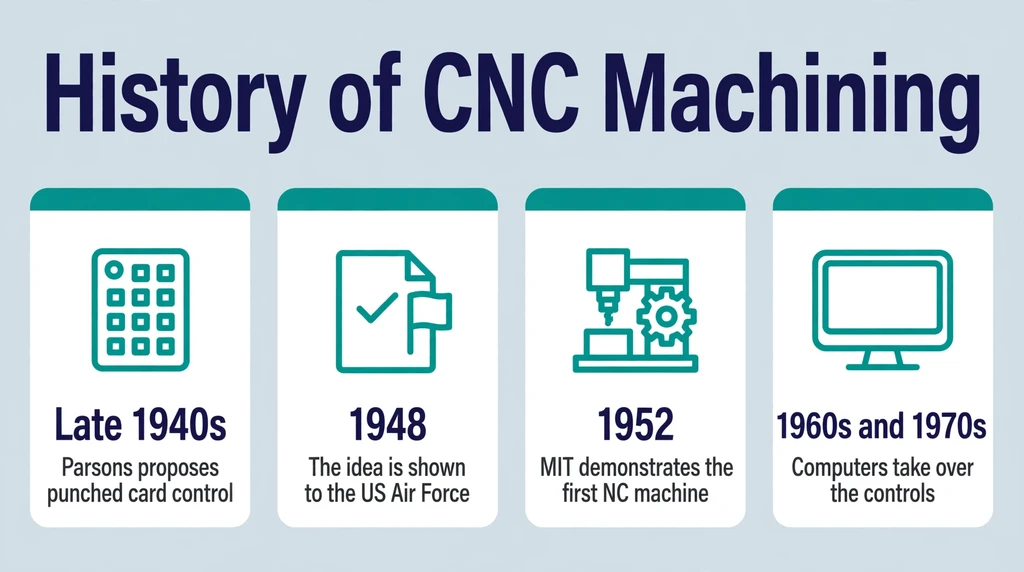
The key idea came from John T. Parsons, an American manufacturer, in the late 1940s. Parsons proposed driving a machine tool with coordinate points recorded on punched cards. He demonstrated the concept to the US Air Force in 1948. The Air Force then sponsored development work at the Massachusetts Institute of Technology, better known as MIT.
There, engineers fitted numerical controls to a Cincinnati Hydrotel milling machine. The machine read its instructions from punched tape and moved in three axes. MIT demonstrated it in 1952, and it is widely regarded as the first numerically controlled machine tool. Later research at MIT also produced APT, one of the first programming languages for machine tools. The goal throughout was practical: complex aircraft shapes, made accurately and repeatably.
Computers Take Over the Controls
For years, NC machines remained expensive and rare. Their tape readers and hard-wired cabinets filled whole rooms and needed constant attention. That picture changed as computers shrank and prices fell. During the 1960s and 1970s, manufacturers began fitting machines with real computers. Programs moved from paper tape into electronic memory. Operators could finally edit instructions at the machine itself. This was the moment NC became CNC in the modern sense, and adoption spread from aerospace into general industry.
CAD and CAM Join the Story
Another shift arrived with design software. Early programs were typed by hand or generated with APT on large computers. During the 1970s, computer-aided design and computer-aided manufacturing, CAD and CAM, began to spread through industry. Designers could draw a part on a screen instead of a drafting board. CAM software then turned that drawing into toolpaths automatically. This link between drawing and cutting removed hours of manual calculation. It also reduced errors, because the machine code came directly from the design itself. By the time personal computers reached workshops, the CAD to CAM to CNC chain had become the standard route from idea to part.
CNC in the Modern Workshop
Today, CNC controls are compact, fast and connected. Design files travel from office software straight to the machine. Multi-axis machines finish in one setup what once needed several machines and several days. Small workshops and even hobbyists now run desktop CNC routers and mills. Still, the core idea has not changed since 1952. Numbers describe the part, a computer reads the numbers, and the machine follows them faithfully.
CNC vs Manual Machining
CNC and manual machining remove metal with similar tools. The real difference lies in who, or what, guides each movement. Understanding that difference explains why both methods still exist side by side.
How the Two Methods Differ
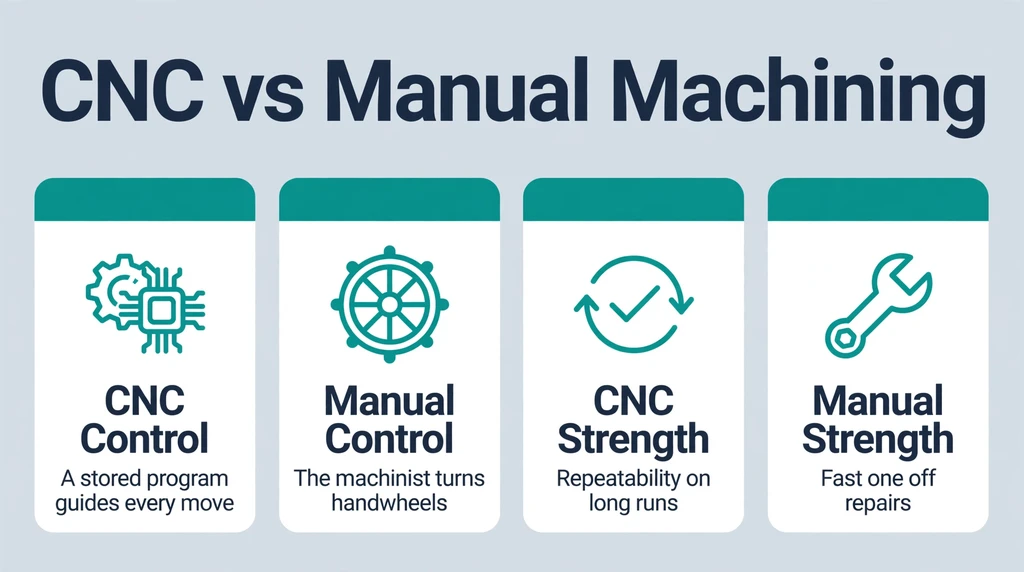
On a manual machine, the machinist turns handwheels and reads dials or digital readouts. Every movement depends on their hands, eyes and judgment. On a CNC machine, the program guides the movement instead. The machinist’s skill shifts from steering the cut to preparing it: writing or loading the program, setting the tools, and proving the first part.
Repeatability is the clearest gap between them. A CNC machine copies a proven program almost identically, whether it makes ten parts or ten thousand. A manual machinist can match that quality on a good day, but fatigue and small lapses creep in over long runs. Complex geometry widens the gap further. Curves and surfaces that need coordinated movement on several axes are natural for CNC and extremely demanding by hand.
Where Manual Machining Still Makes Sense
Manual machines have not disappeared, and for good reason. A one-off repair part can be quicker to make by hand than to program. Simple jobs with loose tolerances do not always repay programming time. Manual machining also remains the classic way to learn the craft, because it teaches how metal behaves under a tool. Many CNC machinists started exactly there. In practice, busy shops often keep both types of machine and choose per job.
A Side by Side Summary
Control: a CNC machine follows a stored program, while a manual machine follows the operator’s hands.
Repeatability: CNC copies a part almost identically across long runs, while manual quality depends on the operator each time.
Complexity: CNC handles multi-axis curves easily, while manual work suits simpler shapes best.
Setup: CNC needs programming before cutting starts, while a manual machine can begin simple jobs at once.
Best use: CNC suits volume and precision, while manual machining suits one-off and repair work.
Advantages and Disadvantages of CNC Machining
The Main Advantages
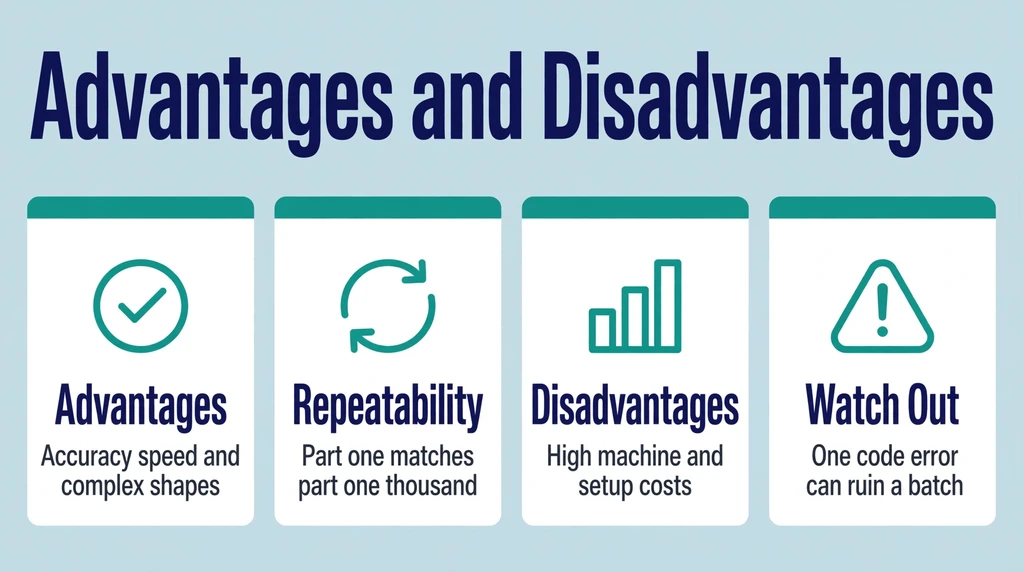
Accuracy leads the list of advantages. CNC machines follow exact coordinates, so parts match their drawings closely. Consistency follows close behind, since the thousandth part can match the first. Speed matters too: once a program is proven, the machine runs with little waiting between parts. Complex shapes become practical, including curves and pockets that are nearly impossible by hand. Safety improves as well, because operators stand clear of the cutting area during the cycle. Finally, one operator can often supervise several machines at once, which raises output per person.
The Main Disadvantages
The technology has real costs. CNC machines carry high purchase prices, and the tooling, software and maintenance add more. Programming and setup take skilled time before the first good part appears. For a single simple part, that preparation can cost more than the job is worth. Errors also scale badly: a wrong value in a program can ruin a whole batch before anyone notices. Skilled programmers and machinists are in short supply in many regions. And like any computer equipment, older controls eventually lose software support.
CNC in Small Workshops and Studios
CNC is no longer limited to large factories. Compact desktop mills and routers have brought the technology into small workshops, schools and studios. Jewellers cut precise models and metal pieces on benchtop machines. Sign makers route lettering that would take hours by hand. Small manufacturers produce short runs of custom products without factory-scale investment. The software side has become friendlier too, with visual programming tools replacing raw code for simple jobs. This spread explains why the abbreviation now appears in hobby forums as often as in engineering journals. The meaning, though, stays the same at every scale: a computer controls the machine.
What Does a CNC Machinist Do?
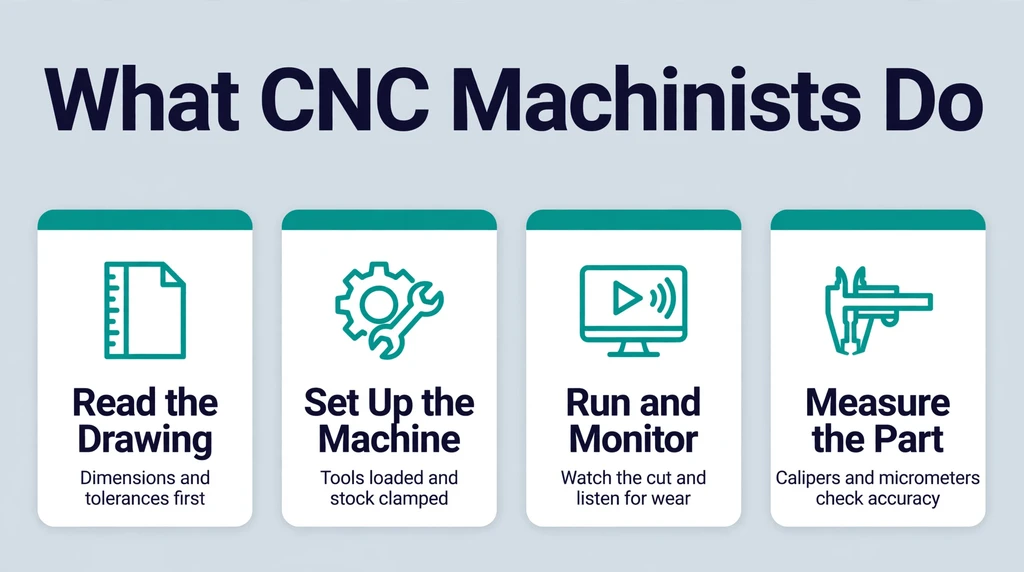
A CNC machinist is the skilled worker who turns programs and raw stock into finished parts. It is a hands-on job with a digital core. Their day starts with the drawing. They study its dimensions and tolerances, then plan the order of operations. Next, they select cutting tools, load them into the machine, and clamp the workpiece securely. If the shop writes its own programs, the machinist may create or adjust the G-code as well.
During the run, the machinist watches and listens. Unusual sounds can signal a worn tool long before measurements drift. They stop the machine at intervals to check dimensions and correct small offsets. After the run, they remove sharp edges, clean the parts, and record the results. Good machinists combine computer skills with a feel for materials. They understand both the code on the screen and the metal in the vice.
Machinist, Operator and Programmer
Shops divide these duties in slightly different ways. A CNC operator mainly loads stock, starts cycles and checks basic measurements. The machinist takes on setup, tooling and troubleshooting as well. By contrast, a CNC programmer focuses on creating the toolpaths and code, often working in CAM software away from the floor. In small workshops, one person may cover all three roles in a single shift. Larger factories tend to separate them into dedicated positions. None of these roles is a button-pressing formality; each one guards the accuracy of the final part.
Skills a Good CNC Machinist Needs
Technical reading comes first. A machinist must read engineering drawings, including the symbols that describe tolerances and surface finishes. Measurement skills follow closely, using micrometers, calipers and gauges to check parts against those drawings. A working grasp of mathematics supports both tasks, especially geometry and unit conversions.
Then come the digital skills: loading programs, editing offsets and navigating the machine control with confidence. Material knowledge matters just as much. A machinist learns how aluminium, steel or plastic responds to different tools and cutting speeds. Finally, patience and attention hold the whole job together. Most costly shop errors come from rushed setups rather than from the cutting itself.
CNC vs 3D Printing
Both technologies turn digital models into physical parts, which is why beginners often confuse them. Their methods, though, run in opposite directions. One removes material to reveal the part. The other builds the part up from almost nothing.
How the Two Processes Differ
CNC machining is subtractive. It starts with a solid block and cuts away everything that is not the part, leaving chips and offcuts as waste. 3D printing is additive. It deposits or fuses material layer by layer, so it wastes far less, apart from support structures that are removed afterwards. Material choice differs as well. Printers work mainly with plastics, resins and selected metal powders. CNC machines cut solid metals, woods and composites that printers cannot match for strength. Precision also differs: CNC parts usually hold tighter tolerances and smoother finishes straight off the machine.
Which One Should You Choose?
Choose CNC when the part must be strong, precise and made from solid metal or wood. It also wins for batches of identical parts, because a proven program repeats reliably. Choose 3D printing when the shape has hollow or internal features that a cutter cannot reach. Printing also wins for cheap one-off prototypes and very fast design changes. In practice, many products use both routes. A team prints a rough model to test the fit, then machines the final version for strength and finish.
Other Meanings of CNC
Short abbreviations usually carry more than one expansion, and CNC is no exception. In engineering, manufacturing, job adverts and technical courses, CNC almost always means Computer Numerical Control. That is the sense this article has covered, and it is the meaning dictionaries of technology list first.
Outside technical contexts, the same letters appear as adult slang. In slang dictionaries, CNC also stands for consensual non-consent, a term from the BDSM community for a prior agreement between partners to act as if consent has been waived. Readers who meet the abbreviation in a dating or relationship forum are usually seeing that second sense. Context settles which meaning applies: a workshop page means the machine, while a slang page does not. If a page mentions programs, tools or materials, it is discussing Computer Numerical Control. If it discusses relationships, it is not.
Frequently Asked Questions
What is the full form of CNC?
CNC stands for Computer Numerical Control. The name describes machine tools run by a computer that follows instructions written as coded numbers. Those numbers control where the tool moves, how fast it travels and when it changes.
What does a CNC machine actually do?
A CNC machine shapes raw material into a designed part automatically. It follows a stored program to cut, drill, mill or turn metal, plastic, wood or composite stock. The result is a precise part that matches a digital model.
What is G-code in CNC machining?
G-code is the standard programming language that tells a CNC machine how to move. Its commands set tool positions, travel paths and feed rates. M-code works alongside it and controls supporting functions such as the spindle and coolant.
What is the difference between NC and CNC?
NC machines read programs from punched tape through hard-wired controls, with no computer on board. CNC machines store programs in a computer’s memory instead. That memory makes programs easy to edit, save and reuse, which is why CNC replaced NC.
Which materials can a CNC machine cut?
Common CNC materials include aluminium, steel, titanium, brass and other metals. Machines also cut plastics, wood and composites such as carbon fibre. The right machine type and tool are matched to each material.
Is CNC machining better than manual machining?
For accuracy, repeatability and production volume, CNC machining is usually better. Manual machining can still win for one-off repairs and very simple parts, where programming time is hard to justify. Most modern shops use both methods together.
How many axes does a CNC machine have?
A standard CNC machine has three axes, named X, Y and Z. Advanced machines add rotational axes, and five-axis models are common for complex parts. More axes let the tool reach more faces of a part in a single setup. Fewer setups usually mean better accuracy, because the part stays clamped in one position.
What does CNC mean in slang?
In adult slang, CNC is short for consensual non-consent, a relationship term defined in the Other Meanings section above. In nearly every technical or workplace setting, though, CNC refers to Computer Numerical Control and machine tools.
Final Thoughts
The CNC meaning is simple once you unpack the three words. A computer follows numerical instructions to control a machine tool, and that single idea reshaped modern manufacturing. It grew from punched cards and a 1952 MIT experiment into the mills, lathes and routers that now produce parts for aircraft, cars and hospitals. Whether you plan to buy a machine, apply for a machinist job, or simply decode an abbreviation, you now have the full picture. You also know what to check when the letters appear in an unfamiliar place: look for the context, and the meaning usually becomes obvious. For readers who want the deeper technical story of how tape-based NC evolved, Xometry’s guide to NC machining traces that development in detail.