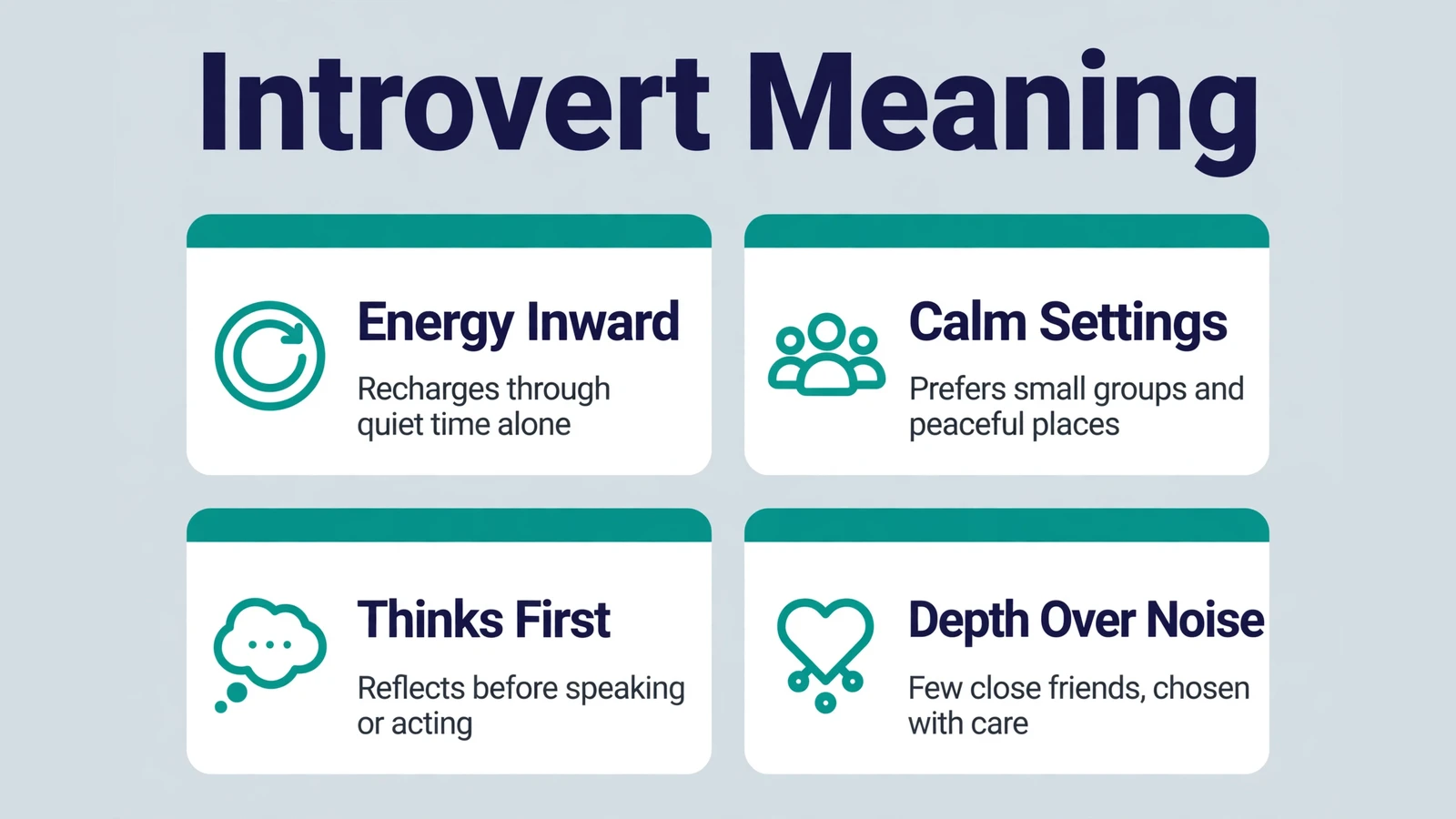
You can enjoy a party and still count the minutes until you can leave it. That small contradiction sits at the heart of the introvert meaning. An introvert is a person who turns inward for energy. Quiet time restores them, while long stretches of noise and company slowly wear them down. Friends may read an early exit as rudeness, but it is really a battery running low. Nothing is wrong with them, and nothing needs fixing.
Psychologists have used the word for about a century, yet everyday speech still bends it toward shy or antisocial. This guide separates the real definition from the stereotype. You will find the dictionary meaning, the Latin roots, the traits people describe, and the honest differences between introverts, extroverts, and the ambiverts in between.
What Does Introvert Mean?
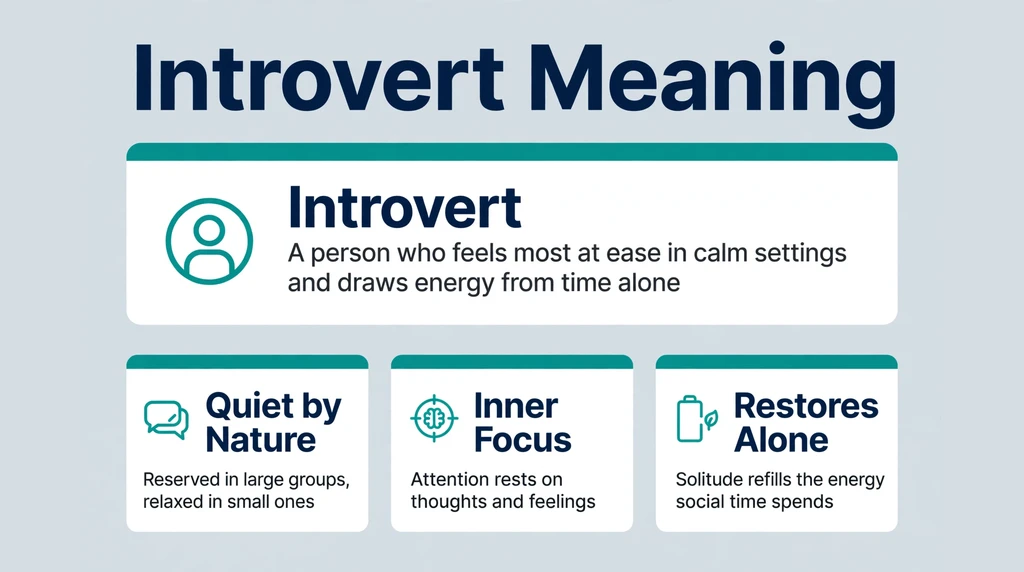
Merriam-Webster defines an introvert as a person whose personality is characterized by introversion. The same entry describes a typically reserved or quiet person who tends to be introspective and enjoys spending time alone. Dictionary.com phrases the everyday sense slightly differently. For that dictionary, an introvert prefers calm environments, limits social engagement, and holds a stronger than average preference for solitude.
Notice what both definitions leave out. Neither one mentions fear, awkwardness, or dislike of people. The dictionary introvert is not hiding from the world at all. Instead, the word describes where a person’s attention and comfort naturally rest.
The core idea behind the word
Psychology gives the word a sharper edge. In that field, an introvert is characterized mainly by concern with their own thoughts and feelings. Their inner life is not an escape from the real world. It is simply the room where they do their best thinking.
Meanwhile, the outside world asks for constant response. Conversations, meetings, and crowded rooms all demand attention at once. An introvert can meet those demands, often very well. However, each hour of response spends something that only quiet can replace.
Energy is the real divider
Modern health writers reduce the idea to one practical test. Ask where a person goes to recover after a demanding week. The introvert books a quiet evening in, and the extrovert calls friends to make plans. Cleveland Clinic psychologist Grace Tworek puts it plainly: being an introvert or an extrovert is about how you get your energy.
That single question explains most of the behavior people notice. It explains the small guest list, the thoughtful pauses, and the love of a closed door. Above all, it explains why solitude feels like rest rather than loneliness.
A working definition
Here is a short version you can keep. An introvert is someone who feels most themselves in low-key settings and refills their energy alone. They usually prefer depth over breadth, in friendships, in conversation, and in work. Given a free afternoon, they protect it instead of filling it.
That definition also carries a useful warning. Introvert describes a tendency, not a cage. The same person may lead a meeting on Tuesday and guard a silent Sunday. Tendencies lean; they rarely lock.
Where the Word Introvert Comes From
The word began life far from psychology. It started as a plain Latin description of direction, and only later became a label for a kind of person. That journey explains why the modern meaning still carries a sense of turning, like a door swinging gently inward.
Latin roots: turning inward
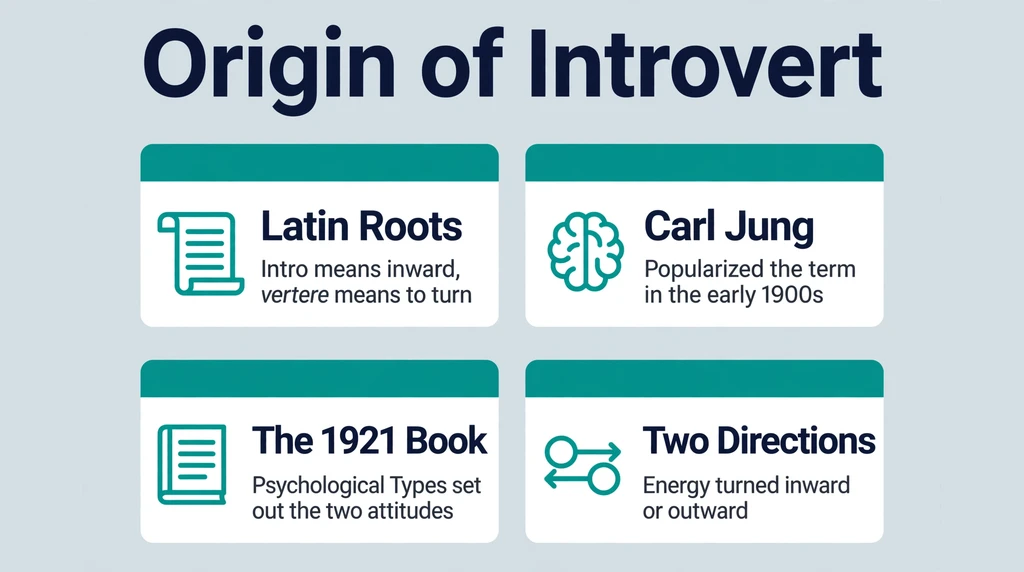
Merriam-Webster traces the verb introvert to the New Latin word introvertere. It joins the Latin prefix intro, meaning inward, with vertere, meaning to turn. So the oldest sense is purely physical: to turn something in upon itself.
The verb first appears in English in 1652, in that physical sense. The noun arrived in 1878, first naming a body part that could be drawn inward. Only in the early 1900s did the word settle onto personality, where it has stayed ever since.
Carl Jung and Psychological Types
The personality sense owes its reach to one man. Swiss psychiatrist Carl Gustav Jung introduced the terms introvert, introversion, extrovert, and extroversion in the early 1900s. He then set the ideas out fully in his 1921 book Psychological Types, published in German and translated into English in 1923.
Jung used the pair to describe two directions of energy. An introvert’s interest points inward, toward feelings and thoughts. An extravert’s attention points outward, toward people and the surrounding world. Britannica still summarizes his scheme in almost those exact words today.
From clinic to everyday word
Jung’s terms escaped the clinic quickly. Personality testing carried them into schools, workplaces, and eventually dinner table conversation. Along the way, the meaning softened and blurred. Many speakers now use introvert loosely to mean any quiet or shy person.
That loose usage is exactly why dictionaries add careful notes. Merriam-Webster itself points out the broad popular sense while keeping the psychological one distinct. Knowing both senses helps you hear which one a speaker actually means.
Introvert Pronunciation and Word Forms
The word is friendlier to say than it looks. It has three syllables, and the stress lands firmly on the first one. Once you hear it spoken, the spelling starts to make sense, because each syllable mirrors a Latin piece.
How to pronounce introvert
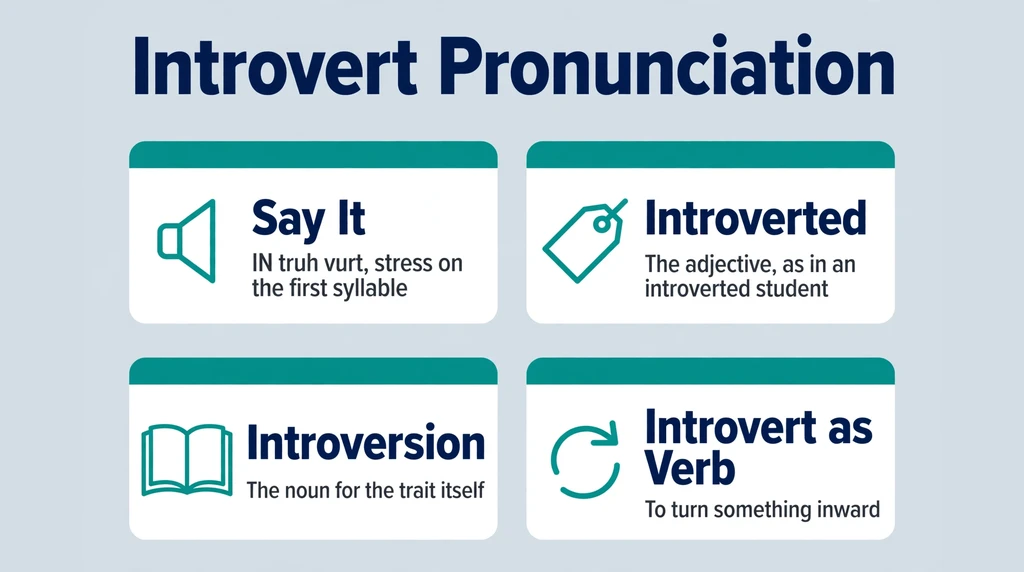
Say it as IN-truh-vurt. In phonetic spelling, British speakers use /ˈɪn.trə.vɜːt/, while American speakers use /ˈɪn.trə.vɝt/. The middle syllable shrinks to a soft “truh,” so the word rolls out quickly. As a verb, some speakers shift the stress to the end, but the noun keeps it up front.
The introvert word family
Introvert itself does triple duty in a sentence. It works as a noun (“She is an introvert”), as an adjective (“an introvert personality”), and as a verb meaning to turn something inward. Writers reach for it in all three roles.
Three relatives complete the family. Introverted is the everyday adjective, as in “an introverted student.” Introversion names the trait itself, the tendency the noun carries. Introversive exists too, though it stays rare and mostly technical.
One spelling note saves confusion. Psychology journals usually write the trait pair as introversion and extraversion, with an “a.” Everyday English, meanwhile, prefers extrovert for the person on the other end. Both spellings are accepted, so context decides.
Signs You Might Be an Introvert
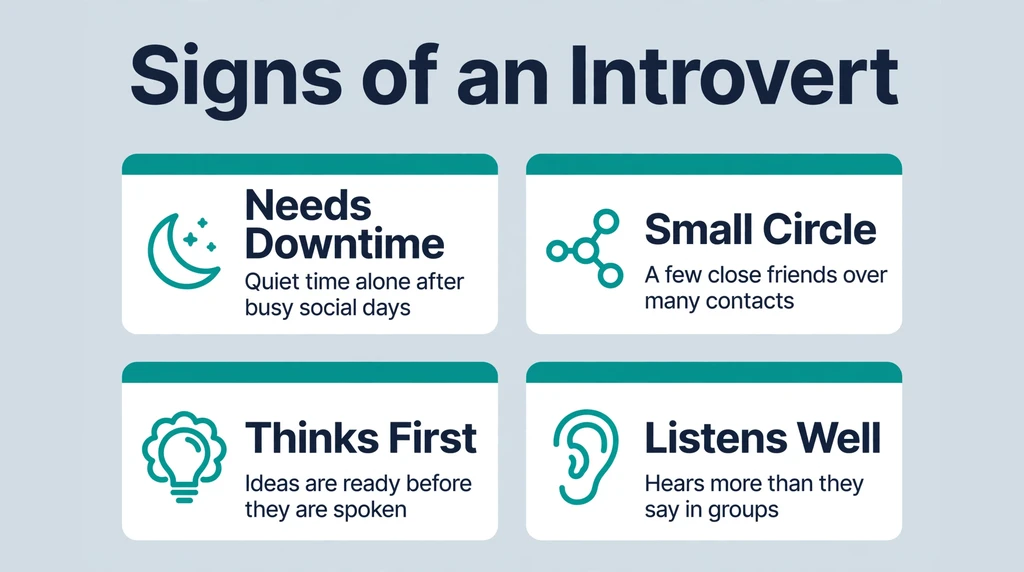
No single habit proves anything, because traits travel in clusters. Still, health writers and psychologists describe a familiar pattern. If most of the signs below feel like a portrait of you, the label probably fits.
You recharge alone, on purpose
The clearest sign involves your calendar after a busy stretch. A packed weekend leaves you craving a blank one, and that craving feels physical. Solitude is not a punishment you endure between social events. Instead, it is the event you quietly plan around everything else.
Importantly, this need says nothing about how much you like people. Many introverts adore their friends and still leave the gathering early. The limit is energy, not affection. Once the tank empties, even beloved company starts to feel like noise.
Your circle is small and deep
Introverts usually keep fewer friendships than extroverts do. However, those friendships tend to run deep and last for years. You would rather have one long conversation than twenty quick hellos. Small talk, by contrast, often feels like a toll you pay before the real exchange begins.
Settings follow the same pattern. Merriam-Webster notes that introverts are typically more comfortable with small groups than with large ones. A dinner for four sounds relaxing. A reception for two hundred sounds like work wearing a name tag.
You think first, then speak
Another common sign is a pause before answering. Introverts tend to process internally, turning an idea over before offering it aloud. Listeners sometimes mistake that pause for doubt or disinterest. In fact, the sentence is simply still under construction.
The same style shows up in listening. Introverts often hear more than they say in a group, and people later seek them out for it. Friends describe feeling genuinely heard, because the introvert was tracking meaning, not waiting for a turn. That quiet attention becomes a social strength of its own.
Your pleasures lean quiet and deep
Look at how you spend a free hour, and a pattern often appears. Introverts gravitate toward pursuits they can sink into: reading, writing, walking, making things, or exploring one interest properly. Health writers list exactly these solo activities again and again. The common thread is immersion without an audience.
Group fun is not banned, of course. However, it usually works best in smaller doses and familiar company. Given the choice, you would rather repeat a favorite place with two friends than sample a loud new scene with twenty. Depth beats novelty almost every time.
Four Shades of Introversion: The STAR Model
Spend time with several introverts, and a puzzle appears quickly. One avoids crowds but fears nothing. Another loves people yet lives inside a rich daydream. A single label clearly hides real variety, and researchers at Wellesley College decided to map it.
Psychologist Jonathan Cheek worked with colleagues Jennifer Grimes and Julie Norem on the question. Their research, published from 2011 onward, proposed four shades of introversion. The shades form the acronym STAR: social, thinking, anxious, and restrained. Most introverts, they found, blend several shades rather than wearing only one.
Social and thinking introversion
The social shade is the classic picture. Social introverts prefer small groups or their own company, and solitude restores them. Crucially, this shade involves preference rather than fear. A social introvert at home with a book is content, not hiding.
The thinking shade points somewhere else entirely. Thinking introverts live in a busy inner world of reflection, imagination, and self-examination. They may enjoy people perfectly well, yet they regularly drift into thought mid-conversation. Daydreaming, for them, is a feature of the mind rather than a distraction from it.
Anxious and restrained introversion
The anxious shade comes closest to shyness. Anxious introverts feel tense around others, especially strangers, and they replay social moments afterward. This shade overlaps with self-consciousness, which is why it causes so much confusion with the whole label. It describes one flavor of introversion, not the definition of it.
The restrained shade concerns pace instead of people. Restrained introverts move deliberately, think before acting, and warm up slowly in new settings. They rarely rush into speech or activity, and they dislike being hurried. Seen together, the four shades explain why two introverts can look almost nothing alike.
How to Tell If You Are an Introvert
After reading the signs, many people still want a straighter answer. No quiz can hand you one, because personality sits on a scale. A few honest questions, though, can show you which way you lean.
Five questions worth asking yourself
First, where do you go after an exhausting day: toward people, or toward quiet? Second, do big gatherings leave you pleasantly tired or strangely hollow? Third, do you rehearse sentences before speaking, even with friends? Fourth, would you protect a free evening rather than fill it? Finally, do your best conversations happen one to one?
Answer mostly toward quiet, depth, and small circles, and the introvert label likely fits. Answer with a shrug in both directions, and you may sit near the ambivert middle. Either result is information, not a grade.
Why the answer matters less than the pattern
The practical prize is not the word itself. It is the pattern the word reveals: how you spend energy, and how you earn it back. Once you know that pattern, you can plan weeks that respect it. You can also explain yourself calmly to people who once misread you.
That explanation often changes relationships. A partner who understands the battery stops hearing rejection in a quiet evening. A manager who understands it stops measuring commitment by visibility. The label simply gives everyone a shared, kinder vocabulary.
Introvert vs Extrovert: The Key Differences
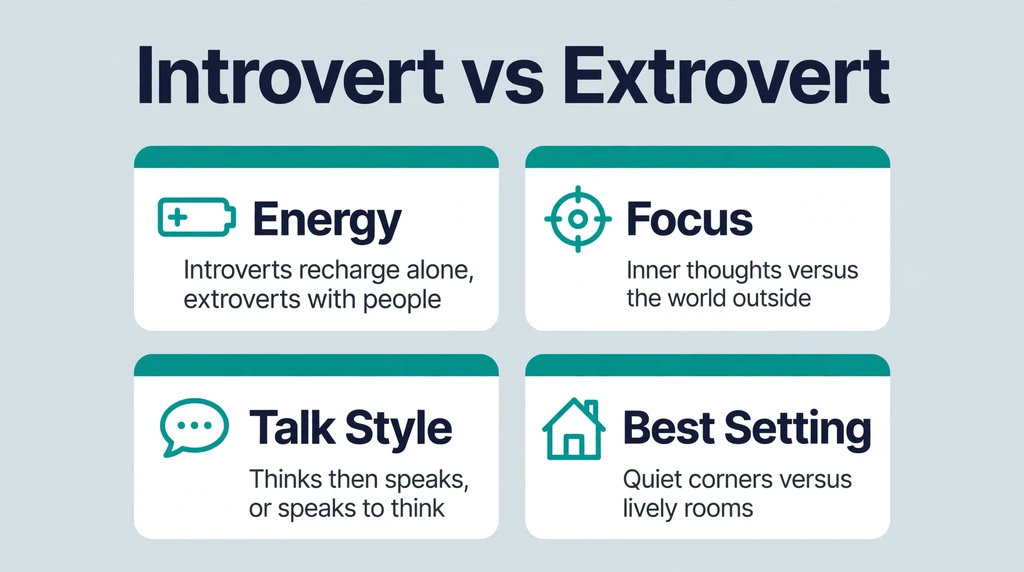
The two words form a pair, so each one sharpens the other. Jung built them as opposite directions of the same energy. Comparing them side by side shows how much of daily life that one difference can explain.
| Aspect | Introvert | Extrovert |
|---|---|---|
| Energy source | Recharges alone, in quiet | Recharges with people and activity |
| Focus | Inner world of thoughts and feelings | Outer world of people and events |
| Talking style | Thinks first, then speaks | Thinks out loud, while speaking |
| Friendships | Few, close, long-lasting | Wide circle, many connections |
| Best setting | Small groups, calm rooms | Lively rooms, big gatherings |
| After a party | Needs recovery time | Ready to plan the next one |
Energy and stimulation
The deepest difference concerns stimulation. Social settings deliver a rich stream of voices, faces, and demands. Extroverts generally find that stream energizing, so they seek more of it. Introverts find the same stream costly, so they dose it carefully.
Consequently, the same Friday night can read as a treat or a task. Neither reaction is a virtue or a flaw. Each one simply reports how a particular nervous system handles company.
Processing and communication
The second difference shows up in conversation. Extroverts often think by talking, shaping ideas in real time with other people. Introverts usually think by reflecting, then speak once the idea feels finished. Both routes can reach excellent conclusions.
Misunderstandings grow when each side judges the other by its own style. The extrovert may read silence as coldness, and the introvert may read chatter as shallowness. Usually, both readings are wrong. The machinery differs, not the goodwill.
Living and working across the line
Mixed pairs succeed when both sides treat the difference as logistics. The extrovert gets gatherings on the calendar, and the introvert gets recovery time after them. Meetings work better when questions arrive in advance, giving reflective minds time to prepare. Parties work better with a quiet corner and an agreed leaving time.
None of this requires either person to change type. It only asks each side to stop treating its own setting as the normal one. Once that happens, the contrast often becomes an asset. One person brings reach and momentum, while the other brings depth and calm.
The Spectrum: Ambiverts and the Middle Ground
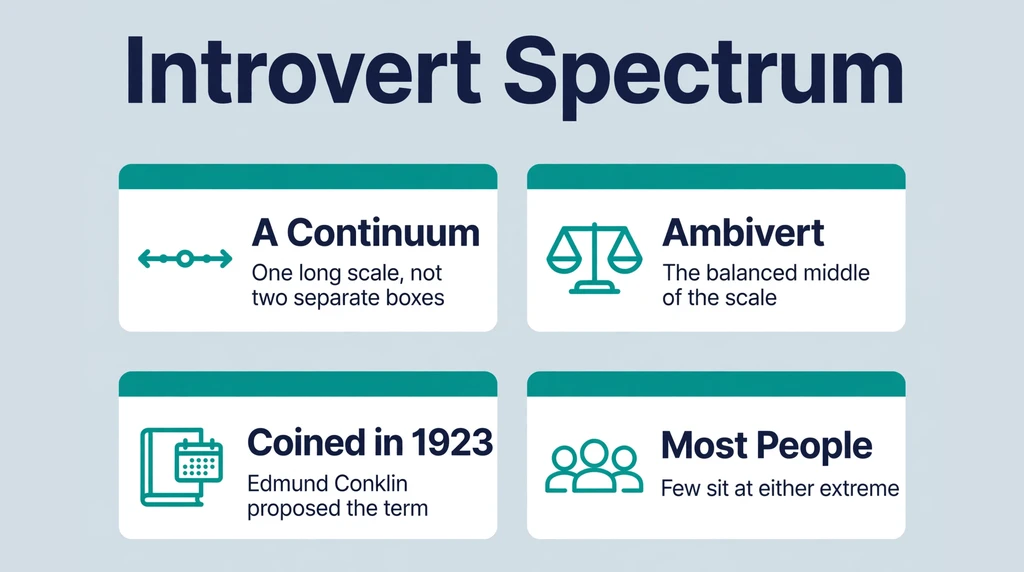
Here the story corrects itself. Jung’s neat pair suggests two boxes, but real personalities refuse to sit still inside them. Modern sources almost always redraw the pair as one long scale.
A continuum, not two boxes
Britannica states the modern view plainly. The old typology is now regarded as overly simplistic, because almost nobody is wholly one type. Most people fall somewhere between the poles, showing each tendency at different times.
Northwestern psychologist Dan P. McAdams describes the same picture as a bell curve. The extremes are thinly populated, while the middle holds the crowd. So if you feel only partly introverted, the statistics are on your side.
Meet the ambivert
The middle of the scale has its own name. Psychologist Edmund S. Conklin proposed the term ambivert in 1923, just two years after Jung’s book. An ambivert draws on both patterns comfortably: sociable at lunch, solitary after dinner, and genuinely fine either way.
Ambiverts often read rooms well, because they know both settings from the inside. They can lead a brainstorm and then happily vanish into a quiet project. Rather than a failed introvert or a muted extrovert, the ambivert is the scale working as designed.
Your position can shift slightly
One more nuance keeps the scale honest. Your exact position can move a little with age, mood, and setting, even though your home base stays stable. Many people grow slightly more selective about company as they get older. A familiar team can also draw out a quiet person in ways a room of strangers never will.
Context can even flip behavior for an evening. An introvert may host brilliantly, enjoy every minute, and then need a silent morning to balance the books. The behavior looked extroverted, while the energy pattern stayed introvert. That is why psychologists measure the pattern, not the performance.
Introvert in the Big Five: What Psychologists Measure
Ask a personality researcher about introverts today, and the answer comes in a different vocabulary. Modern trait psychology folds Jung’s types into a broader map. That map is called the Big Five, and it changes how the word gets used in studies.
Extraversion as a sliding scale
The Big Five sorts personality into five broad dimensions, each measured as a continuum. Extraversion is one of them, covering sociability, assertiveness, activity, and positive emotion. In this model, introversion is not a separate trait at all. It is simply the low end of the extraversion scale.
Scientific American summarizes the low scorers in familiar terms. They tend to be introverted, reserved, and quieter in company. A test score therefore places you at a point, not in a tribe. Your neighbors on the scale differ from you by degree, not by kind.
Eysenck and the arousal theory
An earlier researcher tried to explain the scale with biology. Hans Eysenck proposed that introverts run a higher baseline of brain arousal. Because their minds already hum, they need little extra stimulation to feel alert. Extroverts, running lower, chase stimulation to reach the same level.
The theory neatly explains the crowded bar. One guest feels delight, and another feels static, inside the very same room. Later research has refined Eysenck’s picture, so treat it as an influential idea rather than settled law. Still, it captures something introverts instantly recognize.
Strengths of Being an Introvert
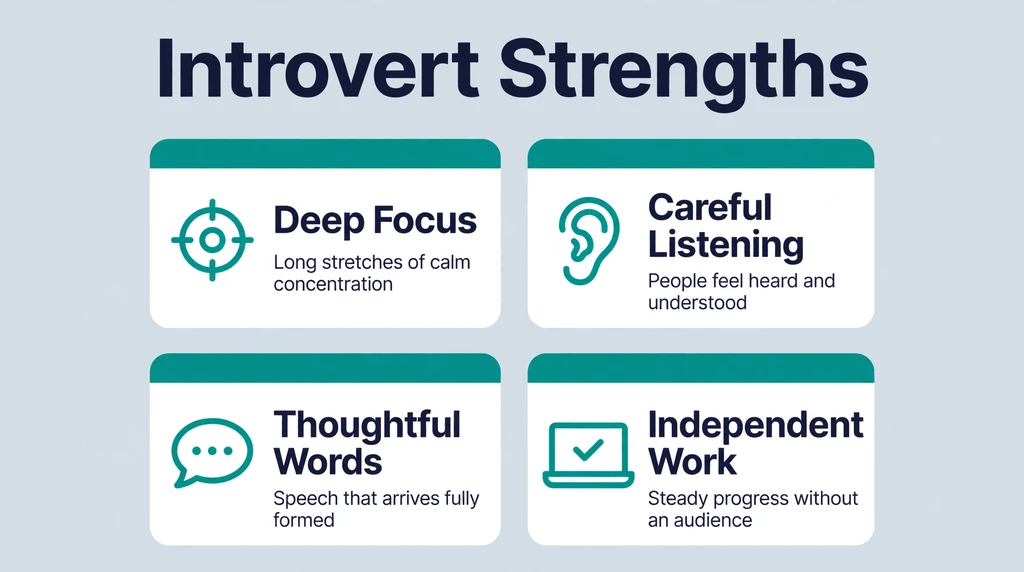
Popular culture often frames introversion as a problem to manage. That framing misses half the ledger. The same tendencies that drain an introvert in a crowd can become real assets in the right setting.
Focus, depth, and follow-through
Quiet suits concentration. Without a steady pull toward the room, introverts can stay with one problem for hours. Writers, programmers, researchers, and craftspeople all trade on that kind of stamina. The work looks solitary from outside, but inside it feels rich and absorbing.
Depth shows up in relationships too. Because introverts invest in fewer people, they often know those people remarkably well. They remember the small details others mentioned weeks ago. That memory quietly builds trust.
Listening and considered speech
An introvert’s pause before speaking has a payoff. Words tend to arrive tested, so colleagues learn to weight them. In meetings, the quiet person’s single comment can redirect the whole discussion, precisely because it was not one of forty.
Listening works the same way. Healthline notes that introverts often share their social energy with a handful of close friends and value them deeply. Good listeners notice hesitation, tone, and what a speaker avoids saying. Many teams and families run on exactly that kind of attention.
Introverts at Work and in Relationships
The meaning of the word becomes practical once you watch it operate daily. Workplaces and relationships both run on energy, attention, and communication. Knowing the pattern helps everyone involved spend those resources wisely.
Introverts at work
Open offices were designed for collaboration, yet they tax introverts steadily. Noise, interruptions, and constant visibility spend the exact energy deep work requires. Introverts often do their finest work in quieter corners, with meetings booked for a purpose instead of by default. Given that setup, their preparation and follow-through tend to shine.
Their leadership style carries the same signature. Quiet leaders often listen first, decide once, and speak with unusual clarity. That approach can steady a team, especially during noisy, uncertain stretches. It simply reaches the result by a calmer road.
Introverts in friendships and relationships
Partners and friends sometimes misread the pattern at first. They see a cancelled plan and hear rejection, when the truth is closer to a flat battery. The healthiest relationships name the pattern early, so quiet evenings need no excuse or apology. Solitude becomes maintenance, not distance.
In return, introverts often offer rare steadiness. They show up for the long conversation, remember what matters to you, and keep confidences well. Their affection may speak softly, through attention and reliability rather than grand social gestures. For many people, that quieter dialect of care is the one that lasts.
A note on introverted children
The pattern often shows early. An introverted child may play happily alone, watch a new group before joining it, and come home from school needing quiet before homework or talk. None of that signals a problem by itself. It is the same energy pattern, wearing smaller shoes.
Adults help most by respecting the recharge instead of treating it as a defect to train away. Gentle encouragement to join in is fine, and new skills can grow steadily. Constant pushing toward the loudest version of childhood, though, teaches the child that their setting is wrong. A child who hears the opposite message learns to trust the pattern instead.
Myths and Misconceptions About Introverts
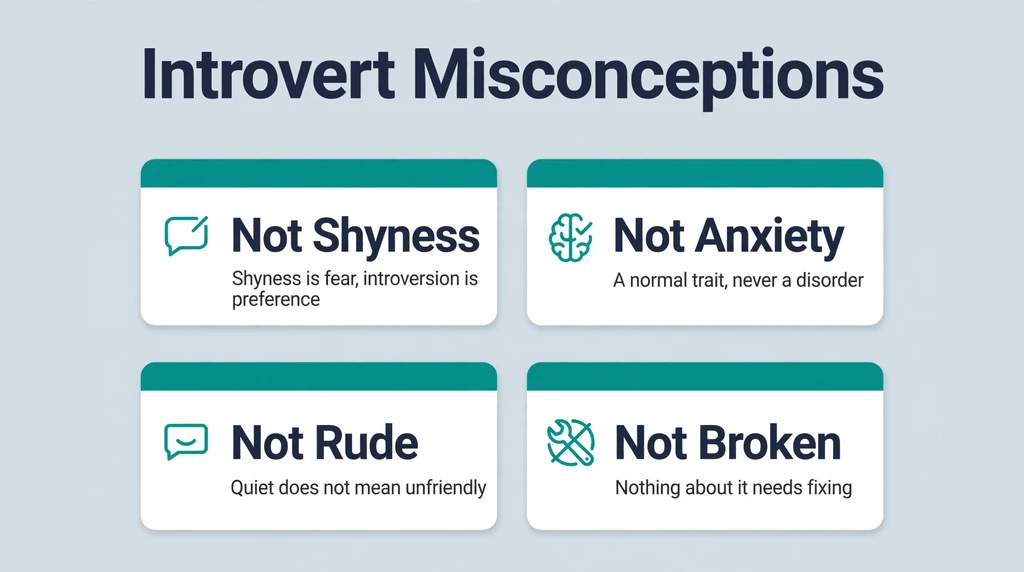
Few personality words carry as much folklore as this one. The myths survive because quiet behavior is easy to misread from outside. Each myth below confuses introversion with something it is not.
Myth one: introverts are just shy
This is the most stubborn confusion of all. Verywell Mind separates the two cleanly. Shyness involves fear of negative evaluation, while introversion involves becoming overstimulated and needing solitude to regain energy.
The American Psychological Association describes shyness as feeling awkward, worried, or tense during social encounters. Notice the emotion at its center: fear. An introvert declining an invitation is doing arithmetic about energy. A shy person declining one is often managing fear of judgment. Same action, entirely different engine.
Myth two: introversion is social anxiety
Social anxiety goes further than shyness. It brings intense fear of being judged or embarrassed, strong enough to interfere with daily life. That makes it a health condition that deserves real support.
Introversion, by contrast, is a normal personality trait. It is not a disorder, and it never needs fixing. Alone time genuinely restores an introvert, whereas it only postpones dread for someone anxious. Keeping the two apart matters, because one needs understanding and the other may need treatment.
Myth three: quiet means rude or uninterested
Silence invites bad translations. A reserved colleague can look aloof, and a quiet guest can look bored. Yet the behavior usually signals processing, not disdain. Many introverts are warm, funny, and fully engaged once the group shrinks.
Context flips the picture entirely. Put the same person in a one-to-one conversation about a favorite subject, and the reserve often vanishes. What changed was not their character. Only the setting did, which is the whole point of the word.
Myth four: introverts cannot lead or perform
Stages and boardrooms seem to belong to the loud, yet the evidence of daily life disagrees. Merriam-Webster illustrates the word with a telling example, describing Bill Gates as quiet and bookish, “an introvert, but not shy.” Quiet people lead constantly; they simply prepare more and broadcast less.
Performance works the same way. Acting, teaching, and presenting are skills, and introverts learn them like anyone else. The difference appears afterward, in the recovery room rather than on the stage. Judging ability by after-hours energy is the real mistake hiding inside this myth.
Introvert in Sentences: Examples and Usage
Example sentences show the word at work better than any rule. Read these with the energy definition in mind, and notice how naturally each one uses it.
- “As an introvert, Daniel skipped the after-party and spent the evening reading.”
- “My sister is an introvert who plans one quiet night for every big family event.”
- “The new office gave introverts a quiet room, and productivity rose within a month.”
- “He may be introverted, but his short speeches often settle the whole debate.”
- “Introverts in the class preferred written comments over speaking in the full group.”
- “Travelers who are introverts often choose small guesthouses instead of busy resorts.”
Usage follows a few simple habits. Introvert works as a noun for the person and as an adjective before a noun, as in “an introvert manager.” Introverted is the safer adjective for personality, while introversion names the trait in formal writing. For the opposite person, everyday English uses extrovert.
Register matters as well. In casual speech, introvert often just means quiet, and listeners accept the shortcut. In careful writing, though, the energy meaning gives the word its precision. Choosing the precise sense keeps shy people and introverts from being filed under one label.
Phrases you will meet often
Certain phrases follow the word around. People describe someone as “a bit of an introvert,” “a quiet introvert,” or “an introvert at heart.” Each phrase softens the label into a tendency, which matches how psychologists treat it. You will also meet “introvert problems” online, a joking label for cancelled plans and drained social batteries.
The opposite corner has its own vocabulary too. Extrovert covers the outgoing person, ambivert covers the middle, and everyday speech adds “people person” for the highly social. Knowing the set helps you place any new example you hear.
FAQs About Introvert Meaning
What is the simple meaning of an introvert?
An introvert is a person who gains energy from quiet time alone and spends energy in social settings. They usually prefer calm places, small groups, and conversations with depth. The label describes energy and preference, not fear or dislike of people.
What is the opposite of an introvert?
The opposite is an extrovert, someone energized by people, activity, and the outside world. People in the middle of the scale are called ambiverts. Psychology often spells the trait form as extraversion when pairing it with introversion.
Is being an introvert the same as being shy?
No. Shyness is a fear of being judged, while introversion is a preference for lower stimulation and recovery time alone. An introvert can feel perfectly confident in a crowd and still need to leave early. A shy extrovert, meanwhile, may crave company yet fear it.
Can an introvert be outgoing?
Yes. Outgoing behavior and introversion can live in the same person. Some introverts present, perform, and lead with real warmth, then recover privately afterward. What makes them introverts is the recovery pattern, not the volume of their voice.
Are introverts antisocial?
No. Introverts select their social time rather than avoiding it altogether. They tend to keep a smaller circle and invest heavily in it. Skipping one loud event usually protects energy for people they value more.
Can someone stop being an introvert?
Traits like introversion are fairly stable across adult life. Habits, skills, and confidence can all grow, and behavior can flex with practice. Still, the underlying preference for where energy comes from usually stays recognizable over the years.
How many people are introverts?
Nobody can give an exact figure, because researchers measure a scale rather than two tribes. Pure extremes are uncommon at both ends. Most people land somewhere in the middle, leaning one way or the other depending on the day.
Is introvert a medical condition?
No. Introversion is a normal personality trait, not a diagnosis or disorder. It appears in personality models as the low end of extraversion. Only conditions like social anxiety disorder, which involve real distress, belong in a medical conversation.
Final Thoughts
The introvert meaning comes down to direction. Energy flows inward, rest grows in quiet rooms, and attention settles on thoughts before it settles on crowds. Jung gave us the word a century ago, and modern trait research has mostly refined his insight rather than replacing it.
So the label works best as a compass, not a verdict. It tells you how someone recharges, and it says nothing about their warmth, courage, or worth. Read that way, the word stops being a box and becomes a small act of understanding. It explains the early exit, the thoughtful pause, and the carefully guarded Sunday in one move. For a fuller comparison of the two directions, the Cleveland Clinic’s guide to introvert vs. extrovert walks through the differences with a health psychologist. However you score on the scale, knowing your own pattern is the useful part.