A stranger in a game lobby opens with three letters: “asl?” An hour later, your friend texts, “I’m tired asl.” Same three letters. Two completely different messages. In a text, ASL traditionally means age, sex, and location, a quick introduction question from the early chat room era. But sitting after an adjective, lowercase asl means something else entirely: “as hell,” slang for extremely.
Position tells you which one you are looking at. Standing alone with a question mark, ASL asks who you are and where you live. Placed at the end of a description, it just turns the volume up. And in a classroom, a hospital, or any talk about Deaf people, ASL is not slang at all. It is American Sign Language, a complete language of its own.
This guide follows how ASL is really used in chats, comments, and classrooms today. Every meaning below was checked against dictionaries and documented slang sources. You will find real examples, tone guidance, and replies you can copy. By the end, no “asl” will slow you down.
ASL Meaning in Text at a Glance
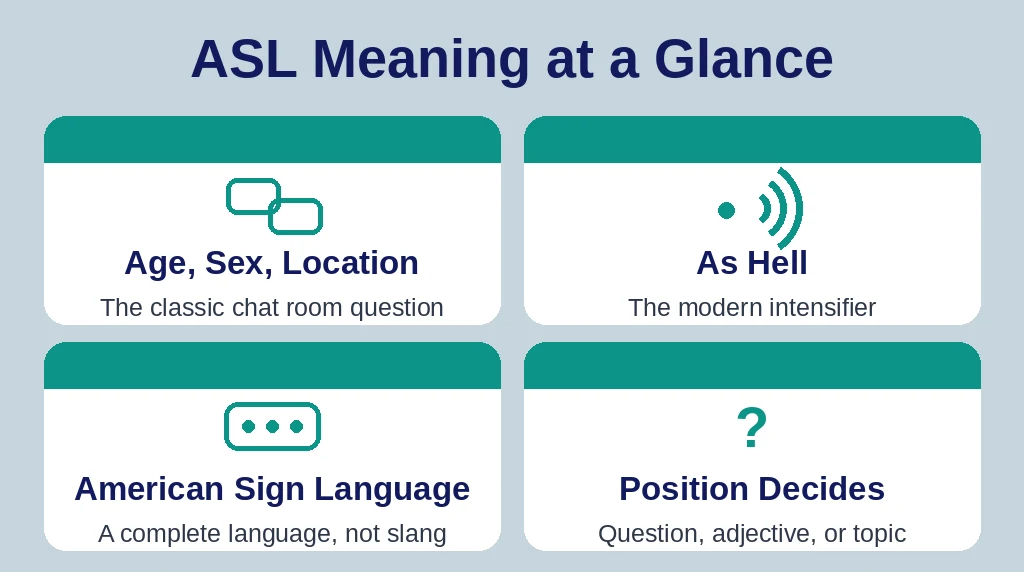
Short on time? Here is the fast version. ASL has three lives. As a standalone question, “asl?” means age, sex, location. After an adjective, lowercase “asl” means “as hell,” as in “funny asl.” In education and Deaf culture, ASL means American Sign Language. The words around it always tell you which one you have.
| Detail | Explanation |
|---|---|
| Most Common Meaning | Age, sex, location (sent as the question “asl?”) |
| Modern Slang Meaning | As hell, an intensifier as in “tired asl” |
| Formal Meaning | American Sign Language |
| Tone | Curious as a question, casual as slang, respectful for the language |
| Common Platforms | Chat rooms, random-chat apps, TikTok, Snapchat, text messages |
| Formal or Informal | Mostly informal; the sign language meaning is formal |
What ASL Really Means in a Text
The classic meaning of ASL is a question, not a statement. In the early internet, chat rooms and instant messengers were anonymous places. There were no profile photos, no bios, often just a username on a screen. So “asl?” squeezed three getting-to-know-you questions into three letters: How old are you? Are you male or female? Where are you from?
The answer usually came back just as compressed. Someone might reply “19/f/Texas” or “25/m/London,” giving all three details in a single short line. Then the real conversation could start. For years, this exchange was the standard doorway into a chat with a stranger, the online equivalent of a handshake and an introduction rolled into one.
Because the question was so often asked when people were looking for dates or flirting, it picked up a pushy reputation along the way. Many people today read a surprise “asl?” as a red flag rather than a friendly opener. That shift matters, because it changes how the same three letters feel depending on who receives them.
One more thing is worth knowing before anything else. You never owe a stranger these answers. Age and location are personal details. If someone pressures you to reply to “asl?” in a private chat, closing the conversation is always a fair response.
The Newer Meaning: ASL as “As Hell”
Among younger users, lowercase asl has been quietly rebuilt into an intensifier. Placed after an adjective, it means “as hell,” which is simply slang for “extremely” or “very.” “Bored asl” means bored as hell. “That exam was hard asl” means the exam was extremely hard. “You look cute asl” is a compliment with the volume turned up.
Dictionary.com’s usage notes record this intensifier sense alongside the older one, and Know Your Meme has documented the confusion it causes. By the late 2010s, the new reading was already puzzling older users, and in the early 2020s the clash became a running joke online: one generation reads “I’m hungry asl” as a statement about being extremely hungry, while the other wonders why a stranger is asking for their age, sex, and location mid-sentence.
The reliable test is position. The question meaning stands alone. The “as hell” meaning never does; it always leans on the adjective right before it.
Other Meanings of ASL You Might See
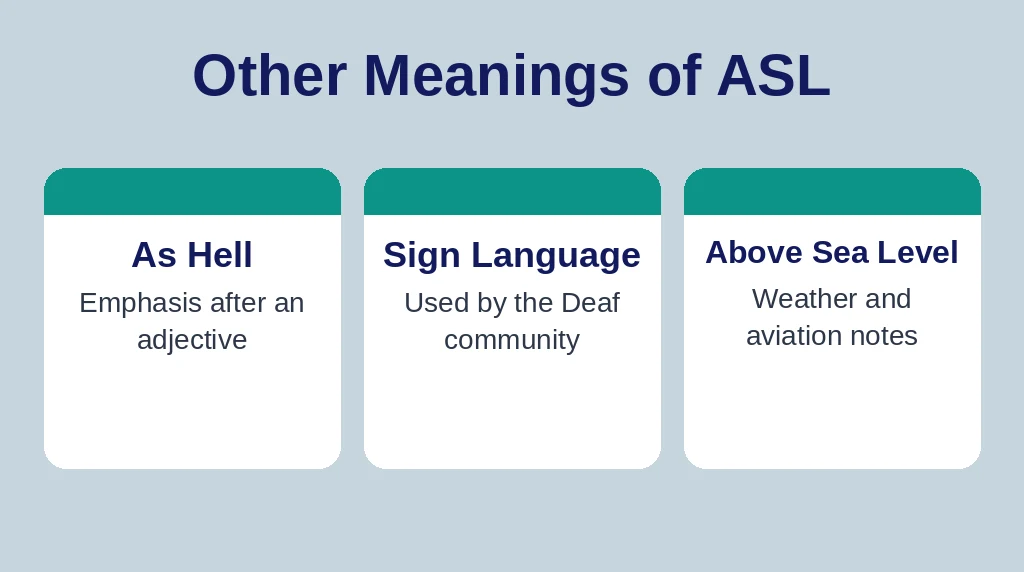
ASL led more than one life before group chats, and those meanings still surface. The setting is your biggest clue: a stranger’s DM points to the question, a caption points to the intensifier, and a course catalog points to the language.
| Meaning | Context | Tone | Example |
|---|---|---|---|
| Age, Sex, Location | A standalone question from a stranger | Curious, sometimes pushy | “hi, asl?” |
| As Hell | After an adjective in casual comments | Casual, emphatic | “That hike was long asl.” |
| American Sign Language | School, work, Deaf community, accessibility | Formal, respectful | “The lecture offers ASL interpretation.” |
| Above Sea Level | Weather, aviation, and geography notes, written lowercase | Neutral, technical | “The village sits 3,000 feet asl.” |
Older chats also used the variant spellings A/S/L and “aslp,” which added a request for a picture to the same three questions. You may still run into those forms in screenshots of early internet conversations. They belong to the question meaning, not the modern slang one.
How Context Changes the Meaning
Four quick signals help you decode ASL almost every time. First, look at position: a standalone ASL is the question, while ASL after an adjective is “as hell.” Second, check the punctuation, because the question almost always carries a question mark. Third, consider the topic, since words like class, interpreter, or Deaf point straight to American Sign Language. Fourth, notice the capitalization: lowercase mid-sentence usually means the slang, while neat capital letters in formal writing usually mean the language.
Watch how the same three letters shift across these short moments:
- “asl?” as the entire first message from someone new is age, sex, location.
- “this song is catchy asl” after an adjective means as hell; the song is extremely catchy.
- “She is studying ASL at college,” near words like class and interpreter, is American Sign Language.
- “cruising at 30,000 ft asl” in a pilot’s flight note means above sea level, not slang at all.
ASL in Chat Rooms, on TikTok, and in Regular Texts
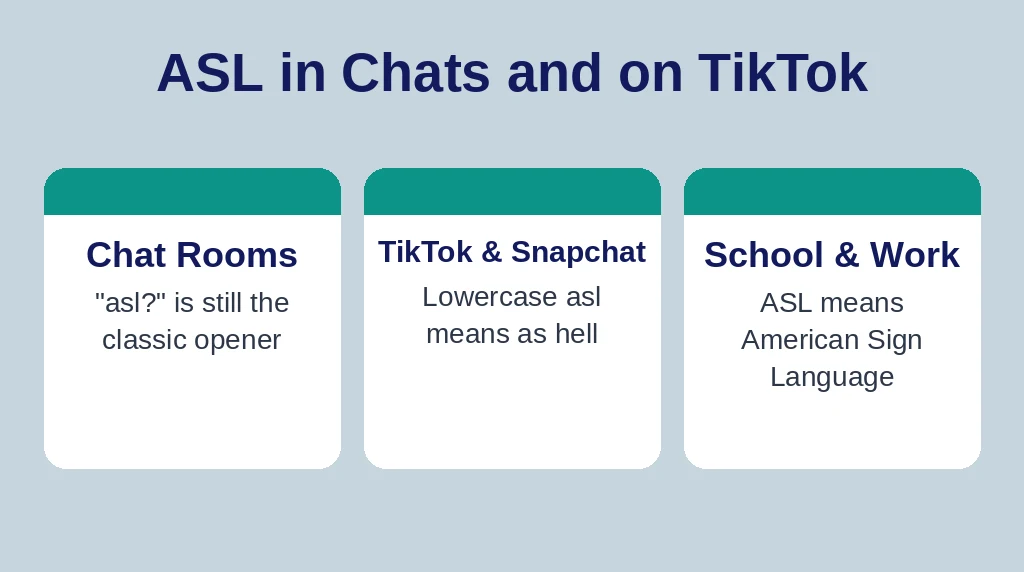
The question form survives in old-school chat rooms and in random-chat apps that pair strangers for quick conversations. There, “asl?” still works as an instant icebreaker, and long-time chat users answer it without thinking twice. Outside those spaces, though, the same opener often lands badly, because most people now guard their age and location far more carefully than early internet users did.
On TikTok, Snapchat, and X, lowercase asl almost always means “as hell.” It shows up in captions and comments as pure emphasis: “pov: you’re hungry asl,” “this beat is fire asl.” If you see asl sitting right behind an adjective on social media, the intensifier is the safe reading nearly every time.
In regular text messages, both worlds meet. Friends trade the “as hell” version constantly, while the question form mostly appears as a joke or a piece of nostalgia between people who remember the old chat rooms. In school and work writing, meanwhile, ASL means American Sign Language, full stop.
Real Conversation Examples
Person A: “hey, just got matched. asl?”
Person B: “21, f, Chicago. you?”
Meaning: Person B read the classic question and answered all three parts at once. Sharing this much is always a choice, never an obligation.
Person A: “how was your first day at the warehouse?”
Person B: “long asl. I slept ten hours after”
Meaning: Person B means the day was long as hell, meaning extremely long and exhausting. Here asl is pure emphasis, not a question.
Person A: “My cousin is learning ASL at night school”
Person B: “That’s great, my aunt signs too”
Meaning: Both people mean American Sign Language. The school setting makes the slang readings impossible here.
Is ASL Rude?
It depends entirely on which meaning is in play. Asking “asl?” out of nowhere can feel rude or intrusive, because you are requesting someone’s age, sex, and location in your very first message, and the question still carries its old dating-chat baggage. Plenty of people treat it as a reason to block rather than reply.
The “as hell” version is milder. It contains the word “hell,” so it is casual rather than polite, but among friends it simply reads as emphasis. Nobody hears “tired asl” as an insult. Just keep it out of formal writing, where the full, plain words always look better.
The sign language meaning is neither rude nor slang. ASL is the name of a real language, and using it correctly, in sentences about Deaf people, interpreters, and classes, is simply respectful and accurate.
How to Reply When Someone Sends ASL
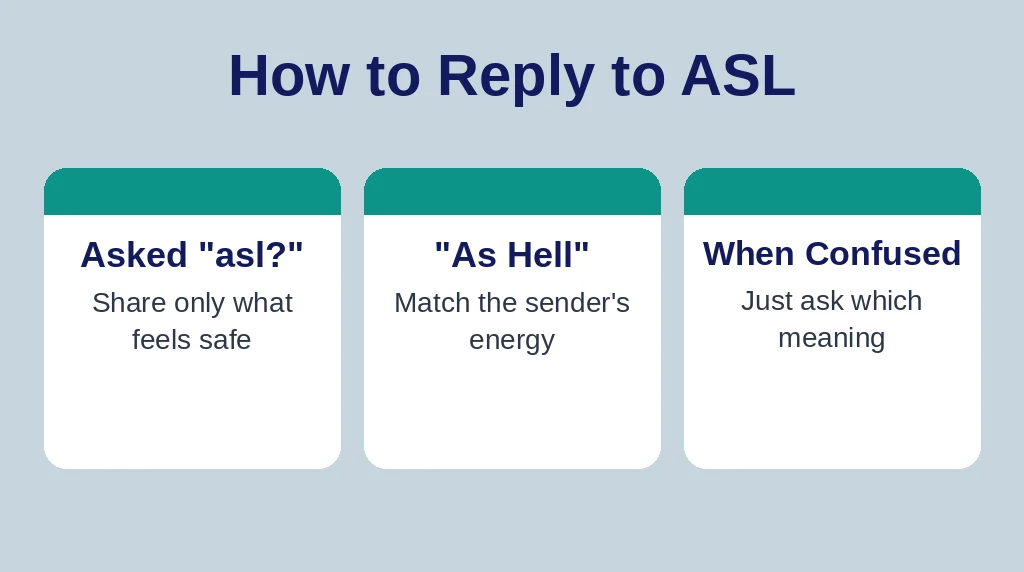
The right reply depends on which meaning arrived. Answer the question only on your own terms, match the energy of the intensifier, and ask a quick question whenever the meaning is genuinely unclear.
Replies When Someone Asks “ASL?”
- “24, f, Toronto. You?” if you are happy to answer
- “I keep that private, but happy to chat about music”
- “old enough, and from Earth” if you want to deflect with a joke
Replies to “As Hell” ASL
- “same, I’m tired asl too”
- “fr, that class was brutal asl”
- “no because why was it actually that loud asl”
Replies When You Are Confused
- “wait, asl as in age, sex, location, or as hell?”
- “asl the question or asl the slang?”
- “which asl are we doing here lol”
When to Use ASL
Use the “as hell” version with friends who already talk that way, in captions, comments, and group chats where casual slang is the normal language. The question form only fits in old-school chat spaces where everyone treats it as the standard greeting, and even there it works best as an obvious joke between people who know each other. The sign language meaning belongs anywhere the topic is the language itself: classes, interpreting, accessibility, and the Deaf community.
When to Avoid ASL
Never fire “asl?” at strangers, and never answer it with real details on a public profile or to someone you just met, especially your exact location. Avoid the “as hell” version in work chats, school assignments, and emails, where mild profanity and unexplained slang both look careless. And skip every slang version in serious conversations, where plain words show more respect for the person in front of you.
Common Mistakes People Make With ASL
Sharing real details with a stranger who asks “asl?” The question feels small and harmless, but your age plus your location is genuinely personal information. Vague answers, jokes, or silence are all safer than the truth when you do not know who is asking.
Reading every asl as age, sex, location. This is the generational mix-up. “I’m tired asl” is not a stranger demanding your details; it is a friend saying they are extremely tired. Check the position before you react.
Treating American Sign Language as internet slang. ASL is a complete natural language with its own grammar, not a texting shortcut. In classrooms, hospitals, and Deaf community spaces, it is a proper name, and treating it like a joke abbreviation lands badly.
Slang That Shows Up Next to ASL
ASL rarely travels alone. It appears beside a small family of short forms, and knowing the neighbors helps you read whole chats at once.
| Term | Meaning | Main Difference |
|---|---|---|
| WYD | What you doing | Opens a chat by asking about your activity, not your identity |
| HMU | Hit me up | Invites future contact instead of asking questions |
| AF | As f*** | A stronger, older intensifier doing the same job as “as hell” |
| RN | Right now | Adds time pressure to a sentence instead of intensity |
Where ASL Came From
The question form of ASL grew out of the chat rooms and instant messengers of the late 1990s and early 2000s, when talking to strangers online was new and nobody had a public profile. A/S/L became the standard opener so quickly that a 2001 Pew Research report found teenagers listing it as the most common question asked of people entering chat rooms. As profiles, photos, and bios became normal, the question faded, and it is now widely treated as an archaism from the early internet.
The “as hell” meaning is the takeover story. Know Your Meme traces the first known case of someone linking asl to “as hell,” and complaining about the confusion, to June 2018. The new meaning then spread widely on TikTok in the early 2020s, helped by memes about the two generations reading the same three letters in completely different ways. The sign language abbreviation, meanwhile, is far older than the internet and has named the language in print and education for decades.
Quick Recap
- A standalone “asl?” asks for age, sex, and location, the classic chat room opener.
- After an adjective, lowercase asl means “as hell,” as in “tired asl.”
- In school, work, and Deaf community contexts, ASL means American Sign Language.
- Never feel pressured to answer “asl?” with real personal details.
- Position, punctuation, and topic reveal the right meaning almost every time.
Frequently Asked Questions
What does ASL mean in text?
In a text, ASL usually asks for age, sex, and location, although younger users often mean as hell instead.
What does ASL stand for?
ASL stands for age, sex, location in chats, American Sign Language in education, and it works as slang for as hell.
What does “tired asl” mean?
“Tired asl” means extremely tired, because lowercase asl placed after an adjective works as the intensifier as hell in modern slang.
Is it safe to answer “asl?” from a stranger?
Never share your real age, sex, or exact location with strangers online, because that question often appears in risky chats.
How should you reply to ASL?
Reply by matching the meaning: answer the question only if comfortable, mirror the joke for as hell, or ask which meaning.
Final Thoughts
ASL is one abbreviation carrying three very different lives. To an older chat user it is a quick introduction question. To a younger texter it is pure emphasis, a way to say “extremely” without typing it. In a classroom it is neither, just the name of a language. The letters never change, so let the sentence around them do the work: position, punctuation, and topic will point you to the right meaning nearly every time. And if you want every dictionary sense in one place, Dictionary.com’s entry for ASL lists them side by side.
Related slang guides: WGO meaning in text, WLW meaning in text, and TS meaning in text.