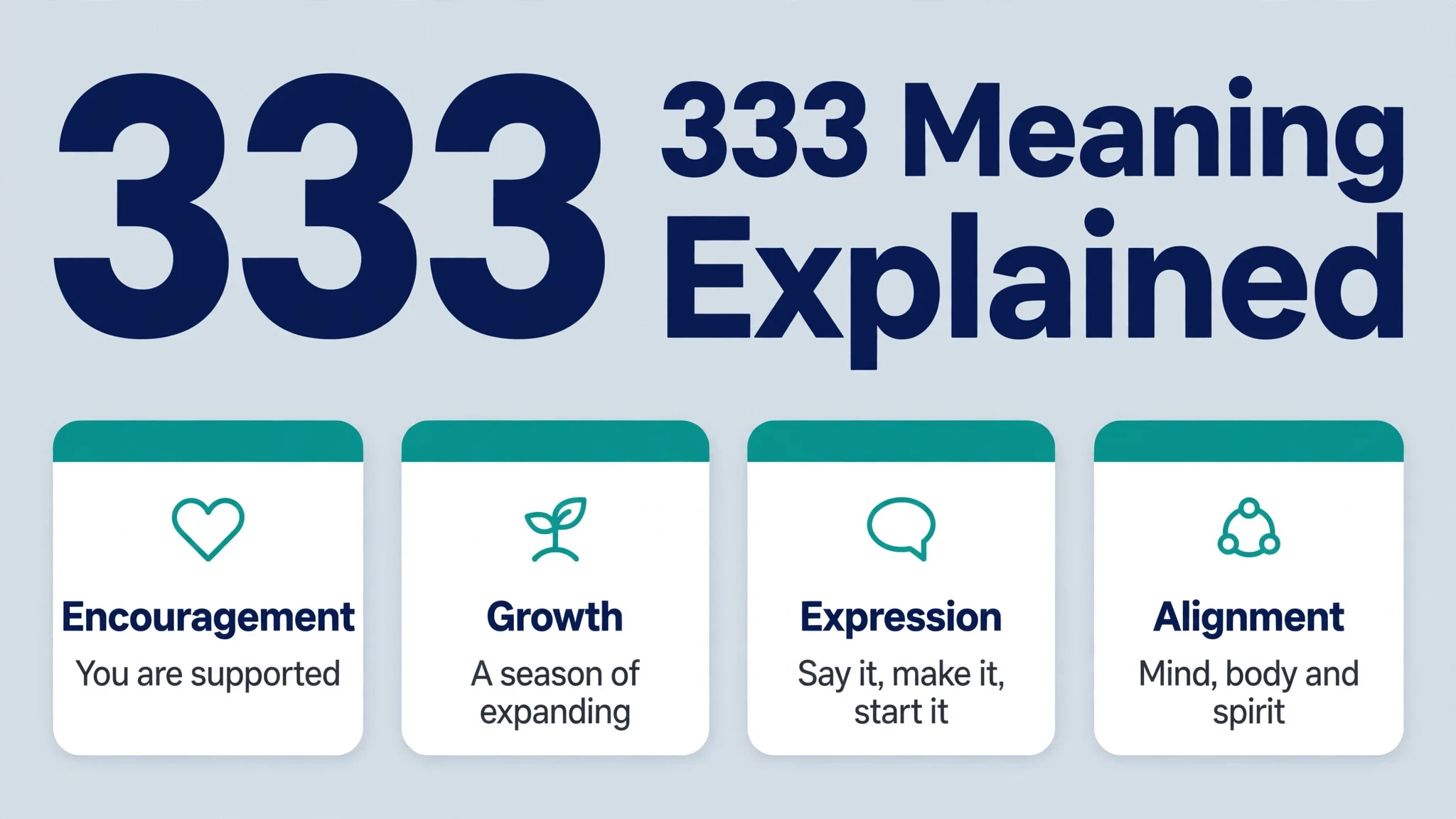
You glanced at the clock at 3:33. Then it was on a receipt, a licence plate, a page number. And the number 333 seemed to be following you around. In modern numerology, numerologists class 333 as an angel number, a repeating sequence believed to carry an encouraging message. You are supported, your creativity and growth are being urged forward. And a decision you have been postponing deserves action. That is the tradition’s reading, recorded faithfully here alongside the other things people mean by this number.
Because 333 leads several lives: as an angel number, as a Bible reference (Jeremiah 33:3), as the 3:33 AM of folklore. And as a calming technique for anxiety.
This guide covers each from the sources: what the tradition says 333 means for love, twin flames, money and work. Where angel numbers came from, and the strange story of the woman who popularised them. What psychologists say about seeing numbers everywhere; and the plain facts under the folklore.
What Does 333 Mean as an Angel Number?

In the angel number tradition, repeating digits are read as messages, and each digit carries a theme that repetition amplifies. Numerology sources associate the number 3 with creativity, self expression, communication, joy and growth. And with connection to higher guidance (many sources name the Ascended Masters, enlightened spiritual teachers, as close when 3 appears). Tripled, the digit is read as that theme at full volume.
The Core Messages
The consensus interpretation of 333 across the major angel number references (including Dictionary.com’s and Parade’s explainers of the trend. And the dedicated numerology sites) combines into a short list:
- Encouragement and support. You are not alone in what you are attempting. Help, spiritual or human, is near, and the effort is worth continuing.
- Growth in progress. A season of personal or creative expansion is under way, and the number is read as confirmation rather than coincidence.
- Speak and create. With 3 the digit of expression, 333 is read as a push to say the unsaid thing, start the creative work, have the conversation.
- Act on the postponed decision. Many readings single out the choice you keep circling: the tradition treats 333 as a green light.
- Alignment. Mind, body and spirit in balance, a common triad reading of the three digits.
Numerologists add a second layer through the number’s digital root: 3 + 3 + 3 = 9. And 9 is the number of completion, compassion and humanitarian purpose. So 333 is sometimes read as growth with an ending or a purpose inside it. And 333 is also read against the master number 33 (more below), which intensifies its first two digits.
A note on the kind of claim this is. These meanings belong to a belief tradition. They are recorded here as that tradition states them, the way a guide to a festival records its rituals. Later sections give the documented history of where the interpretations came from. And the psychological account of why the number seems to appear once noticed. Readers can hold whichever layer they find useful. The meanings themselves are now a cultural fact whatever one’s metaphysics, searched for millions of times and printed on everything from journals to jewellery.
What Are Angel Numbers?
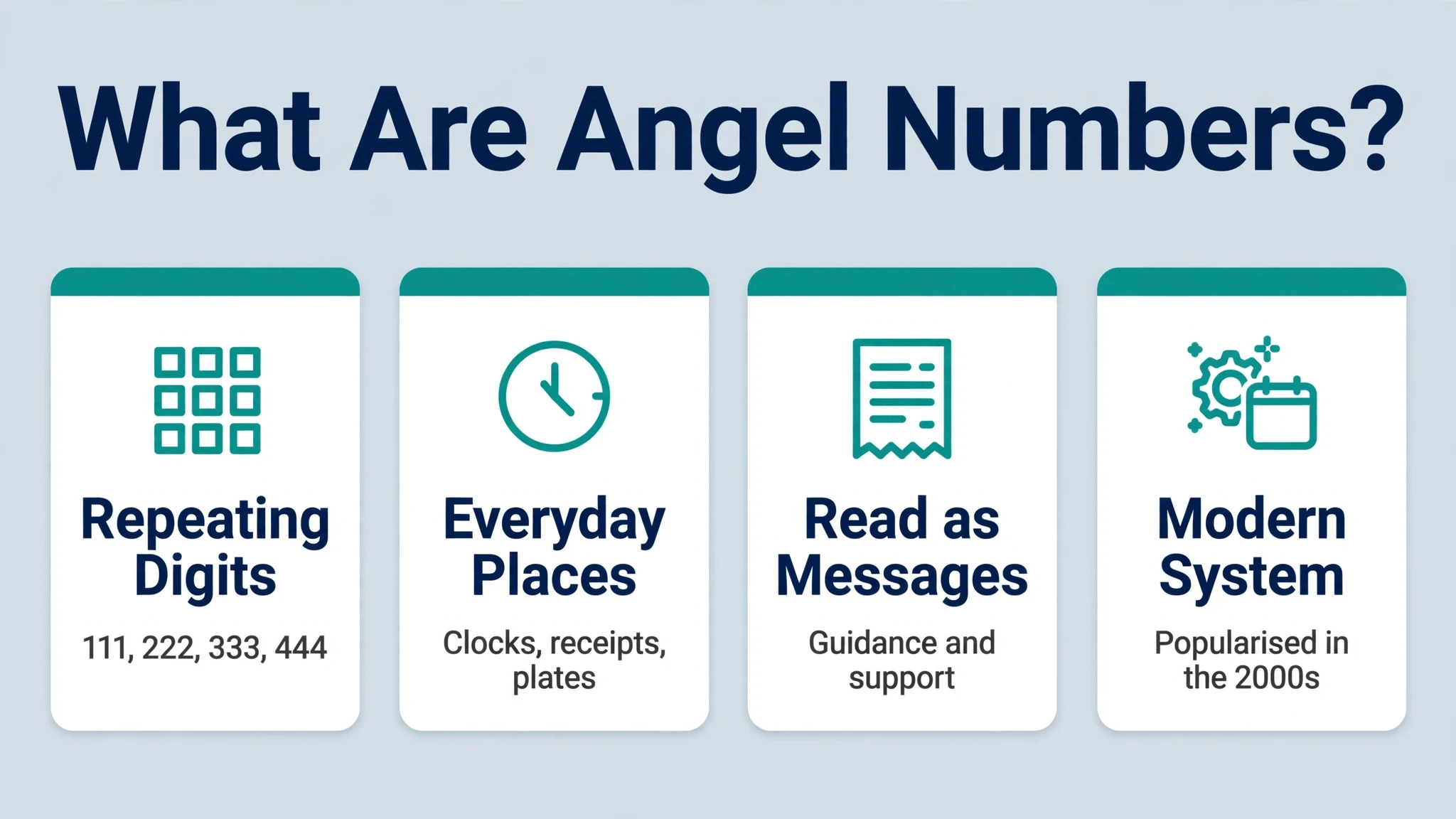
Angel numbers are repeating or patterned number sequences, 111, 222, 333, 444 and their siblings, along with palindromes like 1212, which believers interpret as communications. From angels, from spirit guides, from the universe, or from one’s own higher self, depending on the reader’s tradition. The core claims of the system, as its popularisers present them, are that such sequences appear in ordinary places (clocks, receipts, addresses, plates), that their appearance at meaningful moments is not accidental. And that each sequence carries a specific message keyed to its digits.
The idea that numbers carry spiritual meanings is far older than the angel number format. Numerology itself descends through Pythagorean thought, Jewish gematria and other systems that read the world through number symbolism. And the specific digit themes used today (3 for expression, 9 for completion and so on) descend from that long tradition. The packaging, short sequences interpreted as personal messages delivered through daily life, is the modern layer, assembled in books of the 2000s and spread widely by social media in the 2010s and 2020s. The history section below tells that story, including its most surprising chapter.
One distinction helps readers new to the topic. Angel numbers are a folk interpretive system, not a doctrine of any church. No scripture prescribes them, no authority certifies readings. And interpretations vary between sources in detail while agreeing remarkably on the headlines. This is why this guide can give a “consensus” reading of 333 at all.
The Number 3, Three Times: Digit, Master Number and Root
The whole reading of 333 rests on the symbolism of 3. And 3 has been the world’s favourite structural number for a long time. Beginnings, middles and ends; past, present and future; the triads of a hundred religions and stories. In numerology’s digit table, 3 is the creative communicator: expression, optimism, sociability, imagination, the energy of the speaker and maker. A single 3 in a reading is a nudge toward expression. In the system’s logic, repetition is amplification: 33 and 333 turn the nudge up.
33 holds a special rank as a master number, one of three in standard numerology (11, 22, 33) whose digits are not reduced, because numerologists consider their influence heightened. 33 is called the Master Teacher, carrying the creativity of 3 doubled and directed outward into service and teaching (and reducing, when reduced, to 6, the number of care and responsibility). Readings of 333 frequently borrow this. Sources treat the number as master number energy with an extra digit of emphasis. This is one source of its “you are supported in a teaching or creative mission” flavour.
The root 9 reading (3+3+3=9) pulls the other way, toward completion. 9 ends the single digit cycle and is read as wisdom, closure and compassion. Interpreters combine the two lines into the reading given at this guide’s start. Begin expressing (3), with support (33), toward something that completes (9). Whether one reads any of this as metaphysics or as a well built piece of symbolism, the internal logic is consistent. And it is the logic the tradition’s millions of readers are using when the number catches their eye.
333 in Love and Relationships
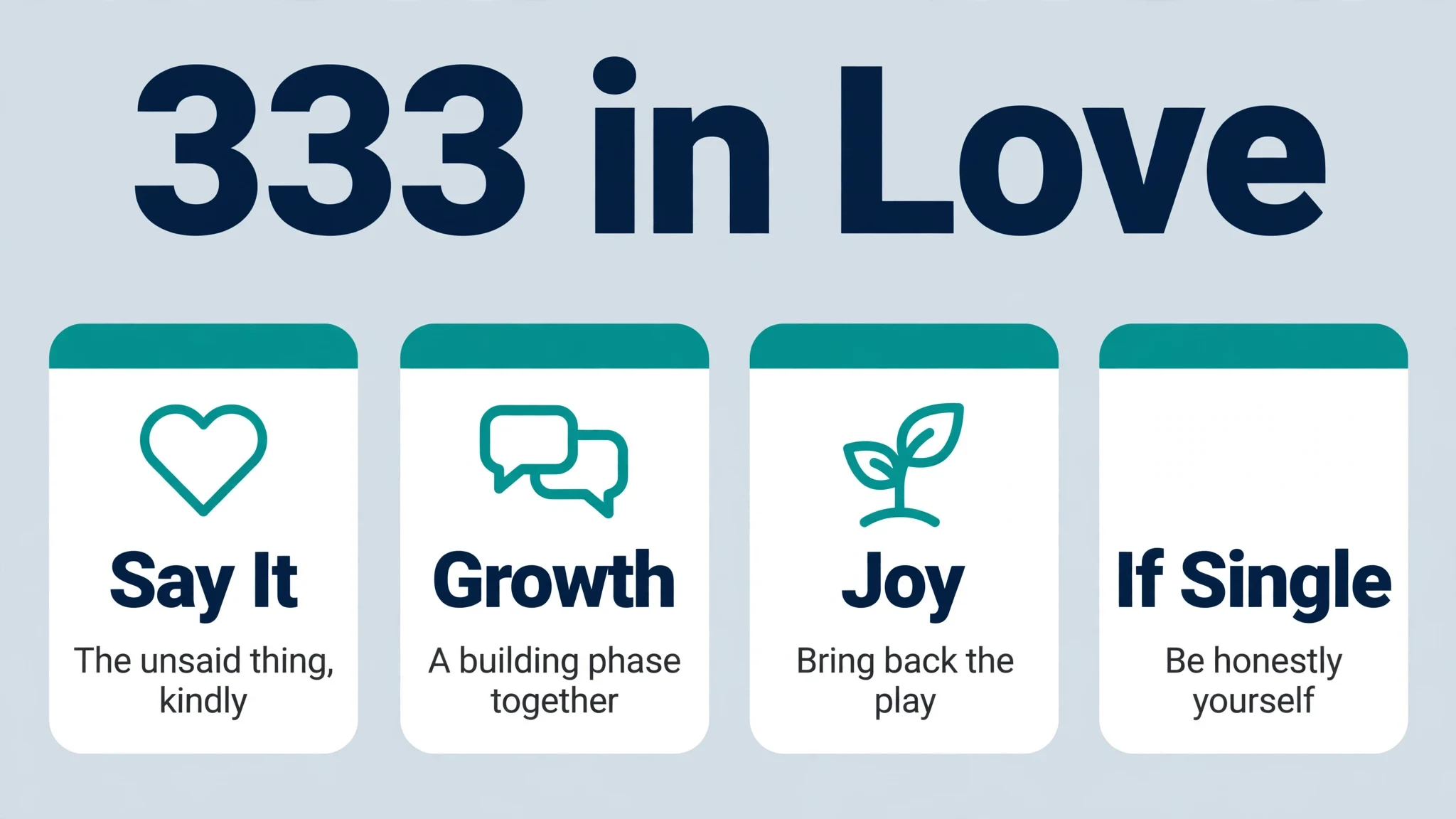
Applied to love, the tradition’s reading of 333 follows its master themes, expression and growth. And the major angel number sources converge on a consistent picture.
For people in a relationship, 333 is read as a prompt toward honest communication. Say the thing that has been going unsaid, kindly and soon. It is also read as a growth sign for the relationship itself, a couple entering a phase of building something (creative, domestic or shared) rather than merely maintaining. Some readings add lightness: 3 is the digit of joy. And the number is taken as a reminder to restore play to a partnership that has become all logistics.
For single people, the standard reading is self expression before strategy. Readers interpret the number as encouragement to be visibly, honestly oneself. And as a sign of personal growth preparing the ground, rather than as a prediction that a specific person is about to enter. Sources differ in how predictive they are willing to be. The consensus line is that 333 in love is about communication and becoming, not about a name or a date.
In a difficult patch, the same reading applies in its sterner form: the postponed conversation is the point. The tradition treats 333’s appearance during conflict as the green light for the honest talk. This is either good mystical advice or good advice wearing mystical clothes, depending on the reader’s framework. Either way, it is the interpretation the searcher is looking for. And it is harmless in the specific way much of this system’s advice is harmless. Its concrete content is usually ordinary wisdom about courage and speech.
333 and Twin Flames
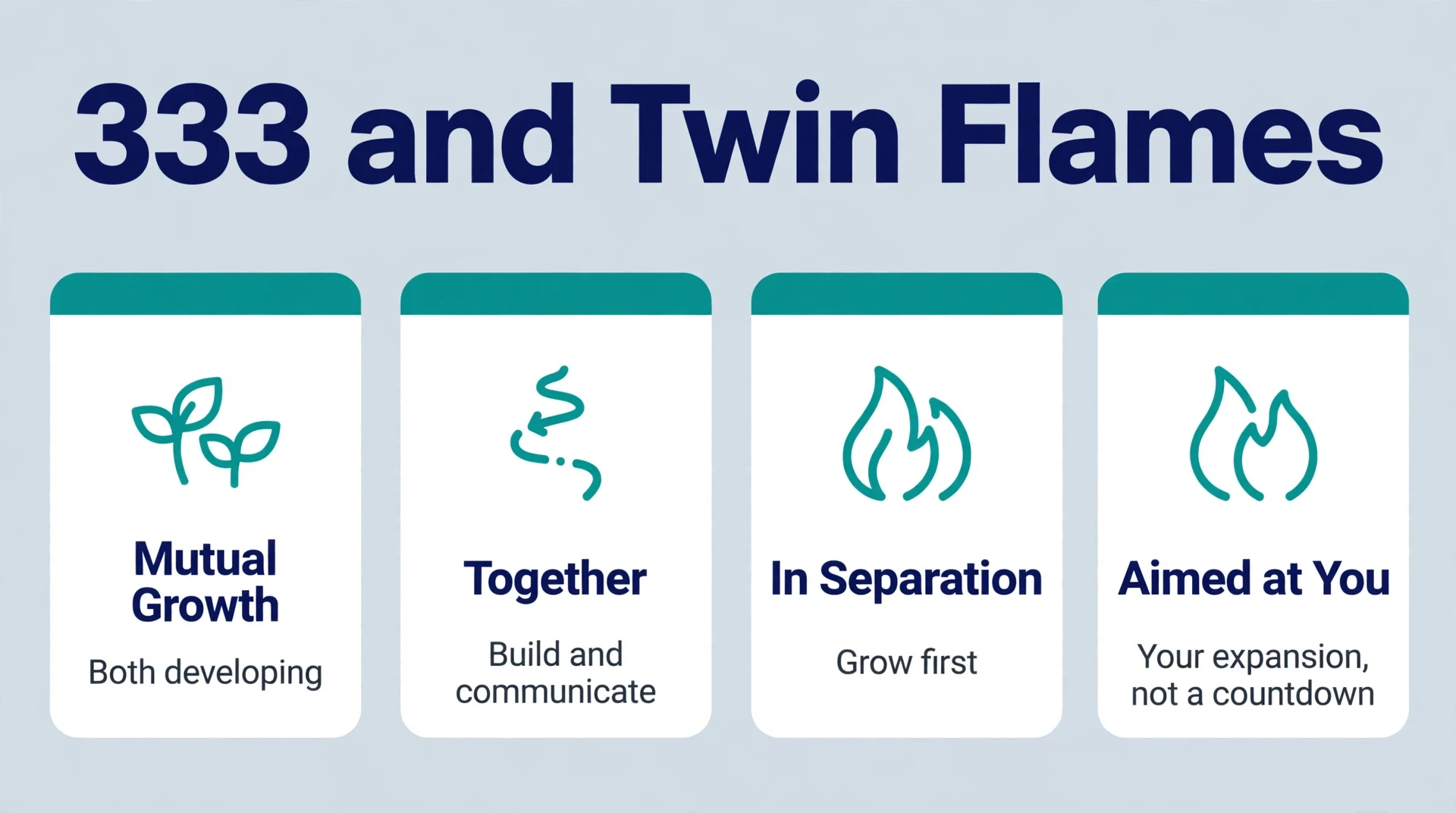
The twin flame concept, a belief that one soul can be split between two people destined to meet, runs its own interpretive track alongside angel numbers. And 333 has a settled place in it. Twin flame readings interpret 333 as a sign of mutual growth. Both parties developing, creatively and spiritually, in the direction the connection requires. Where the pair are together, it is read as encouragement to build and communicate. Where they are in the separation phase the twin flame narrative describes, 333 is read as “grow first”: focus on your own expansion. And treat the number as support rather than as a reunion countdown.
Two honest notes belong in any reference treatment. First, the twin flame framework is itself a recent popular belief, spread largely through online communities in the last two decades. It is not an ancient doctrine, whatever its vocabulary suggests. Second, readers in distress about a specific person should know that no interpretation in this guide, or in the tradition, can certify anything about another person’s feelings. The tradition’s own best interpreters aim the number at the reader’s growth. That aim is safe to follow regardless of the metaphysics.
333 for Money and Career
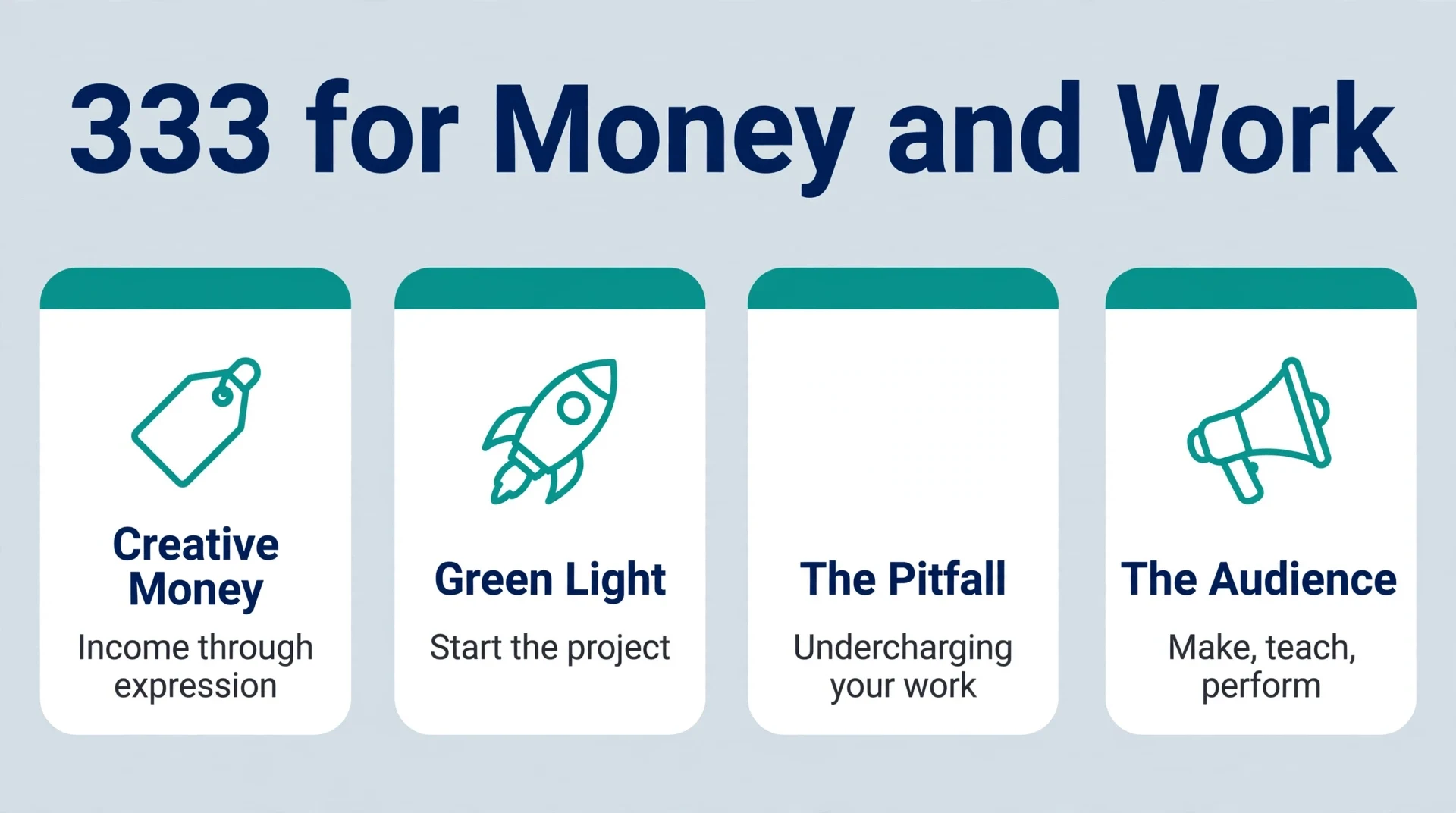
In money and work readings, 333 keeps its identity as the creativity number, and the sources are unusually concrete. People commonly call it a creative money number: income through expression, making, teaching, writing, performing, building an audience. The standard career reading is a green light to start. The project, the application, the business, the portfolio, with procrastination named as the obstacle the number is answering. Its named pitfall, repeated across sources, is undercharging. The creative who prices their work below its worth is the figure 333 is most often said to be addressing, with the reading that support is present and the work may be valued properly.
Read as symbolism rather than signal, this cluster is coherent life advice aimed at a recognisable person: the talented procrastinator. It is worth recording that the tradition’s money reading, unlike some angel numbers’ (888 is the abundance number in the standard table), does not promise wealth arriving. It directs effort toward expression and fair pricing, which is as close to a mechanism as numerology gets.
Seeing 333 Everywhere, and Waking at 3:33
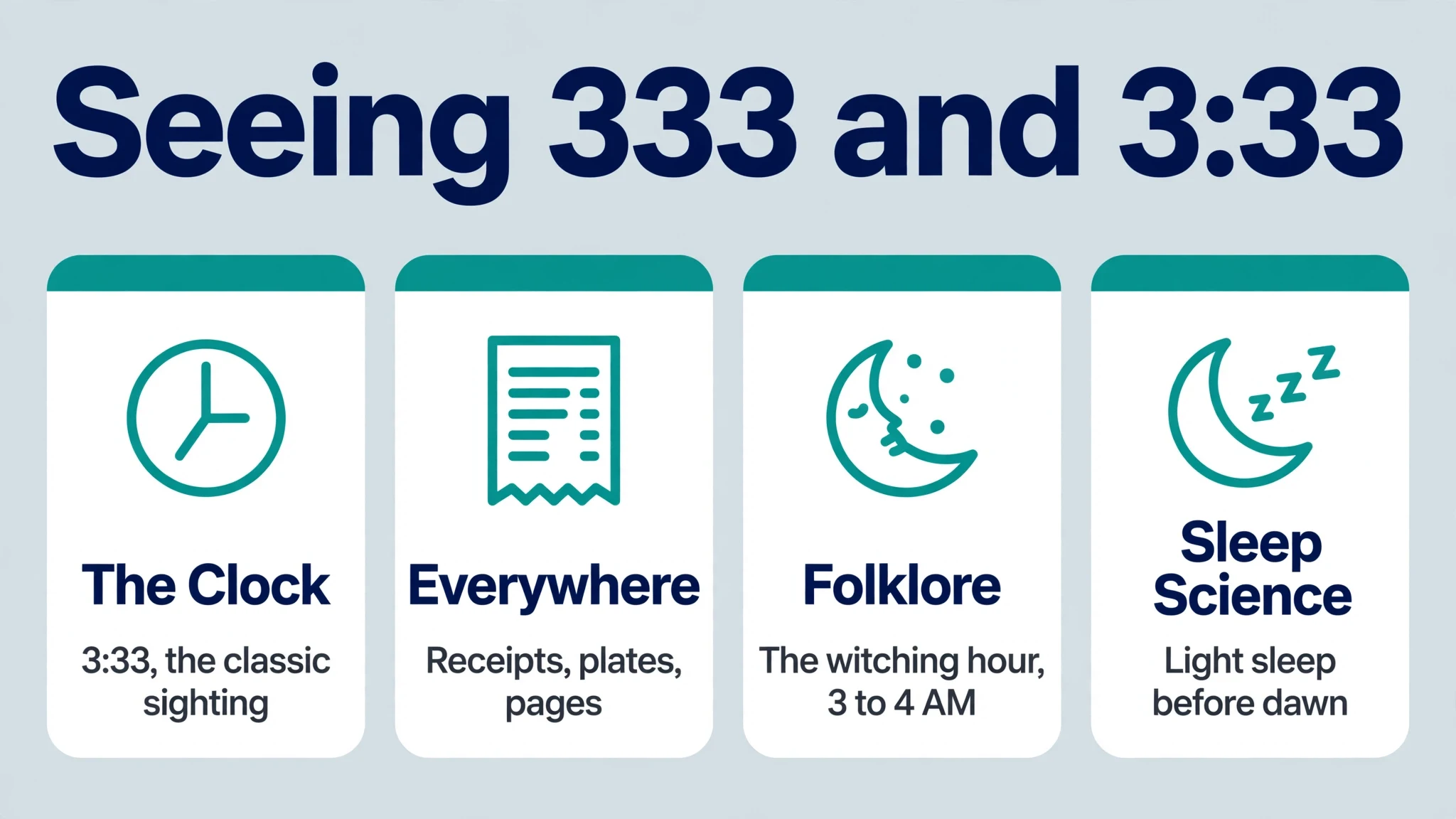
The commonest experience behind this search is not a single sighting but a run of them. The number seems to be everywhere for a week. Tradition reads such runs as intensified messages, a sequence “activating” or following a person who needs it. The psychological account of the same experience has its own section below. The two accounts are not as opposed as they look, since both begin from a real phenomenon, the number genuinely is appearing often in a world saturated with digits. And the noticing is doing the rest.
The classic sighting spots recur so consistently across the tradition’s literature and forums that they amount to a checklist. The clock first of all (3:33, day or night), then receipt and bill totals landing on 3.33 or 333, building and room numbers, page numbers, view and like counts pausing at 333, message timestamps, and the humble odometer. Guides advise practitioners to note the thought in mind at each sighting, on the theory that the sequence comments on it. Sceptics note, fairly, that decimal currency and 12 hour clocks manufacture 333 collisions at industrial scale. And that no sighting log ever records the day’s far larger count of meaningless numbers. Both observations can be true at once. And in this guide’s experience of the sources, mature readers on both sides tend to accept exactly that.
Waking at 3:33 AM
3:33 AM has its own folklore. Folklore folds waking at that hour into the “witching hour” complex, the belief, widespread in folk tradition, that the hours after midnight, often given as 3 to 4 AM, are when supernatural activity peaks. A related piece of folklore calls 3 AM the “devil’s hour”, sometimes explained as an inversion of 3 PM, the traditional hour of the crucifixion. These are folklore, recorded as such: no scripture or church doctrine establishes them. Sleep science offers its own unglamorous account of the same hour.
The body’s cortisol begins its pre dawn rise, sleep is lightest in the second half of the night. And waking then is common and normal (Swedish folklore, with no malice at all, calls the pre dawn waking stretch the “hour of the wolf”). Many people wake at 3:33 simply because sleep is shallow then and the clock is the first thing a waking mind reads. The number on the clock is memorable. Those thousands of unmemorable wakings at 2:47 are not, which is a selection effect any honest guide should name.
333 in the Bible: Jeremiah 33:3
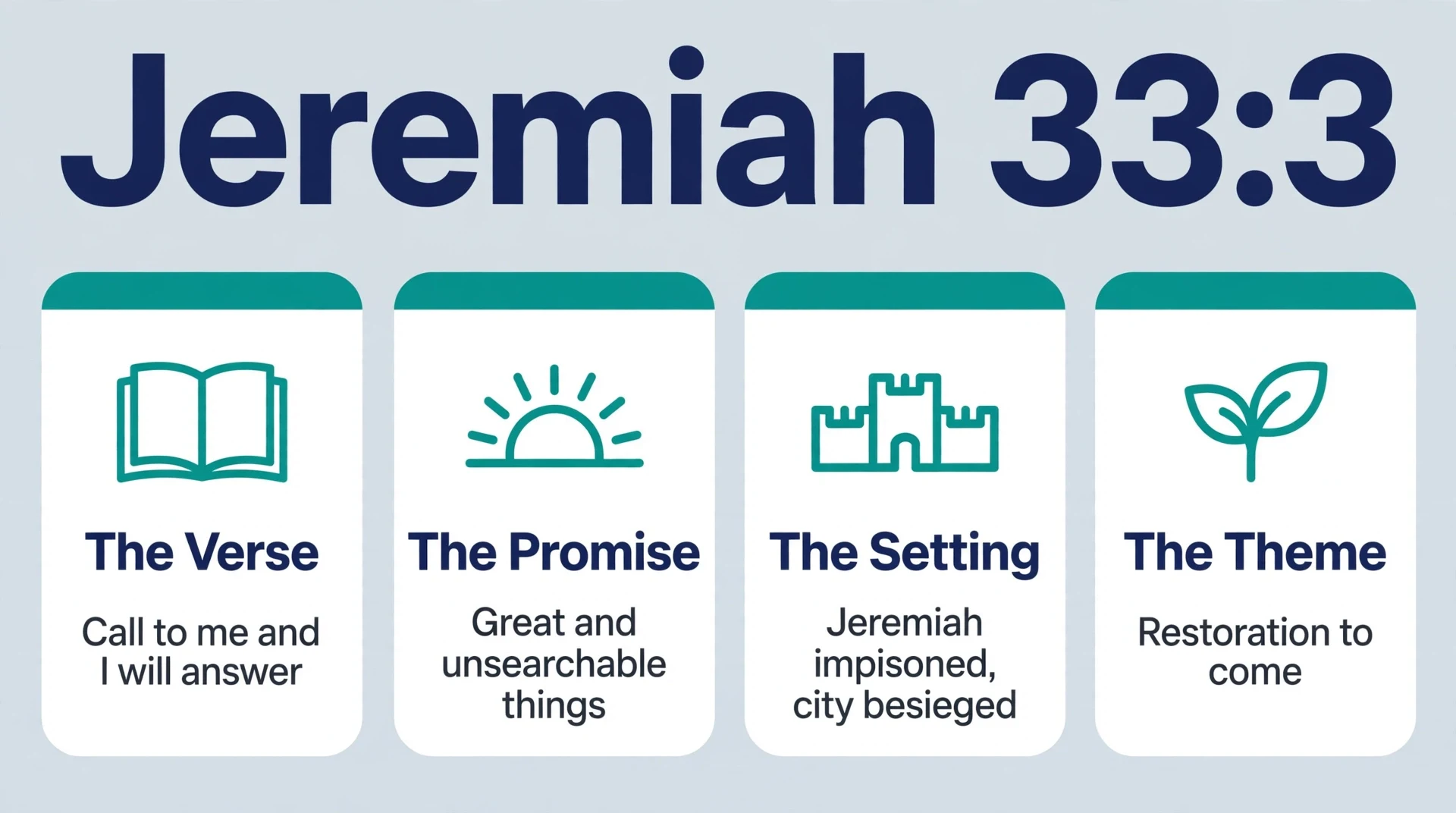
The strongest documented anchor the number has is a verse. Jeremiah 33:3 reads, in the New International Version. “Call to me and I will answer you and tell you great and unsearchable things you do not know.” The verse is beloved in its own right, often quoted as an invitation to prayer. And it is the reason many Christian readers arrive at the number 333 at all.
Its context deserves the same care as the verse. The Book of Jeremiah’s thirty third chapter is spoken to the prophet while he is imprisoned in Jerusalem during the Babylonian siege. And its message is restoration: a destroyed city promised healing, return and a righteous future. Verse 3 sits inside that promise, God inviting the imprisoned prophet to ask and promising knowledge beyond his situation. Read closely, it is a verse about prayer answered in dark circumstances. This fully explains its devotional popularity without any numerology at all.
Two clarifications keep the record straight. First, the Bible sets out no doctrine of the number 333: the verse’s fame comes from its words. And the reading of 33:3 as a meaningful address is a modern devotional habit, sometimes affectionately nicknamed “God’s phone number” in popular usage. Second, Christian opinion on angel numbers as a system is divided to negative. Many pastors and theologians treat the system as incompatible with Christian teaching on divination, a position that, strikingly, the system’s own populariser eventually came to share, as the next section tells.
The Woman Who Popularised Angel Numbers, and Renounced Them
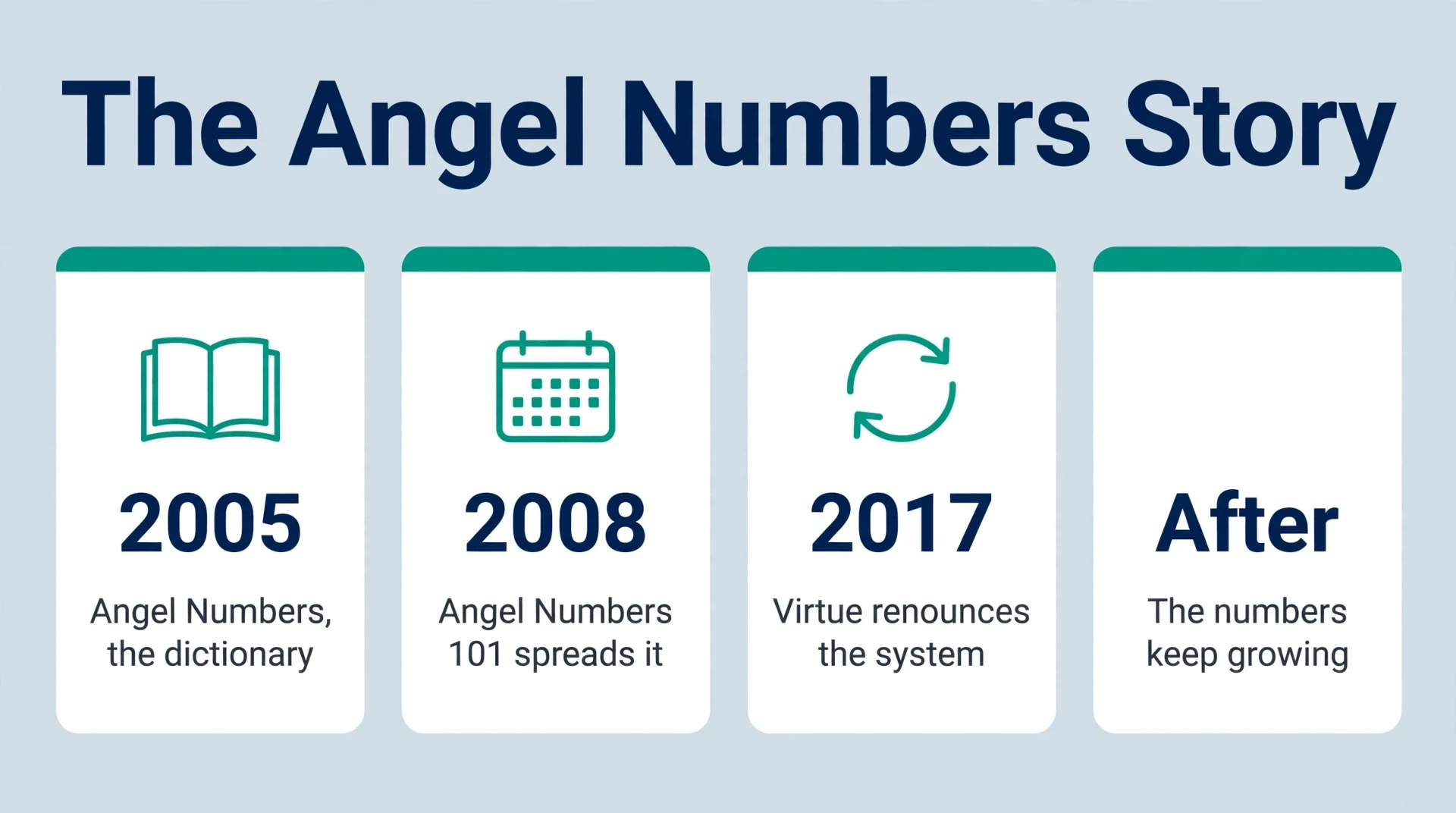
The modern angel number system has an identifiable author figure. Doreen Virtue, a Californian author with a background in psychology, built a publishing career on angels and New Age spirituality with Hay House. And among her dozens of books were the two that codified the numbers. Angel Numbers (2005, with Lynnette Brown), a dictionary of sequences from 0 to 999 with a short message for each. And Angel Numbers 101 (Hay House, 15 July 2008), the expanded successor through which most readers met the system. Her entry for 333, from the original book, reads. “The Ascended Masters are near you, desiring you to know that you have their help, love, and companionship. Call upon the Ascended Masters often, especially when you see the number 3 patterns around you.” Nearly every 333 interpretation on the internet descends, directly or through copies, from that paragraph.
The Renunciation
Then the story turns. Virtue converted to Christianity, was baptised in February 2017. And later that year publicly renounced her New Age work, angel numbers included, arguing from Deuteronomy’s prohibitions on divination that the practice she had popularised was one Christians should abandon. She told the story at length in her book Deceived No More (2020) and in a first person essay for Christianity Today (2022). Profiled by The Cut in 2024, looking back at the whole enterprise, she said: “I regret it. And I’m sorry that I made them.”
The renunciation changed nothing about the numbers’ popularity, which is itself the interesting fact. Detached from their author, the interpretations had already become folk property, copied into thousands of pages, apps and social accounts. And they continued growing through the social media boom on the strength of the experience they name. A reference guide can only record both halves: the system’s most influential modern author considers it a mistake. And the culture at large has kept it anyway.
The Sceptical View: Why the Number Finds You
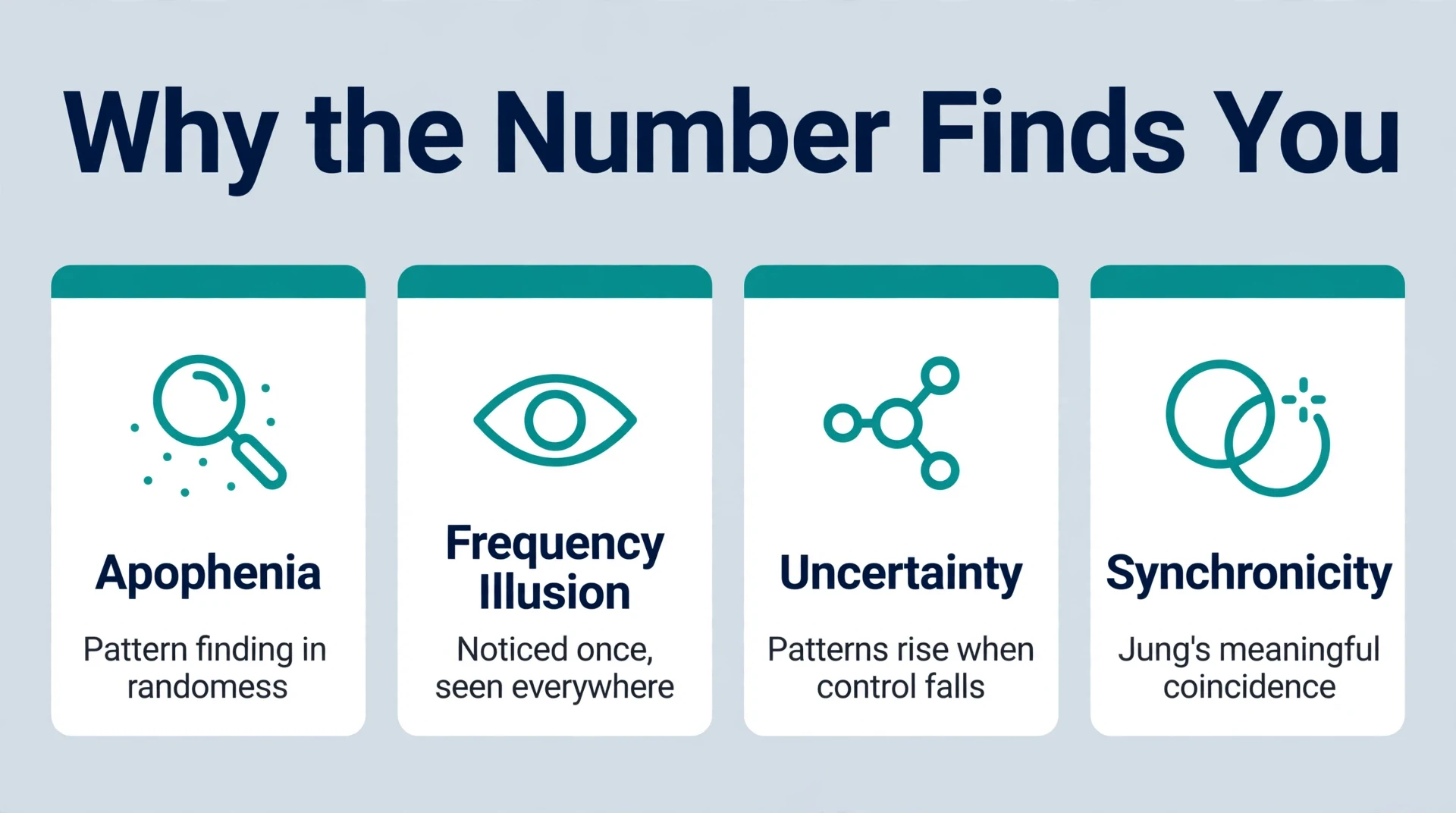
Psychology has named the machinery behind the 333 experience. And its account deserves a full hearing, not least because it explains the experience without mocking it.
Apophenia is the human tendency to perceive meaningful patterns in random or unrelated data. The psychiatrist Klaus Conrad coined the term in his 1958 work on the early stages of schizophrenia, where the pattern sense runs painfully strong. But the underlying faculty is universal and mostly useful. It is the same pattern finding that lets humans read faces, learn languages and spot the tiger in the grass.
The Frequency Illusion
The frequency illusion, also called the Baader-Meinhof phenomenon, is the specific mechanism for the number that follows you. Once you notice a pattern, it primes your attention. The mind, which filters out nearly every number it passes, now flags each 333. And the count of sightings climbs steeply while the actual frequency of the number in the environment has not changed at all. Experiments on perceived control (Whitson and Galinsky, 2008) add the emotional layer. People in situations of uncertainty or low control detect patterns more readily. This fits the biography of most angel number searches, typed at turning points, in grief, in suspense about someone.
Synchronicity is the bridge concept between the two worldviews. Carl Jung developed the idea of meaningful coincidence, an “acausal connecting principle”, in work made public from 1930 and set out fully in his 1952 essay written alongside the physicist Wolfgang Pauli. Jung’s claim was that some coincidences carry a meaning for the person experiencing them that mechanism cannot exhaust. Believers in angel numbers often cite synchronicity as their framework. Sceptics reply that the frequency illusion explains the sightings without residue. A guide need not referee: it can note that both sides agree on the experience, the surge of meaning when the number appears. And disagree only on its address of origin.
333 in Everyday Culture
However one judges its metaphysics, 333’s cultural footprint is now a plain sociological fact. The canonical sighting is the phone screenshot. 3:33 on a lock screen, posted to social feeds with the number as its own caption, a small genre of post that platforms’ algorithms have learned to circulate because the comments fill with other people’s sightings. Around the genre an economy has formed, angel number journals with printed sighting logs, candles, jewellery and phone cases stamped with sequences, planners that open with a page of number meanings. And a large creator class reading sequences for audiences in the millions. Pop music has absorbed the vocabulary too. The singer Tinashe titled her 2021 album simply “333”, taking the number’s creative encouragement meaning as the record’s stated theme.
The sociologists’ observation worth keeping is about timing. Angel number culture surged during the pandemic years and after, a period of mass uncertainty. This matches the experimental finding that pattern seeking rises when control falls. A repeatable, benign, personally addressed pattern, one that says you are supported and should begin, is close to a perfect folk technology for anxious times: cheap, portable, unfalsifiable. And aimed at the reader’s courage rather than their fear. Guidebooks can record the meanings and the mechanisms side by side, as this one has. And let the reader decide what the 3:33 on their own lock screen is. The culture has clearly already decided what it is for. A reason, arriving three digits at a time, to say the thing and start the work.
The Other 333: The 3-3-3 Anxiety Rule
One more meaning of the search belongs in any complete guide, because a share of the people typing “333” are looking for this instead. The 3-3-3 rule, a grounding technique recommended by clinicians, including the Cleveland Clinic, for moments of anxiety or panic. When anxiety spikes, the practice is:
1. Name three things you can see.
2. Name three sounds you can hear.
3. Move three parts of your body (ankles, fingers, shoulders, for example).
The technique works by hauling attention out of the spiral of worried thought and back into present sensory fact, one channel at a time. And it is widely recommended precisely because it needs nothing, works anywhere, and takes under a minute. It shares nothing with the angel number except the digits. And a reader who arrived here anxious is better served by this paragraph than by any interpretation above. The coincidence that the internet’s favourite calming pattern and its favourite angel number are the same three digits is, sceptics and believers may jointly enjoy, exactly the sort of pattern this article has been about.
333 Among the Repeating Numbers
333 sits in a family, and its meaning sharpens against its siblings. The standard readings, one line each, run like this:
- 111: new beginnings, intention and manifestation; watch your thoughts, a door is opening.
- 222: balance, partnership and trust; things are aligning, be patient.
- 333: support, growth and creative expression; you are helped, speak and make.
- 444: protection, stability and foundations; you are surrounded and secure.
- 555: change; something is shifting, release the old pattern.
- 666: reflection; rebalance material and spiritual concerns (not, in this system, an evil omen).
- 777: luck, spiritual insight and inner wisdom; keep going, you are on the path.
- 888: abundance and flow, the system’s money number; cycles completing prosperously.
- 999: completion and release; a chapter ends, let it.
Against that table, 333’s distinctness is its direction. It is the creative encouragement number, pointing not at receiving (888), enduring (444) or ending (999) but at expressing, making, saying, beginning the work with support at your back. Readers who see runs of different sequences often read them as a sentence in this grammar, 333 arriving as its verb: create, speak, begin.
What to Do When You Keep Seeing 333
The tradition’s own advice, collected from its sources, is consistent and practical in shape. Pause and note what you were thinking about when the number appeared (interpreters treat the thought as the message’s subject). Take the creative or communicative step you have been postponing; and express the unsaid thing. Journals and notes apps are where modern practitioners keep their sighting logs. And many report that the practice’s real value is the pause itself, a built in moment of reflection three digits wide.
A reader who prefers the psychological frame loses nothing by the same routine. The pause, the honest note, the postponed decision finally taken, are good instruments under either metaphysics. The number, on both accounts, works if it moves you to do the thing you already knew you should. That may be the deepest consensus available on 333. As message, as mirror, or as mnemonic, it points at expression, growth and the courage to start. And it has accumulated its following by pointing there at the moments people most needed to hear it.
Frequently Asked Questions
What does 333 mean as an angel number?
In the angel number tradition, 333 means encouragement and support. Your guides or the universe are near, a season of growth and creative self expression is under way. And you should act on the decision you have been postponing. The reading comes from the digit 3 (creativity, communication, growth) amplified by repetition, with master number 33 (the Master Teacher) and the root 9 (completion) adding layers in fuller interpretations.
What does 333 mean in love?
For relationships, 333 is read as a call to honest communication, saying the unsaid thing. And as a sign of a growth phase for the couple. For single people, the standard reading is encouragement toward authentic self expression and personal growth rather than a prediction about a specific person. In twin flame readings, 333 signifies mutual growth, and during separation it is read as “grow first”.
What does 333 mean in the Bible?
The Bible reference is Jeremiah 33:3. “Call to me and I will answer you and tell you great and unsearchable things you do not know” (NIV), spoken to the imprisoned prophet Jeremiah during the siege of Jerusalem, in a chapter promising restoration. The Bible itself sets out no doctrine of the number 333. The verse is quoted for its words, as an invitation to prayer. And the “God’s phone number” nickname is a modern devotional habit.
Why do I keep seeing 333 everywhere?
The tradition reads repeated sightings as an intensified message. Psychology names the mechanism the frequency illusion (or Baader-Meinhof phenomenon). Once your attention is primed by a first striking sighting, your mind flags every later 333 while filtering out other numbers. So sightings seem to multiply although their real frequency never changes. The broader pattern finding tendency behind it is called apophenia.
What does waking up at 3:33 AM mean?
In folklore, the hours around 3 AM are called the witching hour or devil’s hour, with no biblical or church basis. Sleep science explains the experience plainly. Sleep is lightest in the second half of the night as cortisol begins to rise, waking then is common. And 3:33 is simply the time a waking person happens to read on the clock. Both the folklore reading and the scientific one are recorded in this guide; neither suggests anything is wrong with you.
Who created angel numbers?
The meanings of number symbolism descend from ancient numerology. But the modern angel number system was popularised by Doreen Virtue, principally in Angel Numbers (2005, with Lynnette Brown) and Angel Numbers 101 (2008). In 2017, after converting to Christianity, Virtue publicly renounced the system and her New Age work, later writing Deceived No More (2020) and telling The Cut in 2024 that she regretted creating them. The interpretations continued spreading regardless, as folk property.
What is the 3-3-3 rule for anxiety?
It is a grounding technique recommended by clinicians including the Cleveland Clinic. During anxiety, name three things you can see, three sounds you can hear. And move three parts of your body. It redirects attention from worried thoughts to present senses and takes under a minute. It is unrelated to the angel number except for sharing the digits.
What is master number 33?
In numerology, 11, 22 and 33 are master numbers, not reduced to a single digit because their influence is held to be heightened. 33 is called the Master Teacher. The creativity and expression of the digit 3, doubled and directed outward into teaching and service (and associated, when reduced, with 6, care and responsibility). Readings of 333 often borrow master number 33’s supportive, mission oriented tone.
Is seeing 333 a warning?
In the standard interpretations, no. 333 is one of the system’s most positive numbers, read as encouragement, support and a creative green light rather than an omen. The sterner notes in its readings concern procrastination and unspoken words, not danger. Readers who find the experience frightening rather than encouraging may prefer the psychological account in this guide. And anyone in genuine distress should talk to a person, not a pattern.
Conclusion
333 is a small number carrying an unusual load of human hope. An angel number promising support and creative growth, a verse of Jeremiah promising answers, a folk hour of the night, a renounced author’s most famous paragraph. And a psychologist’s cleanest example of the pattern hungry mind. This guide has given each layer its sources and its honesty labels, because the number deserves the same treatment as any other word in this dictionary. What it means in the tradition that uses it, where that meaning came from, and what is actually known. What survives every frame is the advice at the tradition’s core. This no school of thought has ever managed to make bad. Say the thing, start the work, grow. If a number on a clock gets a person to do that, the number has earned its following, whatever sent it.