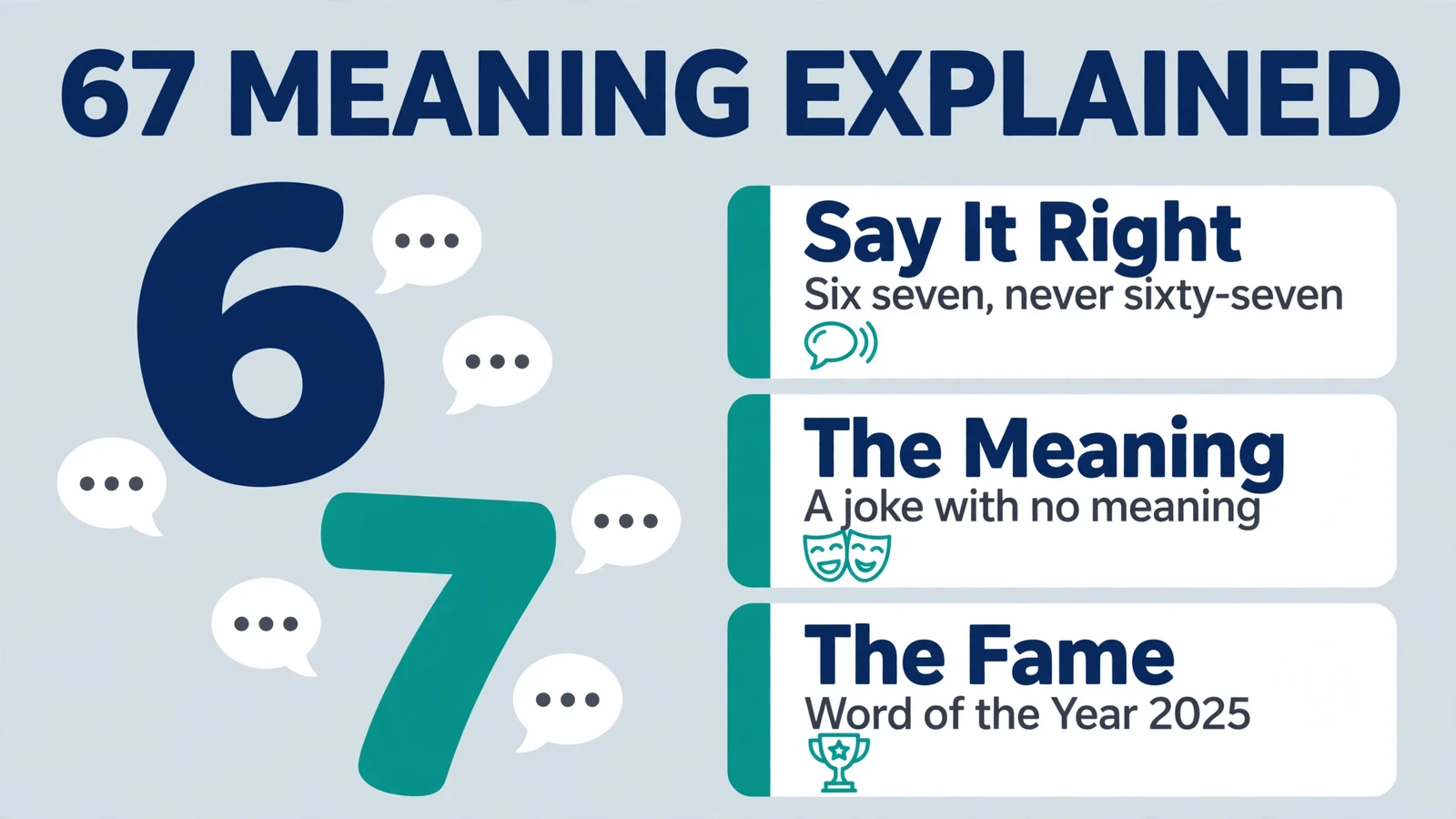
A teacher says “turn to page 67”. And the whole class erupts: “six seven!” A scoreboard, a price tag, a maths answer of 67 percent, any of them can set it off. If you are wondering what 67 means, here is the honest answer up front. It is a viral slang interjection from a rap song and a basketball meme, and it has no fixed meaning. That is not a gap in the definition. That is the definition.
The term, pronounced “six seven” and never “sixty-seven”, became so unavoidable that Dictionary.com chose 67 as its 2025 Word of the Year.
This guide was built from the record: the dictionary entries themselves, the song. And reporting by NPR, The Wall Street Journal, The Guardian and others. Below: the meaning, the gesture, the song, the basketball player, the kid who became its face, the school bans. And the Word of the Year story, checked against real sources.
What Does 67 Mean?
Let us give you the dictionary answer first, because two major dictionaries have now written one.
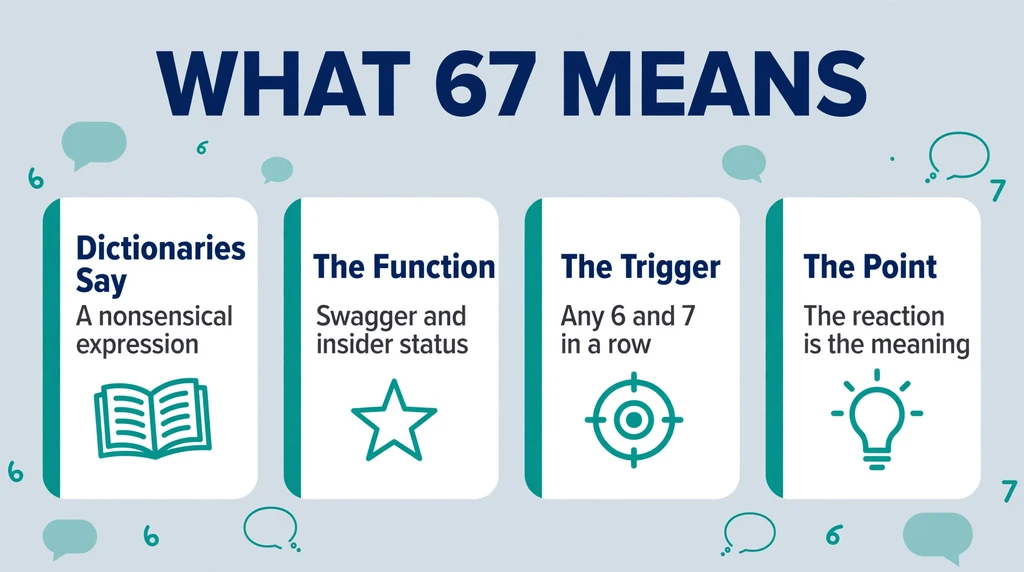
Merriam-Webster defines “six seven” as slang “used as a nonsensical expression especially by children and young teenagers (as upon hearing or seeing the numbers 6 and 7 in succession) and often accompanied by up-and-down hand gestures as if weighing two options.”
Dictionary.com’s main entry defines 67 as an interjection “used to indicate swagger or insider status in internet and youth culture”. And its slang guide calls it “a viral, ambiguous slang term” that is “largely nonsensical”.
Put together, the working definition is this. 67 is a nonsense interjection that children and young teenagers shout for fun, to signal that they are in on the joke. It can be an exclamation, a celebration, a greeting, or a deliberately empty answer to any question at all. “How was school?” “Six seven.” “What is 120 minus 53?” “Six seven.” The less sense it makes, the funnier it is to the people saying it.
Three usage rules matter more than any definition:
- It is a group signal. Saying 67 announces membership. The meaning is not in the number; it is in the shared reaction, the laughter and the fact that every adult in the room is confused.
Does 67 mean “so-so”?
Sometimes, a little, and never officially. Dictionary.com’s slang entry notes that some people read 67, especially with its hand gesture, as “so-so” or “maybe this, maybe that”, a shrug expressed in numbers. It is a loose, retrofitted reading that clings to the gesture, not the core meaning. It is also not a rating. Despite the obvious temptation, 67 is not a settled slang term for “six or seven out of ten” or a new word for “mid”. When a basketball prospect in the meme’s orbit rated a drink by saying “six, seven”, he was doing the joke, not filing a review.
Why This Number? The Sound of Six Seven
It is worth asking why 6-7, of all digit pairs, caught. Part of the answer is musical. “Six seven” is two crisp syllables with a hard stop in the middle, easy to chant in unison, easy to fit on a beat. And punchy enough to survive being shouted across a playground. Part of the answer is visual: 6 and 7 sit side by side in the number line. So the pair appears naturally everywhere, in sequences, scores, heights, ages and prices, giving the joke a thousand daily triggers that a rarer pair like 4-9 could never match. And part of the answer is that the numbers meant something to the two source texts. A height on a roster and a hook on a record. Memes need raw material with handles, and 6-7 came with two.
How 67 Is Used: A Field Guide
Outsiders always ask for a translation. The honest field guide is a list of occasions, because the occasion is the meaning.
As a non-answer. Any question can be answered “six seven”: your age, the time, the score, how the exam went. The emptier the fit, the better the joke lands. Dictionary.com’s own usage entry documents questions being answered this way as standard practice.
As a sighting ritual. The numbers 6 and 7, or the number 67, appearing anywhere in the wild is an event. Page 67 of a book, 6:07 on a clock read carelessly, a 67 percent charge on a phone, seat 67, bus 67. The spotter announces it, and everyone in the know reacts. Think of it as birdwatching, except the bird is printed on everything.
67 as a Greeting and Celebration
As a greeting and celebration. A chant of “six seven” works the way a team chant does. After a goal, at a party, in a group photo. It says we are the people who know this.
In text. Typed “67” or “6-7” in a chat, it carries the same charge with no sound at all. A reply that answers nothing, teases gently, and confirms the sender is current. In text it is also the safe version for classrooms, since nobody can ban a typed number without banning arithmetic.
On the calendar. Merriam-Webster’s citations include the playful date use “Happy 6/7” on June 7, when the date itself becomes the joke. Brands noticed the same trick: McDonald’s UAE ran its promotion under a “6(7)” sticker, squeezing the digits into the logo.
The spellings follow the platforms: 6-7 is the form dictionaries and newspapers prefer, 67 is the form the Word of the Year took and the one children type. And six seven is how it is spoken and how Merriam-Webster files its entry. All three are the same animal.
The 67 Hand Gesture
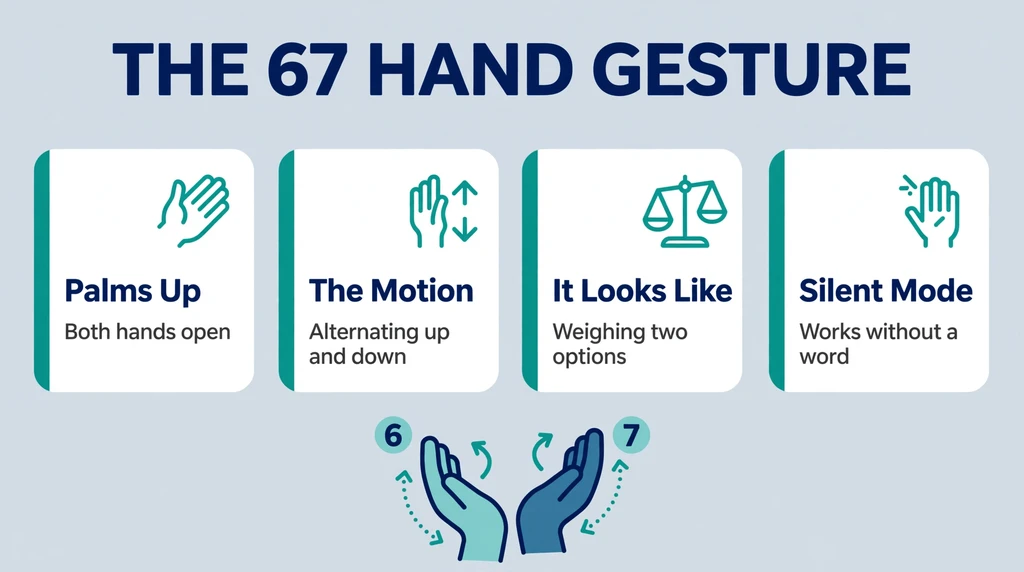
Half of the meme is silent. The gesture, described by Merriam-Webster as hands moving up and down “as if weighing two options”, works like this. Both palms turn face up, fingers loose. And the hands bob alternately, left down right up, right down left up, like an old fashioned balance scale or a juggler keeping two invisible balls in the air. A common variant raises one palm per number, one hand for the six, the other for the seven.
The gesture matters for three reasons. It lets the joke travel where shouting cannot: across a classroom, during a test, in a family photo. It supplies the “so-so” reading, since weighing hands look like indecision. And it gives the meme a physical trademark as recognisable as any dance. This is why the boy who became the 67 Kid is remembered as much for his pumping palms as for his voice.
Where Did 67 Come From? The Song
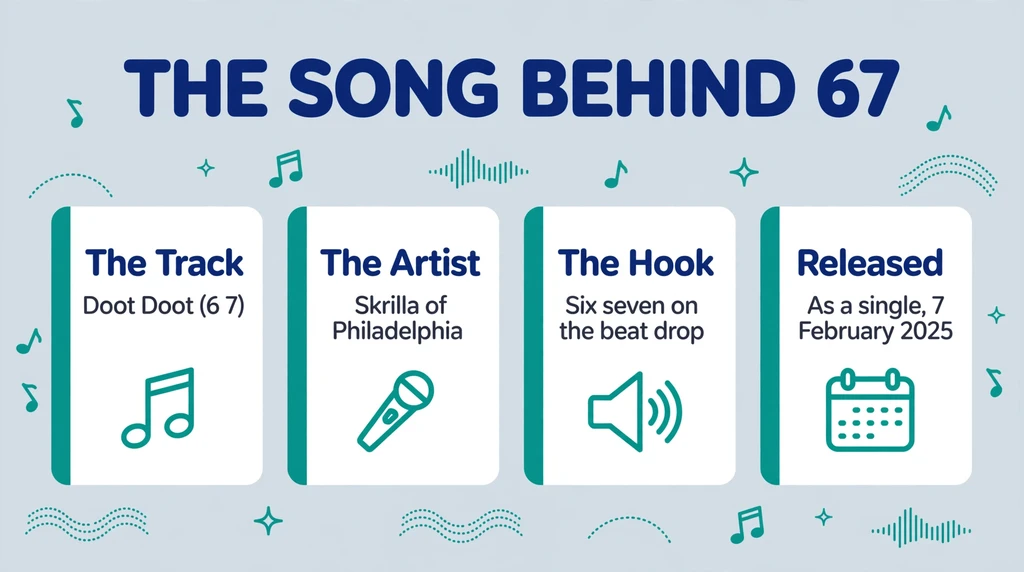
Every account of the term starts with a song. “Doot Doot (6 7)” by Skrilla, a drill rapper from Philadelphia whose real name is Jemille Edwards. The track circulated unofficially in December 2024 and was released officially as a single on 7 February 2025.
In the hook, Skrilla raps “6-7, I just bipped right on the highway” right as the beat drops. The two numbers land like a punchline in the production, short, chantable. And instantly detachable from the rest of the song. TikTok did what TikTok does: it took the drop and left the song behind. Within weeks, “6-7” was less a lyric than a sound effect looking for places to happen.
Did Skrilla mean anything by it?
Almost certainly not, and he has said so himself. Theories about the lyric spread anyway. Fans connected it to 67th Street in Philadelphia, Skrilla’s home city, or to 67th Street in Chicago, the home of drill music. The linguist Taylor Jones, who studies African American English, offered a darker theory. That the phrase plays on “10-67”. This he described as a police code connected to notifying of a death, fitting the song’s violent lines. Even that theory comes with a caveat attached. In standard police ten-code lists, 10-67 actually means “clear to read net message”, so the connection is contested.
Skrilla has declined to confirm any of it. “I never put an actual meaning on it and I still would not want to,” he told The Wall Street Journal. Later, reflecting on the term’s strange journey, he told XXL that it “changed from a negative thing to a positive” and that “everybody got they own meaning to it, ’cause I never put a real meaning on it.” The creator left the number empty. And a generation filled the emptiness with itself.
The Basketball Connection: LaMelo Ball, TK Kinney and the Edit Wave
A song alone does not explain the wildfire. The second parent of the meme is basketball.
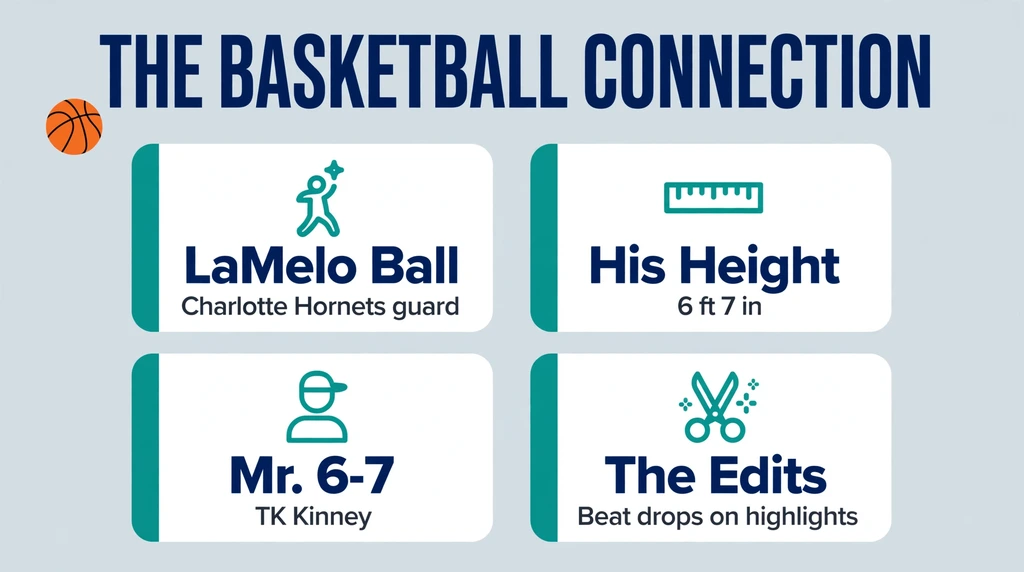
In January 2025, fan editors on TikTok began pairing the “6-7″ beat drop with highlight reels of LaMelo Ball, the Charlotte Hornets point guard who is listed at 6 feet 7 inches tall. The joke writes itself: the song chants six seven, the player is 6’7”. And the drop lands on his best plays. One early viral edit riffed on a commentator’s line that Ball moves like a much shorter guard, “except he’s 6’7″”. From then on, Ball was the meme’s patron saint, whether he wanted the job or not.
Asked about it in a September 2025 TikTok, Ball gave the most honest review the term will ever get. “It’s really nothing though, for real. Just six seven.”
TK Kinney and the Ratings
The other great amplifier was younger. Taylen “TK” Kinney, a player in the Overtime Elite league, went viral for rating things in the meme’s rhythm, most famously rating a Starbucks drink by chanting “six, seven”. His constant use of the phrase earned him the nickname “Mr. 6-7”, a New York Times profile, and eventually his own 6-7 branded canned water line. Kinney turned a joke into a personal brand while still a teenager. This tells you something about the economy this slang circulates in.
From there the term walked through professional sport generally: NBA highlight culture, WNBA press conferences, NFL touchdown celebrations. LeBron James and Paige Bueckers were both reported using it in interviews. Shaquille O’Neal appeared in a 6-7 video while openly admitting he did not understand it, a combination that fairly summarised the adult experience of 2025.
Why basketball, of all sports? Partly the coincidence of one player’s height, but mostly the format. Highlight edits are built around beat drops. And “Doot Doot” has a beat drop with a chant sitting exactly on it. Editors could sync the numbers to dunks, crossovers and buzzer beaters with no editing skill beyond timing. This meant thousands of versions appeared in weeks. Basketball also supplied the meme’s second stage: arenas are full of numbers, scores, shot clocks, jersey numbers. And every one of them is a fresh occasion for the chant, live and in person.
The 67 Kid
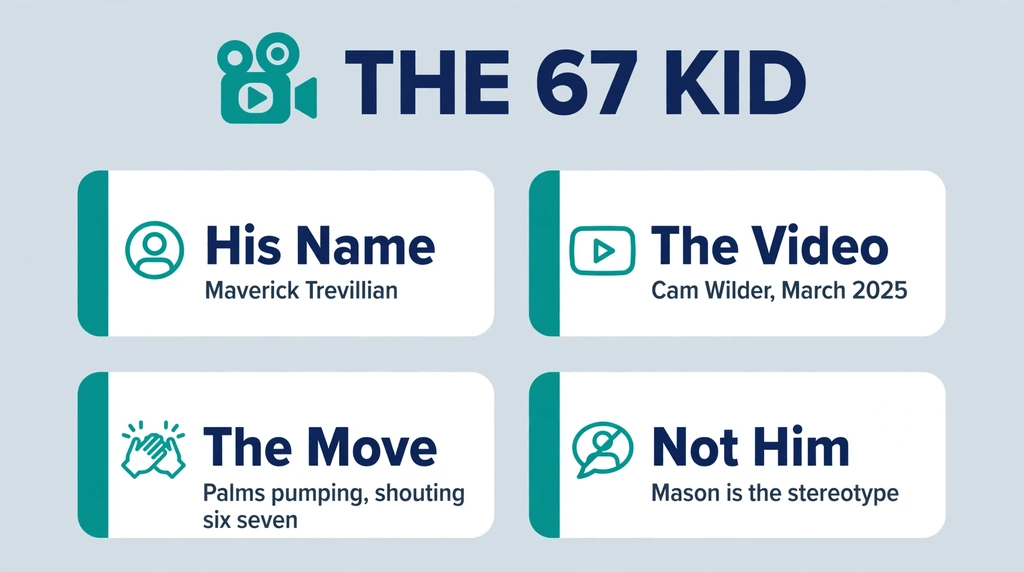
If the meme has a face, it is a schoolboy’s. On 31 March 2025, the basketball YouTuber Cam Wilder posted a video of his AAU team. And in it a boy named Maverick Trevillian leaned toward the camera, pumped both upturned palms up and down. And yelled “six seven” with the delight of a person who has discovered fire. The clip was clipped, reposted and remixed endlessly. Trevillian became the 67 Kid.
Two confusions follow him around, and a good guide should clear both up. First, his name: some explainers call him “Mason”, but Mason is not the boy. “Mason” became a separate stereotype name for the generic boy who overuses the slang, the way other eras used their own stock names. The 67 Kid’s name is Maverick Trevillian. Second, the horror edits: in August 2025, grotesque analog horror remixes of his clip circulated under the name “SCP-067 Kid”, borrowing the style of the SCP Foundation fiction project. For the record, the actual SCP-067 in that fictional archive is an anomalous fountain pen. The horror version is internet remix culture doing to the 67 Kid what it does to everything it loves.
Why Do Kids Say 67?
This is the question underneath the search, usually typed by a parent or teacher at the end of a long day. The experts who have weighed in give a consistent answer, and it is kinder than the behaviour feels.
It is a belonging machine. Dr Becky Kennedy, the parenting psychologist, told NPR that the term is “meaningless in content. But not meaningless in feeling.” Saying 67 costs nothing, requires nothing. And instantly proves you are inside the group and the adults are outside it. For children forming their first independent culture, that is not a small thing. That is the whole thing.
It is anti-adult humour, safely. The joke’s only victim is adult comprehension. It breaks no rule by itself, contains nothing rude. And cannot be confiscated, which is precisely why confiscation attempts make it funnier. The Washington Post’s verdict on the phenomenon was that “it’s really beautiful because it’s dumb.”
Endlessly Available
It is endlessly available. Most slang needs a situation. 67 needs only the numbers 6 and 7, which are printed on everything. The world supplies fresh occasions for the joke all day long, in every classroom, shop and stadium, forever.
It feels like theirs. Commentators at Business Insider and elsewhere have framed 67 as Generation Alpha’s first signature slang, the moment the youngest generation stopped merely inheriting internet culture and started minting it, the way skibidi marked the same arrival two years earlier. Children can feel that status even if they would never put it in those words.
So when your child shouts “six seven” at a page number, they are not communicating information and they are not, usually, mocking you personally. They are doing a tiny public ritual that says: I know, you know, and they do not. It will pass. The generation before them had its own rituals, and so did you.
A word about “brain rot”
You cannot read about 67 for long without meeting the phrase brain rot, the umbrella term for online content that spreads through repetition and absurdity rather than meaning. The phrase itself was Oxford’s Word of the Year for 2024. And 67 is routinely filed under it, by Business Insider, by Smithsonian Magazine’s coverage. And by Dictionary.com, which used the phrase in its own Word of the Year announcement. The label sounds like a diagnosis. But the lexicographers use it descriptively: this is media whose pleasure is in the sharing, not the sense. Skibidi walked this road two years earlier. Six seven is the same road, with better paperwork.
Generation Alpha’s First Word
Every generation gets a slang term that announces it. For Generation Alpha, the cohort now in primary and middle school, commentators keep nominating the same one. Business Insider framed 67 as a sign of Gen Alpha’s growing influence on internet culture. And Wikipedia’s account of the term treats it as the generation’s signature. It was initially credited to Gen Z, the older siblings, before the reporting caught up with the playgrounds. This one belongs to the younger children. And it may be the first piece of global slang that does.
The detail that gives the story its edge is the “Mason” stereotype, the stock name for the boy who says 67 too much. A generation minting slang and a mocking name for its own overusers at the same time is a generation already developing an internal culture, complete with insiders, outsiders and its own critics. Teachers who post about the trend, like the middle school teacher and comedian Philip Lindsay, describe the same thing from the other side of the desk. A complete little civilisation, with six seven as its flag.
67 in Schools: The Bans, the Essays and the Fake Tickets
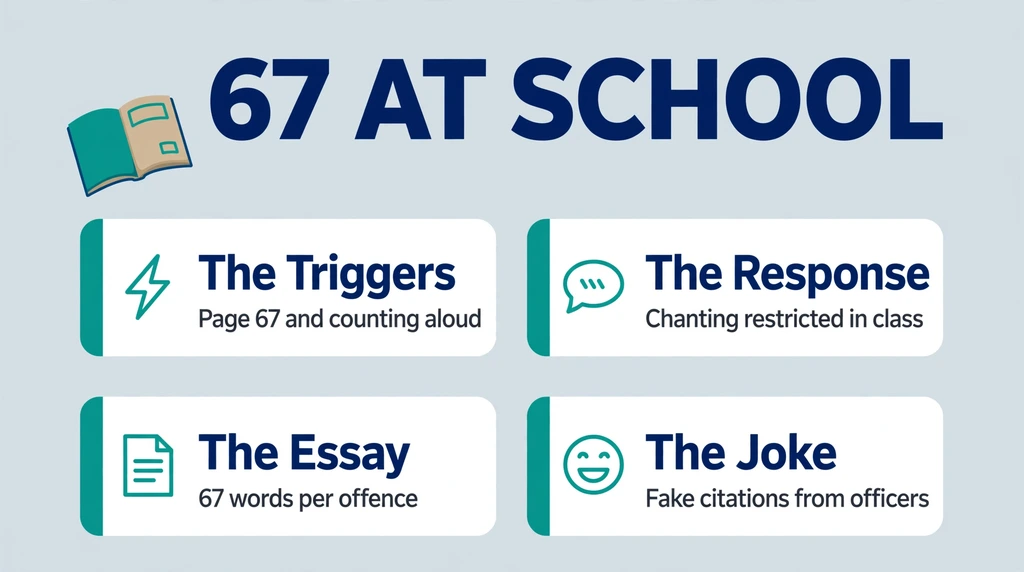
Nowhere did the joke land harder than in school, for a simple reason: schools are full of numbers. Page 67 in the textbook. Counting aloud. A test question whose answer is 67. A height chart, a bus number, a register. Teachers found their lessons booby trapped.
Coverage tells the story in headlines alone. The Guardian called 67 “the bane of school teachers everywhere”. The Wall Street Journal reported that “the numbers six and seven are making life hell for math teachers”. Fast Company wrote that the term was “so annoying that schools are banning it”. Individual teachers went on record: Adria Laplander, a Michigan sixth grade teacher with twenty years of experience, told TODAY.com that “nothing has driven me crazier than this one”. Others described removing the numbers six and seven from lessons entirely, or never asking a question whose answer could be 67.
Bans and Restrictions
Schools and teachers in the United States and the United Kingdom banned or restricted chanting “6-7” in class. And the punishments became part of the lore. One teacher required an essay of exactly 67 words on what 67 means for every offence, rising to 670 words after five offences. Another set lines in matching numbers: write the promise six times, then seven, then 67. In Indiana, the Tippecanoe County Sheriff’s Office leaned the other way and turned enforcement into a joke, posting a video of school officers handing students fake citations for saying “6-7”, a bit later mentioned on Saturday Night Live.
Plenty of teachers chose the third option and joined in, filming themselves doing the hand gesture with their classes while counting. Their calculation was sound: a meme the teacher performs is a meme half defused.
It is worth being precise about what is being banned. Nobody has outlawed a number. Schools restrict the chanting and the disruption, in maths lessons the number 67 remains stubbornly itself. And the distinction is one even most of the chanting children understand perfectly well.
A Parent’s and Teacher’s Playbook
If the chanting has reached your house or classroom, the record of 2025 offers some tested options. None of them involves understanding the joke, which is fortunate, because there is nothing to understand.
Do not ban the number; manage the noise. Every successful school response treated 67 as a disruption issue, not a content issue. Lessons, exams and quiet reading get protected; the chant itself, at break time, mostly burns itself out.
Use the joke once, then retire it. The teachers who filmed themselves doing the hand gesture with their classes were not surrendering. A meme performed by authority loses its outlaw charge, and children move on to fresher contraband. The Indiana sheriff’s office fake citations worked the same way: authority laughing first.
Answer like Dr Becky. The parenting guidance that travelled furthest came from psychologist Becky Kennedy. Treat the term as “meaningless in content, but not meaningless in feeling”. The content is nothing; the feeling is belonging. Responding to the feeling, with curiosity rather than panic, is the whole technique.
Wait it out. Slang of this intensity has a short half life. The generation chanting six seven will be rolling its eyes at the next number within a school year or two. And will then have to explain to you, with great embarrassment, what 67 used to mean. Save this article for them.
Word of the Year: How a Non-Word Won 2025
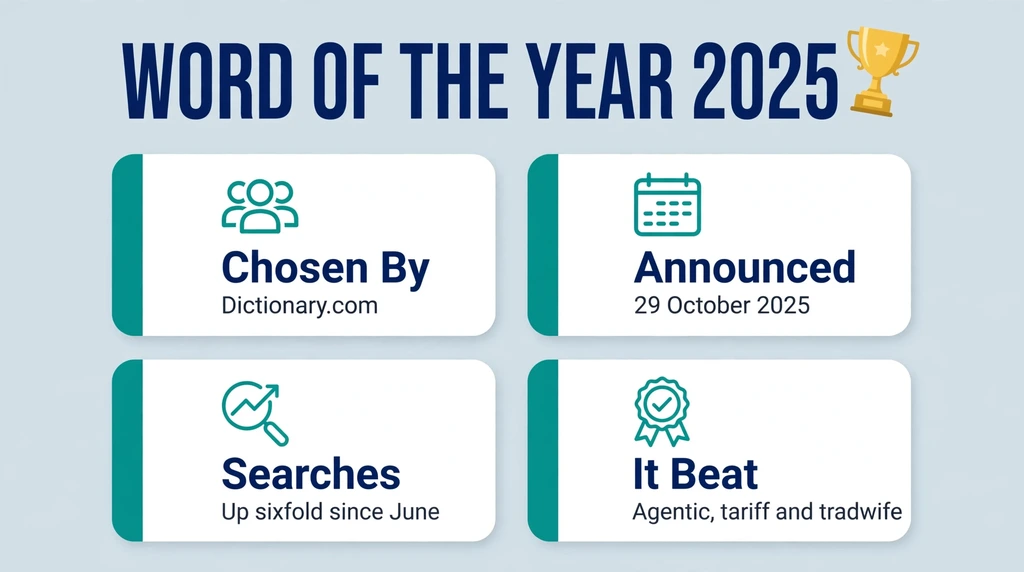
On 29 October 2025, Dictionary.com announced its Word of the Year: 67. Searches for the term on the site had surged more than sixfold since June. And the announcement reached a verdict that doubles as this article’s thesis. “Perhaps the most defining feature of ’67’ is that it’s impossible to define,” the announcement said. “It’s meaningless, ubiquitous and nonsensical. In other words, it has all the hallmarks of brain rot.”
To win, 67 beat a formal shortlist of agentic, aura farming, overtourism, tariff and tradwife, a list that reads like a summary of the adult world’s 2025. Steve Johnson, Dictionary.com’s director of lexicography, explained the choice by calling 67 “one of the first Words of the Year that works as an interjection, a burst of energy that spreads and connects people long before anyone agrees on what it actually means.”
The lexicographers’ case is that this is what language looks like when a new generation starts flexing its muscles. In short, the point of the word is not reference, it is recognition. The critics’ case, aired in the same coverage, is that a dictionary has crowned a shrug. Both cases are honestly held, and both are partly right. This is why the announcement generated more argument than any Word of the Year in years. Meanwhile Merriam-Webster simply got on with it and gave “six seven” a full dictionary entry, first known use 2025, etymology: Skrilla’s song. Between the two dictionaries, 67 achieved in ten months what most slang never achieves at all: paperwork.
67 Everywhere: South Park, Burgers and Video Games
By the autumn of 2025 the term had escaped schools and colonised general culture. South Park built its Season 28 premiere, “Twisted Christian”, aired on 15 October 2025, around the meme, portraying elementary students as if brainwashed by 6-7 and lampooning both the trend and the adults panicking about it. When South Park and the sheriff’s office are doing the same bit, a meme has achieved total coverage.
Brands moved in, as brands do. In-N-Out Burger quietly removed the number 67 from its order calling system, skipping from 66 to 68, after teenagers began gathering in restaurants purely to erupt when the number was called. Pizza Hut sold wings for 67 cents. Domino’s ran a pizza deal priced at 6.70 dollars. McDonald’s in the UAE gave away free nuggets between 6 and 7 in the evening. Video games, whose players overlapped with the meme’s inventors, added official 67 emotes. Clash Royale in October 2025, after reaching 6.7 million Instagram followers, and Overwatch 2 the following month.
Read that list again and notice what it means. A lyric with no meaning, attached to a basketball player’s height, chanted by children at page numbers, is now load bearing in the marketing of burger chains and the patch notes of major games. This is what a fully mainstream meme looks like in 2025: not a joke everyone has heard. But infrastructure everyone has to plan around.
The Variants: 41, 61 and the Number Meme Pattern
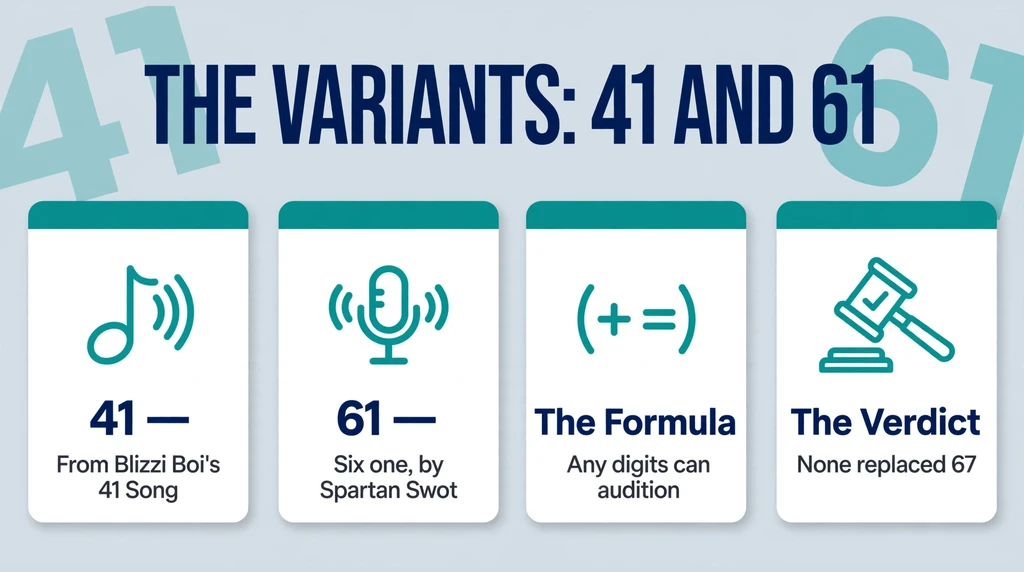
Success breeds sequels. Two direct descendants followed the forced number formula. 41 comes from rapper Blizzi Boi’s “41 Song (Saks Freestyle)” and was covered by TODAY as “the new 6-7”. 61, pronounced “six one”, is credited to the creator Spartan Swot. Meme trackers list further attempts, including 93, none of which has dethroned the original.
Know Your Meme also tracks the smaller fry the original spawned: a “67 handshake”, a “6/7 weekend” micro trend. And number siblings auditioned by other creators. None stuck. The pattern is the point. A number meme is a template: any digits can be fed into it, and the community will audition them. Most fail, because the joke was never the digits. It was the song, the player, the kid, the gesture and the year, arriving together. Variants can copy the numbers; they cannot copy the moment.
Is 67 a Bad Word?
No. This is the shortest answer in this guide. And parents may want it in writing: 67 is not a swear word, not an insult. And not coded hate speech in any reliable source. It carries no profanity and targets no one. The darkest threads attached to it are unconfirmed theories about what a rap lyric might reference, speculation about a song. This say nothing about what a ten year old means when chanting it in a corridor, which is nothing, on purpose.
One nuance is worth naming, because it causes most of the actual friction. The word is harmless, but the performance has a time and place. And children know this perfectly well, which is half the fun. The chant during a maths test or the gesture in the middle of a formal school photograph is a manners question, not a language question. And it is best handled as one: nobody is corrupted by a number. But everybody has to learn when a joke is welcome.
The practical guidance follows from that. The word itself is harmless; the disruption is the only real issue. And schools are handling it as a disruption issue, with bans on chanting rather than on vocabulary. At home, the evidence of 2025 suggests that joining in occasionally deflates it faster than banning it. And that every generation’s nonsense sounds like the end of language to the generation before it. Sixty-seven is just a number. “Six seven” is just a generation saying hello to itself.
The 67 Timeline
- December 2024: Skrilla’s “Doot Doot (6 7)” circulates unofficially.
- January 2025: TikTok editors fuse the song’s beat drop with LaMelo Ball highlights.
- 7 February 2025: The song is released officially as a single.
- 31 March 2025: Cam Wilder’s AAU video makes Maverick Trevillian the 67 Kid.
- August 2025: The SCP-067 Kid horror edits circulate.
- 15 September 2025: Dictionary.com publishes its slang entry on 67.
- 15 October 2025: South Park’s Season 28 premiere is built around the meme.
- 29 October 2025: Dictionary.com names 67 its Word of the Year for 2025.
- November 2025: In-N-Out removes order number 67. Pizza Hut, Domino’s, McDonald’s UAE, Clash Royale and Overwatch 2 run 67 promotions and emotes.
67 in Sentences
- “The bus erupted when the scoreboard hit 67, and the driver just sighed.”
- “Asked what he wanted for his birthday, my son said ‘six seven’ and did the hands.”
- “She answered every question on the car ride with 6-7, including ‘are we there yet’.”
- “The whole class whispered it when the teacher wrote page 67 on the board.”
- “He rated my cooking a ‘six, seven’ and thought this was generous.”
Frequently Asked Questions
What does 67 mean?
67, pronounced “six seven”, is a viral slang interjection used mainly by children and young teenagers. It comes from Skrilla’s song “Doot Doot (6 7)” and LaMelo Ball highlight edits. And dictionaries confirm it has no fixed meaning. It is an inside joke and a sign of belonging, often paired with an up and down hand gesture.
Why do kids say six seven all the time?
Because it signals membership. Saying 67 proves a child is in on the joke, needs no context, and baffles adults, which is the point. Parenting experts describe it as meaningless in content but meaningful in feeling: a small ritual of belonging for Generation Alpha.
Where did 67 come from?
From the drill song “Doot Doot (6 7)” by Philadelphia rapper Skrilla. This circulated in December 2024 and was released as a single on 7 February 2025. It fused with TikTok edits of Charlotte Hornets guard LaMelo Ball, who is 6 foot 7, in January 2025, and spread from there.
Who is the 67 Kid?
Maverick Trevillian, a schoolboy who yelled “six seven” at the camera while pumping both palms up and down in a Cam Wilder AAU basketball video posted on 31 March 2025. The clip became the meme’s defining image. “Mason”, by contrast, is a stereotype name for any boy who overuses the slang, not the kid himself.
What is the 67 hand gesture?
Both palms face up and bob alternately up and down, as if weighing two objects. Merriam-Webster uses exactly that description in its dictionary entry. A variant raises one palm for the six and the other for the seven.
Is 67 a bad word?
No. It is not profanity, not an insult and not a slur. Schools that restrict it are restricting the chanting and classroom disruption, not the word itself. And the number 67 has of course not changed its meaning in mathematics.
Why was 67 named Word of the Year 2025?
Dictionary.com chose it on 29 October 2025 after searches surged more than sixfold since June. The site called it impossible to define, meaningless, ubiquitous and nonsensical. And argued that this made it the perfect emblem of how Generation Alpha uses language: connection first, meaning optional.
What does 41 mean in slang?
41 is a follow up number meme in the same forced pattern as 67, taken from Blizzi Boi’s “41 Song (Saks Freestyle)”. Like 67, it is used as a nonsensical chant and inside joke rather than a word with a definition. A second variant, 61 (“six one”), is credited to creator Spartan Swot.
Conclusion
Sixty-seven is a perfectly ordinary number that does its work in maths and never asked for fame. “Six seven” is something else entirely. A lyric fragment and a basketball player’s height that fused on TikTok into the defining slang of 2025, a chant with a hand gesture, a classroom menace, a burger chain incident. And a Word of the Year that dictionaries admit they cannot define. It means swagger, belonging, so-so, celebration and absolutely nothing, all at once, depending on which child is shouting it. That is not a failure of the English language.
One day soon, the children chanting it will be explaining it, slightly embarrassed, to younger cousins who find it ancient, the way every generation inherits and then retires its nonsense. The dictionaries, characteristically, will keep the fossil. Six seven, interjection, first known use 2025, a burst of energy that connected people long before anyone agreed on what it meant. They never did agree. That was the meaning. That is the English language doing what it has always done in the mouths of the young. And 67 is simply the loudest proof of it in years.