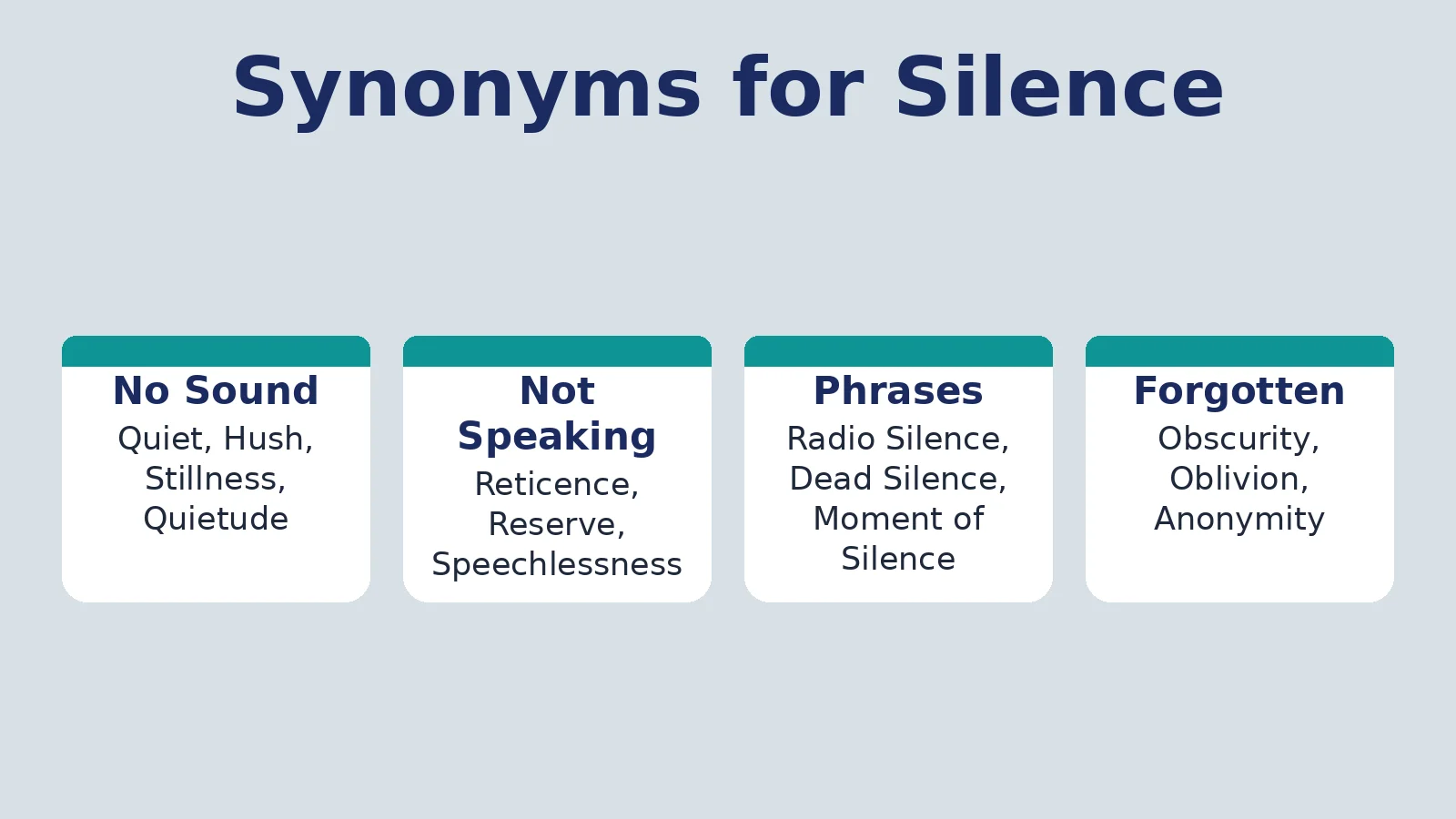
Silence sounds simple until you try to describe it. The silence of a snowy field, the silence of a friend who will not answer, and the silence of a library at midnight are three different things, and plain silence flattens them all. The most useful synonyms for silence include quiet, hush, stillness, quietude, lull, peace, reticence, reserve, and speechlessness, and each one points at a different kind of nothing. Hush is gentle and shared. Stillness adds the feeling that nothing is moving either. Reticence is a person choosing not to speak.
This guide sorts more than 40 synonyms for silence by sense, from the absence of sound to the refusal to speak. Every word carries a short meaning, the phrases writers actually use get their own sections, and the key entries add examples. By the end, you will know exactly which word your silence needs.
Top Synonyms for Silence: Quick Reference
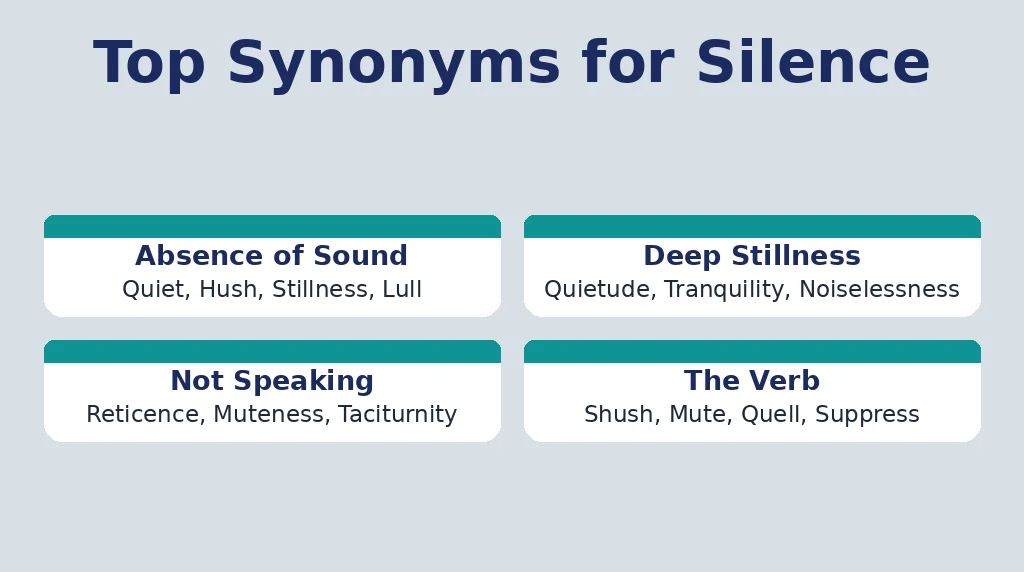
The table below gathers the 24 synonyms readers reach for most often. Use it for a fast swap, then read the grouped sections for the finer shades.
| Word | Meaning in one line | Best for |
|---|---|---|
| Quiet | Little or no sound; the state of it | Everyday all-purpose use |
| Hush | A gentle, sudden stillness | Crowds settling, libraries |
| Stillness | No sound and no movement | Scenes, nature, held moments |
| Quietness | The quality of being quiet | Neutral descriptions |
| Quietude | Deep, restful stillness (noun) | Formal and literary writing |
| Lull | A temporary period of calm | Storms, battles, conversations |
| Calm | Freedom from noise or disturbance | Weather, rooms, moods |
| Peace | Quiet freedom from disturbance | Places, rest, treaties |
| Tranquility | A state of deep calm | Landscapes, retreats |
| Peacefulness | The quality of being peaceful | Settings, atmospheres |
| Noiselessness | The complete absence of noise | Technical, exact descriptions |
| Still | Without sound or motion (also adjective) | Poetry, night scenes |
| Speechlessness | Being unable to speak | Shock, awe, grief |
| Muteness | Inability or refusal to speak | Formal, clinical writing |
| Voicelessness | Having no voice, literal or political | People, groups, writing |
| Reticence | Holding back from speaking | Colleagues, interviews, diplomacy |
| Reserve | Restrained, unspeaking manner | Characters, professionals |
| Taciturnity | The habit of saying very little | Formal character description |
| Obscurity | Being unknown and unnoticed | Careers, books, artists |
| Oblivion | Being completely forgotten | Fame, history, endings |
| Anonymity | The state of being unnamed | Crowds, sources, donors |
| Shush | To tell someone to be quiet (verb) | Libraries, cinemas, parents |
| Mute | To deaden sound; also silent (verb) | Devices, instruments, reactions |
| Suppress | To stop something by force (verb) | News, dissent, evidence |
What Does Silence Mean?
Silence is the near or complete absence of sound. Merriam-Webster puts it exactly that way, and the word near matters more than readers expect. A forest at dawn is silent in everyday speech, even though a single bird can call without breaking the spell. True, measured silence exists mainly in laboratories and soundproofed rooms.
The word carries a second, human sense as well. Silence also means not speaking, whether by choice, by shock, or by rule. A witness can fall silent. A government can answer questions with silence. A friend can punish you with it. This is why the synonyms split so cleanly: one family describes ears, and the other describes tongues.
A third sense hides in plain sight. A career, a book, or a whole town can sink into silence, meaning obscurity, when the world stops paying attention. The grouped sections below follow those three senses in order, then cover the verb. One comparison is worth fixing now: quiet allows soft sound, while silence, strictly used, allows almost none. The adjective side of that line is covered in our guide to synonyms for quiet.
Silence can even be a command. Judges, teachers, and examiners still call “Silence!” when a room must stop at once, and older courtrooms treated the word as an order rather than a description. That small usage explains the word’s authority: few nouns can walk into a noisy hall and end the noise by being named.
Synonyms for Silence as the Absence of Sound
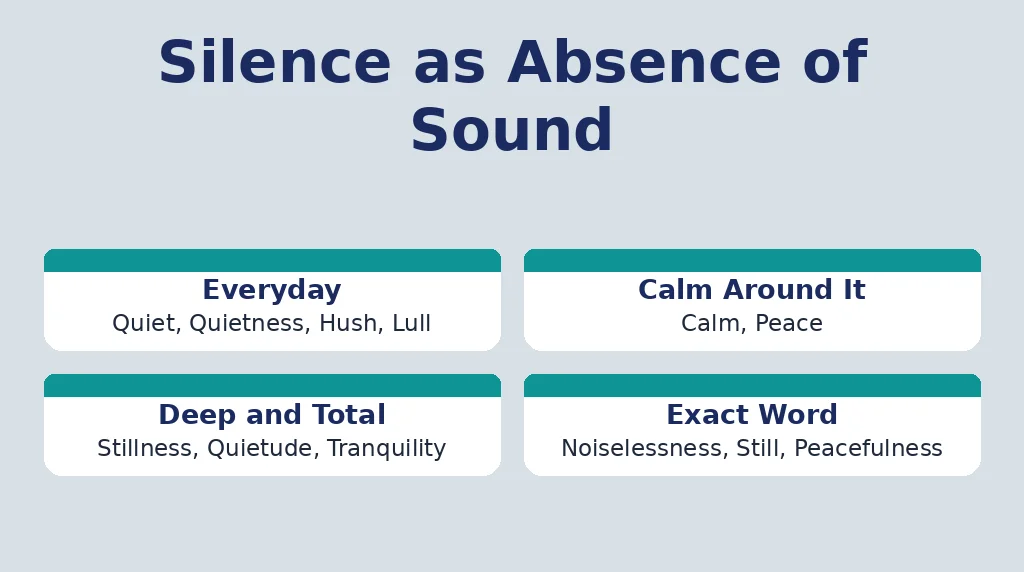
This is the home sense: a place or moment where sound drops away. The music stopped suddenly, a door closed, and suddenly the ears notice the nothing. These words describe that nothing at different depths.
Everyday Stillness
Most real silences are gentle and incomplete. A few distant sounds remain, yet the overall feeling is rest. These are the words for that everyday depth.
- Quiet: little or no sound; the most flexible word in this family. Example: The quiet of the house settled over her.
- Quietness: the quality or state of being quiet. Example: The quietness of the ward helped the patients rest.
- Hush: a sudden, gentle stillness that falls over people or a place. Example: A hush fell as the bride entered.
- Lull: a temporary period of calm between bursts of activity. Example: In the lull between storms, they repaired the roof.
- Calm: freedom from noise, wind, or disturbance. Example: The calm after the festival felt unreal.
- Peace: quiet combined with freedom from trouble. Example: She moved to the hills for some peace.
Deep and Total Silence
When writers want the floor of the scale, they reach for stronger words. These suggest that even the smallest sound would feel like an event.
- Stillness: no sound and no movement together. Example: The stillness of the frozen lake held all afternoon.
- Still: without sound or motion, often poetic. Example: In the still of the night, the house creaked once.
- Quietude: deep, restful stillness, formal and literary. Example: The quietude of the chapel suited the ceremony.
- Tranquility: a state of deep, settled calm. Example: The tranquility of the valley surprised the city visitors.
- Peacefulness: the quality of being peaceful, gentle rather than total. Example: The peacefulness of the garden slowed everyone’s steps.
- Noiselessness: the complete absence of noise, exact and technical. Example: Engineers tested the room for noiselessness.
Modifiers do much of the work at this depth. Total silence, complete silence, and dead silence all promise the maximum. Writers should keep that promise: if a clock ticks two lines later, the silence was only ever a hush.
Silence in Nature
Nature supplies the deepest everyday silences, and it cheats slightly to make them. Fresh snow absorbs sound instead of reflecting it, which is why a field after snowfall feels muffled and still at once. Desert nights come close too, once the wind drops and the animals settle.
Altitude and water play their parts as well. High mountain air carries few sounds and few creatures to make them, while the world under deep water slows every noise to a murmur. Writers describing these places reach for stillness and quietude, because hush belongs to rooms full of people, and nobody is there to hush.
Silence in Writing: Literary Words and Phrases
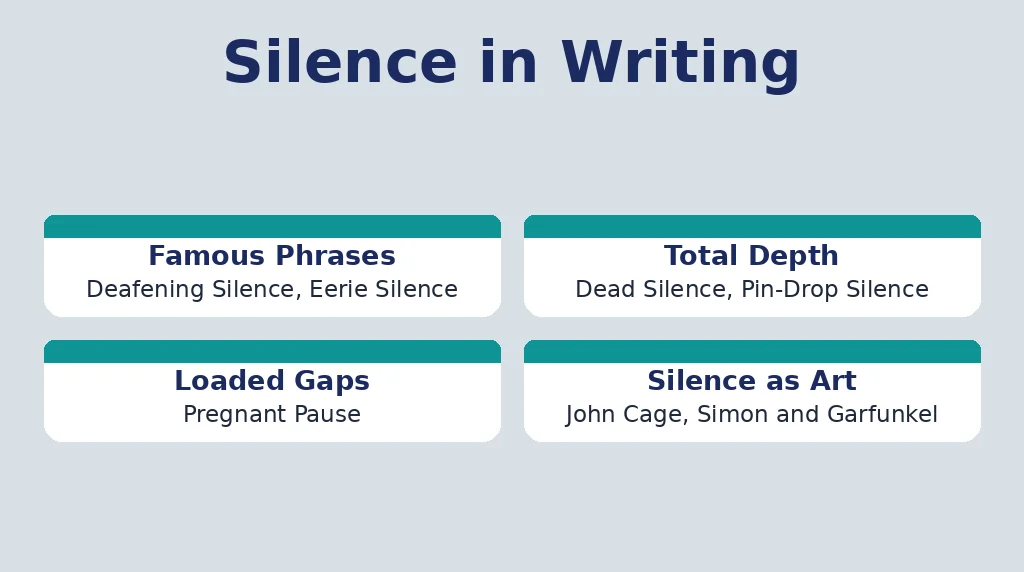
Poets and novelists rarely leave silence bare. They dress it in phrases that give the nothing a texture, a temperature, or a threat. These phrases are not strict synonyms, but they are what strong writing actually uses, so they earn their own section.
Phrases That Paint Silence
Deafening silence is the most famous of them all. It is an oxymoron, a figure of speech that joins opposites, and it describes a silence so heavy and pointed that it feels loud. Use it when people expected a reply: the question hung in the air, and the deafening silence answered it.
Eerie silence adds unease. It belongs in streets that should be busy, houses that should be lived in, and forests where the birds have stopped. The word signals that the silence itself feels wrong, as if something has just happened or is about to.
Dead silence promises the absolute zero of sound and reaction. A joke can meet dead silence, and so can a stage at the held second before the curtain rises. It is blunt, complete, and slightly theatrical.
Pin-drop silence paints the same depth with a picture instead: the room is so quiet that a falling pin would be heard. Teachers and chairpersons ask for it, and audiences, briefly, deliver it.
Pregnant pause is the cousin worth knowing. Strictly it is a pause, not a silence, but writers use it for a gap in speech loaded with meaning. The pause is pregnant because everyone can feel what is about to be born from it: a confession, a verdict, a no.
Silence on Stage and in Song
Two famous works turned silence into art, and both reward a mention. In 1952, the composer John Cage premiered 4’33”, a piece in three movements in which the performer plays nothing at all. Cage had visited an anechoic chamber and heard his own body still making sound, which convinced him that true silence does not exist for living listeners. The piece simply frames the sounds that are already there.
A decade later, Paul Simon wrote the opposite complaint. “The Sound of Silence,” recorded by Simon and Garfunkel in 1964, treats silence as a failure of people to truly speak and listen to each other. Between Cage and Simon, the word covers both a physical fact and a human one, which is exactly the split this guide follows.
Synonyms for Silence as Not Speaking
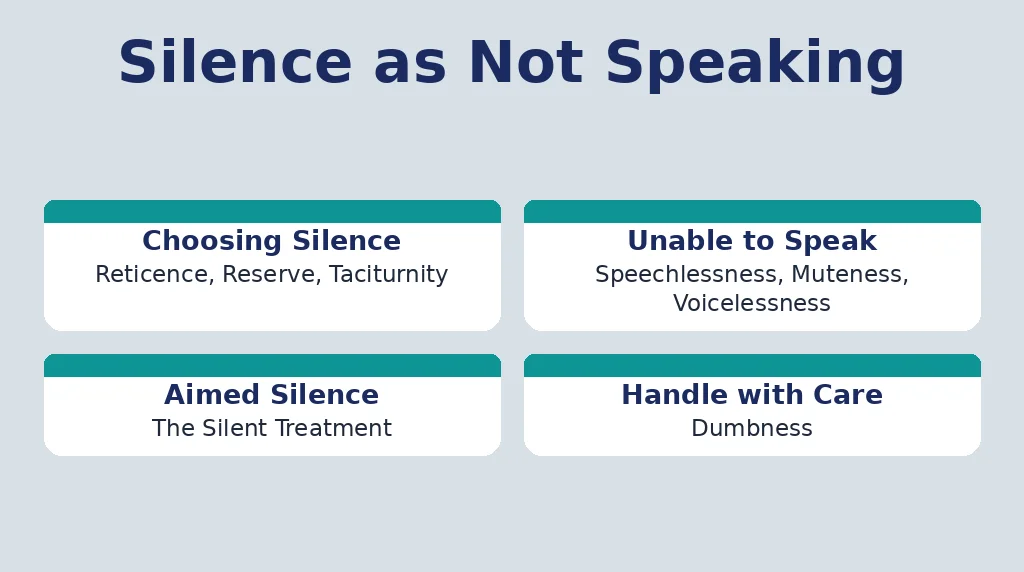
The second family of silence lives in the throat, not the ear. A long silence at the dinner table can make everyone feel the seconds passing, even with the dishwasher humming in the next room. These words describe people who do not speak, and the reasons matter.
Choosing Not to Speak
Chosen silence is a strategy. It can protect privacy, signal displeasure, or simply reflect a temperament that never wastes words.
- Reticence: holding back from speaking, especially about yourself. Example: Her reticence about the deal frustrated the reporters.
- Reserve: a restrained manner that reveals little. Example: He answered the committee with cool reserve.
- Taciturnity: the settled habit of saying very little. Example: His taciturnity was famous across the whole valley.
- Stillness: Merriam-Webster lists it first for this sense too, restraint held in the body. Example: Her stillness during the accusations unnerved everyone.
Unable to Speak
Other silences are not chosen at all. Shock, grief, awe, and the body itself can take the words away.
- Speechlessness: being unable to speak, usually from strong emotion. Example: Speechlessness spread through the room as the results appeared.
- Muteness: the state of not speaking or being unable to speak. Example: The muteness of the witness lasted the whole hearing.
- Voicelessness: having no voice, literally or as a political metaphor. Example: The report describes the voicelessness of seasonal workers.
- Inarticulateness: being unable to express yourself in words. Example: His inarticulateness at the funeral hid a deep grief.
- Dumbness: an old word for this state. Use it with great care: about people, dumb is now dated and offensive, so modern writers choose muteness or speechlessness instead.
The famous social weapon in this family is the silent treatment: refusing to speak to someone as a punishment. Dictionaries record the phrase, and everyone who has met it remembers the weight of a silence that is aimed, not empty.
Comfortable Silence and Awkward Silence
Not all shared silence is hostile, of course. Friends and long-married couples speak warmly of a comfortable silence, the kind where nobody needs to perform. The same word, silence, covers it, and only the surrounding words tell the reader whether to relax.
The awkward silence sits at the other pole. It arrives when a remark lands badly, a joke fails, or strangers run out of road. Writers mark it with the company it keeps: glances, coughs, and sudden interest in the furniture. Naming the type, comfortable or awkward, is often better than hunting for a rarer synonym.
Silence as a Social Signal: Phrases and Customs
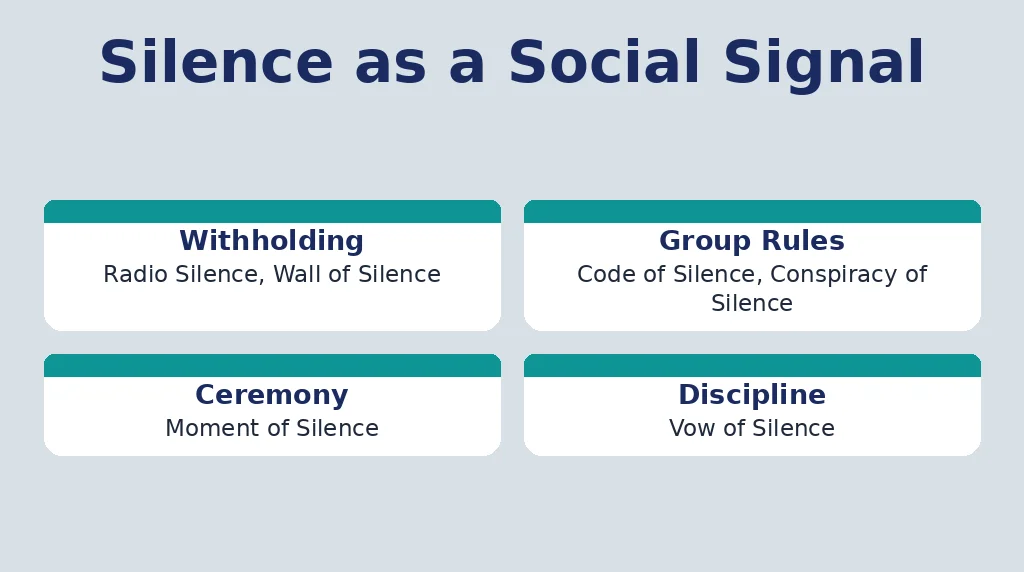
Some silences are not states at all. They are messages, agreements, and rituals that whole groups understand at once. English keeps a small set of set phrases for them, and each one translates a silence into a clear social act.
Withholding: Radio Silence and Walls
Radio silence began at sea, where operators kept scheduled silent periods so faint distress calls could be heard. Today it means a total stop in communication: no calls, no messages, no replies. A friend, a company, or a celebrity can all go radio silent.
Wall of silence describes a group that refuses to give information. Neighbors, teammates, or officials present the wall together, and investigators or journalists report that every question met it. The phrase always implies protection, and often disapproval from the writer.
Code of silence is the rule behind the wall: an unwritten agreement inside a group never to inform on its members. It appears in reporting about crime, but also about offices, regiments, and professions that close ranks.
Ceremony, Discipline and Agreement
Moment of silence is the public, respectful opposite. Stadiums, parliaments, and classrooms hold a short, shared silence to remember the dead or mark a tragedy. Here silence is not withheld speech; it is speech replaced by honor.
Vow of silence is a promise, often religious, to give up speaking for a period or for life. Monks are the classic example, though activists and artists also take temporary vows. Of all the phrases here, this one treats silence as a discipline rather than an absence.
Conspiracy of silence stretches the code of silence across a whole society or profession. It names an unspoken agreement, shared even by outsiders, that some subject will simply not be discussed. Journalists use it when the silence itself becomes the story.
Read these phrases as units, not as synonyms to swap word by word. Radio silence cannot be shortened to radio quiet, and a moment of quiet is just a rest, while a moment of silence is a ceremony.
Silence as a Verb: To Hush, Mute and Suppress
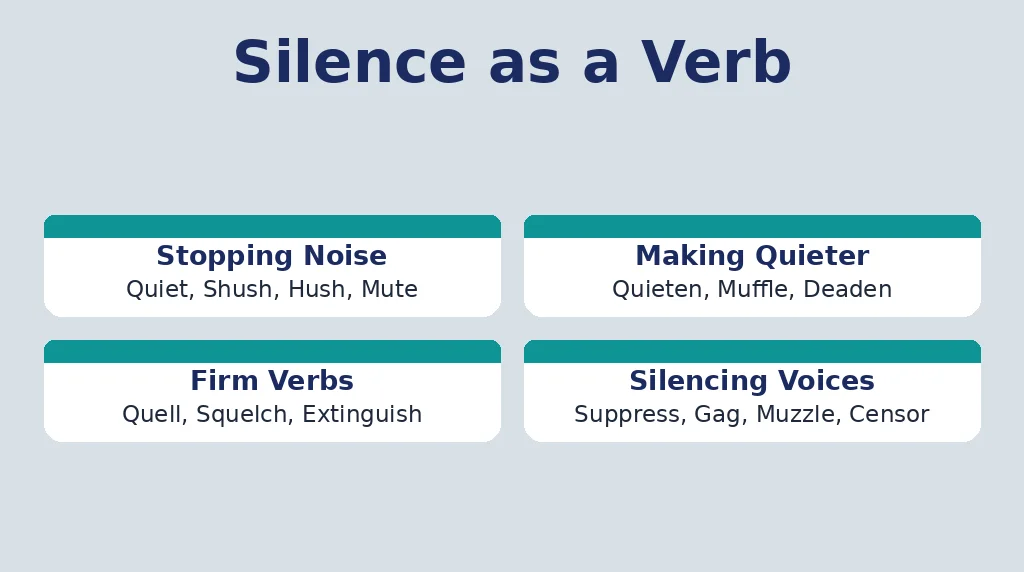
Silence also acts. As a verb it means to stop noise or speech, and its synonyms run from a librarian’s finger to the machinery of censorship. Tone matters enormously in this family, so the groups below run from gentle to forceful.
Stopping Noise and Speech
These are the everyday actions: making a sound, a person, or a device stop.
- Quiet: make or become quiet, the plain all-purpose verb. Example: One look quieted the noisy table.
- Shush: tell someone directly to be quiet, informal. Example: The usher shushed the latecomers.
- Hush: bring to silence, gentler and more literary. Example: A hand on the door hushed the argument inside.
- Mute: deaden or switch off sound. Example: She muted the television during the call.
- Still: make quiet, an old verb still found in poetry and prayer. Example: Be still, the old hymn begins.
- Quieten: make quieter, standard in British English. Example: Thick curtains quietened the street noise.
- Squelch: silence with a wet, crushing decisiveness, informal. Example: The manager squelched the rumor in one sentence.
- Extinguish: put out completely, used of sounds and hopes alike. Example: The announcement extinguished the last cheers.
Silencing Voices
When the target is not noise but speech itself, the verbs darken. These describe power being used against voices, and careful writers choose them deliberately.
- Suppress: put a stop to something by force or authority. Example: The regime suppressed every independent newspaper.
- Subdue: bring under control after resistance. Example: Guards subdued the shouting in the corridor.
- Stifle: smother so something cannot develop or be heard. Example: The rules stifled debate before it began.
- Quell: put an end to a disturbance, firm and formal. Example: Police quelled the protest by midnight.
- Gag: prevent from speaking, literally or by law. Example: A court order gagged the witnesses.
- Muzzle: restrain from expressing views, like a dog’s muzzle restrains biting. Example: The contract muzzled former employees.
- Censor: remove or ban material before the public sees it. Example: Editors censored the photographs before release.
- Muffle: deaden sound by wrapping or covering. Example: Snow muffled the whole city.
- Deaden: make a sound less intense. Example: Carpets deadened the footsteps overhead.
Modern devices have given this verb family a second life. We silence phones, mute microphones, and deaden notifications a dozen times a day, and the old verbs handle the new jobs without strain. Only the target has changed: it is no longer the crowd that gets hushed first, but the pocket.
Into the Silence: The Obscurity Sense
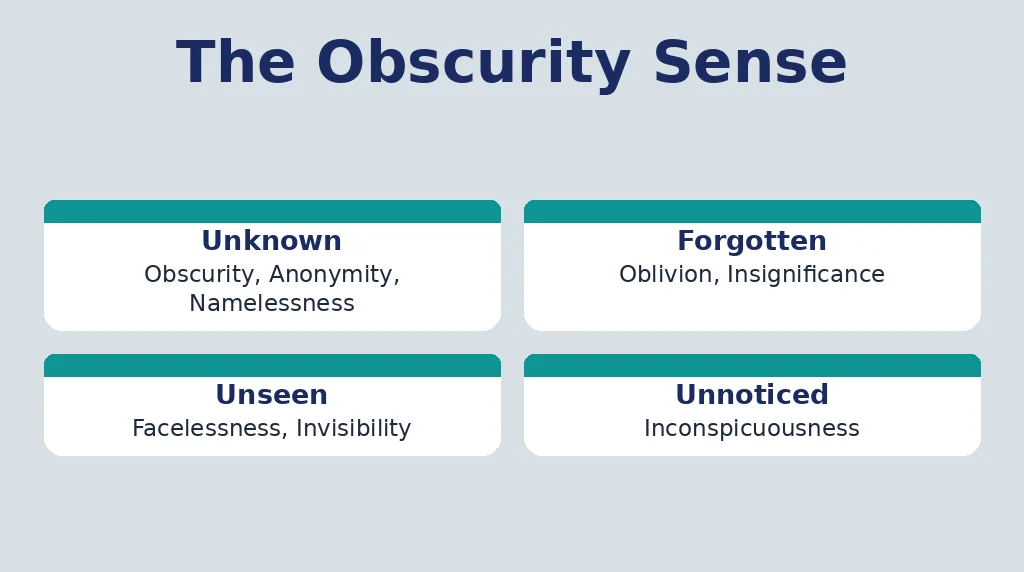
The third noun sense is the quietest of all. A person, a book, or a business can fall silent in the public sense: nobody talks about it anymore. Merriam-Webster defines this silence as the state of being mostly or completely unknown, and its synonyms map the geography of being forgotten.
- Obscurity: the state of being unknown or unnoticed. Example: The poet wrote in obscurity for thirty years.
- Oblivion: the state of being completely forgotten. Example: Most hit songs slide into oblivion within a decade.
- Anonymity: the state of being unnamed or unrecognized. Example: She donated in strict anonymity.
- Namelessness: having no name attached to your work or deeds. Example: The namelessness of the ballad’s author is total.
- Facelessness: lacking any public identity or face. Example: The facelessness of the agency frustrated the victims.
- Invisibility: being unseen, literal or social. Example: Older workers complain of invisibility at the office.
- Insignificance: counting for very little in others’ eyes. Example: The party shrank into insignificance after the split.
- Inconspicuousness: the quality of attracting no attention. Example: The safe house relied on its inconspicuousness.
The tone here is rarely neutral. Obscurity can be a tragedy for an artist and a relief for a spy. Context, as always, tells the reader which silence this is: the restful kind, or the kind that erases.
Silence in Everyday Life: Where the Word Works Hardest
Abstract lists only go so far. Silence earns its living in ordinary settings, and each setting bends the word a slightly different way. Knowing the settings makes the synonyms above much easier to place, because the reader’s ear judges the word against the room it belongs to.
At Work and in Meetings
Office silence is usually negotiated. A hush falls when the director walks in, a lull opens when the agenda runs dry, and a pointed silence answers a proposal nobody wants to touch. Managers learn to read these quickly, because a silent room can mean agreement, boredom, or revolt.
Written work has its own version. An unanswered email thread is the modern radio silence, and teams feel it within hours. Reports describe such gaps with restraint: the department maintained silence on the matter, which is the formal cousin of no comment.
Between Friends, Partners and Families
At home, silence is a mood before it is a measurement. The comfortable silence of a long friendship needs no repair, while the same length of silence after an argument can fill a house. Context words, warm or icy, do the real describing.
Families also keep the ritual kind. A moment of silence at a memorial, or a hush before a birthday song, turns not speaking into something shared and deliberate. These small ceremonies are why silence so often signals respect rather than emptiness.
In Restaurants, Hotels and Reviews
Reviews trade in this vocabulary daily. Guests praise a silent air conditioner, a quiet room, and a hotel where the corridor hush survives the night. Restaurants earn the opposite fame fast: noise is among the most common complaints in dining criticism, and a calm room is a selling point.
Writers of reviews should grade honestly, as this guide does. A room with a faint hum is quiet, not silent. A dining room where spoons ring against cups is lively, not hushed. Readers trust the review that keeps the ladder straight.
On Phones and Devices
Technology has made silence a setting. Silent mode, muted group chats, and silenced calls are now everyday vocabulary, and the verb forms above do the work: we mute, we silence, we deaden. A silenced phone is not broken; it is behaving exactly as instructed.
The social meaning followed the setting. To leave a message unanswered is now a readable act, and going radio silent has moved from ships to group chats without losing its sting. The phrases in this guide were built for voices, yet they fit notifications perfectly.
How to Choose the Right Synonym for Silence
Start by asking which silence you mean. Is it a sound level, a person not speaking, a social signal, or a fading reputation? Each answer opens a different shelf, and most mistakes come from grabbing a word off the wrong one.
Paired examples show how much the choice changes the facts:
- The valley lay in stillness. Nothing sounded, and nothing moved.
- The valley lay in quiet. A river and a few birds still reached the ear.
- The witness answered with reticence. He chose his silence carefully.
- The witness answered with speechlessness. He wanted to speak and could not.
- The star vanished into oblivion. The world forgot her completely.
- The star kept radio silence. She simply stopped communicating, fame intact.
Notice the discipline each word imposes. Stillness forbids the next sentence from adding a breeze. Reticence credits the silent person with control, while speechlessness takes control away. Oblivion closes a story, but radio silence only pauses one.
Verbs that travel with silence deserve a glance too. Silences fall, descend, and stretch in ordinary prose, and they break, shatter, or end when sound returns. Matching the verb to the depth keeps the scene honest: a hush is broken by a whisper, while a stillness is shattered by a shot.
The quick picker below matches common situations to strong first choices.
| Situation | Strong first choice |
|---|---|
| A courtroom settling down | Hush |
| A landscape with no sound at all | Stillness |
| A diplomat refusing to comment | Reticence |
| A celebrity ignoring all media | Radio silence |
| A forgotten one-hit wonder | Oblivion |
| A phone you need to quiet (verb) | Mute |
| A protest being stopped (verb) | Suppress |
Silence in Reports, News and Professional Writing
Formal writing handles silence with gloves on. News reports prefer neutral phrasing: the minister declined to comment, the company maintained its silence, no statement was issued. Each formula records the absence of speech without accusing anyone of hiding.
Business and legal writing adds the contractual kind. Confidentiality clauses, gag orders, and non-disclosure agreements are all machinery for producing silence on purpose. When you describe them, the verbs from the suppression group, gag, muzzle, and censor, should be used only where real compulsion exists. Otherwise, keep the record plain and let the facts supply the drama.
Antonyms for Silence
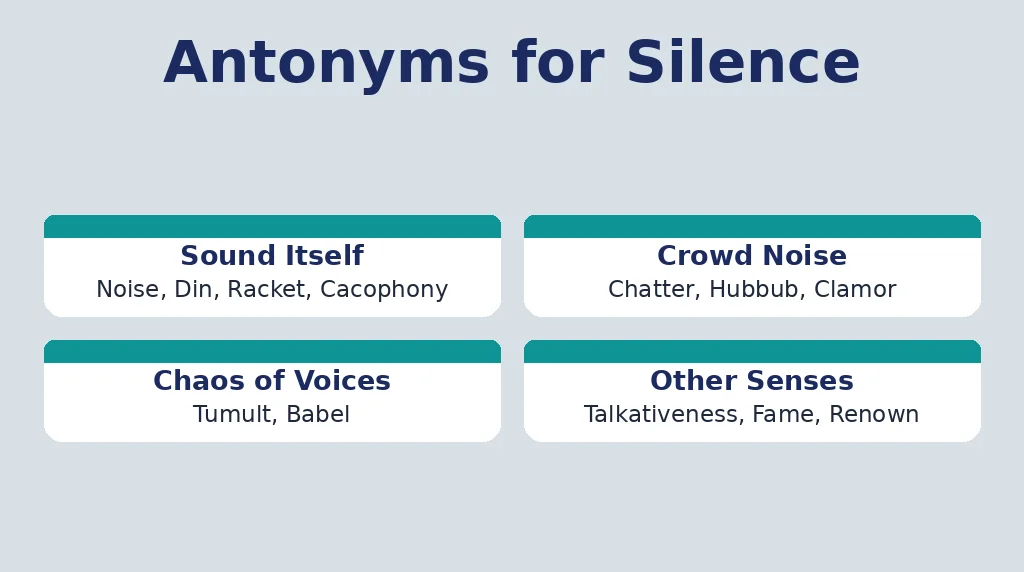
The core antonyms name sound itself: noise, sound, din, racket, and cacophony. They differ in manners. Noise is any unwanted sound, neutral and general. A din is a loud, confused mixture that hurts concentration. A racket is loud and annoying, often with blame attached, while cacophony is the formal word for a harsh jumble of sounds.
Human noise has its own set: chatter, hubbub, clamor, tumult, and babel. Chatter is light and rapid talk. Hubbub is the roar of a crowd being busy. Clamor adds demand, the sound of people insisting on being heard, and babel imagines everyone talking at once with nobody understood.
For the not-speaking sense, the opposites are speech and talkativeness, and for the obscurity sense, fame and renown. Keep each antonym on its own shelf, as with the synonyms, and your contrasts stay exact.
Pairs help here as well. Silence breaks, shatters, and falls in set phrases, and each verb has its natural opposite scene: applause breaks a silence, an alarm shatters it, and a hush falls where noise stood a moment earlier. Writers who learn the pairs rarely reach for a bare noisy when a scene deserves better.
Common Mistakes: Words That Are Not True Synonyms for Silence
Quiet is the closest call. Quiet allows soft sound, while silence, strictly used, means none. A quiet room has whispers and a ticking clock; a silent room has neither. Writers who treat them as identical end up promising more stillness than the scene can deliver.
Pause names a gap, not an absence. A pause is temporary by definition, and it happens inside speech or music that continues around it. The world outside a pause can be roaring. Silence describes the whole scene, not one gap in it.
Solitude and privacy describe company, not sound. A solitary beach can be loud with waves and gulls, and a private conversation can be heated. Either word can accompany silence, but neither contains it.
Peace is wider than silence in every direction. Peace also means the end of war, the settling of a quarrel, and simple freedom from worry. A peace treaty can be signed in a very noisy hall.
Stillness earns a careful note rather than a rejection. Dictionaries list it among the closest synonyms for silence, yet its home meaning is the absence of movement. A still crowd may be chanting. Use stillness for silence when the scene is motionless too, and the word will never mislead.
Frequently Asked Questions
What is the best synonym for silence?
For pure absence of sound, stillness and quietude are the strongest choices, with hush for the moment silence falls. For a person not speaking, reticence is the most useful everyday word. Plain quiet remains the safest all-purpose swap, and it is the choice least likely to overstate your scene.
What is the difference between silence and quiet?
Silence means no sound, or so close to none that the difference cannot be heard. Quiet is softer and wider: it allows faint sound, and it can also describe calm places and unbusy days. Silence is the extreme end of the quiet scale.
What is a word for complete or total silence?
Dead silence is the standard phrase for the absolute maximum. As a single noun, noiselessness is the most exact term, while stillness is the most natural in ordinary prose. Writers also use total silence and complete silence as plain, clear options.
What does deafening silence mean?
It is an oxymoron, a figure of speech that joins opposites for effect. A deafening silence is a silence so noticeable and pointed that it feels loud, usually when a reply was expected and none came. It describes pressure, not volume.
What does radio silence mean?
Originally, radio silence was a set period when operators stopped transmitting so faint distress calls could be heard. Today it means a complete stop in communication from a person or organization: no calls, no messages, and no replies, whether planned or pointed.
What is the opposite of silence?
For sound, the opposites are noise, din, and racket. For a person who will not speak, the opposite is talkativeness. For the forgotten sense of silence, the opposites are fame and renown, the state of being widely known and talked about. As with the synonyms, the sense decides the answer.
What is a fancy or literary word for silence?
Quietude is the classic choice: formal, calm, and slightly old-fashioned in the best way. Stillness serves poetry well, and the phrase the still of the night carries a literary flavor that plain silence cannot match.
Final Thoughts
Silence is never just one thing. It can rest a landscape, accuse a friend, honor the dead, or erase a famous name. Once you sort its synonyms by sound, speech, signal, and reputation, the right word usually picks itself: a hush for the courtroom, reticence for the diplomat, and oblivion for the forgotten star.
The habit worth keeping mirrors the word itself. Before you write silence, listen to the scene for one honest second. If a clock ticks, choose quiet. If a person is holding back, name the holding. Precision, here, is just careful listening written down.
For an even deeper list with related words and near-synonyms, the Merriam-Webster Thesaurus entry for silence is a reliable next step. Keep this guide bookmarked, and your silences will say exactly what you mean.