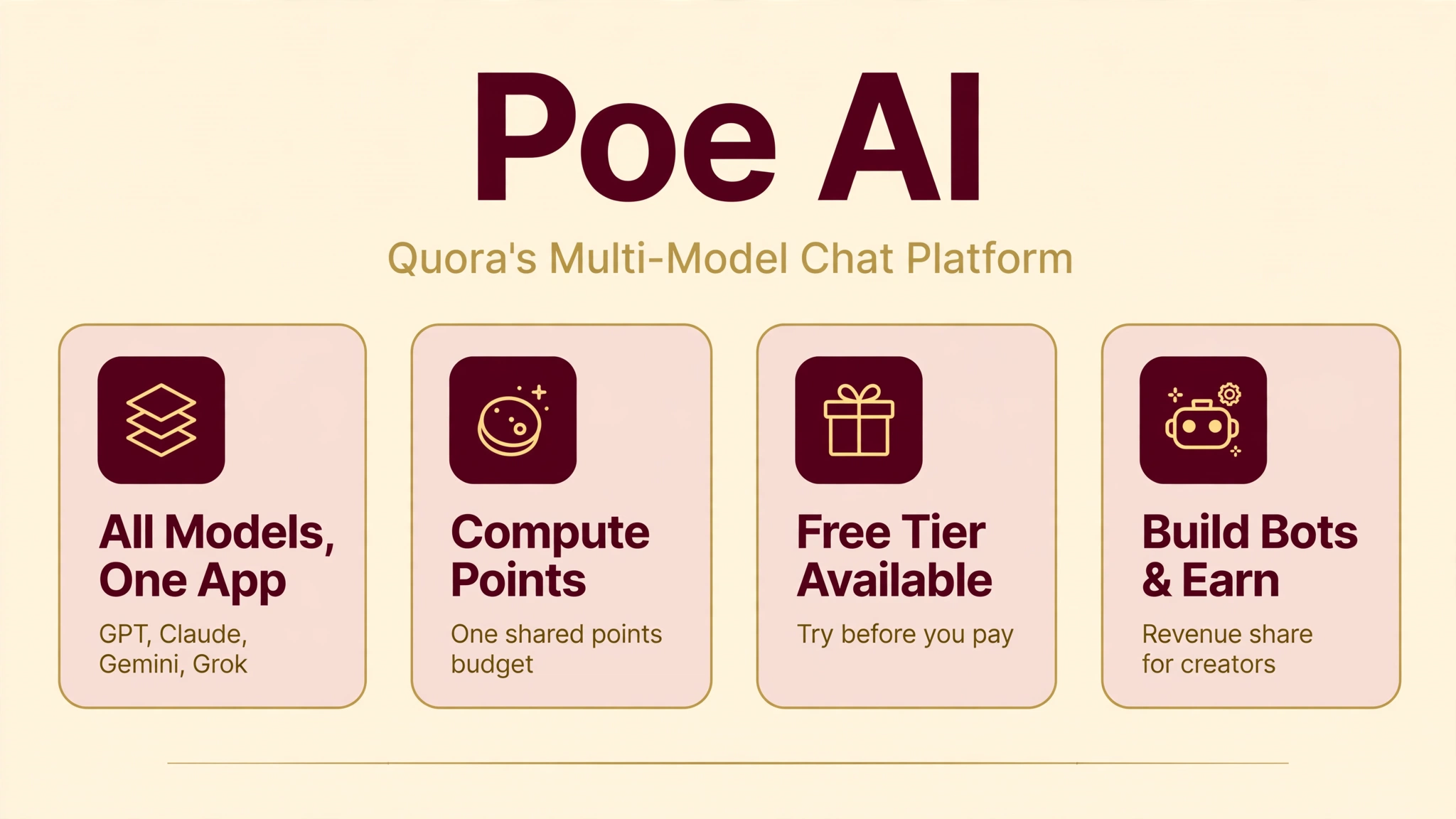
Poe is Quora’s multi-model AI chat platform, and it answers a simple frustration: instead of paying for ChatGPT, Claude, Gemini, and Grok separately, you get them all inside one app at poe.com. One subscription unlocks models from OpenAI, Anthropic, Google, xAI, Meta, DeepSeek, and Mistral, plus image and video models and thousands of user-made bots, all sharing a single compute-points budget.
We researched how Poe’s points system actually works, what each pricing tier gets you, and where the platform beats or loses to the native apps. The standout ideas are model comparison in one interface, a bot builder anyone can use, and a creator economy where popular bot makers earn revenue share. There are trade-offs too, from per-model limits to a points system that takes some learning.
In this guide we break down the features, the real pricing math, how to create bots, and the closest alternatives.
Quick Answer
Poe (poe.com) is a chat platform by Quora that gives you access to many AI models under one roof: GPT-class models from OpenAI, Claude from Anthropic, Gemini from Google, Grok from xAI, Llama from Meta, plus DeepSeek, Mistral, image models like DALL-E, Flux, Imagen, and Ideogram, and thousands of community-built bots. It is free with limited daily messages; paid plans start at $4.99 per month, with the popular Premium tier at $19.99 per month including 1 million monthly compute points. You can also build and publish your own bots and earn revenue share when others use them.
What Is Poe AI?
Poe launched as Quora’s answer to a fragmented AI market. Every major lab now ships its own chatbot app and its own $20 subscription, which gets expensive fast if you want the best of each. Poe collapses that stack: one account, one interface, one subscription, and you can switch between frontier models mid-conversation.
The platform hosts official models from the big labs alongside Poe’s own bots and a huge marketplace of user-created bots. Each bot is essentially a model plus a custom prompt and settings, tuned for a purpose: a writing coach, a coding helper, an image generator, a roleplay character. With thousands available, the long tail of specialized use cases is where Poe gets interesting.
Quora’s distribution muscle matters here. Because Poe is a first-party Quora product rather than a third-party wrapper, it gets fast access to new model releases, often within days of launch, and it can negotiate the kind of model access that keeps the catalog fresh.
You can start chatting today at the official Poe website, with native apps for iOS, Android, Mac, and Windows keeping everything in sync.
How Does Poe Work?
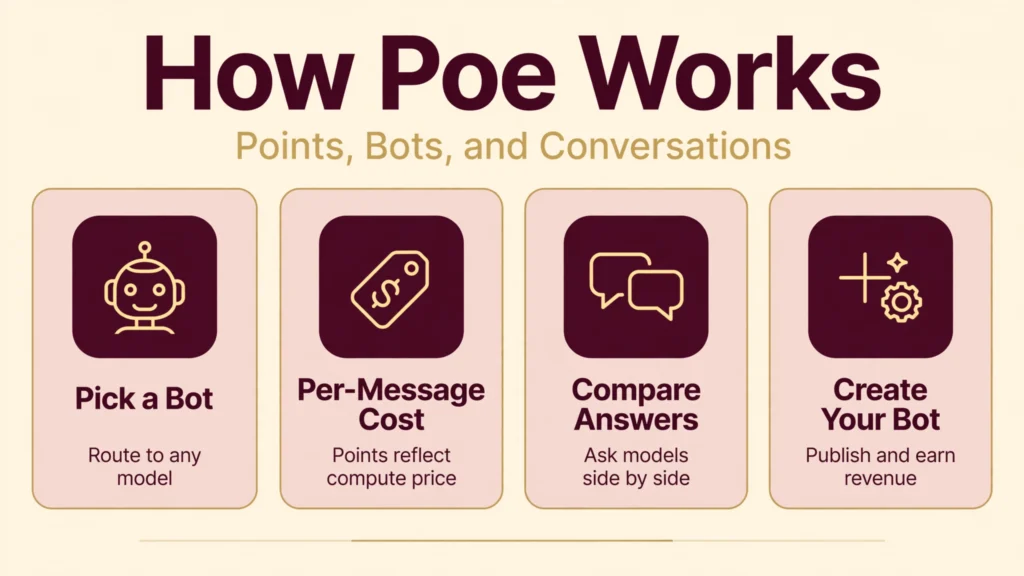
The core mechanic is compute points. Every model on Poe has a per-message point cost reflecting its underlying compute price: small fast models cost very little, while frontier models like GPT-class or Claude Opus cost significantly more. Your subscription gives you a monthly points budget, and each message you send draws from it.
In practice, you pick a bot, type your message, and Poe routes it to the underlying model. You can compare answers by asking the same question to multiple bots, continue in group threads, or talk to several bots in one conversation. File uploads, image generation, and video generation draw from the same budget at their own point rates.
Smart users treat points like a budget, not a limit. A practical rhythm is to draft and brainstorm on cheap, fast models, then spend frontier-model points only on the final version, the tricky bug, or the important decision. Checking a bot’s per-message cost before a long session takes five seconds and is the difference between points lasting all month and running dry in a week.
Creators get a second layer: the prompt-bot builder lets anyone wrap any available model in a custom system prompt, publish it to the marketplace, and earn revenue share based on usage. Developers can go further with server bots, hosting custom logic or external APIs behind Poe’s open protocol and turning Poe into a distribution channel.
Key Features of Poe
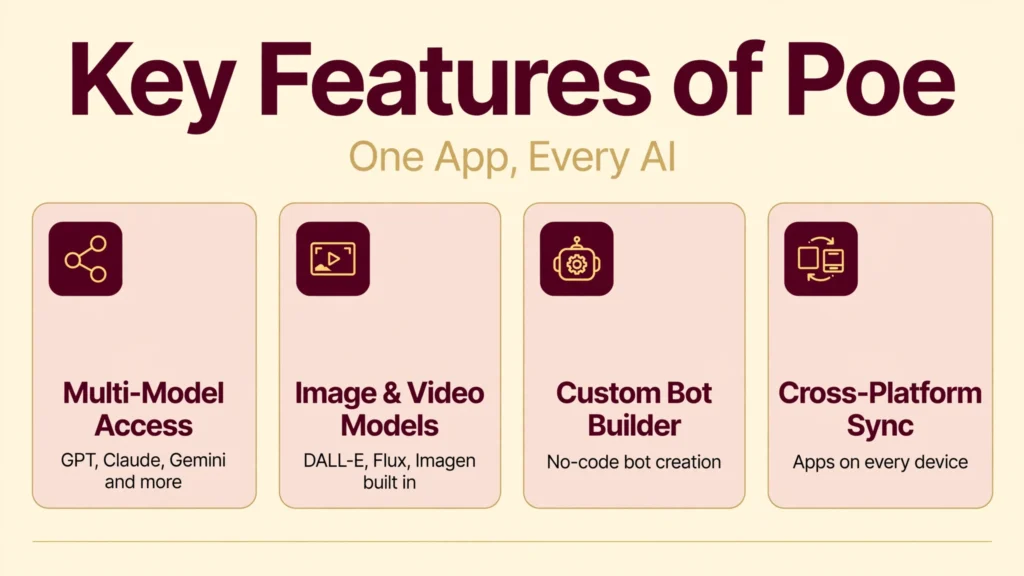
- Multi-model access: Chat with GPT, Claude, Gemini, Grok, Llama, DeepSeek, Mistral, and more from one account instead of juggling subscriptions.
- Image and video models: Generate visuals with DALL-E, Flux, Imagen, Ideogram, and Stable Diffusion, plus short-form video models, inside the same chat interface.
- Custom bot builder: Create prompt-tuned bots on any underlying model with no coding, publish them, and earn revenue share from usage.
- Server bots and API: Developers can host bots with custom logic and expose them through Poe’s protocol and API.
- Group chat and multi-bot threads: Talk to several bots in one conversation or chat privately, whichever the task needs.
- Model comparison: Ask the same question across models side by side, the fastest honest way to learn their differences.
- Cross-platform sync: Native iOS, Android, Mac, and Windows apps plus web, with chats synced everywhere.
- Fast model onboarding: Newly released models typically appear on Poe within days.
Is Poe Free?
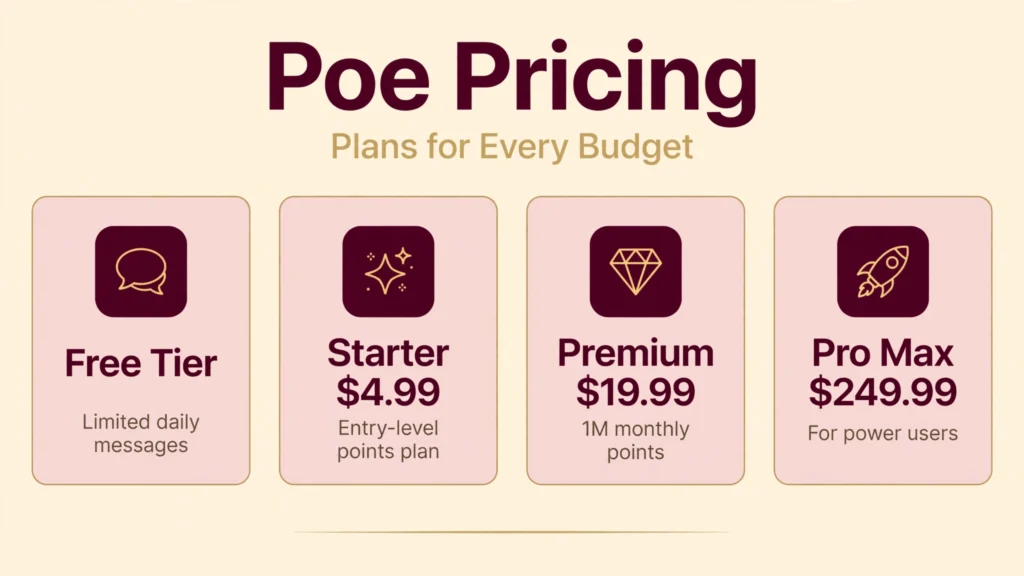
Yes, Poe has a genuine free tier. Free users get a limited number of daily messages across a rotating set of models, around 150 messages or 3,000 points per month depending on the current terms, plus access to community bots. It is enough to try the product and handle light daily chat.
Paid plans scale with usage. Starter costs $4.99 per month for entry-level compute points, Premium at $19.99 per month is the most popular with about 1 million monthly compute points, Premium Plus at $49.99 suits heavy daily use, while Pro at $99.99 and Pro Max at $249.99 target power users and small teams. An annual plan at $199.99 per year works out to roughly $16.67 per month, about 17 percent off monthly billing.
The value question is simple: one $20 subscription replacing two or three $20 single-model subscriptions. If you regularly use more than one AI, Poe pays for itself. If you only ever use one model and want its best native experience, that model’s own app is usually the better buy.
How to Use Poe
1. Create an account. Sign up at poe.com or in the mobile app. The free tier needs no payment details.
2. Pick your bots. Browse the Explore page for official models and community bots. Start with one flagship chat model from each major lab so you learn their personalities.
3. Learn the points. Check each bot’s per-message point cost before long sessions. Use cheaper models for drafting and brainstorming, and save frontier models for the messages that matter.
4. Compare models. For important questions, ask two or three bots and compare. This is the single best habit Poe enables.
5. Try multimodal bots. Switch to image or video bots when the task is visual; the same points budget covers them.
6. Build your own bot. Hit Create Bot, choose a base model, write a system prompt describing its role and style, test it, and publish. If people use it, you earn a share of the revenue.
For an independent deep dive, this Poe review at AI Tool Finder covers the points system, pricing, and alternatives in detail.
Is Poe Safe?
Poe is a legitimate product from Quora, a well-established tech company, so the baseline trust level is high. Your chats are tied to your Quora-linked account with standard security controls, and payment processing follows normal subscription practices.
The usual cautions apply. Do not paste passwords, private documents, or sensitive personal data into any AI chat, Poe included, since prompts may be processed by third-party model providers under their own terms. Review the privacy policies of both Poe and the underlying model providers if you handle confidential work.
Community bots deserve extra skepticism. Anyone can publish a bot, and quality varies: a bot’s system prompt is written by its creator, not audited by Quora. Treat user-made bots like third-party apps, useful but not authoritative, and never follow a bot’s instructions for anything involving money, health, or security without independent verification.
Poe Pros and Cons
Pros
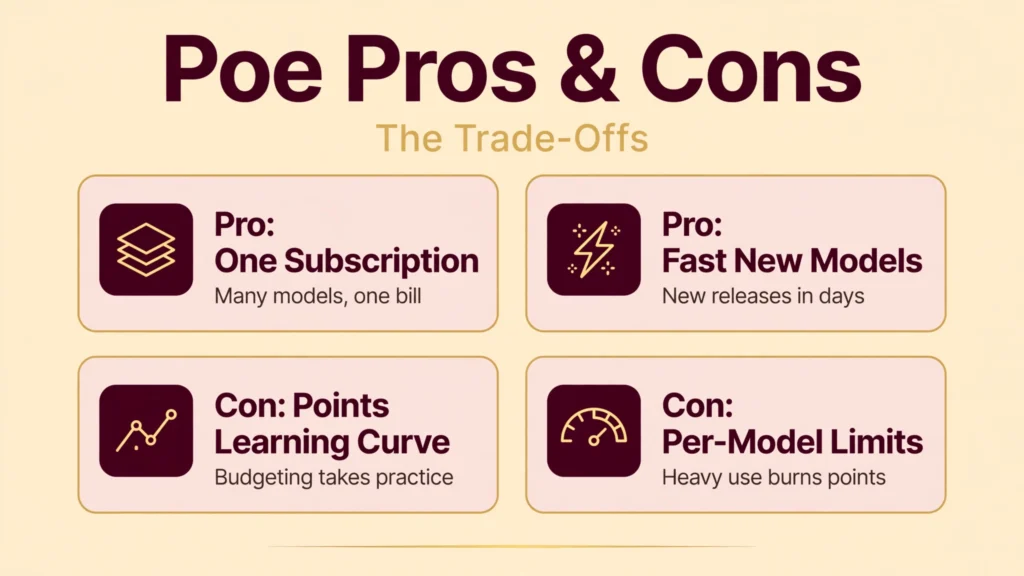
- One subscription, many models: Access GPT, Claude, Gemini, Grok, and more for less than the cost of two separate subscriptions.
- Easy model comparison: Side-by-side answers reveal each model’s strengths faster than any review.
- Creator economy: Build bots with no code and earn revenue share when they get used.
- Good free tier: Enough daily messages to evaluate the platform properly.
- Great apps: Polished native apps across mobile and desktop with full sync.
- Fast new-model access: New releases land on Poe within days.
Cons
- Points system learning curve: Budgeting compute points across models takes getting used to.
- Usage limits per model: Heavy frontier-model use can burn through points faster than expected.
- Less polished than native apps: The official ChatGPT and Claude apps still offer deeper features for their own models.
- Variable bot quality: Community bots range from excellent to junk.
- No built-in web search on some bots: Browse-dependent tasks may need the native apps.
Poe vs Alternatives
The direct alternative is subscribing to each model natively: ChatGPT Plus, Claude Pro, and a Google AI plan. Native apps win on polish, exclusive features like deep research modes and projects, and the most generous usage of their own models. Poe wins on breadth and price: one bill instead of three, plus the bot marketplace.
Other aggregators exist. OpenRouter targets developers with pay-per-token API access to many models, but it is a developer tool, not a chat app. Third-party multi-model chat apps come and go, but few match Poe’s catalog depth or Quora’s staying power.
Then there is the free route: using each lab’s free tier directly. That costs nothing but means juggling apps, hitting separate rate limits, and missing Poe’s comparison and bot features. For casual users it is fine; for anyone comparing models seriously, Poe’s $20 tier is the efficient choice.
Best Poe Alternatives
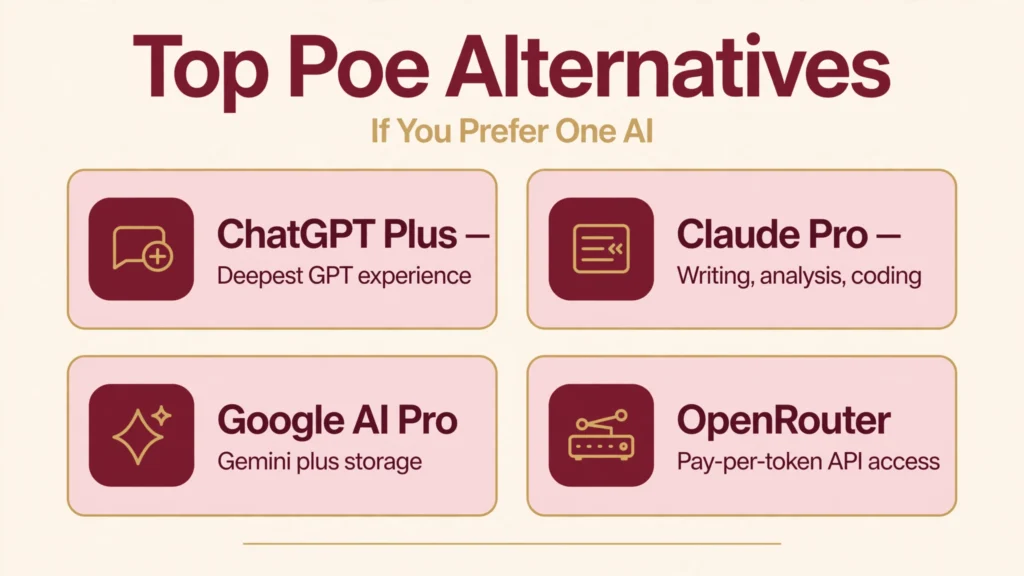
ChatGPT Plus. The best single-model experience if GPT is your daily driver, with the deepest features, custom GPTs, and generous usage of OpenAI’s own models.
Claude Pro. Ideal for long-form writing, analysis, and coding with Anthropic’s models, plus projects and strong document handling.
Google AI Pro. Gemini models plus video generation, Gemini in Gmail and Docs, and bundled Google storage for users deep in Google’s ecosystem.
OpenRouter. A developer-focused aggregator with pay-per-token access to hundreds of models, great for building apps rather than chatting.
If your main use is writing rather than model-hopping, our AI Text Generator | 10 Best Free and Paid Tools and AI Story Generator | 7 Best Tools, Features and Pricing guides compare the best single-purpose options, and Janitor AI: Free Character Chatbot? Full Guide covers a popular character-chat alternative.
Who Should Use Poe
Poe is ideal for AI enthusiasts who compare models, professionals who need different models for different tasks, and creators who want to build and monetize bots without running infrastructure. If your workflow touches two or more AI labs, Poe is almost certainly cheaper and simpler than separate subscriptions.
Students and researchers get particular value from the comparison habit: seeing how GPT, Claude, and Gemini each handle the same hard question teaches you more about their strengths than any benchmark table. Small teams also benefit, since one Premium seat can cover writing, coding help, and image needs that would otherwise require three separate tools.
It is a weaker fit if you live inside one ecosystem: a ChatGPT power user gets more from Plus, a Claude devotee from Pro. Beginners who find the points system confusing may also prefer the simplicity of one native app, at least until their needs grow.
Creating Bots That Earn
The bot builder is Poe’s most underrated feature. Start with a narrow job, not a general assistant: a resume reviewer, a SQL explainer, a bedtime-story generator with a specific voice. Narrow bots get reused; vague ones get forgotten.
Write the system prompt like a job description: role, audience, tone, output format, and what to do when unsure. Test against tricky inputs before publishing, because the first impression decides whether users return. Give the bot a clear name, an honest description, and a good greeting message.
Revenue share follows usage, so distribution matters. Share the bot where its audience already hangs out, iterate on feedback, and watch which prompts people actually run. Like any creator platform, a few bots earn meaningfully while most earn little, so treat it as a fun upside, not a business plan.
FAQs
What is Poe AI?
Poe is Quora’s multi-model AI chat platform at poe.com. It lets you chat with models from OpenAI, Anthropic, Google, xAI, Meta, and others, plus image and video models and thousands of user-created bots, all under one account and subscription.
Is Poe free to use?
Yes, with limits. The free tier includes a set number of daily messages across rotating models plus community bots. Paid plans start at $4.99 per month, with Premium at $19.99 per month offering 1 million monthly compute points.
How do Poe compute points work?
Each model has a per-message point cost based on its compute price. Your plan includes a monthly points budget, 1 million on Premium, and messages draw from it. Points reset monthly, and you can buy add-ons if you run out.
Can I create my own bot on Poe?
Yes. The prompt-bot builder lets anyone wrap a model in a custom system prompt, publish it, and earn revenue share based on usage. Developers can also build server bots with custom logic via Poe’s API.
Is Poe better than ChatGPT Plus?
It depends. Poe gives you many models for one price, which wins for comparison and variety. ChatGPT Plus gives you the deepest GPT experience with exclusive features. If you use multiple AIs, Poe offers more value; if you only use GPT, Plus is better.
Conclusion
Poe solves a real and growing problem: AI subscriptions are multiplying faster than anyone’s budget. By putting GPT, Claude, Gemini, Grok, and thousands of bots behind one login and one points budget, Quora built the closest thing the AI world has to a universal remote. The bot builder and creator revenue share add a genuinely different dimension that single-model apps cannot copy.
Start free, learn the points rhythm, and upgrade only when you feel the limits. If you regularly reach for more than one AI, Poe’s $20 tier is one of the best values in the space. If you are loyal to a single model, its native app remains the deeper experience.
Discover More: