“Undress AI” is not a single app. It is a term for a category of AI tools, also called nudifiers, that claim to digitally remove clothing from photos of real people. These tools use generative image models to fabricate explicit imagery of someone without their consent, and that is where this guide draws a hard line: creating or sharing such images is illegal in a growing number of jurisdictions.
We researched the legal and safety landscape so you get facts, not instructions. Lawmakers in the US and EU are advancing specific bans, city attorneys have filed lawsuits to shut these sites down, and the tools are widely reported as vectors for malware, data theft, and extortion. There is no safe or legal way to use them on real people.
This article explains what the term means, how the technology works at a high level, the legal and ethical landscape, and the legitimate alternatives for AI image editing. If you or someone you know has been targeted, you will also find guidance on what to do next.
Quick Answer
“Undress AI” is a term for a category of AI tools that claim to digitally remove clothing from photos of real people. These tools, also called “nudifiers,” use generative image models to fabricate explicit imagery of someone without their consent. Creating or sharing such images is illegal in a growing number of jurisdictions, with lawmakers in the US and EU advancing specific bans, and city attorneys filing lawsuits to shut the sites down. Beyond the legal danger, these tools are widely reported as vectors for malware, data theft, and extortion. This article explains what the term means, how the technology works at a high level, the legal and ethical landscape, and the legitimate alternatives for anyone interested in AI image technology.
What Is Undress AI?
“Undress AI” is not a single product. It is a label applied to dozens of websites and mobile apps that market AI-powered clothing removal. A user uploads a photo of a person, and the software generates a synthetic image that depicts the person without clothes. The output is a fabrication: the AI predicts and invents anatomy based on patterns learned from training data. It does not reveal anything real about the person in the photo.
These services exploded in visibility alongside the broader generative AI boom. Investigative reporting has found them widely distributed: one technology transparency report tested app stores with simple searches for terms like “nudify” and found dozens of Android and iOS apps offering undressing features, some rated for young age groups. The San Francisco City Attorney’s office moved to shut down 16 of the most popular undressing websites, describing them as tools used to bully, threaten, and humiliate women and girls.
The victims are overwhelmingly women and minors. Schools have dealt with cases of students generating explicit images of classmates. The harm is not theoretical: non-consensual intimate imagery causes severe psychological distress, reputational damage, and in some cases, self-harm among victims, even when everyone involved knows the image is fake.
It is important to separate this category from legitimate technology. AI tools for virtual clothing try-on in fashion retail, costume design previews, and medical imaging are real, consensual applications of similar underlying techniques. The difference is consent and purpose, and it is the entire difference.
How Does Undress AI Work?
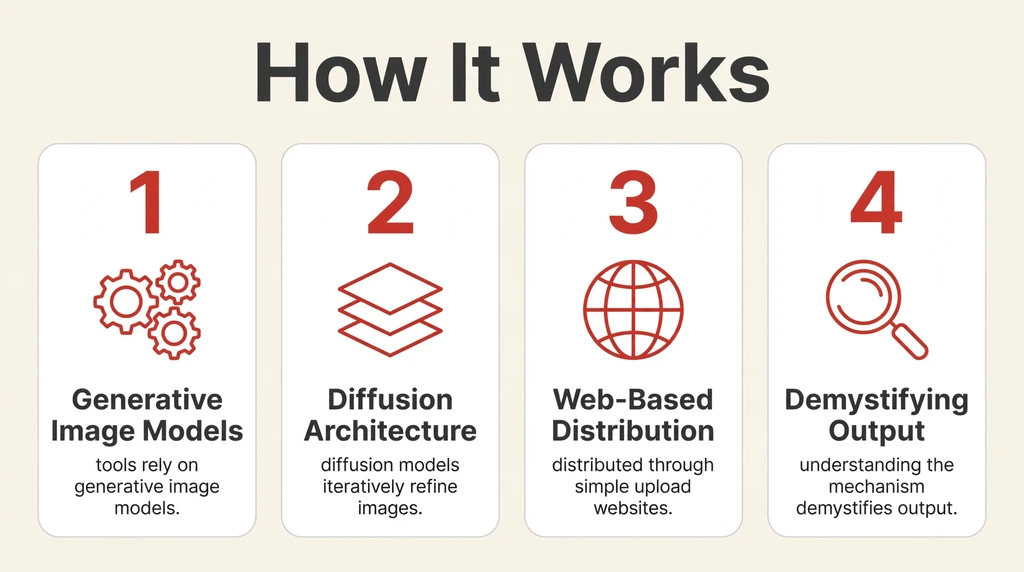
At a technical level, these tools rely on generative image models, the same family of technology behind mainstream AI art generators. The models are trained on large datasets of human imagery and learn statistical patterns of bodies, clothing, lighting, and pose. Given an input photo, the system segments the clothed regions and synthesizes plausible replacements, effectively painting over the original image with AI-generated content.
Modern versions use diffusion-based architectures, which iteratively refine random noise into a coherent image guided by the input photo’s structure. Earlier tools used GANs, a two-network setup where one network generates images and another judges their realism. Either way, the result is a confident-looking fabrication, not a revelation of hidden truth.
Distribution typically happens through websites with simple upload interfaces or through mobile apps with “face swap” and template features. Many operate from jurisdictions with weak enforcement, migrate between domains when shut down, and monetize through subscriptions, per-image fees, or advertising. Some are outright scams: cybersecurity researchers report that a significant share of these sites bundle malware, harvest uploaded photos and device data, or function as extortion pipelines.
Understanding the mechanism matters for one reason: it demystifies the output. These images prove nothing about anyone. They are statistical guesses rendered in pixels, and treating them as anything more grants the technology a credibility it does not deserve.
There is a second technical point worth making, because it counters a common misconception. People sometimes assume these tools “see through” clothing the way an X-ray sees through luggage. They do not. There is no hidden information being revealed. The model invents every pixel of the output based on training patterns, which means the image says everything about the software’s training data and nothing about the person photographed. Anyone presenting such an image as evidence of anything is either mistaken or lying.
Key Features of Undress AI
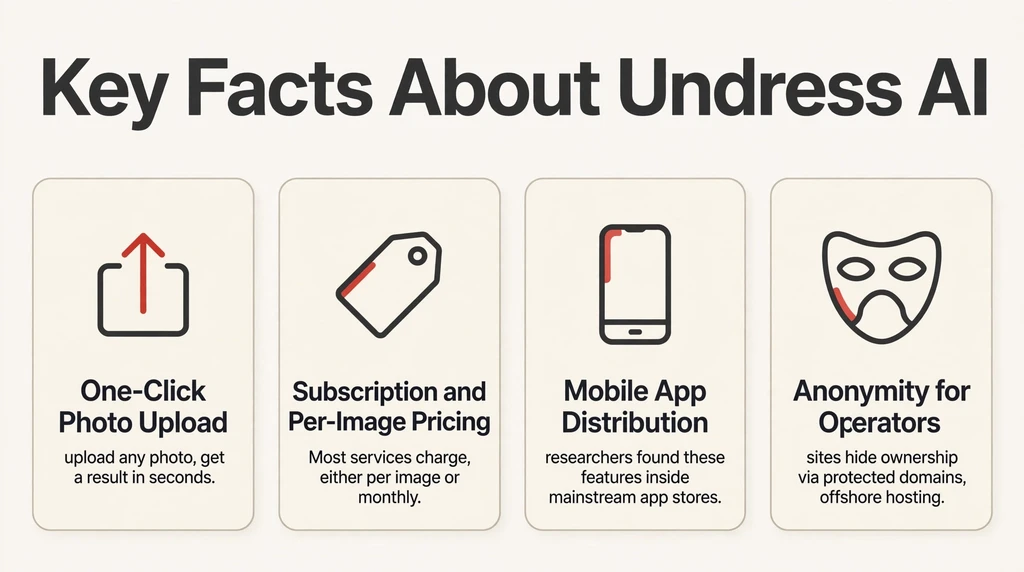
Rather than a feature list, which would serve as promotion, here is how these tools are typically marketed and what that marketing conceals.
One-Click Photo Upload
Sites advertise simplicity: upload any photo, get a result in seconds. What the marketing omits is that your upload, including metadata, device fingerprints, and sometimes the photo itself, may be stored, resold, or used for extortion. The convenience pitch hides a data-harvesting operation.
Subscription and Per-Image Pricing
Most services charge, either per image or monthly. Payment goes to operators who are frequently anonymous, hosted offshore, and unreachable for refunds or data deletion requests. Paying them funds the ecosystem and creates a financial trail linking the buyer to the activity.
Mobile App Distribution
Transparency researchers found undressing features inside mainstream app stores, sometimes bundled into “AI video” or “face swap” apps with innocent-sounding descriptions. This distribution channel puts the tools one search away from minors, despite store policies that nominally prohibit them.
Anonymity for Operators
The sites typically hide ownership through privacy-protected domains and offshore hosting. When authorities act, mirror sites appear within days. This whack-a-mole dynamic is why lawmakers have shifted toward banning the underlying AI systems themselves, not just individual websites.
False Legitimacy Signals
Polished interfaces, fake reviews, and “AI innovation” branding are designed to make the tools feel like normal software. They are not. The product is non-consensual intimate imagery, and the packaging is camouflage.
Is Undress AI Free?
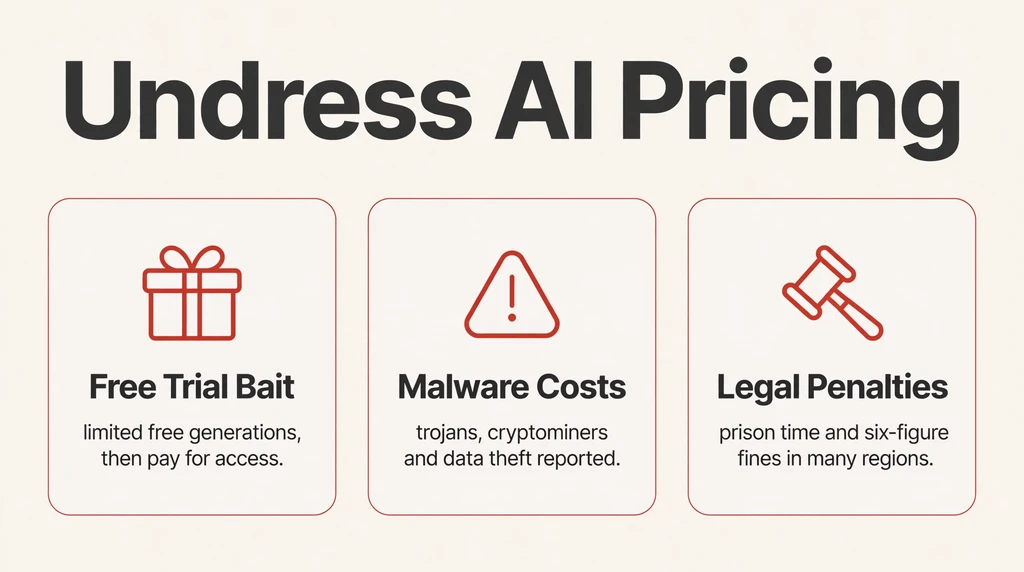
Many of these tools advertise free trials or limited free generations to hook users, then charge for full access. But the real price is not the subscription fee. Users face reported risks including malware infection, theft of banking credentials, and harvesting of personal photos. Cybersecurity analyses have described these platforms as malware distribution networks disguised as AI services, with trojans, cryptominers, and remote access tools found in a large share of samples tested.
The legal price can be far steeper. Depending on jurisdiction, creating or distributing non-consensual intimate deepfakes can carry criminal penalties including years of imprisonment and six-figure fines. Civil lawsuits from victims add another layer of exposure. “Free” is the bait; the costs arrive later, in forms no one would willingly pay.
How to Use Undress AI
This guide does not provide instructions for operating these tools, because doing so would facilitate harm. Instead, here are numbered steps for the things that actually matter: recognizing, avoiding, and responding to this category of software.
- Recognize the red flags. Any app or site promising to remove clothing, “see through” outfits, or “nudify” photos is in this category, no matter how it brands itself. Treat it as hostile software.
- Do not upload photos. Never upload your own photos or anyone else’s to these services. Uploads may be stored, shared, or used for extortion regardless of what the site promises.
- Warn others. If friends mention these apps as jokes or pranks, explain plainly what they are and the legal consequences. Social pressure is how they spread; social clarity is how they stop.
- Report the apps. Flag undressing apps in the iOS App Store and Google Play Store, and report websites to organizations that track non-consensual imagery abuse.
- If you are victimized, preserve evidence. Save URLs, screenshots, and timestamps without resharing the images. Report to platform moderators and, where applicable, to law enforcement.
- Seek support. Victim support organizations and cyber civil rights groups offer confidential help, including takedown assistance and legal referrals.
- Explore legitimate alternatives. If your interest is AI image technology itself, the alternatives section below lists consensual, legal applications worth your time instead.
Is Undress AI Safe?
No. These tools are unsafe in nearly every dimension that matters.
Legally, the direction is unambiguous: toward criminalization. European lawmakers approved amendments banning AI systems that generate non-consensual intimate imagery. In the United States, the NO FAKES Act advanced through the Senate Judiciary Committee to create federal rights over AI-generated likenesses, and city-level lawsuits are actively targeting operators. Existing revenge-porn and deepfake statutes already cover much of this conduct in many states and countries.
Technically, the tools are a security nightmare. Independent analyses report high rates of bundled malware, credential theft, and data harvesting. Uploading a photo to one of these sites is among the riskier things an ordinary internet user can do.
Ethically, there is no defensible use case for generating sexualized imagery of a real person without their explicit consent. “Prank” framing does not change what the output is or whom it harms. Researchers consistently find that victims are disproportionately women and girls, and that the images are used for bullying, coercion, and humiliation.
The only safe interaction with this category is avoidance, reporting, and supporting the legal and technical efforts to eliminate it.
Parents should know that these tools reach children through two routes: app stores, where they hide inside broader “AI photo” apps, and peer sharing, where students pass links around schools. Open conversations work better than surveillance alone. Teenagers who understand what these tools are, that the images are fabricated, that creating them can be a crime, and that victims suffer real harm, are far less likely to treat them as jokes. Schools that address the topic directly, rather than discovering it after an incident, consistently report better outcomes.
Undress AI Pros and Cons
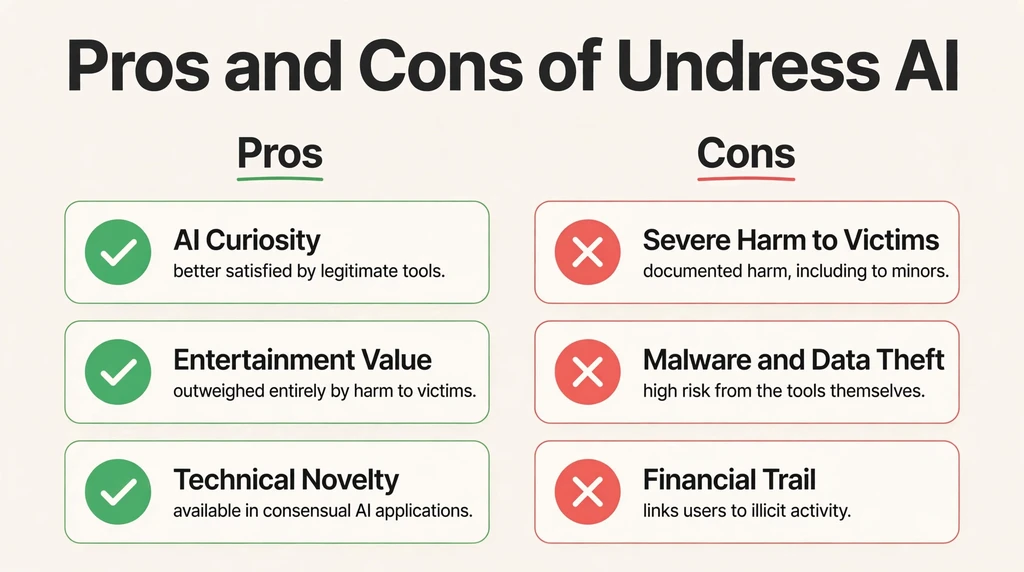
An honest accounting requires stating plainly: there are no legitimate “pros” to non-consensual undressing tools. What follows is the reality, not a sales pitch.
Claimed pros (and why they fail):
- Curiosity about AI image generation, better satisfied by legitimate creative tools
- “Entertainment” value, outweighed entirely by the harm to victims
- Technical novelty, available in countless consensual AI applications
Cons:
- Illegal in growing numbers of jurisdictions, with criminal penalties
- Severe documented harm to victims, including minors
- High malware and data-theft risk from the tools themselves
- Financial trail linking users to illicit activity
- Fuels extortion and harassment ecosystems
- Normalizes non-consensual behavior under the cover of innovation
Undress AI vs Alternatives
The meaningful comparison is not between undressing tools, it is between this abusive category and the legitimate image technologies that share its technical roots.
Virtual try-on for fashion lets shoppers see how clothes look on a digital model of themselves, with full consent and a clear retail purpose. Major retailers and fashion tech companies invest heavily here, and the results keep improving.
Costume and character design tools help game developers, filmmakers, and cosplayers visualize outfits on fictional or consenting subjects. The creative possibilities are enormous without involving any real person’s likeness against their will.
Medical and fitness imaging uses body-visualization AI for health assessments, always with informed consent and professional oversight.
General AI art generators, the creative cousins of this technology, produce original imagery from text prompts without targeting real people. For anyone fascinated by what generative models can do, these tools offer the wonder with none of the harm.
Best Undress AI Alternatives
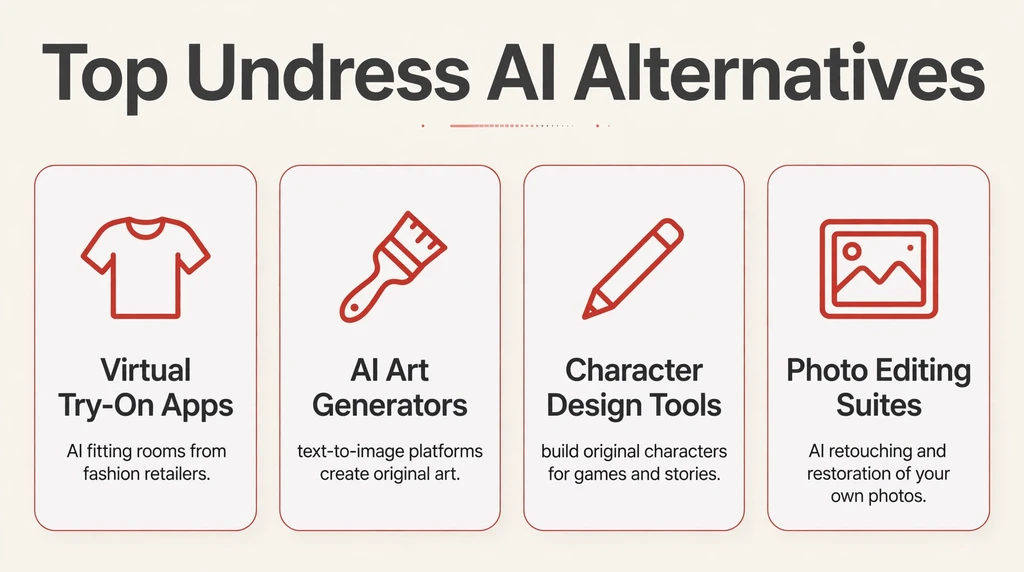
Virtual try-on apps: Fashion retailers offer AI fitting rooms where you visualize clothing on yourself. Consensual, useful, and improving fast.
AI art generators: Text-to-image platforms create original artwork from your imagination. All of the creative thrill, none of the victims.
Character design tools: Build original characters for games, stories, and art projects with full creative control.
Photo editing suites: Professional editors with AI features for retouching, background work, and restoration of your own photos.
3D avatar creators: Design digital representations of yourself for virtual worlds and social apps, entirely on your terms.
Who Should Use Undress AI?
No one should use these tools to generate non-consensual imagery of real people. That is the direct answer, and everything else follows from it.
The people who legitimately engage with this topic are researchers studying AI abuse, journalists documenting the ecosystem, policymakers drafting regulation, and victim advocates building defenses. If you are reading this out of curiosity about the technology, redirect that curiosity toward the legitimate alternatives above. If you are reading this because someone used these tools against you or someone you know, the reporting and support steps earlier in this article are your next move.
Frequently Asked Questions About Undress AI
- Is Undress AI legal?
Creating or sharing non-consensual intimate deepfakes is illegal in a growing number of places. The EU has moved to ban AI systems that generate such imagery, US federal legislation has advanced, and existing revenge-porn and harassment laws already cover much of this conduct. Laws vary by jurisdiction, but the trend is uniformly toward criminalization. - Can someone tell if an image was made by Undress AI?
Often yes, though not always at a glance. Forensic tools, metadata analysis, and AI-detection systems can frequently identify synthetic imagery. More importantly, platforms and law enforcement increasingly treat suspected deepfakes as evidence to be investigated, not as curiosities. - What should I do if someone makes a fake explicit image of me?
Preserve evidence without resharing it, report to the platform hosting it, and contact law enforcement where applicable. Victim advocacy organizations offer confidential guidance on takedowns and legal options. - Are these apps really full of malware?
Cybersecurity researchers report that a large share of undressing sites and apps bundle malware, harvest data, or facilitate extortion. The business model selects for untrustworthy operators, since legitimate companies will not touch this category. - What are legal uses of similar AI image technology?
Virtual clothing try-on in retail, costume design for entertainment, medical imaging with consent, and general AI art generation are all legitimate applications of related techniques. Consent and purpose are what separate them from abuse.
Final Thoughts
“Undress AI” is a case study in how quickly powerful technology can be turned toward harm, and how decisively societies are responding. Lawmakers are banning it, city attorneys are suing its operators, app stores are under pressure to remove it, and researchers keep documenting its dangers. The technology underneath is genuinely impressive, which is exactly why it belongs in consensual, creative, and professional applications, not in tools built to violate people. If this article leaves you with one takeaway, let it be this: curiosity about AI imagery is healthy, and there are extraordinary legitimate tools waiting for it.
Read the reporting on the San Francisco lawsuit against AI undressing sites and this analysis of the EU ban and the US NO FAKES Act for the legal picture.