
Staring at a blank page is the hardest part of writing. An AI story generator fixes that: it is a tool that writes fiction from your prompts, helping with everything from short stories to full novels. The best options each serve a different kind of writer.
We compared the leading tools hands-on to match them to real use cases. Sudowrite shines for sensory prose and beating writer’s block, NovelAI suits branching stories with deep world memory, Novelcrafter gives full novel control, DreamGen offers interactive story steering, and ChatGPT or Claude work as versatile free starting points. Most dedicated tools cost between $8 and $44 per month.
In this guide we rank the 7 best AI story generators, break down their pricing, and help you pick based on whether you want a guided writing partner, a worldbuilding system, or an interactive roleplay experience.
Quick Answer
An AI story generator is a tool that writes fiction from your prompts, helping with everything from short stories to full novels. The best options include Sudowrite for sensory prose and writer’s block, NovelAI for branching stories with deep world memory, Novelcrafter for full novel control, DreamGen for interactive story steering, and ChatGPT or Claude as versatile free starting points. Most dedicated tools cost between $8 and $44 per month, while general chatbots offer capable free tiers. The right choice depends on whether you want a guided writing partner, a worldbuilding system, or an interactive roleplay experience.
What Is an AI Story Generator?
An AI story generator is software that uses artificial intelligence, usually a large language model, to create fictional narratives from your input. You provide a premise, a few characters, a genre, or even a single sentence, and the tool produces story text: scenes, dialogue, descriptions, and plot twists. Unlike a simple autocomplete, modern story generators maintain characters, remember plot threads, and adapt tone across long passages.
These tools serve two broad audiences. For writers, they act as tireless brainstorming partners that draft scenes, suggest plot directions, and help push past writer’s block. For everyone else, they are entertainment: interactive fiction engines, roleplay sandboxes, and personalized bedtime story machines. The technology has matured to the point where the best tools can sustain consistent worlds across tens of thousands of words, remembering that the coat was still dripping in scene four without being reminded.
The category has split into distinct philosophies. Some tools, like Sudowrite, focus on beautiful prose and guided creativity. Others, like Novelcrafter and NovelAI, emphasize control systems such as lorebooks and codices that keep long projects coherent. A third group, led by AI Dungeon and DreamGen, treats storytelling as interactive play, where you steer the narrative beat by beat.
How Does an AI Story Generator Work?
Under the hood, an AI story generator runs your prompt through a large language model trained on vast amounts of text, including fiction. The model predicts the most fitting continuation of your story, one piece at a time, shaped by the instructions, examples, and context you provide. What separates good story tools from generic chatbots is the scaffolding around the model.
First, there is memory management. Tools like NovelAI’s Lorebook and Novelcrafter’s Codex store facts about your world: character traits, locations, magic rules, timelines. When a relevant name appears, the system injects those details into the model’s context so the story stays consistent. Second, there is steering: inline notes, scene beats, and guided prompts let you redirect the plot without rewriting everything. Third, many tools offer branching, so you can retry a scene, explore an alternate choice, or keep several story threads alive at once.
Pricing usually follows one of three models: flat monthly subscriptions, credit bundles where each generation spends credits, or software fees plus the cost of the AI model you connect. Free tiers exist but typically limit story length, features, or daily usage.
Context windows deserve a special mention because they decide how much of your story the AI can “see” at once. Entry level tools remember a few thousand words, enough for a short story. Serious novel tools offer 30,000 tokens or more, roughly a full draft plus notes. When a tool forgets your villain’s motivation in chapter nine, the cause is almost always a context window too small for the project, not a dumb model. Matching the tool’s memory to your manuscript length prevents most continuity headaches.
Model choice is the other lever. Some platforms let you pick the underlying AI: a flagship model for quality, a cheaper one for brainstorming, or even a local model for privacy. Beginners should start with whatever default the tool recommends, then experiment once they can feel the difference in output quality.
Key Features of AI Story Generators
When comparing tools, these are the features that actually change the writing experience.
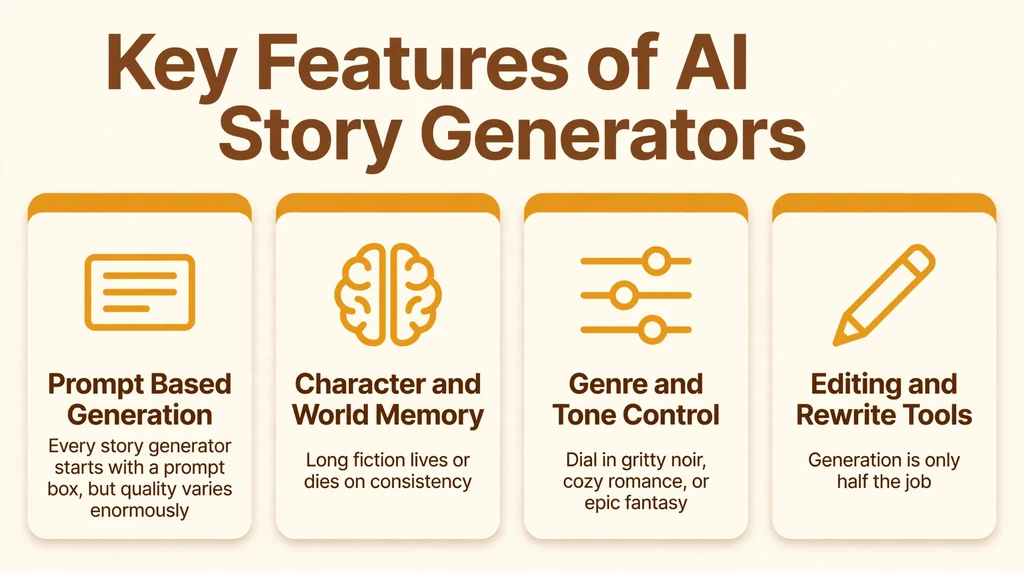
Prompt Based Generation
Every story generator starts with a prompt box, but quality varies enormously. The best tools accept rich prompts with genre, point of view, tense, and style notes, then honor those choices across the whole draft instead of drifting after a few paragraphs.
Character and World Memory
Long fiction lives or dies on consistency. Lorebooks, codices, and character bibles let you define your world once and have the AI respect it automatically. This is the single most important feature for anyone writing beyond short stories.
Genre and Tone Control
Good tools let you set the emotional register: gritty noir, cozy romance, epic fantasy, dry comedy. The best ones maintain that tone across chapters rather than sliding into generic adventure prose.
Editing and Rewrite Tools
Generation is only half the job. Look for rewrite options that can expand a thin paragraph into a full scene, describe a setting with sensory detail, or rephrase dialogue. Sudowrite’s Describe and Expand functions are the benchmark here.
Branching and Retries
The ability to retry a scene, keep the version you like, and branch the story in a new direction turns the AI from a slot machine into a collaborator. Interactive tools make this the core loop.
Export Options
Check how you get your story out. Basic tools offer copy paste, while better ones export to documents, audio narration, or formatted manuscripts. If you plan to publish, export flexibility matters.
Is an AI Story Generator Free?
Many AI story generators offer free access with limits. ChatGPT, Claude, and Google’s Gemini all have free tiers capable of writing stories, and they cost nothing to try. Dedicated fiction tools with free plans include AI Dungeon, which offers a free tier for interactive adventures, and DreamGen, which provides a starter allowance for testing its story steering.
Free plans come with real constraints: word count caps, shorter context memory, fewer models to choose from, and sometimes slower generation. For casual fun or short stories, free is often enough. For novels, consistent worldbuilding, or commercial projects, paid plans are the practical route.
Paid pricing clusters between $8 and $44 per month. Novelcrafter’s Hobbyist plan starts around $8 per month plus whatever your chosen AI model costs. NovelAI ranges from $10 to $25 monthly. Sudowrite runs $10 to $44 depending on credits. AI Dungeon’s premium tiers run about $10 to $30. Claude Pro sits around $17 to $20 monthly, and ChatGPT Plus is $20. Annual billing usually trims 15 to 20 percent off these prices.
How to Use an AI Story Generator
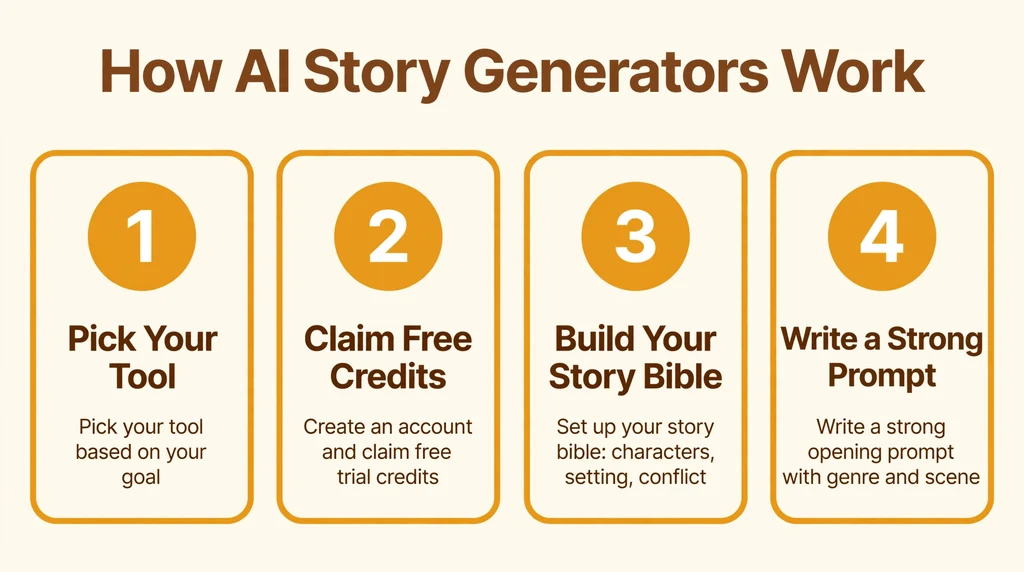
You do not need technical skill to start. Here is a workflow that works with almost any tool:
- Pick your tool based on your goal: a dedicated fiction app for novels, an interactive platform for play, or a general chatbot for quick experiments.
- Create an account and claim any free trial or starter credits before committing money.
- Set up your story bible first: names, appearances, personalities, setting rules, and the central conflict. Ten minutes here saves hours of corrections later.
- Write a strong opening prompt with genre, point of view, tense, and the scene you want. Specific beats vague every time.
- Generate in scenes, not chapters. Review each scene, keep what works, and use rewrite or retry tools on what does not.
- When the plot drifts, steer with an inline note or a new beat rather than regenerating blindly. Direct the AI like a collaborator, not a vending machine.
- Export your draft regularly and do your final polish in a proper editor. AI drafts are raw material, and your judgment is the finished product.
Dialogue deserves special attention because it is where AI assistance shines brightest and fails most visibly. Generate ten versions of a key exchange, keep the two lines that sound like your character, and discard the rest. Nobody will know the other eight existed. For description, the reverse often works better: write the scene yourself, then ask the AI to suggest three sensory details you missed. This division of labor plays to each party’s strength.
Finally, track what you change. Keep a simple log of AI generated passages versus your own rewrites for the first few chapters. Most writers discover a personal ratio, perhaps 30 percent AI draft to 70 percent human rewrite, that produces their best work. Once you know your ratio, you can budget credits and time with confidence instead of guessing.
Is Using an AI Story Generator Safe?
Using an AI story generator is safe in the ordinary sense: reputable tools do not harm your device, and your account is protected by standard login security. The real questions are about your content and your rights.
On privacy, remember that your prompts and stories live on the provider’s servers. Avoid pasting unpublished manuscripts you consider trade secrets, personal details, or anything you would not want stored externally. Check each tool’s data policy if this matters to you.
On originality, AI generated text can occasionally echo its training data, so run important work through a plagiarism checker before publishing. On ownership, most platforms grant you rights to your outputs, but terms differ, so read the terms of service if you plan to sell your book.
Finally, be honest with readers and platforms. Some marketplaces and publishers ask whether AI was used in a work. Disclosure keeps you on the right side of those rules and builds trust with your audience.
AI Story Generator Pros and Cons
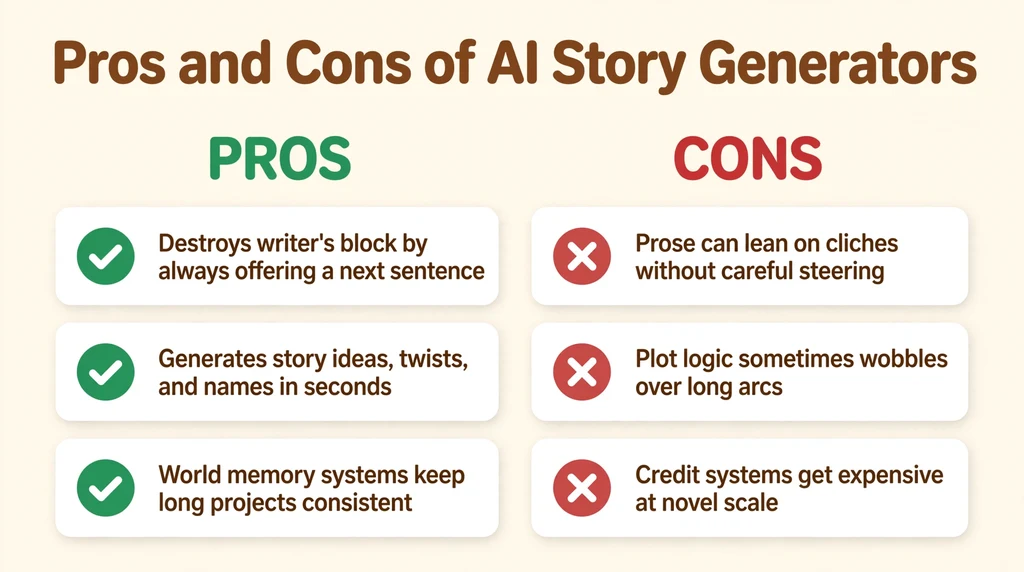
- Destroys writer’s block by always offering a next sentence
- Generates story ideas, twists, and names in seconds
- World memory systems keep long projects consistent
- Interactive modes make storytelling genuinely fun
- Far cheaper and faster than hiring a ghostwriter
- Available any time, with infinite patience for revisions
- Prose can lean on clichés without careful steering
- Plot logic sometimes wobbles over long arcs
- Credit systems get expensive at novel scale
- Risk of echoing training data, so check originality
- Over reliance can dull your own writing instincts
- Free tiers are too limited for serious projects
AI Story Generator vs Alternatives
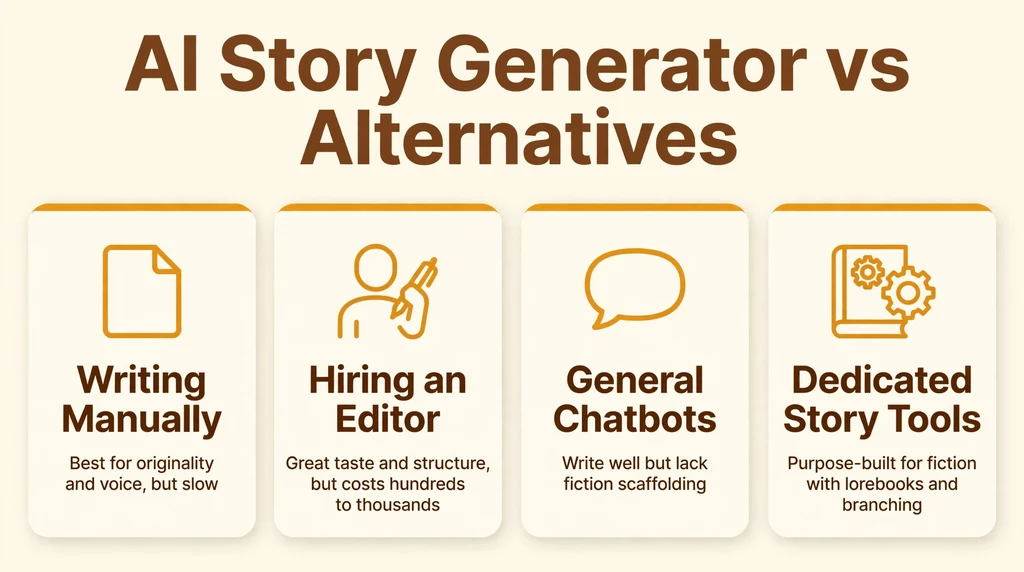
The obvious alternative is writing the old fashioned way: you, a blank page, and your imagination. Nothing beats it for originality and voice, but it is slow, and writer’s block is real. An AI story generator does not replace that process so much as accelerate the messy middle: drafting, exploring options, and testing scenes.
Hiring a human ghostwriter or developmental editor is the premium alternative. A good editor brings taste and structural insight no AI can match, but costs hundreds to thousands of dollars per project. For most hobbyists and indie authors, that is not on the table.
General chatbots like ChatGPT and Claude sit in the middle. They write well and cost little, but they lack fiction specific scaffolding: no lorebooks, no scene branching, no manuscript hierarchy. They are excellent drafting assistants and mediocre novel managers. Dedicated story tools exist precisely to fill that gap.
Writing workshops and critique groups are another alternative many authors overlook. A human group gives you what AI cannot: genuine reader reactions, market instincts, and accountability. The downside is scheduling and the emotional labor of critique, but pairing a weekly group with an AI drafting tool covers both speed and taste.
For interactive entertainment specifically, traditional video games and tabletop roleplaying remain strong alternatives. A good game master or a well designed RPG offers the same collaborative surprise as AI Dungeon with richer rules and social play. AI story tools win on availability: they are ready at midnight, never cancel, and never get bored of your campaign.
Best AI Story Generator Alternatives
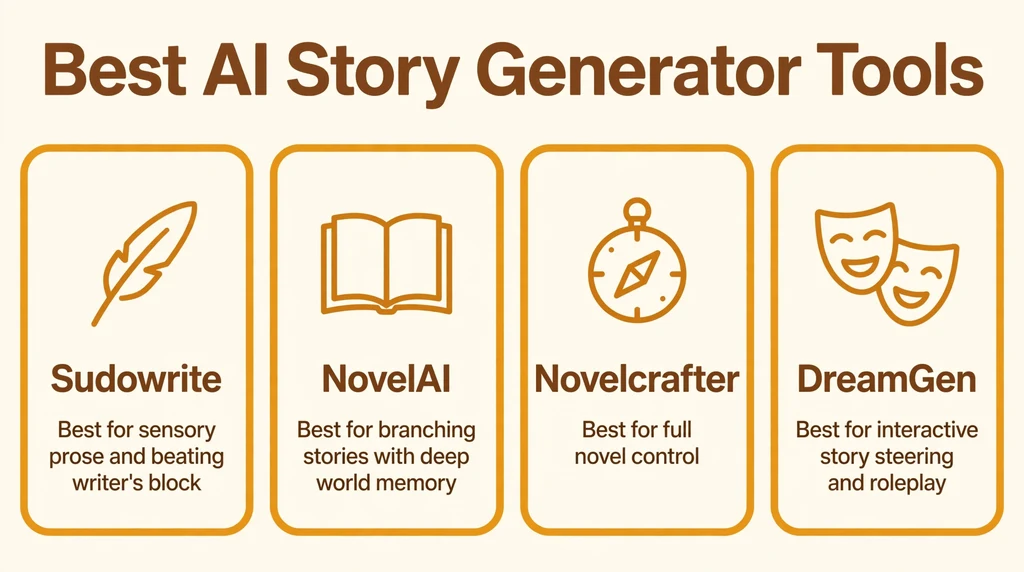
These are the top tools worth your time, each with a different strength.
Sudowrite
Best for sensory prose and beating writer’s block. Its guided Write feature, Describe tool for rich sensory detail, and Expand function for fleshing out scenes make it the favorite of authors who care about beautiful sentences. Pricing runs $10 to $44 per month depending on credits. The main downside is credit burn on very long projects.
NovelAI
Best for branching stories with deep world memory. Its Lorebook system, text adventure mode, and choice of AI models make it ideal for writers building complex worlds and long fiction. Tiers run $10 to $25 per month. Setup takes some learning, and it is less flexible outside fiction.
Novelcrafter
Best for full novel control. The Codex acts as a private wiki for every character, location, and plot thread, with scene specific prompts and your choice of AI model, including OpenAI, Anthropic, or local models. The Hobbyist plan is about $8 per month plus model costs. Expect a steeper initial setup.
DreamGen
Best for interactive story steering and roleplay. Inline bracket notes let you redirect single beats, the Scenario Codex keeps worlds consistent, and multi character chat tightens dialogue. A free tier covers light use, with Pro around $48 per month for the full experience.
AI Dungeon
Best for infinite interactive adventures. Part game, part writing tool, it generates open ended stories you steer with free text input, with multiplayer and worldbuilding sandbox modes. A free plan exists, with premium tiers around $10 to $30 monthly. Prose is less polished than dedicated writing tools.
ChatGPT
Best versatile starting point. Excellent for brainstorming, outlining, dialogue practice, and short stories, with custom GPTs and memory on paid plans. The free tier is genuinely useful, and Plus is $20 per month. It can rush pacing and needs guidance for scene depth.
Claude
Best for rewriting and long form coherence. Its huge context window, Projects feature, and strong continuity make it superb for editing chapters and managing complex drafts conversationally. Pro costs around $17 to $20 per month. It has no built in manuscript hierarchy or visuals.
Who Should Use an AI Story Generator?
Aspiring novelists drowning in worldbuilding notes will get the most from Novelcrafter or NovelAI. Writers who prize beautiful prose and need a push through the blank page should try Sudowrite. Roleplayers and interactive fiction fans will feel at home in AI Dungeon or DreamGen. Students, bloggers, and the merely curious can start free with ChatGPT or Claude and upgrade only if the habit sticks.
Who should skip them? If you write literary fiction where every sentence must be unmistakably yours, AI assistance may feel like interference. And if you plan to publish traditionally, check your publisher’s AI policy first, since rules vary widely.
Parents and teachers form a growing audience. Personalized stories keep reluctant readers engaged, and classroom tools built for storytelling turn creative writing into a game. Look for kid focused options with content filters and read aloud features if young writers are involved.
Finally, a word on expectations. The writers who love these tools share one trait: they treat the AI as a junior collaborator whose drafts need direction, not as an author replacement. Bring your ideas, your taste, and your willingness to rewrite, and the tool will multiply your output. Expect it to do the thinking for you, and you will be disappointed.
Frequently Asked Questions About AI Story Generators
1. What is the best free AI story generator?
ChatGPT and Claude offer the most capable free tiers for general story writing. For dedicated fiction tools, AI Dungeon has a free plan for interactive stories, and DreamGen offers starter credits. Free plans limit length and features but are fine for short stories and experiments.
2. Can AI write a full novel?
Yes, with human guidance. Tools like Novelcrafter and NovelAI are designed for long form projects with world memory systems. Expect to steer, edit, and rewrite heavily. The AI drafts, you direct, and the final quality depends on your judgment.
3. Is it legal to publish AI generated stories?
In most cases you own the outputs under the platform’s terms of service, but terms differ by tool, so read them before commercial publishing. Run your manuscript through a plagiarism checker, disclose AI use where publishers require it, and consider consulting a professional for high stakes projects.
4. Do AI story generators plagiarize?
They can occasionally produce text similar to their training data, though wholesale copying is rare. The safeguard is simple: treat AI output as a draft, rewrite in your own voice, and check finished work with a plagiarism detector before publishing.
5. Which AI story generator is best for beginners?
Start with ChatGPT or Claude for zero cost and zero learning curve. When you outgrow them, Sudowrite is the friendliest dedicated fiction tool, while AI Dungeon is the most fun if you want interactive play rather than polished prose.
The learning curve question comes up often, and the honest answer is that prompting is a skill that compounds. Your first stories will feel generic. Your twentieth will feel directed. Keep a swipe file of prompts that produced great output, noting the genre, the structure, and the style cues you used. Within a month you will have a personal playbook more valuable than any tutorial.
One more practical habit: generate with the end format in mind. A story meant for audio narration needs simpler sentences and more dialogue tags than one meant for print. A bedtime story needs gentle pacing and clear morals. Telling the tool the final format up front saves a full rewrite pass later, and it is the kind of instruction beginners forget and professionals never skip.
Final Thoughts
An AI story generator will not make you a novelist on its own, but it might be the thing that finally gets your novel written. The technology has crossed the line from novelty to genuinely useful collaborator, especially for drafting, brainstorming, and maintaining sprawling worlds. Start free, learn to steer with specific prompts and story bibles, and let the AI handle the blank page while you handle the taste.
For a hands on comparison of the leading fiction tools, see this tested roundup of AI story generators. For more options across budgets and use cases, browse this wider list of story writing tools.