Power users do not want one chatbot. They want a library of thousands of characters and the freedom to plug in any AI model they like. That is Chub AI, officially CharacterHub: a character card repository and AI roleplay platform in one. Think of it as two products: a massive public library of community-made character cards, and a chat frontend that connects those characters to your choice of model.
We researched the platform’s unusual setup to explain who it is really for. It is model-agnostic, so you can run chats on Chub’s native models, including Soji, or plug in your own API keys for OpenAI, Claude, Gemini, KoboldAI, or OpenRouter. Born from the merger of Venus AI and CharacterHub, it is the platform of choice for worldbuilders and roleplayers who outgrew simpler apps.
Pricing starts free with limited test messages, with Mercury at $5 per month and Mars at $20 per month. This guide covers the features, pricing, and best alternatives.
Quick Answer
Chub AI, officially known as CharacterHub (chub.ai), is a character card repository and AI roleplay platform for power users. Think of it as two products in one: a massive public library of community-made character cards, and a chat frontend that connects those characters to your choice of AI model. It is model-agnostic, which means you can run chats on Chub’s native models, including Soji, or plug in your own API keys for OpenAI, Claude, Gemini, KoboldAI, or OpenRouter. Pricing starts free with limited test messages, with Mercury at $5 per month and Mars at $20 per month for native model access. Born from the merger of Venus AI and CharacterHub, it is the platform of choice for worldbuilders, writers, and tinkerers who want total control over their AI characters.
What Is Chub AI?
Chub AI is best understood as the “app store” for AI characters. Users create, share, and download detailed character profiles called character cards, which define everything about a persona: name, appearance, backstory, personality traits, speech patterns, and the scenario where a conversation begins. The library holds hundreds of thousands of community-created characters across every genre imaginable, from fantasy heroes and sci-fi androids to historical figures and original creations.
But Chub is more than a repository. Through its chat interface, historically associated with the Venus AI project that merged into CharacterHub, you can talk directly with any character in the library. The clever part is the separation of concerns: Chub provides the characters, the chat interface, the memory scaffolding, and the lorebooks, while the actual text generation comes from whichever AI model you connect. That model can be one of Chub’s own or an external service through your own API key.
This architecture makes Chub the opposite of a walled garden. Character cards use open formats, Tavern V1 and V2, and can be exported freely for use in other apps like SillyTavern. If you ever leave the platform, your characters leave with you, which is a meaningful difference from competitors that lock creations inside their ecosystem.
The platform draws an estimated 7 to 14 million monthly visits, smaller than giants like Character AI but with a far more technical and dedicated user base. It is, as one reviewer put it, not a product you consume but a workshop you build things in.
How Does Chub AI Work?
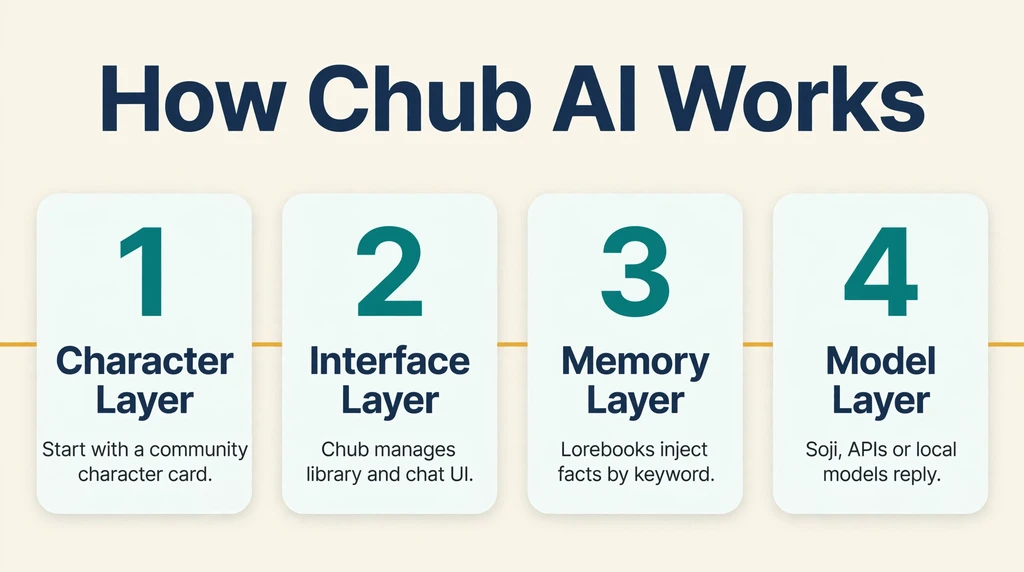
Chub operates in four layers, and understanding them explains both its power and its learning curve.
First, the character layer. Every conversation starts with a character card: a structured file containing the persona, backstory, tone rules, sample dialogue, and starting scenario. Cards are community-made and searchable by tags, popularity, and chat counts. You can also build your own with the Character Card Builder, defining alternate greetings, system prompts, and embedded lore.
Second, the interface layer. The Chub website and app manage your library, the chat UI, personas (which define who you are in the story), and prompt engineering controls. The interface itself generates nothing; it orchestrates.
Third, the memory layer. Lorebooks provide long-term memory through keyword-triggered context injection. You define facts, world rules, and lore entries tied to keywords, and when those keywords appear in conversation, the relevant entries re-enter the AI’s context. This is how long stories stay consistent across thousands of messages.
Fourth, the model layer, the actual AI brain. Options include Chub’s native Soji models on paid tiers, rotating free test models, or your own API keys connected to OpenAI, Anthropic Claude, Google Gemini, NovelAI, OpenRouter, or a local KoboldAI setup. More choice means more control over response quality, content filtering, and cost.
Getting started is straightforward: sign up with email, Google, Apple, or GitHub, browse the card library with tag filtering, and hit chat on anything that catches your eye. The depth reveals itself gradually, through personas, lorebooks, presets, stages, forks, and group chats.
One thing newcomers should know is that the “right” model choice depends entirely on what you value. If you want the smartest prose and do not mind paying per message, a Claude or GPT-class API key is the premium route. If you want unlimited chatting without a meter running, Chub’s native subscription models are the predictable option. And if privacy is the priority, a local KoboldAI setup means your stories never leave your computer, at the cost of needing decent hardware. There is no single best answer, which is exactly why the platform refuses to pick one for you.
The community is also a resource in itself. Card creators publish tuning notes, share lorebook templates, and document which model settings work best for specific genres. Lurking in community spaces for an evening before building your first serious character will save you hours of trial and error, because the platform’s documentation, while improving, still assumes more background knowledge than a casual user brings.
Key Features of Chub AI
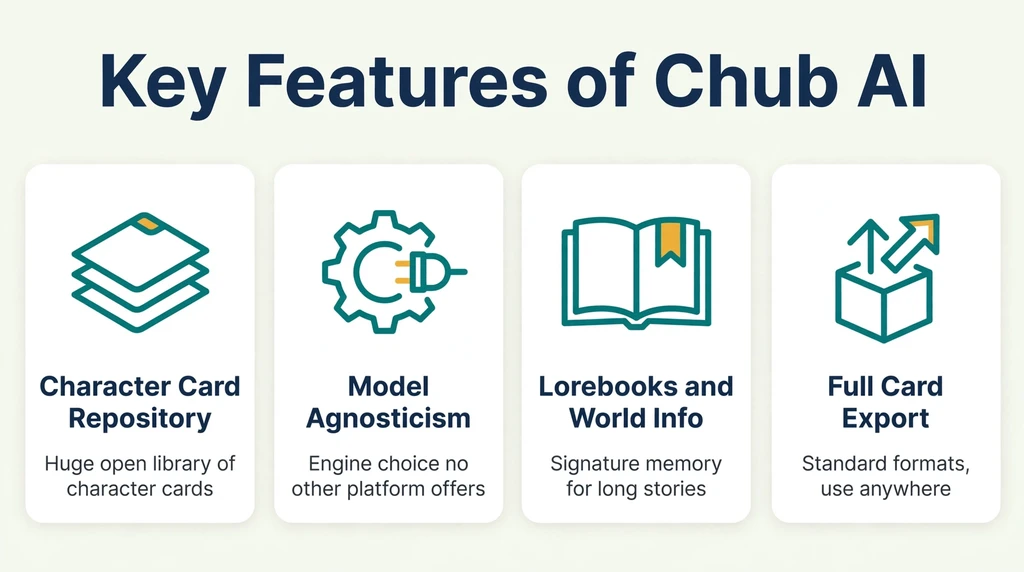
Character Card Repository
The public library is the heart of the platform: hundreds of thousands of cards in open Tavern formats, searchable by tags and sortable by trending, stars, or chat counts. Because the format is open, cards work in other apps too, and the community has built tools for bulk export. For character collectors, it is the deepest catalog outside the biggest mainstream platforms.
Model Agnosticism
No other major platform offers this much engine choice. Run Chub’s native Soji models, connect OpenAI or Claude with your own key, aggregate dozens of models through OpenRouter, or go fully local with KoboldAI for total privacy. Each option has different strengths: Soji is tuned for roleplay, Claude excels at prose, local models offer zero data leaving your machine.
Lorebooks and World Info
Lorebooks are Chub’s signature memory system. Define world facts, character relationships, and setting rules as keyword-triggered entries, and the platform injects the relevant ones into context automatically. For anyone writing long-form stories or running persistent worlds, this is the feature that keeps everything coherent.
Full Card Export
Every card can be exported in standard formats and used in SillyTavern or other frontends. Many power users browse on Chub and chat locally, combining the best library with the most private setup. Export freedom also means your creative work is never hostage to one company’s decisions.
Personas and Group Chats
Personas let you define your own identity in stories, so the AI treats you consistently as a specific character rather than a generic “user.” Group chats bring multiple characters into one scenario, each holding its own personality. Combined with stages and forks, which let you branch stories at any point, the storytelling toolkit is unusually complete.
Venus Chat Interface
The chat frontend, historically Venus AI and now part of the merged platform, offers a polished roleplay interface with voice and multimedia generation for subscribers. You can try chat with starter credits and no account required, which lowers the barrier for curious newcomers.
OpenAI-Compatible API
Chub exposes an OpenAI-compatible API, so characters and setups work in third-party frontends. Developers and tinkerers can wire Chub’s ecosystem into their own tools, which has seeded a small galaxy of community utilities around the platform.
Is Chub AI Free?
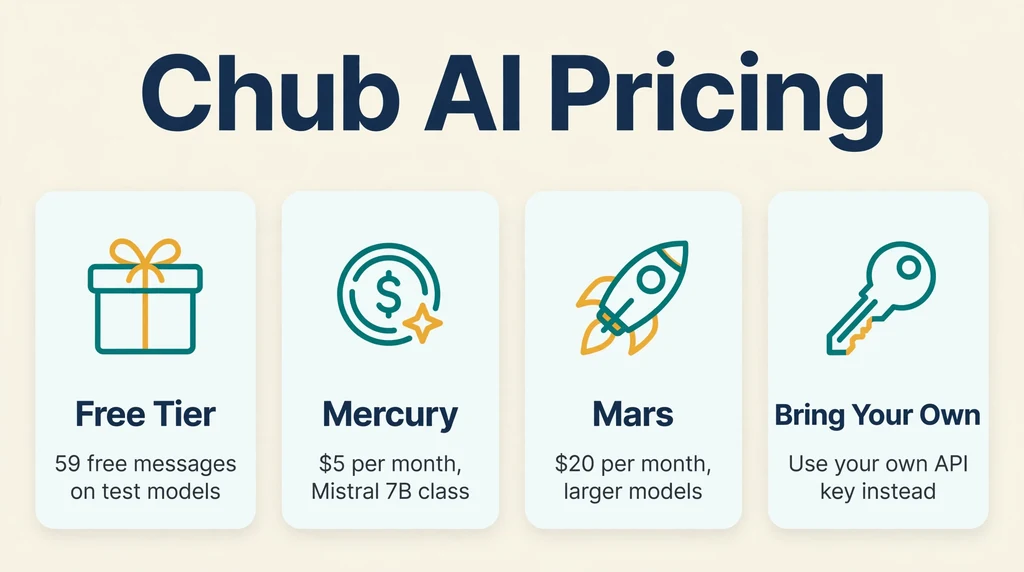
Chub is free to browse and start using. Account creation costs nothing, the character library is fully browsable, and the free tier includes a limited number of messages, roughly 59, on built-in test models. That is enough to evaluate the platform and a few characters properly.
For sustained use of Chub’s native models, two subscription tiers exist. Mercury at $5 per month bundles models like Mistral 7B and MythoMax 13B with an 8,000-token context window. Mars at $20 per month adds larger models such as Asha 70B and Mixtral 8x7B with early access to new releases. Payments process in multi-month blocks, and the platform accepts cryptocurrency.
The alternative to subscribing is bringing your own model. Connect an OpenAI, Claude, or OpenRouter API key, or run KoboldAI locally, and your only cost is whatever that provider charges, or nothing at all for local models. Many experienced users consider this the best value path: Chub’s free interface plus a cheap or free model backend. Pricing details can change, so verify current tiers on the site before committing.
How to Use Chub AI
- Sign up. Register at chub.ai with email, Google, Apple, or GitHub. Browsing works even before you commit to anything.
- Browse the card library. Filter by tags, sort by trending or chat counts, and read card descriptions. The 20-per-page layout rewards patient browsing.
- Try a chat. Open a character and start talking. Free test credits let you sample the experience without a subscription.
- Set up a persona. Define who you are in the story so the AI addresses you consistently across conversations.
- Choose your model. Stick with free test models, subscribe to Mercury or Mars for native models, or connect your own API key for maximum choice.
- Build lorebooks. For long stories, add world info entries tied to keywords so the AI remembers your setting’s rules.
- Create or import cards. Use the Character Card Builder or import Tavern-format cards from elsewhere, then publish or keep them private.
- Export freely. Download any card for use in SillyTavern or other frontends whenever you want.
Is Chub AI Safe?
Chub AI is a legitimate platform with real infrastructure, but its design philosophy shapes its safety profile. Content filtering is light and tag-based rather than strict, which gives creators freedom but means you will encounter adult-oriented characters and themes while browsing. This is not a platform with training-wheels defaults.
Privacy depends heavily on your model choice, which is actually a strength. Use Chub’s native models and your data follows the platform’s policies. Connect a third-party API and your chats go to that provider. Run KoboldAI locally and nothing leaves your machine at all. Few platforms give you this much control over where your words go.
Payments deserve a note: subscriptions bill in multi-month blocks and crypto is accepted, so read the billing terms carefully before subscribing. The free tier’s message limit means you will hit a decision point fairly quickly if you use the platform regularly.
As with all character AI, keep perspective. The personas are fictional constructs, impressive ones, but constructs. They are built for creative roleplay and companionship, not for advice you would bet your health, money, or relationships on.
One more practical point: because card quality varies enormously across hundreds of thousands of community uploads, check chat counts, ratings, and descriptions before investing time in a character. The best cards are excellent; the median card is a work in progress.
It is also worth being realistic about what the free tier teaches you. Those roughly 59 test messages are enough to learn the interface and fall in love with a character or two, but they run out right as you are getting invested, which is clearly by design. Go in with a plan: either budget for Mercury, prepare an API key, or set up a local model before the free messages expire, so your first good story does not stall at the paywall.
Chub AI Pros and Cons
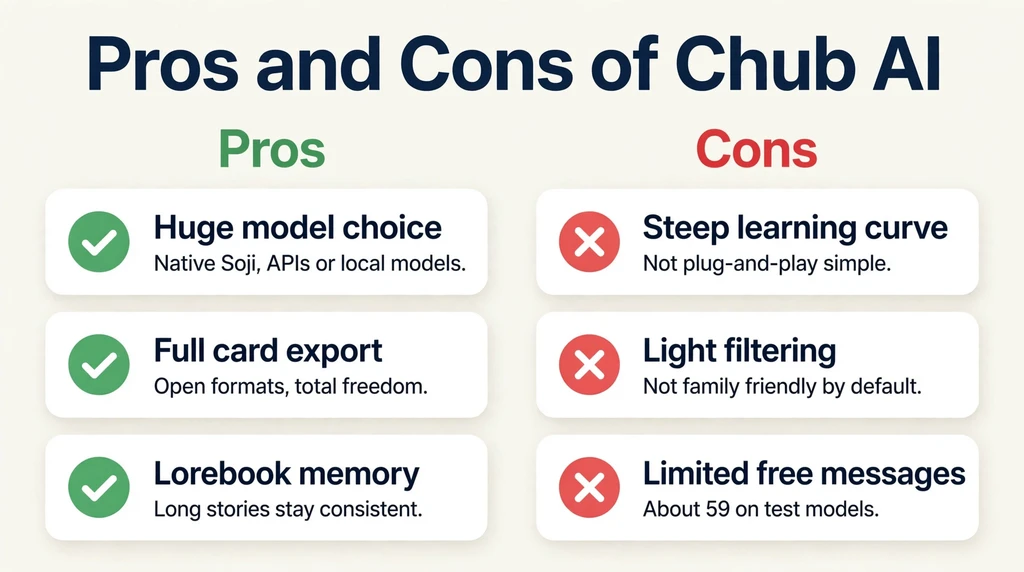
Pros:
- Unmatched model choice, from native Soji to any major API or local models
- Open character card formats with full export freedom
- Powerful lorebook memory system for long stories
- Personas, group chats, stages, and story forks
- Free tier for evaluation; cheap Mercury entry at $5 per month
- Strong community of serious worldbuilders and writers
- Privacy options up to fully local, offline operation
Cons:
- Steep learning curve compared with plug-and-play competitors
- Light content filtering is not family friendly by default
- Free native messages are limited, around 59 on test models
- Subscription billing in multi-month blocks
- Character quality varies widely across the huge library
- Smaller community than the biggest mainstream platforms
- Best experience requires technical comfort with models and APIs
Chub AI vs Alternatives
Against Character AI, Chub trades polish for freedom. Character AI is bigger, smoother, and strictly filtered, with no card export and one in-house model. Chub gives you export, prompt control, and model choice, at the cost of a steeper learning curve and lighter moderation.
Against Janitor AI, the two are close cousins and frequent comparisons. Both are model-flexible and permissive. Janitor AI is simpler to start with and has a larger casual community, while Chub offers deeper tooling: lorebooks, stages, forks, and the card repository itself.
Against SillyTavern, Chub is the hosted, social version of the same philosophy. SillyTavern is pure local software with no library or accounts; Chub adds the discovery layer, the community, and optional hosted models. Many users combine them: discover on Chub, chat in SillyTavern.
Best Chub AI Alternatives
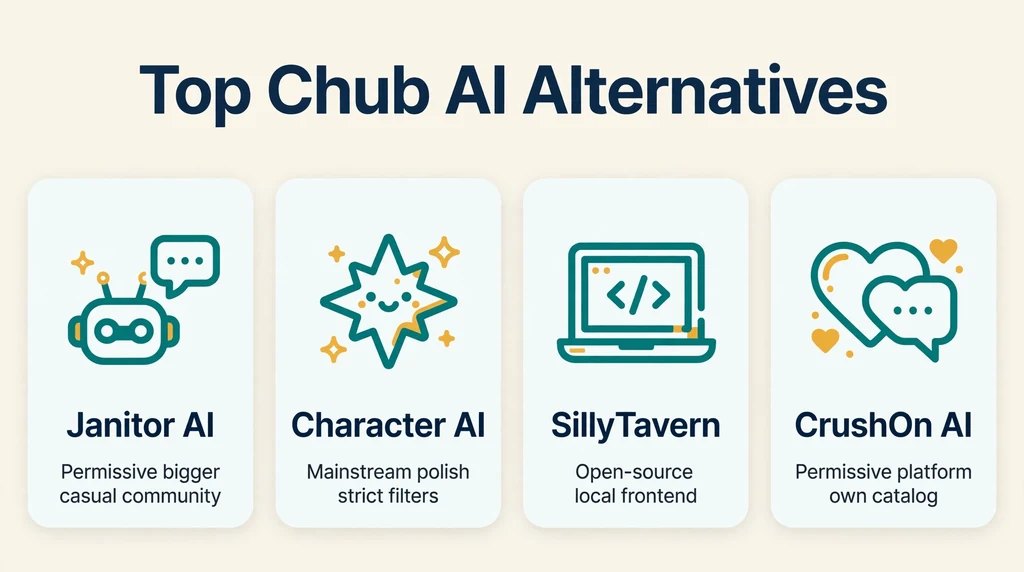
Janitor AI: Similar permissive philosophy with a bigger casual community and simpler onboarding. Best if you want freedom without the learning curve.
Character AI: The mainstream giant with the most polish and strictest filters. Best for users who want safety and simplicity.
SillyTavern: Open-source local frontend for total privacy and control. Best paired with Chub’s card library.
CrushOn AI: Another permissive character platform with its own catalog. Best as a straightforward alternative.
Venus AI interfaces: Since Venus merged into Chub, the venus.chub.ai interface remains the familiar chat home for longtime users.
Who Should Use Chub AI?
Chub AI is built for power users: worldbuilders, fiction writers, prompt engineers, and anyone who wants to control every layer of the character experience, from card to model to memory. If you enjoy tinkering and want your characters portable across apps, there is nothing else quite like it.
It is less suited to casual users who want to open an app and start chatting in ten seconds, to parents seeking a filtered environment, or to anyone uncomfortable managing API keys and model settings.
Frequently Asked Questions About Chub AI
- Is Chub AI the same as CharacterHub?
Yes. Chub AI is the common shorthand for CharacterHub at chub.ai. The platform merged with Venus AI, whose chat interface lives on at venus.chub.ai, which is why you will see both names used. - Is Chub AI free?
Browsing and signup are free, and the free tier includes limited messages on test models. Native model subscriptions start at $5 per month for Mercury and $20 for Mars. Alternatively, connect your own API key or a free local model. - Can I export characters from Chub AI?
Yes, and this is a signature feature. Cards export in open Tavern formats for use in SillyTavern and other frontends, so your creations are never locked in. - What models work with Chub AI?
Native Soji models on paid tiers, plus external options via API key: OpenAI, Claude, Gemini, NovelAI, OpenRouter, and local KoboldAI setups. - Is Chub AI safe for kids?
No. Content filtering is light and tag-based, and adult-oriented characters are common in the library. It is designed for adult hobbyists, not for children.
Final Thoughts
Chub AI is the workshop of the character AI world. It asks more of you than its competitors, a little technical curiosity, some patience with the learning curve, but it returns more: open cards, your choice of model, memory systems that actually sustain long stories, and the freedom to take your creations anywhere. If you have ever wished a character platform would get out of your way and hand you the tools, this is the one. Start free, browse deep, and let the lorebooks do the remembering.
Learn more from this complete Chub AI features and pricing guide and this Chub AI guide with model comparisons.