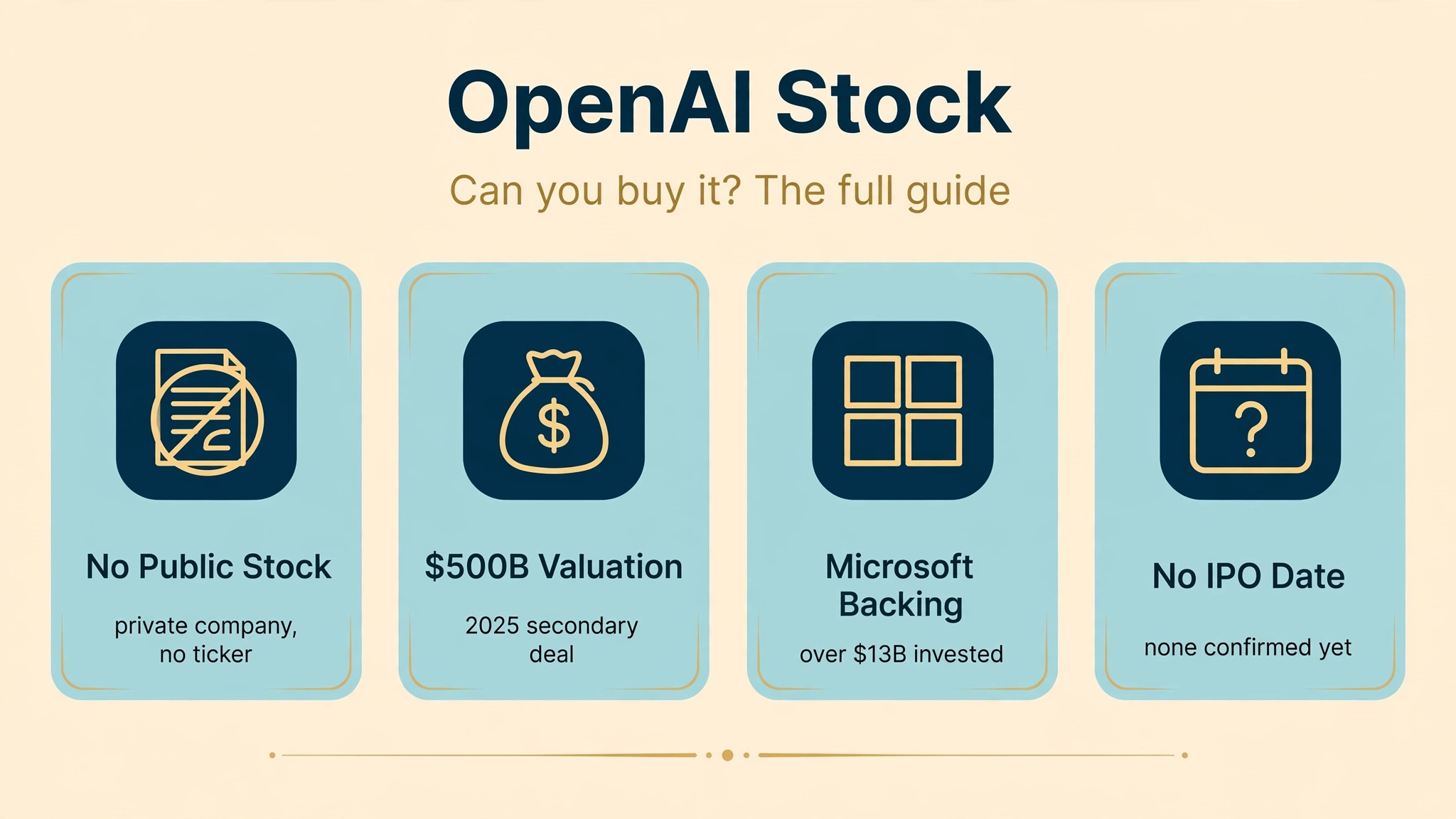
No, you cannot buy OpenAI stock on any public exchange. OpenAI is a private company with no ticker symbol on the NYSE or Nasdaq, so there is no way for a regular investor to purchase its shares through a normal brokerage account. Anyone claiming to sell you “OpenAI stock” through a standard broker is misleading you.
We researched the private-market routes that do exist so you get the full picture. Accredited investors can sometimes access shares through secondary marketplaces like Forge Global and Hiive, usually with minimums of $25,000 or more, while everyone else can get indirect exposure through Microsoft stock or a handful of public funds that hold OpenAI equity. There is also no confirmed IPO date, despite frequent rumors.
This guide is for research and education only and is not financial advice.
Quick Answer
OpenAI stock does not exist for public investors. The company behind ChatGPT, GPT models, DALL-E, and Sora remains privately held, most recently valued around $500 billion in a 2025 secondary transaction, with later funding rounds and reported talks pushing implied valuations far higher. Retail investors cannot buy shares; access is limited to accredited investors via private secondary markets such as Forge Global, Hiive, and EquityZen, typically requiring $25,000 minimums and long waitlists. The simplest legal route to OpenAI exposure is Microsoft (MSFT), which has invested over $13 billion and holds exclusive licensing rights, or public funds like Ark Venture Fund that hold OpenAI equity.
What Is OpenAI? Company Overview
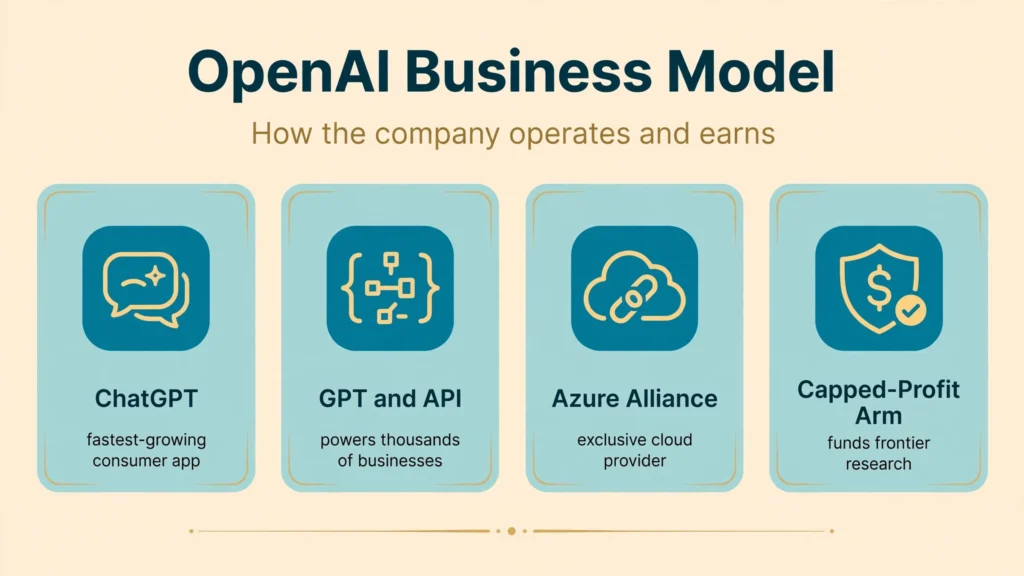
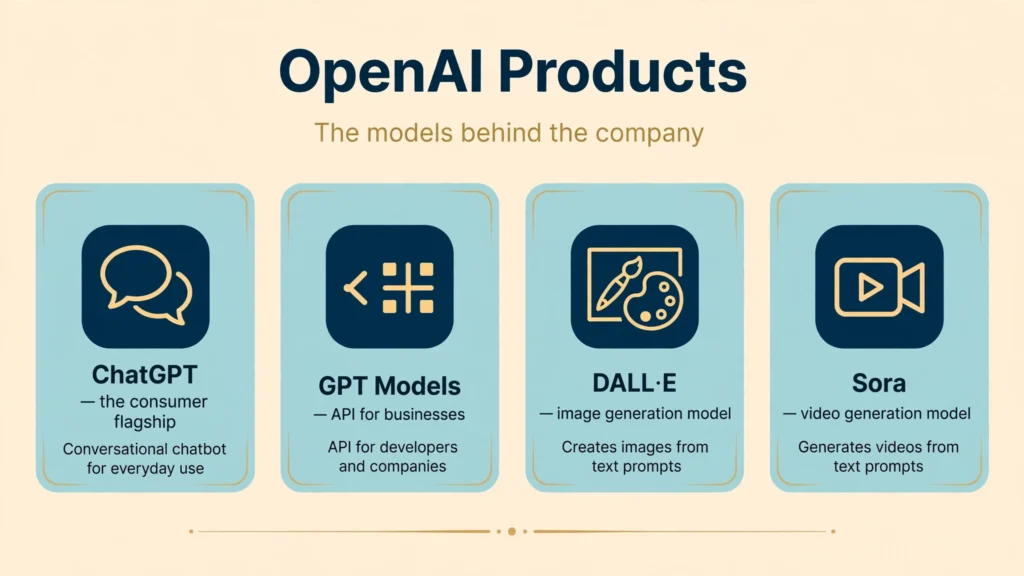
OpenAI is the artificial intelligence research company behind ChatGPT, the fastest-growing consumer application in history, along with the GPT family of language models, the DALL-E image generator, and the Sora video model. Founded in December 2015 as a nonprofit AI research lab, it later added a capped-profit arm, OpenAI LP, to raise the enormous capital needed to train frontier models.
The company is led by CEO Sam Altman and operates at a scale few private companies ever reach. Its products serve hundreds of millions of users, its API powers thousands of businesses, and its research sets the pace for the entire AI industry. Enterprise partnerships, including a deep alliance with Microsoft, distribute its models through Azure and Microsoft 365 products used worldwide.
Financially, OpenAI is in a league of its own among private companies. A major secondary transaction in 2025 valued it at about $500 billion, making it the most valuable private company in history at the time. Subsequent funding rounds in 2026 came at higher valuations, and press reports have cited unconfirmed talks at valuations up to $1.5 trillion. These are private valuations from funding rounds, not market prices, and they can differ by source.
For the official story, visit OpenAI’s website, where the company publishes its research, product news, and business updates.
Why OpenAI Has No Public Stock
A company has publicly tradable stock only after it completes an initial public offering (IPO) and lists on an exchange. OpenAI has never done this. It has filed a confidential S-1 registration statement, which is a preparatory step, but management has pushed back IPO expectations, with the CEO indicating 2026 is unlikely and the CFO previously pointing toward 2027.
There are good reasons for the delay. As a private company, OpenAI can raise money from institutional investors without quarterly earnings pressure, keep its research strategy secret from competitors, and avoid the disclosure obligations of a public listing. Given its access to seemingly unlimited private capital at rising valuations, the urgency to go public is low.
This means there is no ticker symbol, no share price you can look up on a market data site, and no way to place an order through a brokerage. Any website or social media account offering “OpenAI shares” to the general public through a normal trading account is a scam.
Can You Buy OpenAI Stock Pre-IPO?
For most people, the honest answer is no. Pre-IPO OpenAI shares do trade, but only on private secondary markets reserved for accredited investors. In the United States, that generally means a net worth of at least $1 million excluding your home, or annual income above $200,000 for the last two years, plus issuer approval for the transfer.
The main marketplaces are Forge Global, Hiive, and EquityZen. Typical minimum investments run $25,000 to $100,000, availability is extremely limited, and waitlists can stretch for months. Even if you qualify, pre-IPO equity is illiquid: you generally cannot sell until well after an IPO, and post-IPO lockup periods often prevent early investors from cashing out immediately.
There is also a murkier category to avoid: synthetic or tokenized products that reference OpenAI’s valuation but give you no actual claim on its shares. These derivatives and tokens are often marketed aggressively, carry significant legal and structural risks, and are not the same as owning equity. Treat them with extreme skepticism.
Investing in OpenAI via Funds
One route open to ordinary investors is public funds that hold OpenAI equity. Examples frequently cited include the Ark Venture Fund, SuRo Capital, and the Fundrise Innovation Fund. These let you buy in without accredited status, though minimums and fee structures vary.
The caveats matter. These funds hold many private companies, so they are not a pure play on OpenAI; your exposure to OpenAI itself may be a small slice of the portfolio. Some are interval funds, meaning you can only buy or sell on certain dates, sometimes just quarterly. Read the fine print on fees, liquidity terms, and exactly how much OpenAI exposure the fund actually has before investing.
For a clear-eyed walkthrough of these options, NerdWallet’s guide to buying OpenAI stock covers the accredited-investor thresholds and fund alternatives in detail.
The Microsoft Alternative
The simplest and most legitimate way to get OpenAI exposure is Microsoft stock (MSFT). Microsoft has invested more than $13 billion in OpenAI across multiple rounds and holds exclusive licensing rights to its models. OpenAI’s technology is deeply embedded in Azure, Copilot, and Microsoft 365, so Microsoft’s cloud growth is directly tied to OpenAI’s success.
This is not the same as owning OpenAI, but it has real advantages: instant liquidity, dividends, regulatory oversight, and a diversified business behind the AI bet. If OpenAI thrives, Microsoft benefits; if the AI trade cools, you still own one of the world’s most profitable software companies.
The partnership runs deeper than a simple investment. Microsoft is OpenAI’s exclusive cloud provider, so every API call and ChatGPT query runs on Azure infrastructure, and OpenAI models are woven through Copilot assistants across Windows, Office, and GitHub. Microsoft has also secured rights to OpenAI’s intellectual property under certain conditions, which analysts view as downside protection on the investment. When you buy MSFT, you are buying the company best positioned to monetize OpenAI’s technology at global scale.
Other public companies with AI ties exist, but none has Microsoft’s depth of OpenAI integration. For most retail investors, MSFT is the sane answer to the OpenAI question.
OpenAI IPO: What We Know
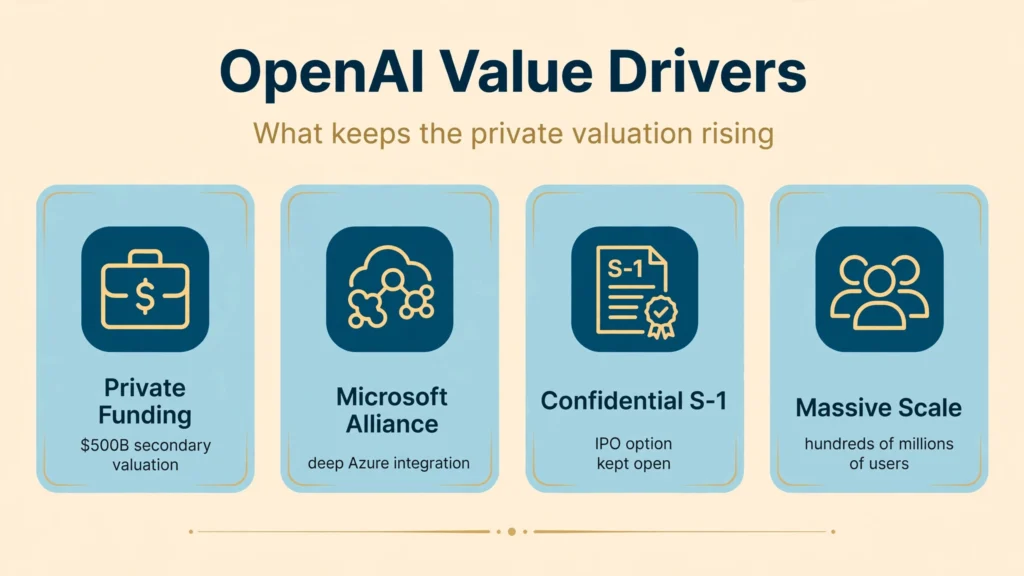
As of late 2026, OpenAI has not confirmed an IPO date. The confidential S-1 filing keeps the option open, but leadership’s own comments suggest no rush. Analyst estimates vary widely, and mega-cap private companies routinely delay listings for years.
When an IPO eventually happens, expect it to list on the Nasdaq, likely under heavy institutional demand. Retail investors typically cannot buy at the IPO price, which is allocated to institutional clients of the underwriting banks; most individuals buy at the market price once trading opens, often after an initial pop.
Between now and then, watch the secondary market for price signals. Large employee tender offers and institutional funding rounds set the private valuation step by step, and those numbers tend to leak into the press. A rising private valuation does not guarantee IPO success, but a flat or falling one is worth noting. Either way, the S-1 filing remains the only confirmation that matters.
Watch for the public S-1 filing as the real signal. Once that drops, a listing usually follows within weeks to a few months. Until then, treat every “OpenAI IPO date” headline as speculation.
Risks of Chasing Pre-IPO Exposure
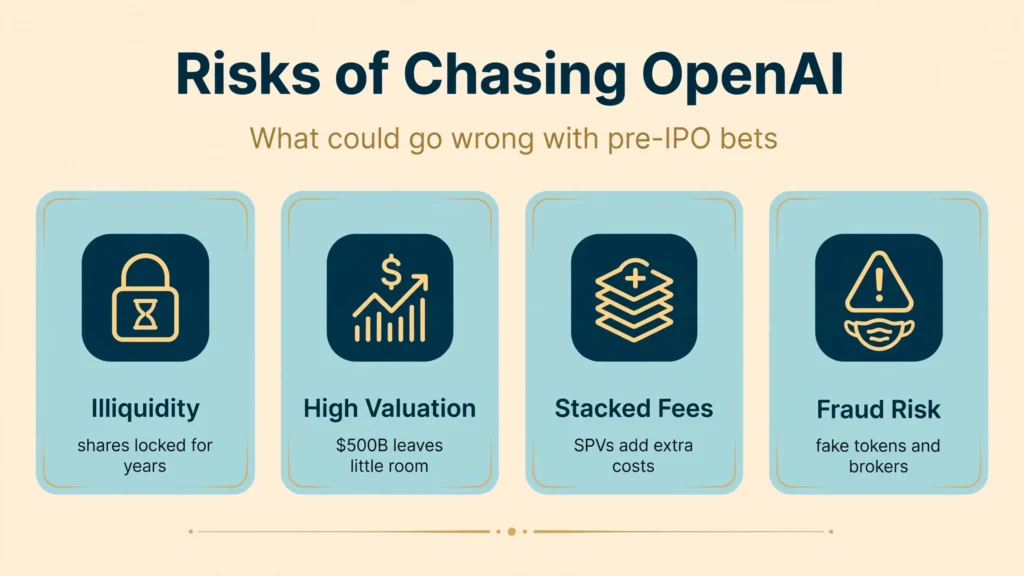
Illiquidity is the defining risk. Private shares can tie up your money for years with no way to sell, and valuations can fall between funding rounds. You are also buying with limited information: private companies disclose far less than public ones.
Fees stack up through intermediaries. Special purpose vehicles (SPVs) and funds add management fees and carried interest on top of whatever the shares cost, and synthetic products add counterparty risk. The further you sit from the actual cap table, the more you pay for the privilege.
Valuation risk is real even for a great company. Buying at a $500 billion-plus valuation leaves little room for error; future returns depend on OpenAI growing into an even larger number. Great technology does not automatically mean great investment returns at any price.
Finally, fraud risk is elevated precisely because demand is so intense. Fake “OpenAI token” sales, impersonator brokers, and guaranteed-return schemes proliferate around hot private companies. If someone promises you easy OpenAI shares, assume it is a scam until proven otherwise.
How to Position Yourself Before an IPO
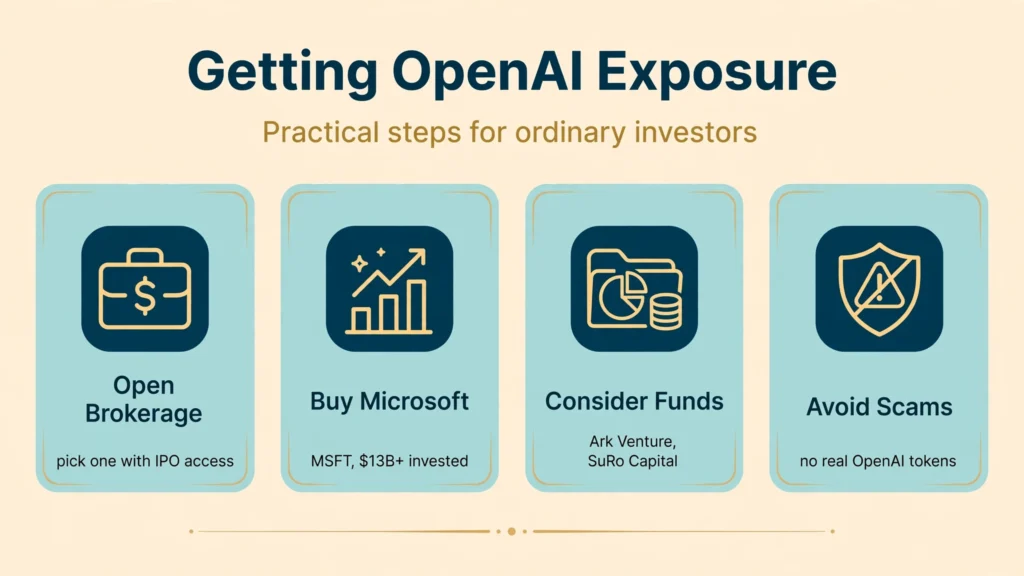
If you want to be ready for a future OpenAI listing, the practical steps are boring but effective. First, make sure you have a brokerage account that offers IPO access; some brokers allocate shares to retail clients, though allotments are small and not guaranteed. Fidelity, Schwab, and others have offered IPO participation programs.
Second, keep learning. Follow the company’s funding rounds, product launches, and any SEC filings. Understanding the business before the IPO hype arrives is the real edge.
Third, decide in advance what the position is for. IPO stocks are volatile in their first months of trading; having a plan for position size and a long time horizon beats chasing the opening-day pop. And never invest money you cannot afford to lose in a single speculative name.
OpenAI vs Other Private AI Companies
OpenAI is not the only private AI giant investors ask about. Anthropic, the maker of Claude, was reported at valuations approaching $965 billion in 2026, ahead of OpenAI in some reported figures. Databricks and Stripe are other highly valued private tech companies with active secondary markets.
The access rules are the same across all of them: no public exchange, accredited investors only for direct secondary purchases, and company approval required for transfers. None of them has confirmed an IPO date either. If you are comparing pre-IPO AI exposure, the diligence questions are identical: valuation, liquidity, fees, and how much you actually understand the business.
For investors who want listed AI exposure today, our Tempus AI stock guide and SoundHound AI stock guide cover two public AI companies you can actually buy, while our BigBear.ai stock guide looks at a small-cap defense AI name.
Who Should Consider OpenAI Exposure
Accredited investors with high risk tolerance and long time horizons are the natural audience for pre-IPO OpenAI shares, and even they should treat it as a small, illiquid satellite position. The lockups and uncertainty demand patience and spare capital.
For everyone else, the sensible path is indirect: Microsoft stock, a diversified fund with disclosed OpenAI holdings, or simply waiting for the IPO. There is no prize for getting in earliest through the riskiest channel.
It is a poor fit for anyone who needs liquidity, cannot meet accredited thresholds, or is tempted by synthetic tokens and social-media share offers. Those paths offer the worst of both worlds: high risk with no real ownership.
Red Flags and Scams to Avoid
The hype around OpenAI has spawned a full ecosystem of scams. Watch for websites selling “OpenAI tokens” or “pre-IPO coins,” Telegram and WhatsApp groups promising guaranteed allocations, and brokers who contact you out of nowhere with can’t-miss offers. Legitimate secondary transactions never work this way.
Real private-market deals involve licensed platforms, extensive documentation, accredited-investor verification, and issuer approval. Anything that skips those steps is not real. Never send crypto or wire transfers to strangers for “OpenAI shares,” and verify any platform through independent sources before sharing personal or financial information.
When in doubt, stick to the public-market alternatives. Microsoft stock will still be there tomorrow; the “exclusive OpenAI allocation” expiring tonight will not, because it never existed. Report suspected scams to the FTC and your state attorney general.
FAQs
Can I buy OpenAI stock on Robinhood or Schwab?
No. OpenAI is private and has no ticker symbol, so no brokerage offers its shares. You can buy Microsoft stock or funds with OpenAI exposure through any brokerage, but not OpenAI itself.
What is OpenAI’s stock symbol?
There isn’t one. OpenAI has never gone public, so it has no NYSE or Nasdaq ticker. Any symbol claimed to represent OpenAI stock is fake.
When is the OpenAI IPO?
There is no confirmed date. The company filed a confidential S-1, but leadership has indicated 2026 is unlikely, with 2027 discussed as a possibility. Treat all IPO date headlines as speculation until a public filing appears.
How much do you need to invest in OpenAI pre-IPO?
On secondary marketplaces like Forge Global, Hiive, and EquityZen, minimums typically start around $25,000, plus you must be an accredited investor and get issuer approval. Availability is limited and waitlists are common.
Is Microsoft stock a good proxy for OpenAI?
It is the most practical one. Microsoft has invested over $13 billion in OpenAI with exclusive licensing rights, and OpenAI’s models drive Azure and Copilot growth. It is not the same as owning OpenAI, but it offers liquid, regulated exposure to the same AI upside.
Conclusion
OpenAI stock remains out of reach for ordinary investors, and that is unlikely to change until an IPO finally materializes. The private secondary market exists, but it is expensive, illiquid, and restricted to accredited investors willing to lock up capital for years. For most people, the rational choices are Microsoft stock, a transparent fund with disclosed OpenAI holdings, or patience.
Whatever you do, avoid the synthetic tokens and too-good-to-be-true offers that swarm around the world’s most famous private company. When OpenAI does go public, it will be one of the most covered events in market history; you will not need a stranger’s Telegram group to hear about it. This article is for research and education only and is not financial advice.
Discover More: