
Say the word lobotomy today and most people picture a horror story from medical history. They are not wrong. A lobotomy was a real brain operation that deliberately cut connections inside the front of the brain. It was performed on tens of thousands of people. Doctors once used it as a serious treatment for severe mental illness.
One of its inventors even won a Nobel Prize for it. Yet within a generation the same operation had become a symbol of medical overconfidence. It showed everything that can go wrong when medicine moves faster than evidence. This guide explains lobotomy meaning in plain language, using what encyclopedias and medical historians actually record. You will learn what the operation was and where the word comes from.
You will also see who spread it, why doctors abandoned it, and why the word survives in slang today.
What Does Lobotomy Mean?

A lobotomy is a surgical procedure in which the nerve pathways in a lobe of the brain are severed from those in other areas. That is the definition the Encyclopaedia Britannica still gives. It captures the essential idea. In practice, the operation cut most of the connections to and from the prefrontal cortex. That is the area at the very front of the brain.
In plain language, surgeons were not removing a part of the brain. Instead, they were cutting the wiring that linked one region to the rest. The change could never be undone, because severed nerve fibers do not reconnect.
The part of the brain involved
The prefrontal cortex sits directly behind your forehead. It helps you plan ahead, weigh consequences, control impulses, and respond to the world with the right amount of emotion. Because it does so much personality work, cutting its connections often changed far more than the symptoms doctors were targeting.
The target was mainly the white matter beneath this region. White matter is made up of long fibers that carry signals between brain areas. Many of them run down toward the thalamus, a relay station near the center of the brain. Moniz believed that faulty loops in these pathways locked patients into fixed, tormenting patterns of thought. Cutting the fibers, he reasoned, might break the loop.
Lobotomy, leucotomy and lobectomy
Three similar words cause constant confusion, so it helps to separate them early. Moniz called his operation a leucotomy, from the Greek word leukos, meaning white, because it cut white matter. Freeman preferred the word lobotomy. That is the term that stuck in the United States, while leucotomy remained common in Britain.
A lobectomy is something different again. In a lobectomy, surgeons remove an entire lobe of an organ, such as part of a lung or a section of the brain. It is usually done to treat a disease like cancer. A lobotomy cut connections within the frontal lobes instead of removing the lobe itself.
Where the Word Lobotomy Comes From
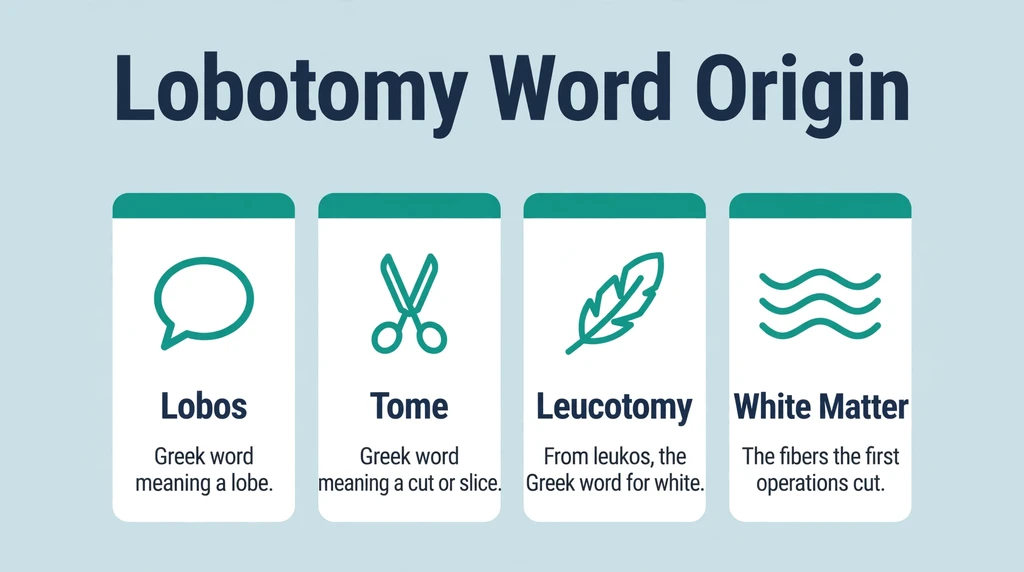
The word lobotomy is built from two Greek parts. The first, lobos, simply means a lobe, one of the rounded sections of an organ like the brain or the liver. The second, tomē, means a cut or a slice. It appears in many medical words that involve cutting.
Put together, lobotomy literally means cutting into a lobe. The name describes exactly what the surgeon aimed to do, which is part of why the word feels so blunt today. Its companion term, leucotomy, swaps in leukos, the Greek word for white. It points to the white matter that the early operations actually cut.
The word is pronounced loh-BOT-uh-mee, with the stress on the second syllable. Its verb form is lobotomize, and a person who had the operation was described as lobotomized. That past-tense word later took on a second, figurative career, which the slang section below explores.
Originally, though, lobotomy was not even the first name for the procedure. Moniz published his results under the name prefrontal leucotomy in 1936, and the field he founded became known as psychosurgery. Only after Freeman renamed the operation for American audiences did lobotomy become the famous word.
Why Doctors Turned to Brain Surgery
To understand why sane, trained doctors embraced such a drastic operation, you have to picture the mental hospitals of the 1930s. They were overcrowded, underfunded, and filled with people suffering from illnesses that medicine barely understood. Schizophrenia, severe depression, and mania could leave patients tormented, self-destructive, or violent for years.
A crisis with few answers
Crucially, doctors of that era had almost nothing that worked. There were no antipsychotic drugs, because the first one would not arrive until the 1950s. Hospitals relied on restraints, sedation, and insulin coma therapy. From the late 1930s, they also used electroshock treatment. All were blunt tools with serious risks of their own.
Families were desperate, and institutions were desperate too. A treatment that promised to quiet a ward sounded like mercy, not cruelty. Even sending some patients home seemed possible, and many people at the time believed it. That desperation explains, though it does not excuse, how quickly the operation spread once early reports sounded hopeful.
The reasoning behind the operation
The theory also sounded scientific for its day. Moniz argued that mental illness could become fixed in the brain, as if thoughts kept circling the same damaged track. If the track was a set of overactive connections, then cutting those connections might let healthier patterns form.
Early animal work seemed to support the hope. When researchers altered the frontal lobes of chimpanzees, an animal that had reacted with fury to mistakes became noticeably calmer. For doctors watching human patients suffer, that single observation carried enormous weight.
The newspapers sold the miracle
The press completed the recipe. In the late 1930s and 1940s, magazines and newspapers ran hopeful stories about patients rescued from torment by the new brain surgery. A May 1941 article in the Saturday Evening Post, then one of America’s biggest magazines, praised Freeman’s pioneering work warmly.
Such coverage mattered, because it reached families directly. Readers wrote to hospitals asking for the operation by name. Hope, amplified by headlines, became its own kind of pressure on doctors to keep offering it.
The Early Experiments
Lobotomy did not appear from nowhere in 1935. Surgeons had wondered for decades whether changing the brain could change behavior, and the earliest attempts were already sobering.
A few isolated attempts followed over the years. The Estonian surgeon Ludvig Puusepp operated on the frontal lobes of a small number of patients around 1910, but his work attracted little attention at the time. The idea needed a trigger, and the trigger turned out to be two chimpanzees at a London conference.
Burckhardt’s forgotten first attempt
In the late 1880s, the Swiss physician Gottlieb Burckhardt removed small parts of the cortex in six patients at the asylum he supervised. His patients heard voices and suffered from symptoms that would later be grouped under schizophrenia. Burckhardt did not claim he could cure them; his stated goal was simply to make them calm.
The results were grim reading. One patient died several days after surgery, and another later took his own life. Several others did become quieter and easier to manage. Even so, the medical world reacted with hostility, and Burckhardt published his results and stopped. For roughly four decades, almost nobody tried anything similar.
The chimpanzee result that changed everything
The idea returned through animal research. In 1935, at a neurological congress in London, the American researchers Carlyle Jacobsen and John Fulton described frontal lobe experiments on two chimpanzees. One animal had reacted to mistakes in a memory task with visible frustration and agitation. After its frontal lobes were altered, that frustration response disappeared.
Sitting in the audience was António Egas Moniz. He reportedly asked whether the approach might help human patients, and he went home to Portugal determined to find out. Within months, the first human leucotomy had been performed in Lisbon.
Egas Moniz and the First Leucotomy
The man who started the lobotomy era was not a surgeon at all. António Egas Moniz was a Portuguese neurologist and a former foreign minister. He was also the inventor of cerebral angiography, a way of imaging the blood vessels of the brain. He was already one of Portugal’s most decorated scientists when he turned to psychiatric surgery at the age of sixty.
The first operation, November 1935
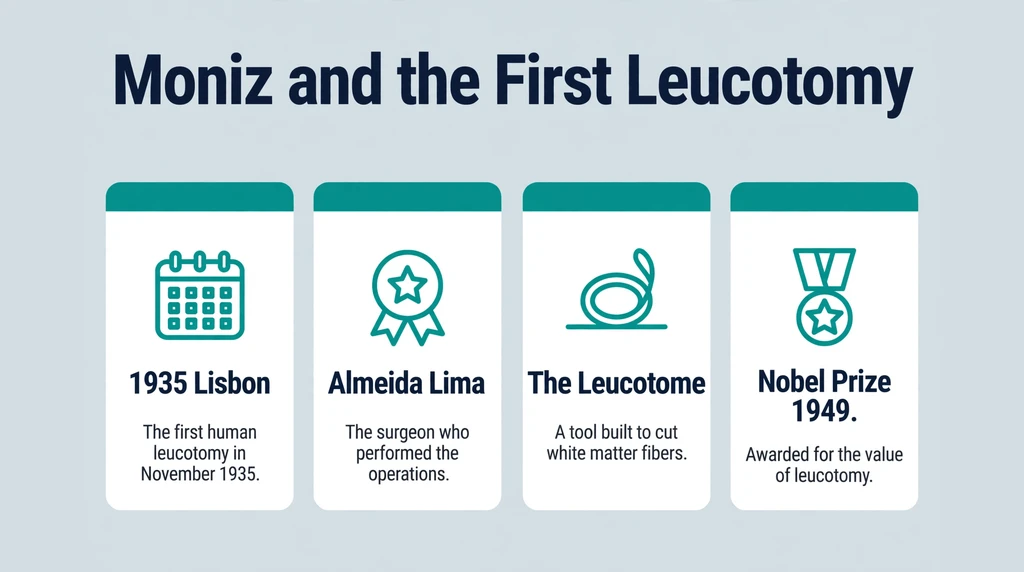
Moniz suffered from gout that damaged his hands, so he could not operate himself. Instead, the young surgeon Pedro Almeida Lima performed the operations under Moniz’s direction. The first took place on 12 November 1935, on a patient with severe paranoia and anxiety.
In the earliest procedures, Lima drilled small holes in the skull. Through them, he injected pure alcohol into the prefrontal cortex to destroy the connecting fibers. The patient survived, and her symptoms appeared to ease. On that slender evidence, an entire field began to grow.
The leucotome and the first results
Alcohol was imprecise, so Moniz designed a purpose-built instrument called the leucotome. It was a needle-like tool with a retractable wire loop. Once the tip was in position, the loop sprang out and rotated, cutting a small core of white matter.
Moniz reported on his first twenty patients in 1936. His summary sounded encouraging: he counted fourteen of the twenty as cured or improved. By 1937, he and Lima had operated on nearly forty people, with more mixed results, including relapses. Nevertheless, his papers traveled fast, because hospitals everywhere were hunting for exactly this kind of hope.
The Nobel Prize
The honour that cemented the operation’s respectability came in 1949. Moniz shared the Nobel Prize in Physiology or Medicine with the Swiss physiologist Walter Hess. His half of the prize recognized his discovery of the therapeutic value of leucotomy in certain psychoses, in the committee’s own words.
At the ceremony, the presenting professor called frontal leucotomy one of the most important discoveries ever made in psychiatric therapy. Today, the award is widely regarded as one of the most controversial in the prize’s history. The Nobel Foundation has never revoked it. The story of why it was given remains a warning about celebrating results before long-term evidence arrives.
Fittingly, one of the people who nominated Moniz for the prize was Walter Freeman himself. The American had built his career on the Portuguese neurologist’s idea, and the award crowned them both.
Shot by a patient
Moniz’s own story carries a dark footnote. In 1939, a patient shot him several times in his consulting room in Lisbon. Moniz survived the attack, but his injuries left him relying on a wheelchair for much of the rest of his life. He died in Lisbon in 1955, six years after receiving the Nobel Prize.
Walter Freeman and the Ice Pick Era
If Moniz invented the operation, Walter Freeman sold it to the world. Freeman was a driven, theatrical American neurologist at George Washington University. He believed psychosurgery could rescue patients whom psychiatry had abandoned. His energy, and his genius for publicity, turned a controversial experiment into a mainstream treatment.
Freeman and Watts bring lobotomy to America
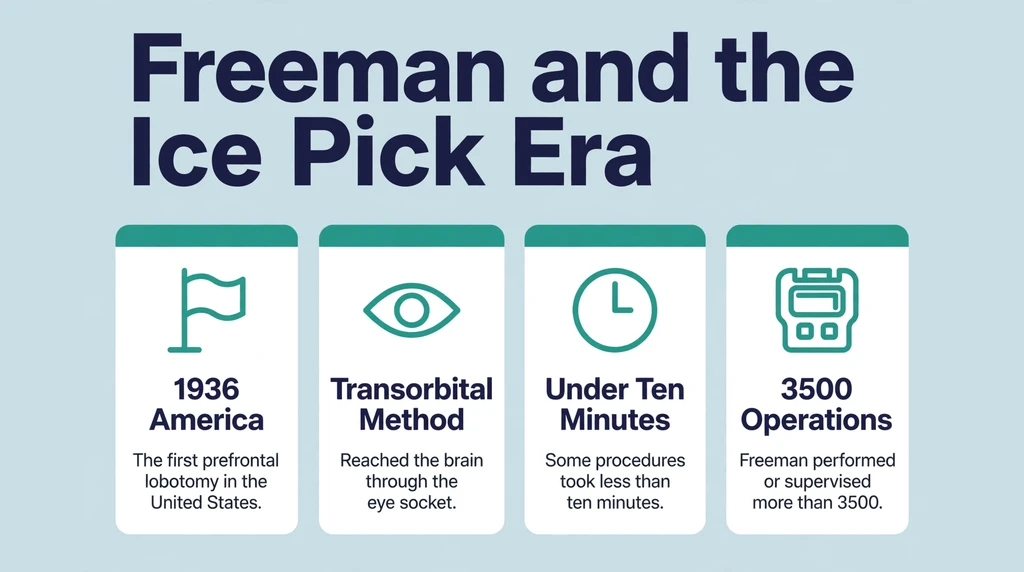
In 1936, Freeman teamed up with the neurosurgeon James Watts to perform the first prefrontal lobotomy in the United States. The arrangement matched their skills: Freeman planned and promoted, while Watts, the trained surgeon, did the cutting. Together they refined the operation into a set routine, the Freeman-Watts standard lobotomy, and published their results widely.
Freeman also gave the procedure its American name. Where Moniz said leucotomy, Freeman insisted on lobotomy, and he wrote and lectured tirelessly to spread the word. Newspapers loved him, because he offered dramatic hope in plain language at a time when asylums had little else to offer.
The transorbital shortcut
Freeman still thought the operation was too slow, too expensive, and too dependent on surgeons. His solution came from an approach first tried in Italy by Amarro Fiamberti. Fiamberti had reached the frontal lobes through the eye socket in 1937. Freeman streamlined the method in 1945 and used it on a patient for the first time in 1946.
In the transorbital procedure, the patient was first subdued, often with electroshock. A slim, pick-like instrument was slipped under the eyelid. It passed through the thin bone at the back of the eye socket. Then it was swept through the frontal lobe tissue to sever the connections. The whole thing could take less than ten minutes, and it left no visible scar.
Because the instrument resembled a household ice pick, the method earned its grim nickname: the ice pick lobotomy. Freeman needed no operating theater and no surgeon, and that was precisely what alarmed his critics. Watts, who considered the shortcut reckless, ended their partnership over it.
Freeman takes to the road
Freeman spent the late 1940s and 1950s demonstrating the procedure across the United States. He performed assembly-line operating sessions at state hospitals, sometimes working on dozens of patients during a single visit. He eventually traveled in a van that came to be nicknamed the lobotomobile, carrying his instruments from institution to institution.
By the late 1960s, Freeman had performed or supervised more than 3,500 lobotomies. No single doctor did more to define the era, and no single doctor did more to discredit it.
How Many Lobotomies Were Performed?
No exact count exists, because records across dozens of countries and thousands of hospitals were never centralized. Historians work from surveys and hospital archives, so every figure in this section is an estimate.
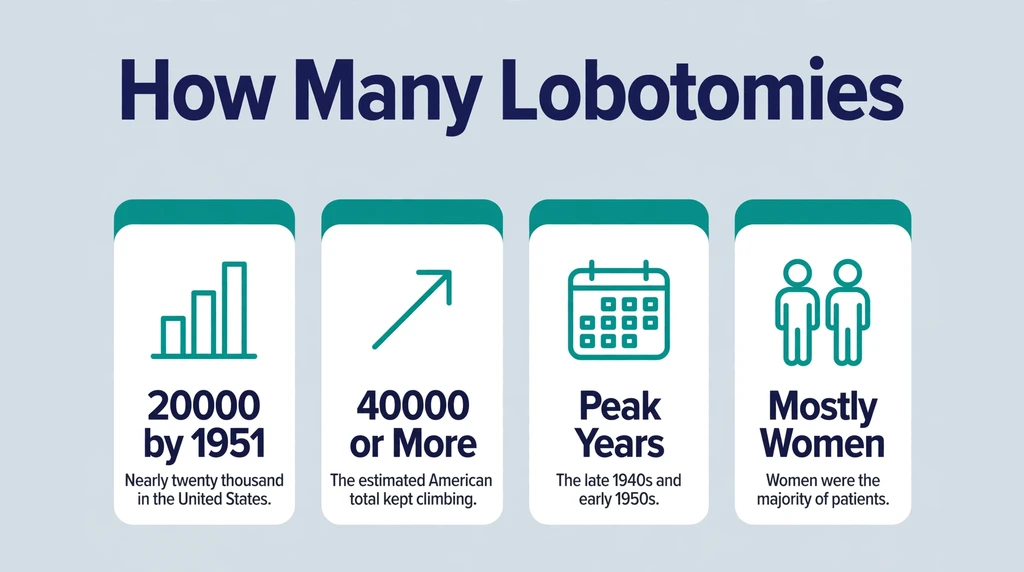
The firmest landmark comes from the United States. By 1951, almost 20,000 lobotomies had already been performed there, and the total was still climbing. The busiest years were the late 1940s and early 1950s, when the operation was at the height of its fashion.
Commonly cited estimates put the eventual American total at 40,000 or more. Britain performed proportionally even more for its smaller population. The procedure was also used widely in Scandinavia and other parts of Europe. Adding the world together, the total runs into the tens of thousands.
The pace could be startling. In one West Virginia state project in 1952, newspapers counted 228 transorbital lobotomies performed by Freeman in roughly two weeks. Speed had become a selling point, and it was also the thing that frightened his critics most.
One pattern in the records stands out to modern researchers. Most patients were women. Seventeen of Freeman and Watts’s first twenty patients were women. Historical studies find the same imbalance across the era as a whole. Yet women did not outnumber men in the asylums themselves.
What a Lobotomy Did to People
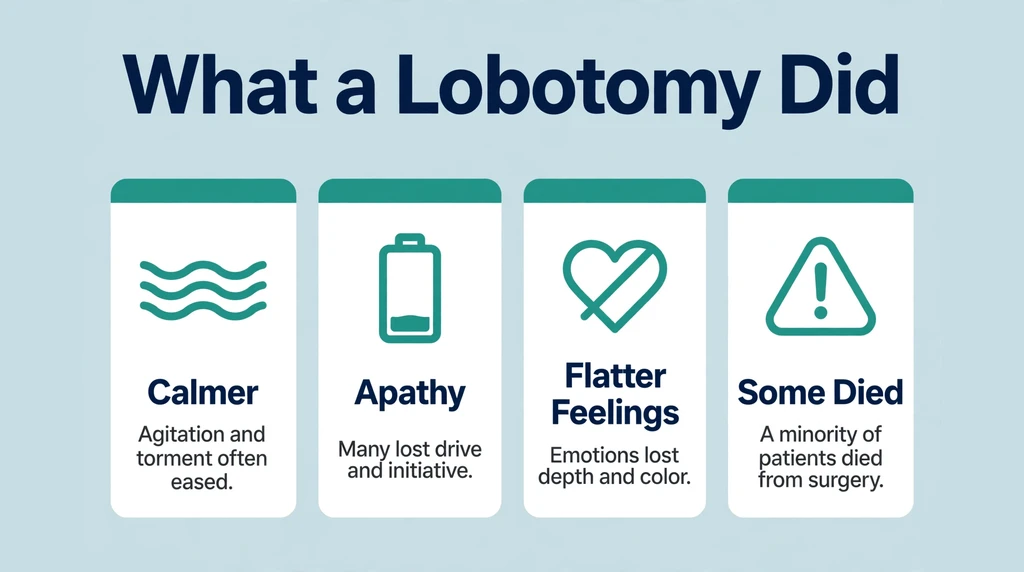
Defenders and critics of lobotomy were often describing the same changes. The argument was over whether those changes counted as recovery.
What improvement looked like
The effect doctors were aiming for was calm. Many patients did become less agitated, less tormented by delusions, and easier to care for. Some who had spent years in locked wards were able to go home. Freeman’s published follow-ups reported that most of his early patients had improved. For exhausted families, a quieter relative could feel like a rescue.
It is important to be fair to that context. Some patients and families were genuinely grateful, and a minority of patients lived stable lives afterwards. The tragedy is that nobody could predict who would land in that group.
The cost written into the personality
The same operation that lowered agitation also tended to lower everything else. Britannica’s summary of the recorded effects lists apathy, passivity, and a lack of initiative. Patients often struggled to concentrate, to plan, or to feel the normal depth of joy, grief, embarrassment, or love.
In other words, the personality itself was blunted. Some patients developed seizures after surgery. Some were left childlike and dependent, unable to work or live independently. And some died as a result of the procedure itself.
Crucially, none of this could be reversed. Families had hoped for a calmer version of the person they loved. Sometimes they found that the person, in important ways, was no longer there.
Two Cases That Shaped the Story
Statistics explain the scale of the lobotomy era, but two individual cases explain its conscience. One was hidden by a famous family for decades. The other was told by the patient himself.
Rosemary Kennedy
Rosemary Kennedy was the eldest daughter of Joseph and Rose Kennedy, and a sister of the future president John F. Kennedy. She had learning difficulties, and by her early twenties her mood swings and rebellious behavior worried her ambitious father. In November 1941, when she was twenty-three, he arranged for Freeman and Watts to perform a lobotomy, without telling his wife beforehand.
The operation was a catastrophe. It left Rosemary permanently incapacitated, unable to speak intelligibly or walk unaided. She spent the remaining sixty-three years of her life in institutions. Largely hidden from public view, she died in 2005 at the age of eighty-six.
Her story stayed quiet for decades, and its slow emergence changed how the public judged the operation. Later, her sister Eunice Kennedy Shriver founded the Special Olympics, drawing in part on the family’s private experience of disability.
Howard Dully, lobotomized at twelve
Howard Dully was not mentally ill. He was a boy whose stepmother found him defiant: he objected to bedtime, daydreamed, and answered back. In December 1960, after consulting Freeman, the family agreed to a transorbital lobotomy. Howard was twelve years old.
Dully survived. He eventually told the world what it was like to grow up in the operation’s fog. His account reached a wide audience through a 2005 radio documentary and his 2007 memoir, My Lobotomy. His case, together with Rosemary Kennedy’s story, forced a plain question. How did a child’s behavior problems ever become a reason for brain surgery?
Most patients, of course, left no memoir and no famous surname. Their names survive in hospital ledgers and case files instead. Historians and journalists have spent decades recovering those quieter stories, and they are the reason the two cases above no longer stand alone.
Why Lobotomy Was Abandoned
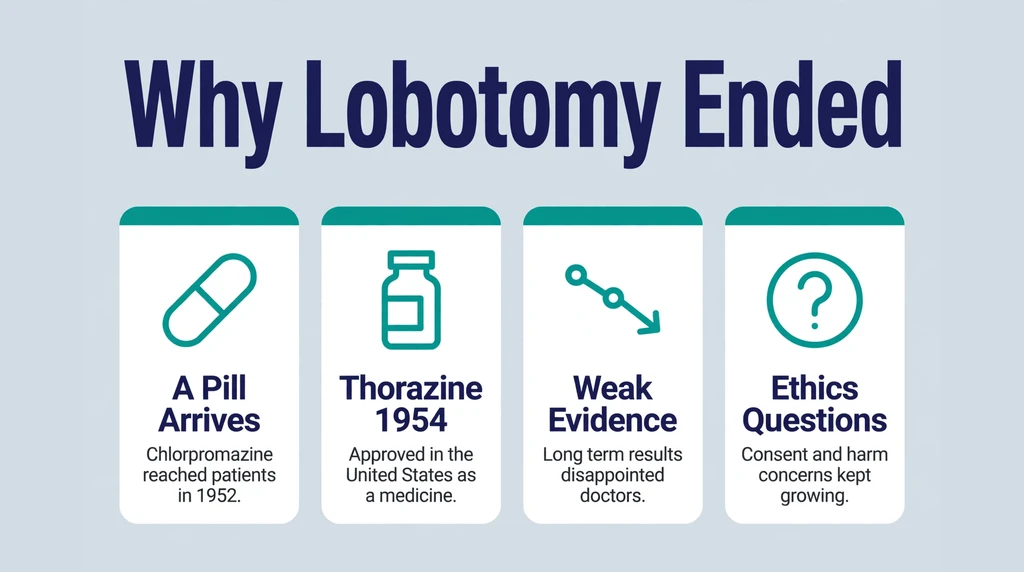
Lobotomy was not ended by a single court case or law. It faded because something better arrived, and because the longer doctors looked at the results, the worse the results looked.
A pill changed everything
The turning point was a drug. Chlorpromazine was introduced in France in 1952 under the name Largactil. In 1954, the United States approved it under the name Thorazine. It was the first antipsychotic, and it could calm psychotic symptoms that had previously seemed untouchable.
The contrast with surgery was obvious to everyone. A pill could be adjusted, reduced, or stopped. It required no holes in the skull and no destroyed tissue. Within a few years, hospitals were shifting wholesale to medication, and the surgical era collapsed with surprising speed.
The evidence and the ethics caught up
Meanwhile, criticism had been building for years. Follow-up studies found relapses, blunted personalities, and patients who were easier to manage but not truly better. The Soviet Union, notably, had banned the procedure outright in December 1950, years before the West let it go.
Consent was the deepest problem. Many patients were in no state to agree to anything, and decisions were often made by families or institutions instead. Cases like Rosemary Kennedy’s showed where that could lead. Freeman himself kept operating into the 1960s, long after the tide had turned. Then, in 1967, a patient died during one of his procedures. He lost his surgical privileges, and the era’s most famous lobotomist never operated again.
Is Lobotomy Still Performed Today?
No. The classic lobotomy, in which a surgeon cut broad connections in the frontal lobes by feel, belongs entirely to history. No reputable hospital offers it. Freeman’s last procedure in 1967 is generally treated as the end of the line in the United States.
That said, the broader field Moniz founded, psychosurgery, did not vanish completely. It shrank, slowed down, and surrounded itself with safeguards. A small number of highly specialized centers still treat a handful of patients. Their severe obsessive compulsive disorder or depression has resisted every standard treatment.
How modern psychosurgery differs
The modern operations share a goal with lobotomy but almost nothing else. Using detailed brain scans and stereotactic guidance, surgeons target a spot measured in millimetres, not a whole lobe. Two examples are anterior cingulotomy and anterior capsulotomy, which interrupt one small, well-mapped circuit linked to obsessive symptoms.
Another option does not destroy tissue at all. In deep brain stimulation, electrodes are implanted in a targeted area and deliver adjustable pulses. The United States allowed the technique for severe, treatment-resistant OCD under a humanitarian device exemption in 2009. Settings can be changed. The device can be switched off. That is the opposite of a cut that could never be undone.
Every modern case passes ethics committees, independent reviews, and strict consent rules. The distance from Freeman’s ten-minute office procedure is deliberate, and it is the point.
What about shock therapy?
Electroconvulsive therapy, the era’s other famous shock treatment, is a different story. Modern ECT is still used occasionally, under anesthesia and strict rules, mainly for severe depression that has resisted medication. It aims to trigger a brief, controlled seizure rather than destroy tissue. Unlike lobotomy, it remains an accepted, regulated part of psychiatry.
Lobotomy in Slang and Popular Culture
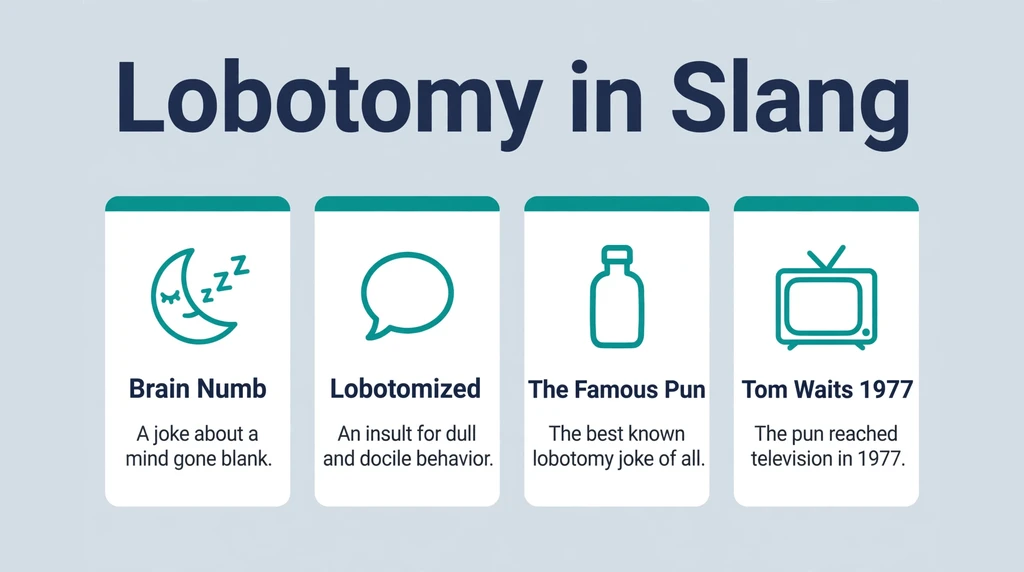
Ask a teenager what a lobotomy is and you may get a meme before you get a medical answer. The word has escaped the hospital and taken up a second life in everyday language.
The word as a joke about a blank mind
In slang, to call yourself lobotomized is to joke that your brain has checked out. People use it after zoning out in a meeting or scrolling their phones into a trance. They use it for staring blankly at a screen at two in the morning. Calling a dull sequel lobotomized makes the same point about something else. A dumbed-down remake gets the same label: the spark has been cut out of it. Software fans use the word when a beloved app returns with its best features stripped away. Car reviewers use it when a lively model comes back sedated and sensible.
The humor works because everyone roughly knows the history. The joke borrows the image of a person left docile and empty. It shrinks that image into a punchline about ordinary mental fog. It is dark comedy, and it depends entirely on the real operation being safely in the past.
The most famous lobotomy joke
The best-known specimen is a pun: “I’d rather have a bottle in front of me than a frontal lobotomy.” Quote researchers have traced its earliest printed form to a 1965 philosophy book, and singer Tom Waits made it famous when he delivered it on television in 1977. Waits himself said he had read it on a bathroom wall.
In 1980, the line became a novelty song by Randy Hanzlick, a real physician recording as Dr. Rock, and it became a favorite on the Dr. Demento radio show. Claims that Dorothy Parker or W. C. Fields coined the line circulate widely, but quote historians have found no evidence for either.
Culture gave the word darker homes too. In Ken Kesey’s novel One Flew Over the Cuckoo’s Nest, McMurphy is lobotomized by the institution he defied. The celebrated film that followed carried the story to millions more. For many people, that story is the lobotomy they know best. It fixed the word’s meaning as a symbol of punishment disguised as treatment.
Common Misconceptions About Lobotomy
Frances Farmer was lobotomized
The actress Frances Farmer was institutionalized in the 1940s, and legend says she received a transorbital lobotomy. There is no evidence it ever happened. The claim traces to a ghostwritten account whose author later admitted under oath that he had fabricated it. The 1982 film Frances showed the operation anyway, and the myth has outlived the correction ever since.
Every patient became a zombie
The outcomes varied more than the horror stories suggest. Some patients were left profoundly disabled, and some died. Others became calmer without obvious devastation, and a minority lived at home for decades afterwards. The honest summary is not that every result was catastrophic. Results were unpredictable, often damaging, and impossible to reverse.
Lobotomies were banned by law
There was never one dramatic worldwide ban. The Soviet Union prohibited the operation in 1950, but in most Western countries lobotomy simply withered. Better drugs arrived, and professional opinion turned. Hospitals stopped offering it, and consent standards tightened until the practice had nowhere left to stand.
Doctors of the time knew it was quackery
At its peak, lobotomy was mainstream medicine. It was taught at major universities and crowned with a Nobel Prize. Its leading promoter was a respected professor, not a back-street operator. That is why historians treat the story as a lasting lesson. Whole professions, not just individuals, can talk themselves into a harmful certainty.
It was only an American story
America produced the era’s most famous promoter, but the operation was international. Britain used it heavily, and Scandinavian countries performed strikingly high numbers for their small populations. A few countries were still performing versions of psychosurgery into the 1970s, long after the practice had collapsed in the United States.
Frequently Asked Questions
What does lobotomy mean in simple words?
A lobotomy was a brain operation that cut the connections between the front part of the brain, the prefrontal cortex, and the rest of the brain. Doctors used it from the 1930s to the 1950s to calm people with severe mental illness. It is no longer performed.
Is a lobotomy the same as a leucotomy?
Yes, they were the same operation under two names. Leucotomy, the earlier term, stressed the white matter being cut, while lobotomy stressed the lobe involved. Britain generally kept saying leucotomy, and the United States adopted lobotomy.
Who invented the lobotomy?
The Portuguese neurologist António Egas Moniz developed the procedure. Surgeon Almeida Lima performed the first operation in Lisbon in November 1935. The American neurologist Walter Freeman then popularised it in the United States from 1936 onward.
Why did Moniz win a Nobel Prize?
In 1949, the Nobel committee honoured Moniz for discovering the therapeutic value of leucotomy in certain psychoses. At the time, early reports suggested the operation helped patients nothing else could reach. The prize has been controversial ever since, because the long-term harms became clear later.
What did a lobotomy do to a person?
The intended effect was calm, and many patients did become less agitated. However, many also became apathetic and passive, lost initiative and concentration, and felt emotions less deeply. Some were left severely disabled, and some died from the surgery.
Are lobotomies still performed today?
No, the classic lobotomy is never performed today. A tiny number of specialized centers still offer precise, image-guided procedures. Examples include cingulotomy and deep brain stimulation, for severe illness that has resisted all other treatment. Those modern treatments are heavily reviewed and regulated.
Did Rosemary Kennedy really have a lobotomy?
Yes. In November 1941, at the age of twenty-three, Rosemary Kennedy was lobotomized by Walter Freeman and James Watts, on her father’s decision. The operation left her permanently incapacitated, and she lived in institutions for the rest of her life.
What does lobotomized mean in slang?
In slang, lobotomized is a joke about a mind gone blank or dull. People say it about themselves after zoning out. They also say it about books, films, or products that seem to have had the life cut out of them. It borrows its image from the flat, docile state the real operation could produce.
Final Thoughts
Lobotomy meaning carries two stories at once. The first is a chapter of medical history. It tells of a real operation, born of desperation, decorated with a Nobel Prize, and abandoned once better treatments arrived. The second is the story of a word that outlived the procedure. It turned into slang for a mind gone blank, and into a punchline about bottles and frontal lobes. Knowing the history makes the jokes land differently, and it should. Behind the slang are tens of thousands of real patients, most of whom never chose what happened to them. For a reliable overview of the medical record, the Encyclopaedia Britannica entry on lobotomy is a solid place to keep reading.