Few workplace words cause as much confusion as furlough. It sounds softer than being fired, yet stricter than a holiday, and headlines rarely explain the difference.
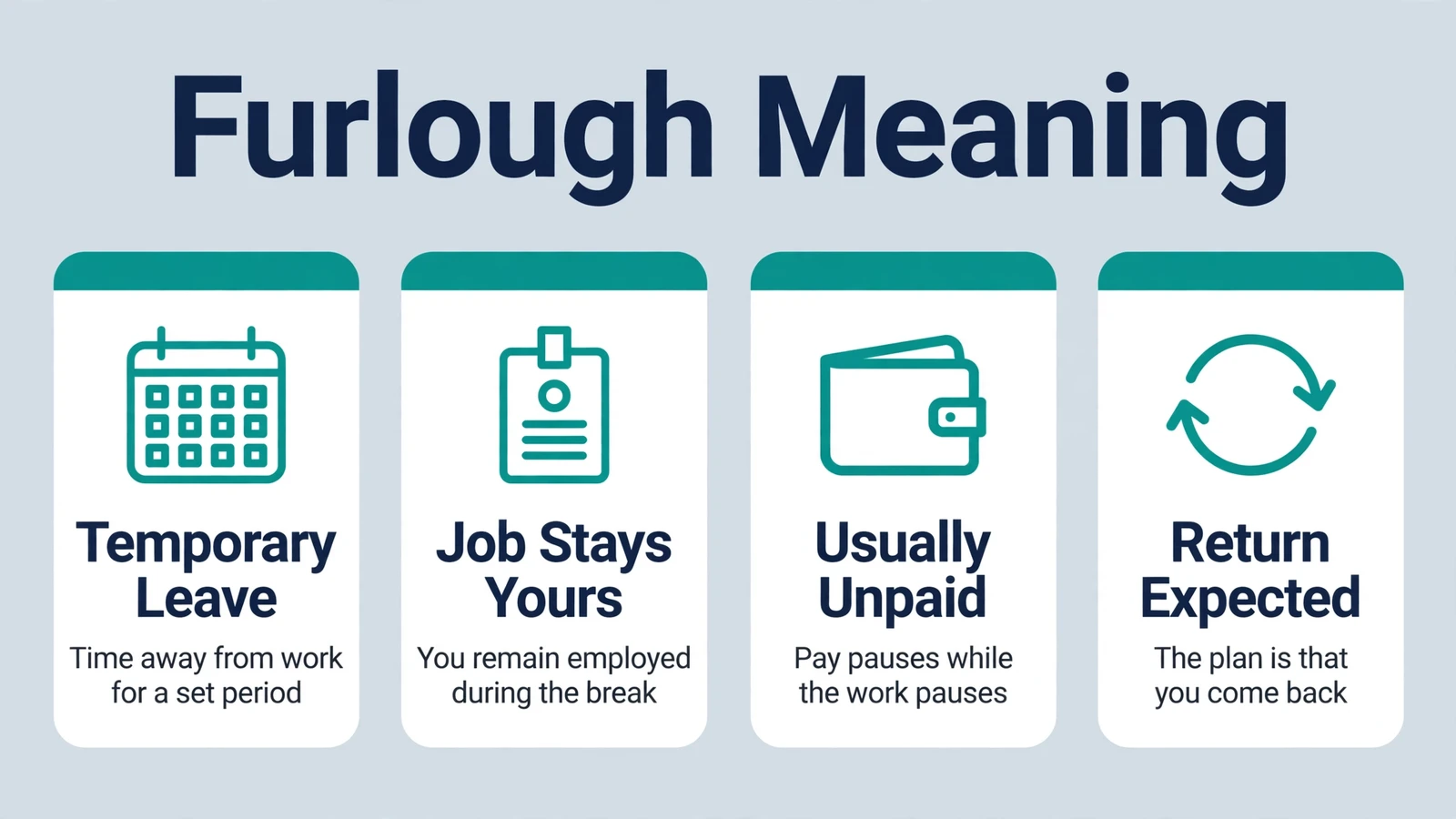
Put simply, furlough meaning comes down to this. A furlough is a temporary leave of absence from work, usually unpaid, that an employer requires during a hard period. The job itself is not gone. You stay employed, you stop working for a while, and the plan is that you come back.
That single idea explains shutdown headlines, airline announcements, and a word the whole United Kingdom learned in 2020. Once you see it, you will start spotting the word everywhere, from factory gates to film sets.
This guide walks through the definition, the history, and the fine print, so the next time you hear the word, you will know exactly where you stand.
What Does Furlough Mean?
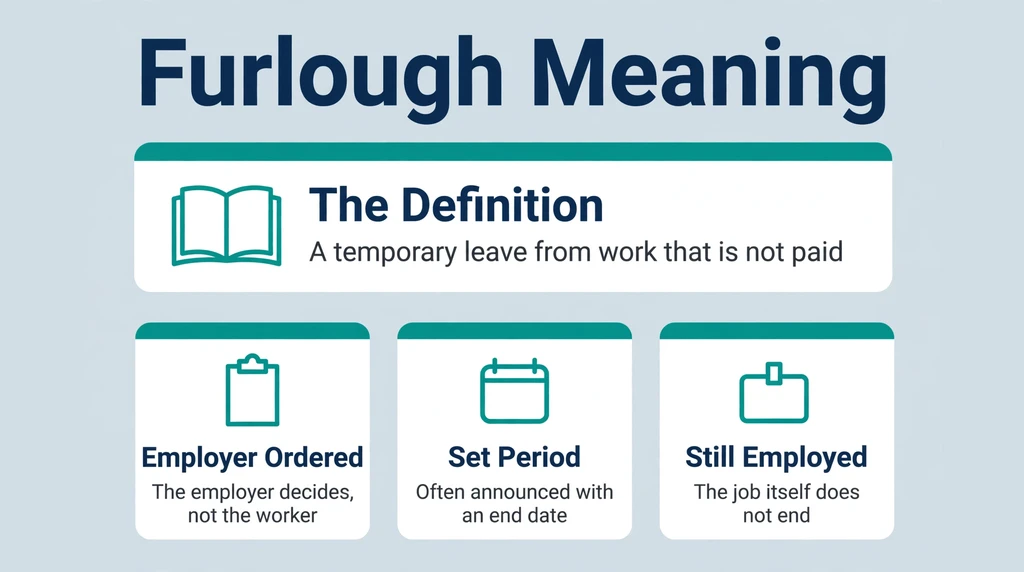
Dictionaries describe a modern furlough as a temporary leave from work that is not paid and is often set for a fixed period. The person is still on the employer’s books. The employer has simply paused the work, and the pay that goes with it.
The Simple Definition
Think of a furlough as a pause button, not a delete button. Your employer faces a cash shortage, a slow season, or a funding gap. Instead of cutting jobs for good, the employer sends people home for a set stretch and saves the wages it would have paid.
Most furloughs share three features. First, the employer orders them, so they are not the same as requested vacation days. Second, they are temporary, with a stated end date or a stated review point. Third, the employment relationship survives. That last feature is the one that separates a furlough from nearly every similar term.
Furlough as a Noun and a Verb
The word works two ways in everyday English. As a noun, it names the leave itself, as in “The airline announced a six-week furlough for its crews.” As a verb, it names what the employer does, as in “The airline will furlough six hundred crew members.”
News reports use the verb form most often, which is why you will see “furloughed workers” far more than “workers on furlough.” Both forms carry the same core sense. Someone’s duties are paused by permission, and the pause is meant to end.
The Word You See in Headlines
When a headline says staff “face furlough,” it means the employer has announced, or is about to announce, a period of forced unpaid leave. When it says workers were “furloughed,” the leave has already started or been formally imposed.
Context usually tells you which world you are in. Shutdown stories point to government staff. Business stories point to private payrolls. Travel stories often involve airlines, which lean on furloughs when flights are cut. The setting changes, but the arrangement stays the same each time.
Mandatory and Voluntary Furloughs
Most furloughs are mandatory. The employer picks the dates, picks the teams, and leaves the worker no real choice in the matter.
A softer variant exists, though. Some employers first invite volunteers to take unpaid days, hoping enough people accept to make forced cuts unnecessary. Others let staff volunteer for extra unpaid leave in exchange for keeping colleagues at work. Reports occasionally call these “voluntary furloughs,” and the arrangement still counts as a furlough, because the employer designs it and the job waits at the end. The imposed kind dominates the news, yet the voluntary kind shows the word’s flexibility.
Core Meaning of Furlough
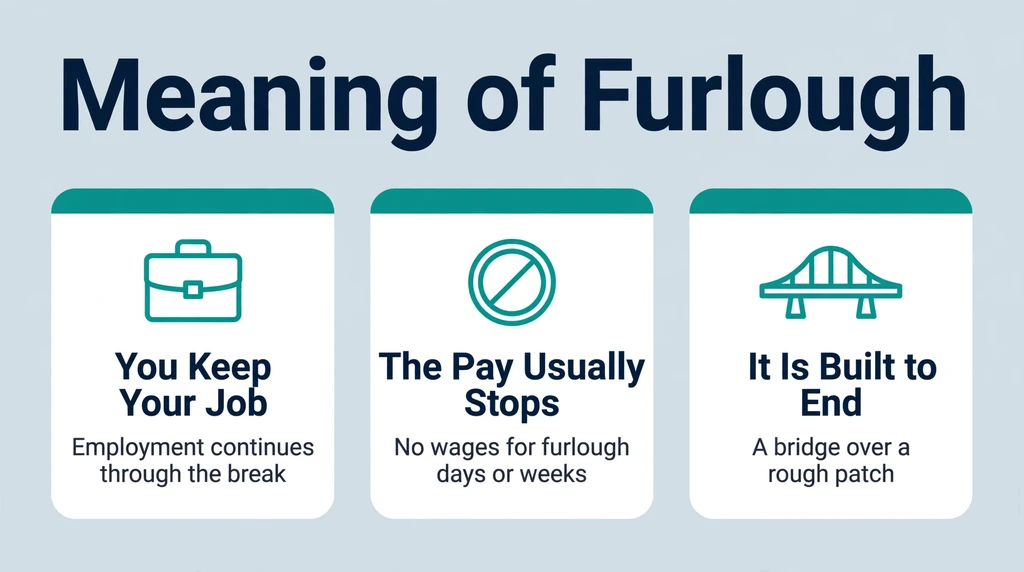
Strip away the settings, military bases, government offices, and factory floors, and the word always carries the same message. Someone in authority grants or imposes time away, and the person is expected back afterward.
You Keep Your Job
The heart of the word is continued employment. A furloughed worker has not been separated, dismissed, or released. Federal guidance in the United States puts it plainly for government staff: a furloughed employee is not separated from the service, and remains an employee throughout.
Private companies use the term the same way. The worker keeps an employee number, keeps seniority, and in many cases keeps a badge, a laptop, and a desk to return to. The relationship bends, but it does not break.
The Pay Usually Stops
In the classic modern sense, furlough time is unpaid time. The worker does not clock in, and the employer does not issue wages for those days. That is the whole point from the employer’s side: payroll is usually the largest single cost a business can cut quickly.
A furlough also differs from a pay cut, and the two are often confused. Under a pay cut, your rate drops while you keep working your normal hours. A furlough removes work time altogether, or removes whole days from your schedule. Your hourly rate or salary figure may stay exactly the same on paper, even though your actual income falls.
Some schemes soften this rule. Governments have sometimes subsidized furlough wages, and a few employers top up partial pay. Even so, unpaid leave remains the default picture most dictionaries describe, and it is the picture workers should plan around unless told otherwise.
It Is Built to End
A furlough is announced as a bridge over a rough patch. The employer expects demand, funding, or both to return, and expects to need the same trained people when they do.
That expectation is real but not a guarantee, and the distinction matters. If conditions keep worsening, a furlough can be extended, and in the worst cases it can turn into permanent job cuts. Hope is built into the word. A promise is not.
How to Pronounce Furlough
The word is pronounced “FUR-loh,” with the stress on the first syllable. In phonetic spelling it is /ˈfɜːrloʊ/ in American English, and it sounds close to /ˈfɜː.ləʊ/ in British English.
The ending surprises many first-time readers. The letters “lough” do not rhyme with “rough” or “cough” here. They sound like the “low” in “below,” which is why the older spellings of the word wandered so much, as you will see in the next section.
The common forms are easy to spot once you know the base word. The past tense and adjective form is “furloughed,” the present participle is “furloughing,” and the plural noun is “furloughs.” All of them keep the stress on “fur.”
Watch the spelling traps as well. The word is often mistyped as “furlow” or “furlo,” and both errors hide in search boxes everywhere. Remember the ending: it borrows the “ough” of “dough,” even though its Dutch ancestor had no such letters at all.
Where the Word Furlough Comes From
Furlough has traveled a long way, in every sense. It started as a soldier’s permission slip, crossed an ocean, and ended up in payroll departments and prison offices.
A Dutch Word for Permission
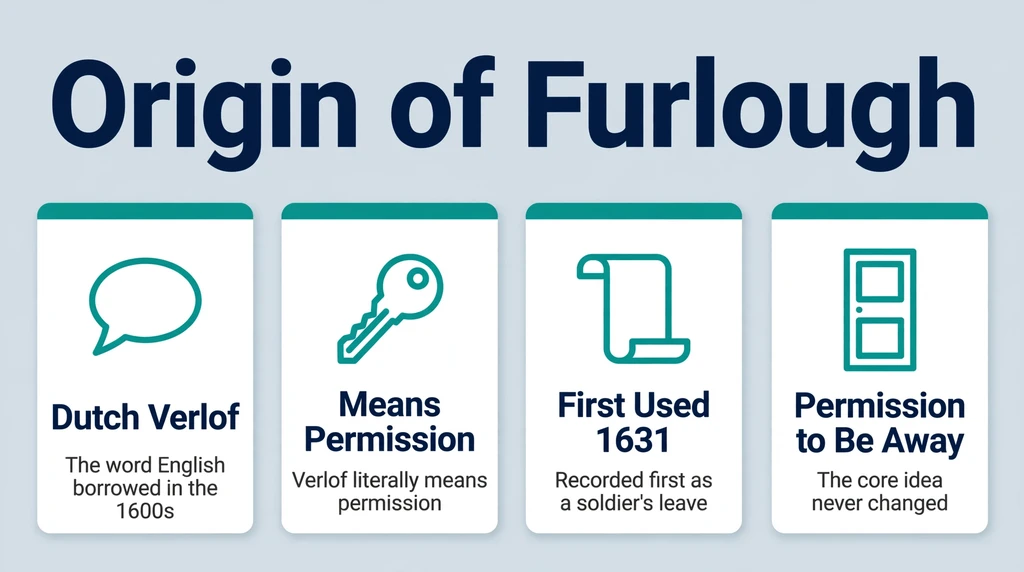
The word entered English in the early 1600s from the Dutch word *verlof*, which literally means “permission.” The Dutch built it from *ver-*, meaning “for,” and *lof*, meaning “permission” or “leave.” English dictionaries give 1631 as the first known use of the noun, in the military sense.
That origin explains the word’s gentle core. A furlough was never, at root, a punishment. It was permission to be away, granted from above. The modern employer version still carries that shape: leave that comes from the employer’s decision, not the worker’s request.
Early English spellings were chaotic. Writers tried *vorloffe*, *furloff*, and *furlogh* before the modern spelling settled. The “-gh” ending became standard in the 1770s, perhaps as a way to show an old “f” sound that later faded from speech.
From Soldiers to Payrolls to Prisons
For roughly three centuries, the word belonged mainly to the military. Soldiers received furloughs to visit home, and the paper that authorized the trip was itself called a furlough.
The jump to civilian jobs came late. By 1946, writers were using furlough for temporary layoffs of workers, starting with civilian employees of the US military. The verb followed the same path, shifting from “grant leave” to “lay off temporarily” around 1940.
The prison sense arrived by 1975, when the word was applied to conditional, temporary releases that let inmates leave for jobs. One word, three worlds, and a single thread through all of them: official permission to be somewhere else for a while.
How a Furlough Works at a Job
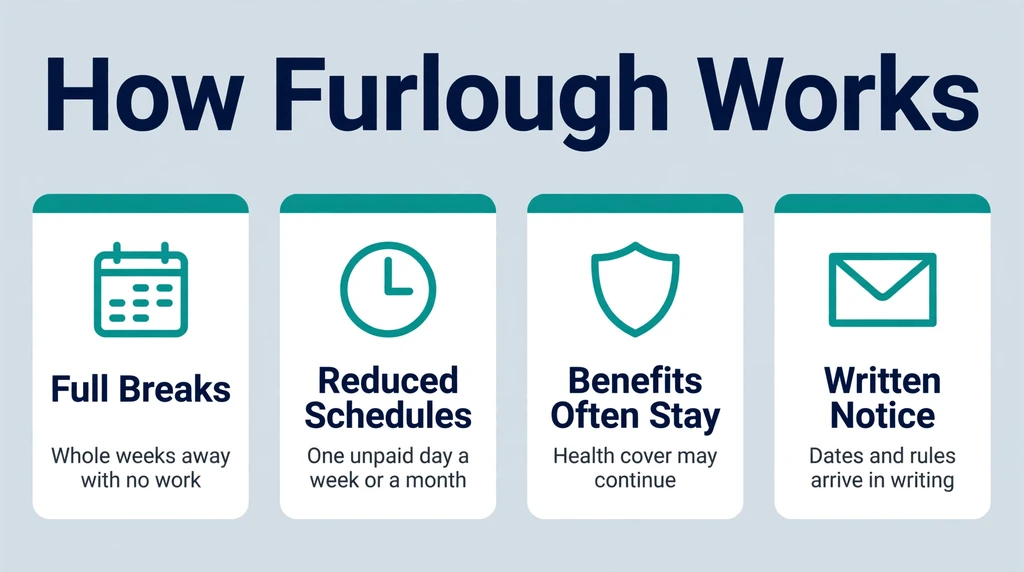
Real furloughs look less dramatic than the headlines suggest. Most are accounting decisions, delivered in a memo, with dates, rules, and a return plan attached.
Full Breaks and Reduced Schedules
The hardest form is a complete break: no work and no pay for a block of weeks or months. Seasonal businesses and struggling airlines have used this version when demand falls off a cliff.
A gentler form spreads the pain across the calendar. Staff might lose one day a week, or one day a month, or work shorter weeks for a quarter. Federal offices in the US have used scattered furlough days, sometimes a single unpaid day in each pay period, so services keep running at a slower pace.
Both forms serve the same purpose. The employer trims payroll without losing trained staff, and the staff share a smaller loss instead of a few people losing everything.
Pay, Benefits, and Seniority
Pay stops for furlough hours, but much of the job’s framework often stays in place. Many furloughed workers keep benefits such as health insurance during the break, though the details depend entirely on the employer and the plan documents.
Seniority usually survives a furlough, and so does the worker’s place in the organization. In the US, furloughed workers may also qualify for unemployment insurance for the unpaid stretch, which can soften the blow. Eligibility follows state rules, so two workers in different states can face different outcomes from the same company decision.
One caution applies everywhere in this article. Employment law differs by country, state, and contract. Treat everything here as general information about how the word is used, not as advice about your own situation.
How a Furlough Is Announced
Most furloughs arrive in writing. The notice names a start date, an expected length, and the rules that apply while you are away. It may also explain benefits, return dates, and whom to contact with questions.
Planned furloughs usually come with more warning than emergency ones. US federal rules, for example, generally require advance written notice before a planned administrative furlough, while a shutdown furlough can begin almost overnight when funding lapses. Private employers follow their own policies and local law, so notice periods vary widely. Whatever the timeline, the written notice is the document that matters most. Keep it.
What You Cannot Do on Furlough
A furlough is not a working holiday in disguise. Under most arrangements, furloughed staff must not perform work for the employer during the break. Even small tasks, like answering work email or joining a planning call, can create legal and pay problems.
That rule protected the logic of schemes like the UK one, where employees initially could not do any work for their employer while furloughed. It also protects the worker. If the employer needs the work done, the furlough is supposed to end and paid work resumes. When in doubt, silence is the safe default: stay away until you are officially called back.
Why Employers Choose Furloughs
Employers reach for furloughs when a problem looks temporary. A factory awaiting parts, a hotel in a dead season, or an agency waiting for a budget can all ride out the gap without rehiring later.
Rehiring is slow and expensive, and training new staff costs even more. A furlough trades a short saving now for a fast restart later. That trade explains why furloughs cluster around recessions, shutdowns, and sudden shocks, then fade from the news when conditions improve.
Furloughs in Government Shutdowns
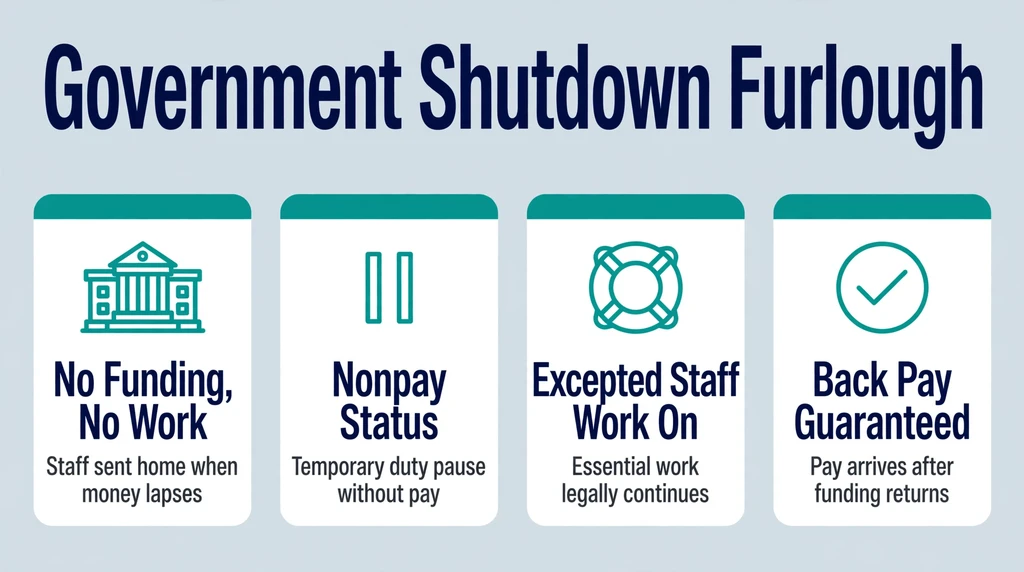
Ask an American what a furlough is, and many will picture a government shutdown. The connection is close, because the US federal system uses the word in a precise, formal way.
The Official Federal Meaning
The US Office of Personnel Management defines a furlough as placing an employee in a temporary nonduty, nonpay status because of a lack of work or funds, or for other nondisciplinary reasons. Every word in that definition does a job. The status is temporary. No duties are performed. No pay is issued. And the cause is money or workload, never misconduct.
Federal rules split furloughs into two types. A shutdown furlough happens when funding lapses and the agency must send people home at once. An administrative furlough is planned in advance as a money-saving step, with notice periods and set procedures.
Excepted Staff and Back Pay
Not every federal worker goes home during a shutdown. Staff whose work may legally continue during a funding lapse are called “excepted” employees. They keep working through the shutdown, and their pay arrives once funding returns.
For years, back pay for everyone else depended on Congress voting for it case by case. That changed with the Government Employee Fair Treatment Act of 2019, which guarantees retroactive pay to federal employees after a shutdown ends. The longest shutdown in US history ran from December 22, 2018 to January 25, 2019, a full 35 days. Roughly 800,000 federal employees were furloughed or worked without pay during that stretch, which is why the word now carries such weight in American news.
The 2013 Sequestration Furloughs
Shutdowns are not the only trigger. In 2013, automatic federal budget cuts known as sequestration forced agencies to save money midyear. Many turned to administrative furloughs, giving staff a set number of unpaid days spread across the summer.
Civilian employees of the Defense Department were among the largest groups affected. The episode taught Americans a new vocabulary of “furlough days” long before COVID-19 made the word global. It also showed the administrative type in action: planned, announced in advance, and built around a budget hole rather than a closed government.
The UK Furlough Scheme in 2020
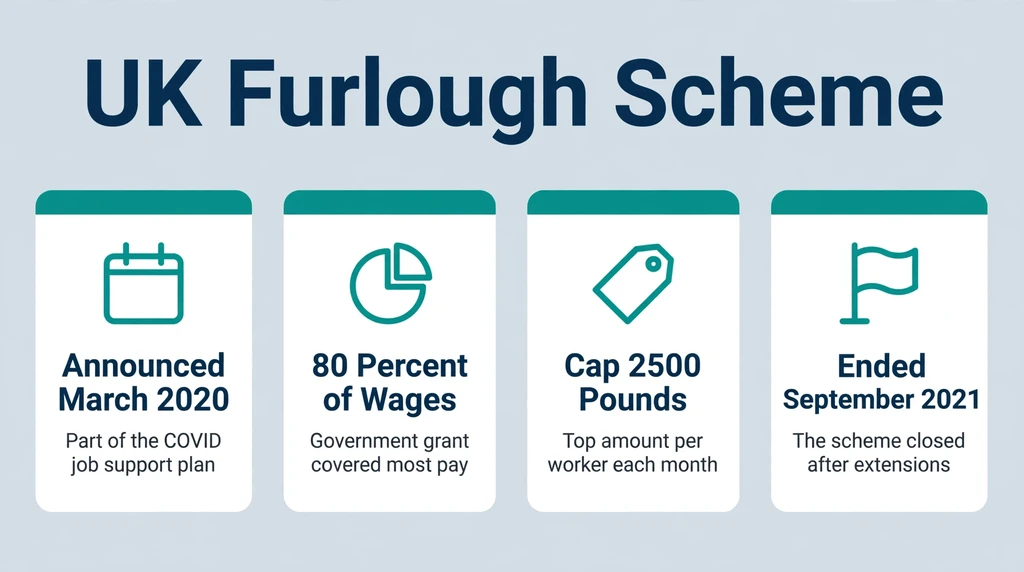
Britain gave the word a second life. Before 2020, most British workers had rarely heard “furlough” outside American films or military stories. Within weeks of the first COVID-19 lockdown, it was the most common job word in the country.
What the Scheme Did
On March 20, 2020, the Chancellor, Rishi Sunak, announced the Coronavirus Job Retention Scheme. Under the scheme, employers kept staff on the payroll while the government covered 80 percent of each furloughed worker’s wages, up to a cap of £2,500 a month.
The design differed from the classic unpaid model in one crucial way. The leave was still employer-directed and temporary, but the wages largely continued, paid through the employer with state support. Employers could also top up the grant from their own funds if they chose, though many could not afford to. While on the scheme, pay remained subject to the usual income tax and deductions, so the arrangement felt much like ordinary employment on reduced activity. Newspapers quickly shortened the scheme’s name to “the furlough scheme,” and the verb “to furlough” entered everyday British speech.
Why Britain Needed the Scheme
The lockdowns of 2020 shut whole industries at once. Cafes, cinemas, airlines, and shops had staff on payroll but no customers and no legal way to trade. Mass redundancies looked likely within weeks.
The scheme was built to hold jobs in place until trading returned. Government statisticians later described its purpose plainly: it kept millions of people in employment through the COVID-19 period. In British usage, “to be furloughed” quickly came to mean one specific thing, being sent home under this scheme, and that narrower meaning still colors the word in the UK today.
How It Changed Over Time
From July 1, 2020, employers could bring staff back part time under “flexible furlough,” claiming support only for the hours not worked. The government’s share later stepped down in stages, with employers paying a growing slice.
After several extensions, the scheme closed on September 30, 2021. By then, “furloughed” had become so normal in British English that it stayed in use after the scheme ended, especially in news reports about American job cuts.
Other Meanings of Furlough
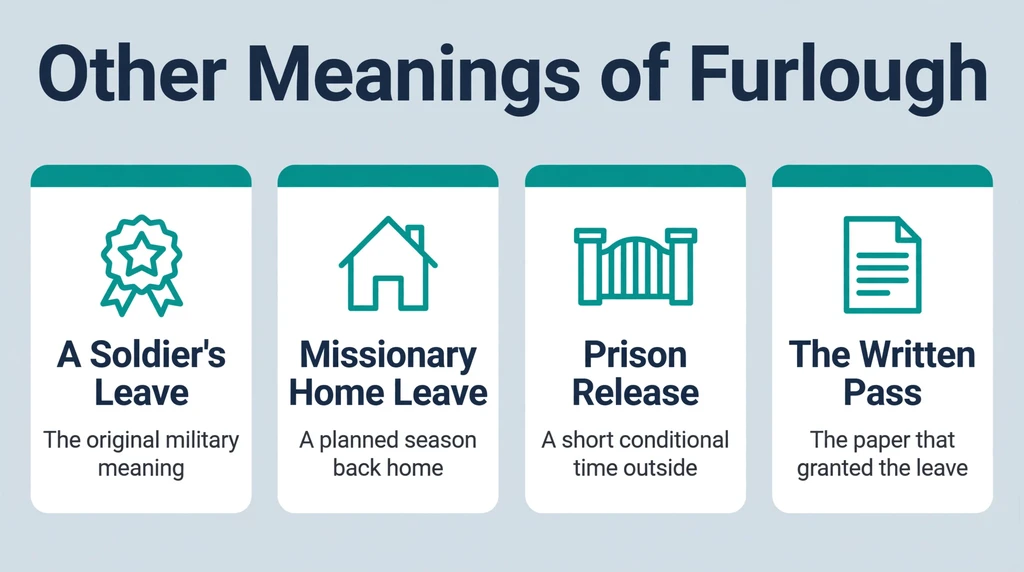
The employment sense dominates today’s searches, but it is not the oldest or the only one. Three older uses still appear in books, church life, and the justice system.
A Soldier’s Leave
The original furlough was military leave. A commanding officer granted a soldier time away from duty, often to travel home, and the document granting it was also called a furlough.
You will meet this sense in older novels, war memoirs, and period dramas. A soldier “home on furlough” has not left the army. He has permission to be absent, a return date, and orders to report back when the leave runs out. The modern job sense borrowed exactly this shape.
In many armies, the leave was also a physical object. The written authorization itself was called a furlough, and the soldier carried it as proof that his absence was legal. Dictionaries still record that document sense, a small reminder that the word began life as paperwork, not as a feeling.
Missionary Furlough
Mission agencies adopted the same word for a different kind of service. A missionary furlough is a planned period back in the home country after a term of work overseas.
Traditional agency policies often followed a rhythm of about four years on the field, then about a year at home. Missionaries used that year to rest, visit family, report to supporting churches, and raise funds for the next term. Many agencies now prefer the term “home assignment,” but “furlough” remains widely understood in church circles, and it is not a vacation in their eyes. It is the home-based half of the same job.
Prison Furlough
In parts of the US justice system, a furlough is a short, conditional release from prison. An inmate may be allowed out for a specific purpose, such as attending a close relative’s funeral, or for a work-release program that holds a job outside the walls.
The release is temporary and tightly conditioned, and failing to return on time is itself a serious offense. Dictionaries record this sense plainly: a set period of time when a prisoner is allowed to leave a prison. It is the same root idea once more, official permission to be away, expected back.
Furlough vs Layoff
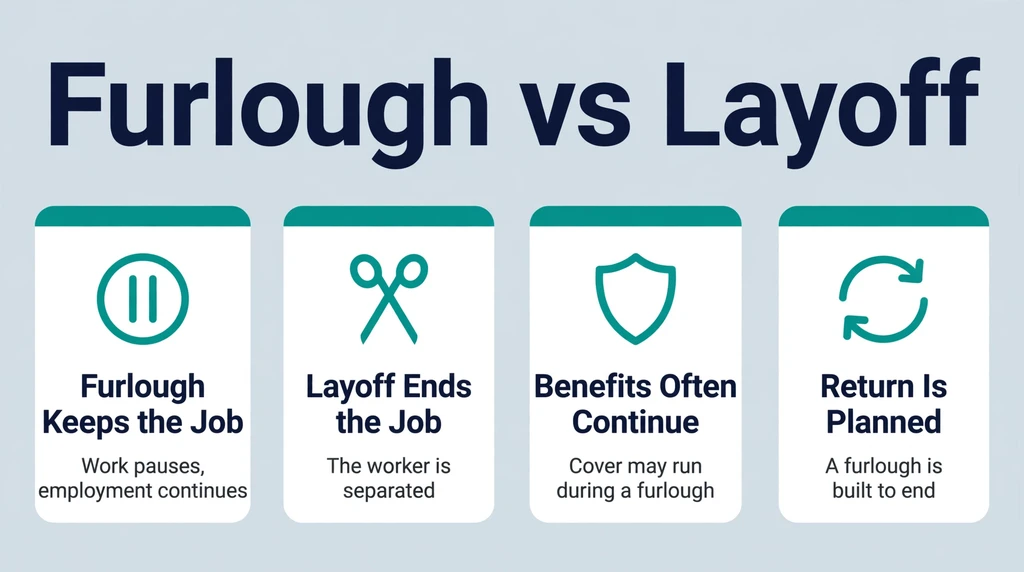
No comparison causes more confusion, and the stakes are personal. The two words can describe the same empty workplace, yet they leave the worker in very different positions.
Furlough vs Layoff
A furlough keeps the job and pauses the work. A layoff removes the worker from the job, and the separation may be temporary or permanent. HR specialists at SHRM draw the line exactly there: furloughed employees still technically have their jobs, while a layoff suspends or eliminates the position itself.
Benefits underline the gap. Furloughed staff often keep health insurance and similar benefits during the break, depending on the employer. Laid-off staff usually lose employer benefits at separation, though some may continue coverage by paying for it themselves. A layoff can end in a rehire when business recovers, but nothing in the word promises one.
Furlough vs Being Fired
Firing, or termination, ends employment for good. It often involves the worker’s conduct or performance, and it carries no expectation of return. A furlough says almost the opposite on every point.
A furlough is not a disciplinary act. It reflects the employer’s finances, not the worker’s record, and it comes with a planned return. A furloughed nurse, clerk, or pilot keeps a clean record and a job title. Someone who is fired keeps neither.
Furlough vs Leave of Absence
A leave of absence is the umbrella term, and a furlough is one species under it. The everyday difference lies in who starts it and whether pay continues.
Workers usually request a leave of absence, for a baby, an illness, or study. Employers impose a furlough, for money reasons, on whole teams at once. Some leaves are paid and others are not, while a classic furlough is unpaid. If your employer announces the break and blames the budget, you are looking at a furlough, whatever label the memo uses.
The Short Version
- Furlough: the job continues, the work pauses, and the pay usually pauses too.
- Layoff: the worker is separated from the job, with a return possible but not planned.
- Firing: the job ends by the employer’s decision, with no return expected.
- Leave of absence: the umbrella term, usually requested by the worker.
Keeping those four lines straight will decode nearly every headline that uses the word.
Words Related to Furlough
A thesaurus view helps fix the meaning, because furlough borrows edges from several neighbors without matching any of them exactly.
Close Synonyms
The nearest everyday phrase is leave of absence, which is broader and covers requested breaks as well. Unpaid leave names the pay feature but not the employer’s decision behind it. Temporary layoff comes close in casual speech, although HR specialists keep the terms apart, since a layoff is a separation and a furlough is not.
Older texts use leave on its own, especially for soldiers, as in “home on leave.” You may also meet stand-down in Australian and military contexts for a temporary halt to duties. Each synonym drops something: the permission at the root, the employer’s order, or the expectation of return.
Words People Confuse With Furlough
Sabbatical is a planned, often paid break, usually earned after years of service and arranged by agreement. Garden leave is a British term for the notice period after resignation or dismissal, when the employee stays home, stays employed, and stays paid. Redundancy, in British usage, means the job itself has disappeared, which is a permanent end rather than a pause.
Set side by side, the differences sharpen the definition. Furlough is imposed rather than requested, unpaid rather than paid, and temporary rather than final. It borrows a little from each neighbor and matches none of them fully.
Furlough in a Sentence
Seeing the word at work settles its meaning faster than any definition. The six sentences below cover the noun, the verb, and the older military sense. Notice how each example keeps the job intact while the duties pause.
- The factory put two hundred workers on furlough until orders picked up again.
- After three weeks of furlough, the museum called its guides back for the summer season.
- Her grandfather came home on furlough twice during his years in the army.
- The agency furloughed half its staff for one day in every pay period.
- Under the UK scheme, millions of employees were furloughed while their workplaces stayed shut.
- He used his furlough to finish repairs on the house, then reported back on Monday.
Common Misconceptions About Furlough
Myths cling to this word, partly because it sits between friendlier and harsher ideas. A few corrections clear the air.
A furlough means you are fired. It does not. Furloughed workers remain employees, and employers use the tool precisely because they want the same people back.
A return date is a legal promise. It is a plan, not a contract. Most furloughs end on schedule, but a deepening slump can extend one, and a failing business can still move to permanent cuts afterward.
Furloughs are unpaid vacations. The time may be free, but it is imposed, unpaid, and often stressful. Missionaries make the same point about their own furloughs: the home stretch involves work, travel, and obligations, not rest alone.
The word is new. Only its fame is recent. English speakers have used it since the 1600s, soldiers lived by it for centuries, and payroll departments adopted it generations before it reached the headlines of 2020.
Only government workers get furloughed. Shutdowns made the word famous, but private employers use furloughs constantly. Airlines ground crews, hotels idle staff in slow seasons, and factories pause lines when orders dry up. The tool belongs to any employer facing a temporary gap.
You can never claim support while furloughed. In the US, furloughed workers can often claim unemployment insurance for the unpaid period, subject to state rules. The details differ by place, but the blanket idea that no help exists is wrong.
Frequently Asked Questions
What does it mean when an employee is furloughed?
It means the employer has placed the employee on temporary, usually unpaid leave. The employee does not work and does not receive regular wages for that period. The job itself continues, and the employer expects to bring the employee back when conditions improve. You will usually receive the terms in writing, including a start date, an expected length, and any rules about benefits or contact during the break.
Do furloughed employees get paid?
In the classic model, no. Pay stops for the furlough period, which is how the employer saves money. Some arrangements differ: the UK scheme of 2020 covered most wages through government grants, and US federal workers now have a legal guarantee of back pay after a shutdown. Private arrangements follow the employer’s policy and local law.
Can you work another job while on furlough?
Often, yes, because you remain employed but are not working your regular hours. Some employers restrict outside work, and federal employees stay bound by government ethics rules even while furloughed. Check your employer’s policy before accepting other work, especially work for a competitor.
How long does a furlough last?
There is no universal length. A furlough can mean scattered unpaid days across a few months, a block of several weeks, or longer in a deep downturn. Employers usually announce an expected end date or review date, and they can extend the period if conditions do not improve. UK scheme rules once required a minimum stretch of three weeks per claim period, but that was specific to that program and is not a general rule.
Do furloughed workers keep their benefits?
In many cases, yes. Furloughed employees often keep benefits such as health insurance during the break, since they are still employees. Coverage details come from the employer’s plan documents, and they vary, so the written policy is the source to trust. Watch for the practical details as well: some plans keep coverage running automatically, while others bill the employee directly for their usual share of the premiums.
Is a furlough the same as being laid off?
No. A furlough is temporary and the job survives, while a layoff separates the worker from the job, temporarily or permanently. Furloughed staff are expected back. Laid-off staff may be rehired later, but the employer has made no commitment.
Can a furlough become a layoff?
Yes, it can. A furlough is chosen when trouble looks temporary, and most end with a return to work. If the employer’s finances keep deteriorating, a furlough may be extended or converted into permanent layoffs. That word describes the employer’s intention at the time, not a guarantee about the future.
Why is it spelled with a “gh” if the word sounds like “low”?
The spelling is a fossil. The word passed through spellings such as *vorloffe* and *furlogh* in its early centuries, and the “-gh” ending became standard in the 1770s. It likely marked an old “f” sound that later disappeared from pronunciation, leaving the spelling and the sound permanently out of step.
Final Thoughts
Furlough meaning is easier to hold once you see the thread that runs through every sense. A soldier’s pass, a missionary’s year at home, a prisoner’s day release, and a clerk’s unpaid month all share one shape: permission to be away, with a return expected.
For workers, the practical summary is short. A furlough pauses your job rather than ending it, usually pauses your pay as well, and reflects your employer’s finances rather than your performance. Rules differ by country, employer, and contract, so your own paperwork always outranks any general guide. If you want the official US federal wording, the Office of Personnel Management’s furlough guidance sets out the definitions and procedures in full.
Words earn their keep in hard times, and this one does a quiet kindness. It lets an employer say “not now” instead of “never,” and lets a worker hear a door left open instead of one shut for good. That is why the word has survived four centuries of hard times, and why it will be ready the next time an economy stumbles.