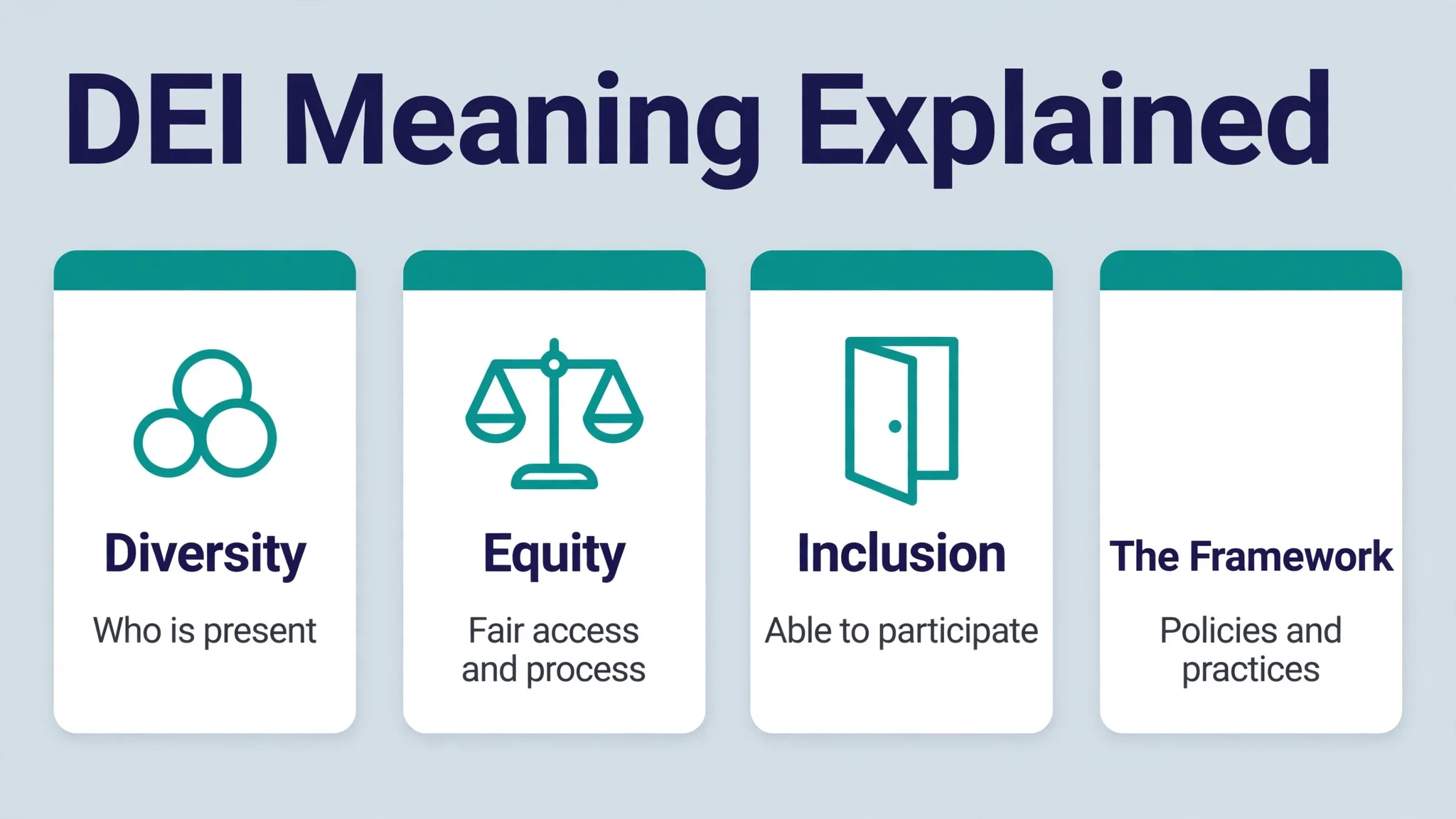
You have seen the letters in job adverts, university statements and headlines, often in arguments and rarely with a definition attached. DEI stands for Diversity, Equity and Inclusion. A framework of organisational policies and practices covering who gets hired and admitted, how fairly people are treated once inside. And whether they can take part fully.
Merriam-Webster defines DEI as “a set of values and related policies and practices focused on establishing a group culture of equitable and inclusive treatment”.
This guide explains the term neutrally, from the record. What each word means, how DEI differs from affirmative action and quotas, where it came from. And why it is debated, each side in its own terms.
What Does DEI Mean?
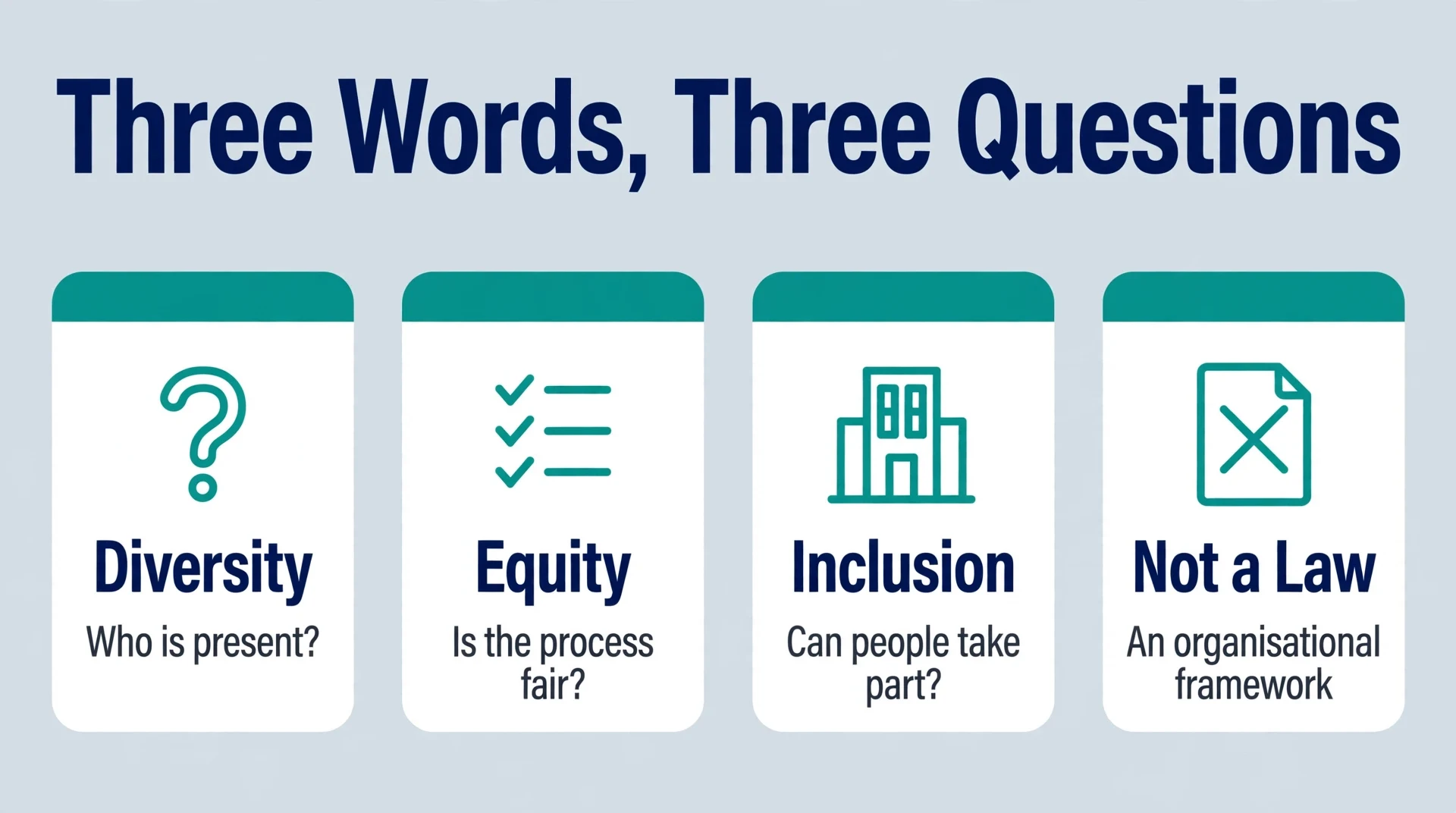
DEI is not a law, a single program or a single policy. It is an umbrella term covering the values, roles, training programs, hiring practices, reporting structures and internal groups that organisations group under the three headings of diversity, equity and inclusion. Two organisations can both say they “do DEI” and mean quite different collections of practices. This is one reason public discussion of the term generates so much confusion. The argument is often about different contents filed under the same three letters.
The three components answer three different questions. And keeping them separate is the key to understanding everything else in this guide:
- Diversity asks: who is present?
- Equity asks: is access and treatment fair, given that people start from different positions?
- Inclusion asks: can the people who are present actually participate, be heard and belong?
Britannica’s reference coverage and the major dictionaries converge on this structure. And no single founder or coiner of the acronym exists in the record. The three word combination assembled gradually out of decades of related practice, a point the history section below traces in dates.
Diversity: Who Is Present
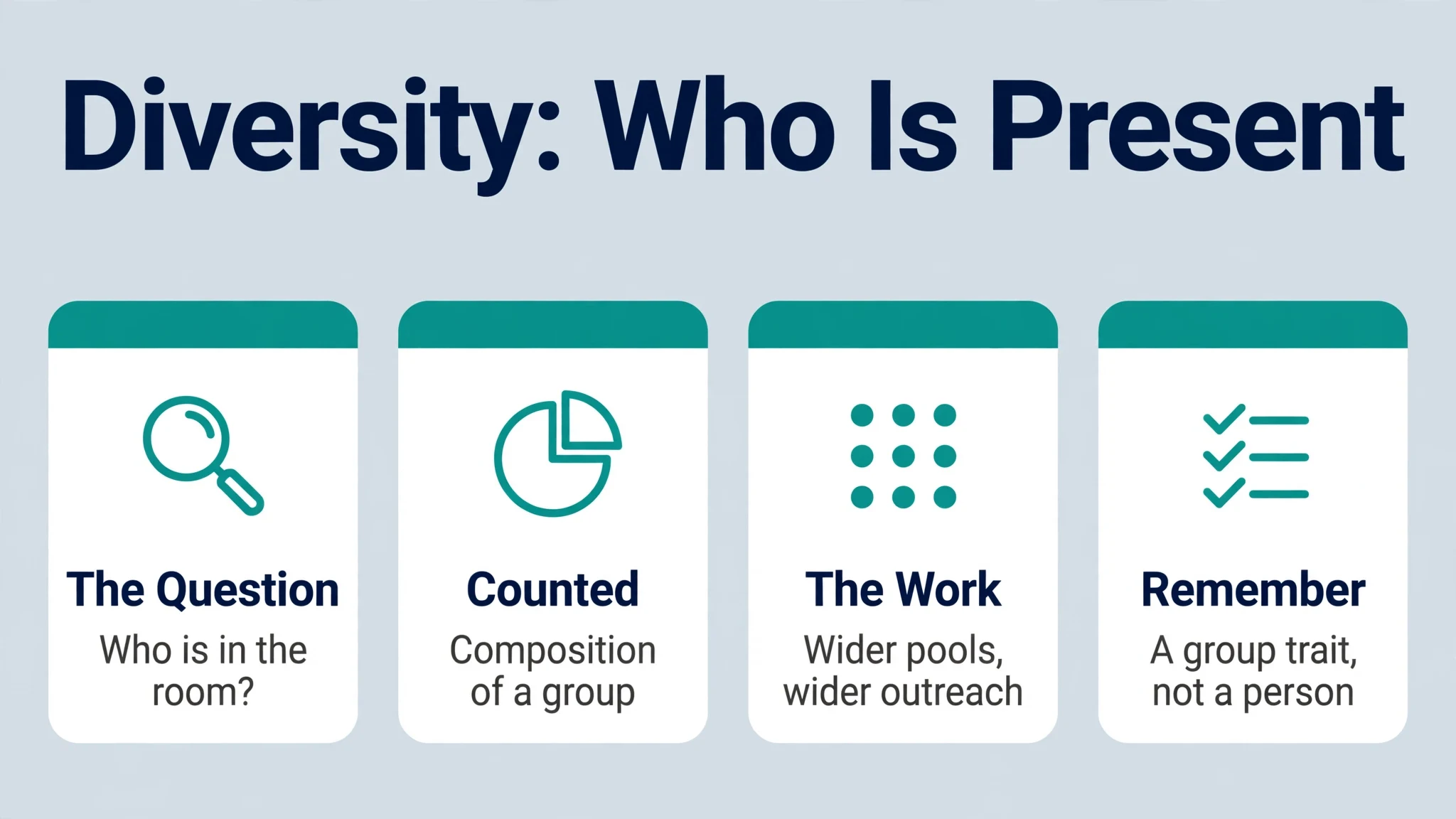
Diversity, in the DEI framework, refers to the composition of a group. The range of backgrounds, identities and characteristics represented among the people in an organisation, a classroom or a leadership team. The dimensions most commonly named in organisational policies include race, ethnicity, gender, age, disability, veteran status, religion, nationality and socioeconomic background.
You answer a diversity question by counting. What share of this year’s intake, this department or this board comes from each group? Diversity work, accordingly, is the work that affects the count. Outreach to wider applicant pools, advertising roles in more places, removing steps in a selection process that screen people out for reasons unrelated to the work. And partnerships with schools and communities an organisation has not recruited from before.
Two clarifications matter. First, diversity in this framework describes a property of a group, never of an individual. A person is not “a diverse candidate”; a cohort, team or faculty is diverse or is not. Second, diversity alone says nothing about what happens to people after they arrive. This is why the framework insists it is only one of the three letters. And why the acronym’s later letters exist.
Equity: Fair Process, and the Difference From Equality
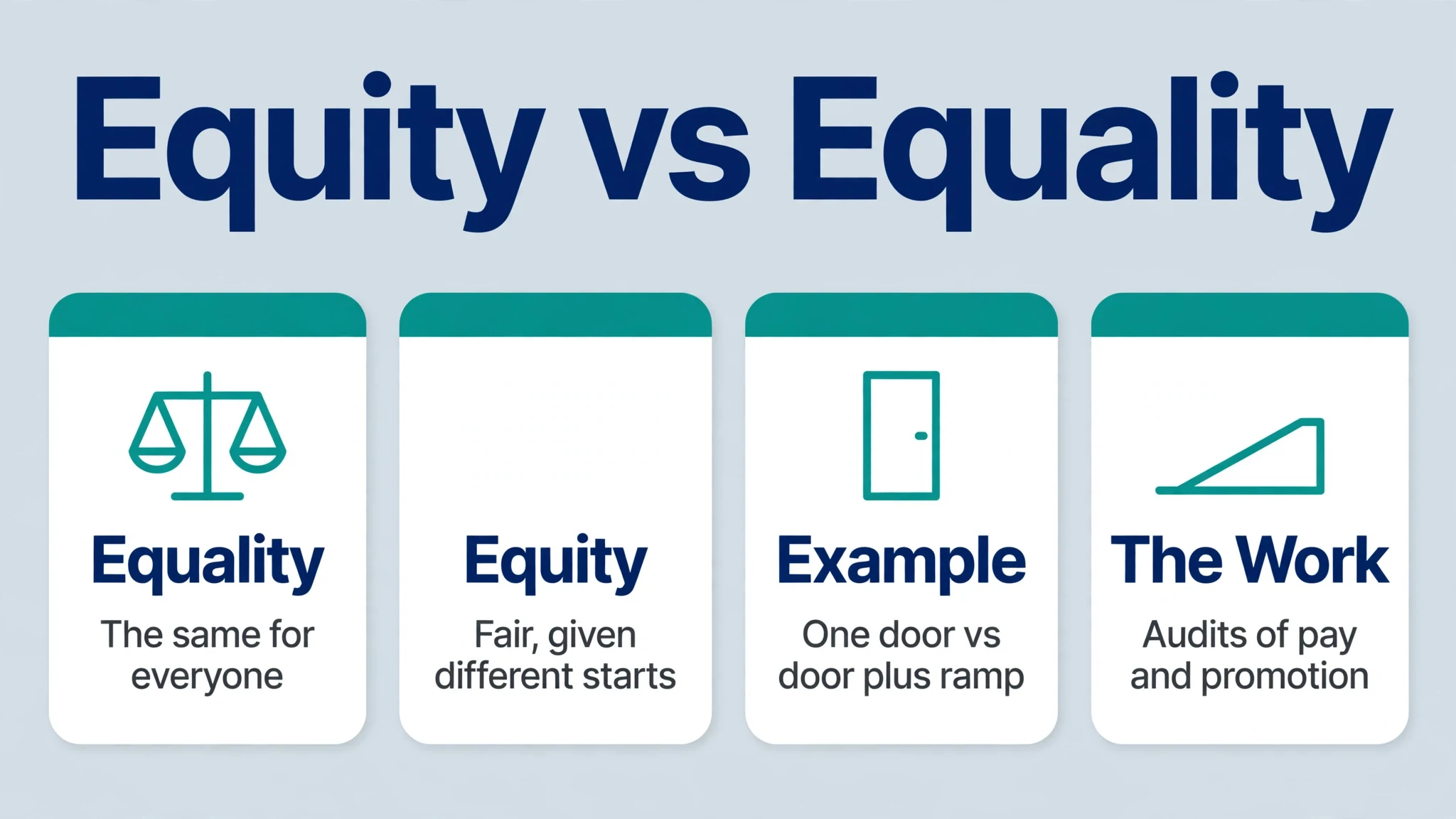
Equity is the framework’s most argued over letter, because it is a deliberate contrast with a neighbouring word. Equality means treating everyone the same: the same rules, the same resources, the same process. Equity means treating people fairly, which the framework holds may require different support for different starting points. So that outcomes do not simply reproduce the advantages and barriers people arrived with.
The standard illustration used by reference sources is disability accommodation. A building with one entrance treats every entrant equally; it is the same door for all. A ramp or lift gives a wheelchair user something extra, something others do not receive. And reference explainers file this under equity: the support differs precisely so that everyone can genuinely share access. Britannica’s phrasing captures the framework’s goal from the other side. In an equitable system, a person’s identity would not predict their outcomes.
In organisational practice, equity work is audits and adjustments. Checking whether promotion rates, pay bands, disciplinary outcomes or admissions results differ sharply by group in ways the stated criteria cannot explain, and changing processes where they do. Supporters describe this as removing distortions from a system. Critics describe some applications of it as engineering outcomes rather than policing process. Both characterisations are positions in a live debate, covered in the debate section below. The definitional point, on which reference sources agree, is that equity inside DEI means fairness pursued with attention to differing circumstances, not identical treatment regardless of them.
Inclusion: Whether People Can Participate
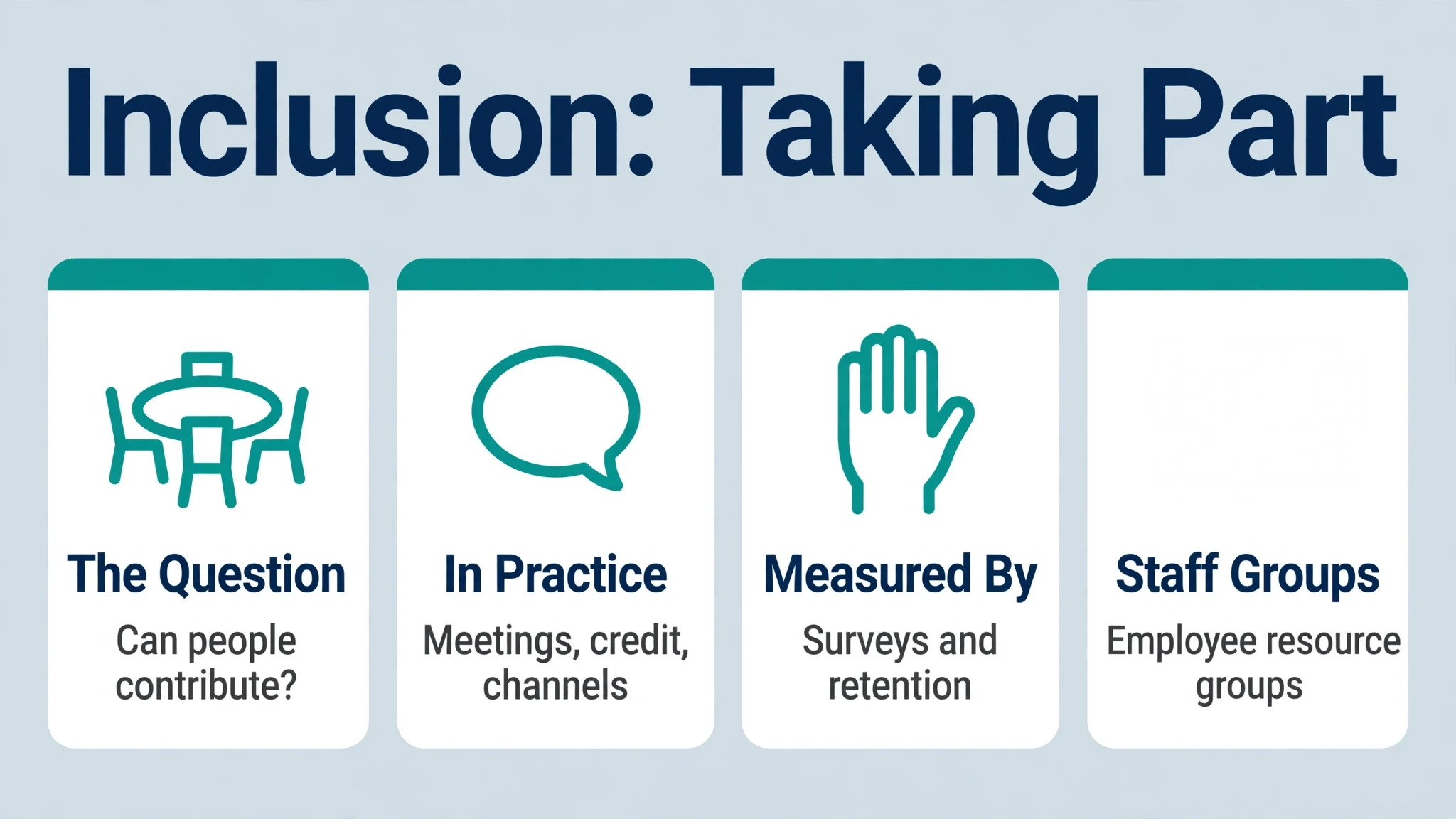
Inclusion covers the experience of the people diversity counted and equity processed. Whether they are welcomed, respected, listened to and able to contribute once they are in the room. A commonly used formulation in the field puts it as the difference between being invited and being asked to participate once there. Diversity is presence, inclusion is what presence feels like from the inside.
In practice, inclusion work is cultural and structural. How meetings are run and whose contributions get credited, whether internal communications and events account for the people actually present, whether reporting channels for mistreatment are trusted. And whether employees or students describe the institution as a place they belong in surveys. Organisations measure it, imperfectly, through engagement surveys, retention differences between groups. And the presence of employee resource groups, the voluntary staff communities (for veterans, parents, particular ethnicities and others) that many large employers host.
Of the three letters, inclusion is the least contested in the abstract, since few argue against colleagues being heard. And the most contested in application, because judgments about a culture are harder to settle than judgments about a count. It is included in the framework because its architects held that representation without participation changes little, a claim the rest of this guide treats as the framework’s stated rationale rather than as a settled finding.
How Organisations Measure DEI
Programs of this kind generate measurement. And the standard instruments are worth knowing because public disputes about DEI often reduce to disputes about its numbers.
Representation statistics are the basic layer. Workforce or student body composition by the categories an organisation tracks, often published in annual reports. They answer the diversity question directly and say nothing, by themselves, about the other two letters, a limitation analysts on all sides point out.
Process and outcome audits examine the machinery. Application to interview to offer conversion rates by group, promotion velocity, pay equity analyses comparing pay for comparable roles, and attrition differences. Where conversion rates fall sharply at one stage for one group, the audit’s finding is about that stage’s process. This is the equity letter in operation.
Experience surveys carry the inclusion letter. Engagement and belonging questionnaires, sometimes broken down by demographic group, plus the uptake and climate of reporting channels. Their weakness is the weakness of all self report instruments. This is why serious programs triangulate them against the hard numbers above.
The honest summary is that measurement can establish composition and process outcomes with reasonable confidence, can suggest where a culture is failing. And cannot by itself settle the argument about what an organisation should do with the findings. That argument is the debate section above, and it continues with or without the dashboards.
The Wider Family: D&I, DEIB, DEIA, JEDI and EDI
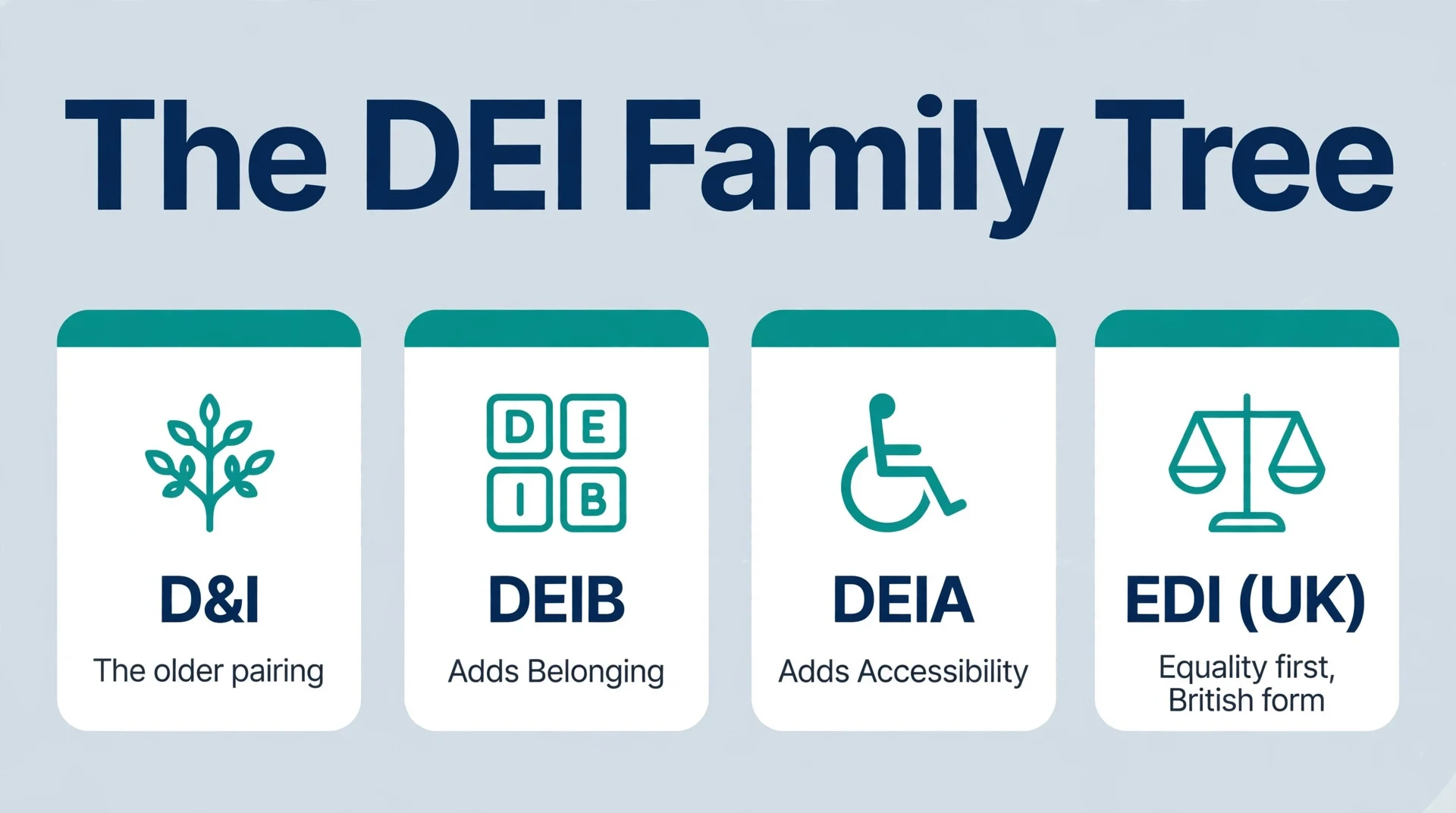
DEI is the best known arrangement of the letters, not the only one. And the variants appear often enough in job titles and strategy documents to be worth a key.
D&I (Diversity and Inclusion) is the older pairing, dominant through the 2000s before equity formally joined the headline terms in many organisations during the 2010s. Plenty of long established programs still carry the D&I name with substantially similar contents.
DEIB adds Belonging, the B reflecting an argument inside the field that inclusion, being something an organisation does, should be paired with belonging, the feeling it is meant to produce in employees or students.
DEIA adds Accessibility. The United States federal government used this form formally. Executive Order 14035 (2021), governing the federal workforce, treated accessibility as part of the framework, defining it in terms of the extent to which a product, environment or service could be used by people of diverse backgrounds and abilities.
JEDI puts Justice first (Justice, Equity, Diversity, Inclusion), a form used by some nonprofits and universities to signal that addressing underlying structures, not only internal culture, is part of their intent.
EDI is the standard British ordering, Equality, Diversity and Inclusion, used across UK universities, the National Health Service and public bodies. The contents overlap heavily with DEI. The first letter’s difference, equality where the American form uses equity, reflects the UK’s Equality Act 2010, the statute under which British practice operates.
That is the family tree’s lesson: the letters are a menu assembled by each organisation, not a certification. Reading any specific program means reading its actual practices, not its acronym.
DEI in the Workplace
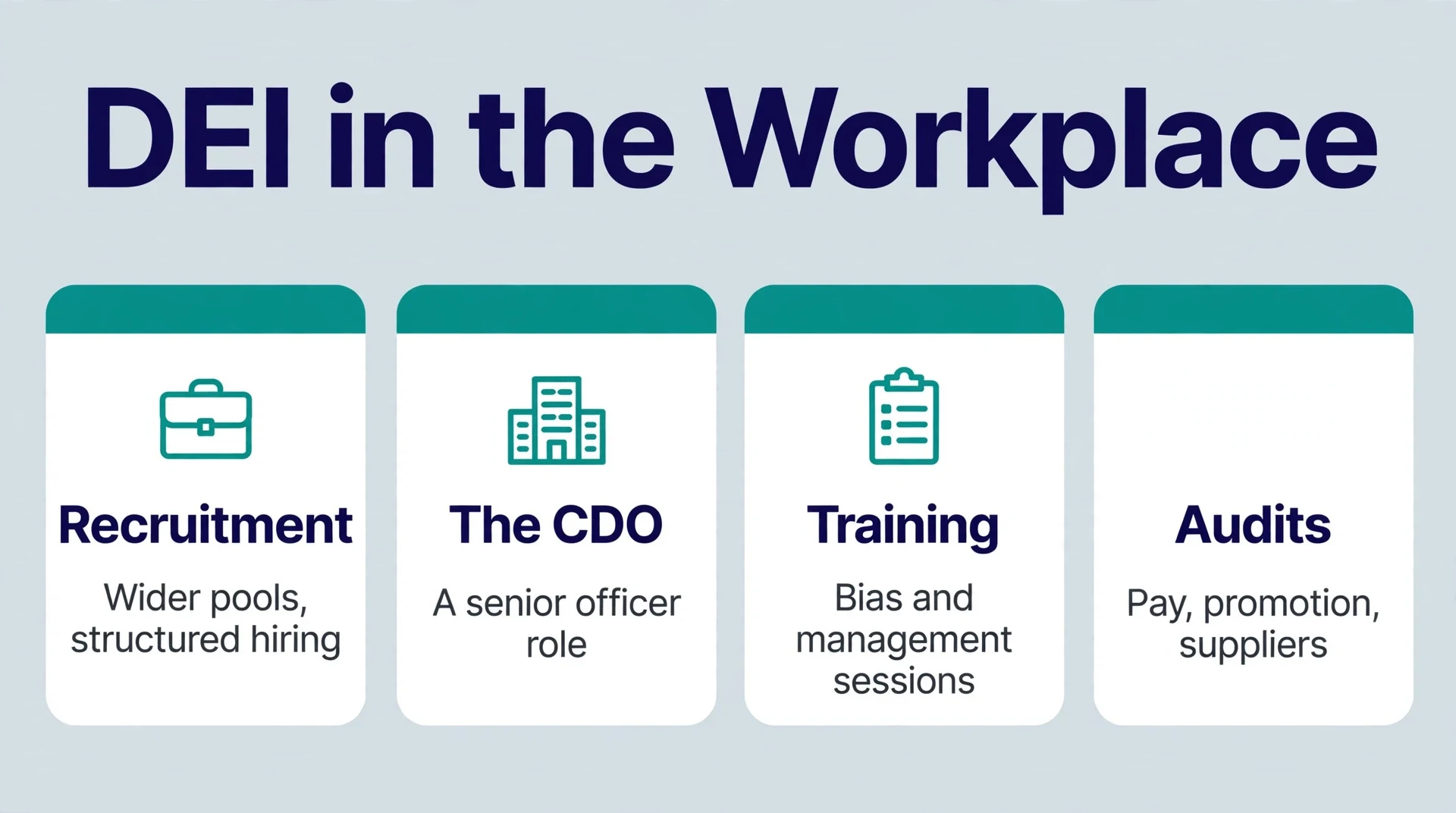
In companies, DEI usually refers to a recognisable bundle of activities. This this section lists descriptively, as they exist across large employers.
Recruitment practices. Widening where jobs are advertised, writing descriptions intended to attract broader applicant pools, structured interviews with standard questions, and diverse interview panels. The Rooney Rule, first adopted by the NFL in 2003 and since adapted elsewhere, requiring teams to interview minority candidates for senior roles, is an early and famous example of a process rule in this family: it mandates interviews, not hirings.
Dedicated roles. Many large organisations employ a Chief Diversity Officer or equivalent, a senior role overseeing the programs. Hiring data tracked by job platforms showed these roles growing rapidly around 2020 and 2021 (LinkedIn’s widely reported figure had chief diversity officer roles up roughly 169 percent in the year after 2020), followed by well documented contraction and reorganisation in later years as companies restructured the function.
Training. Workplace training sessions on topics such as unconscious bias, inclusive management and harassment prevention. This is among the most debated elements: supporters present it as standard professional development. Critics question the evidence that it changes behaviour, a disagreement in which organisational researchers themselves are divided. And on which this guide takes no position.
Employee resource groups, pay and promotion audits. And supplier diversity (directing some procurement spending toward businesses owned by women, minorities, veterans and other specified groups) complete the usual bundle, alongside public reporting, in which some companies publish workforce composition statistics annually.
DEI in Education
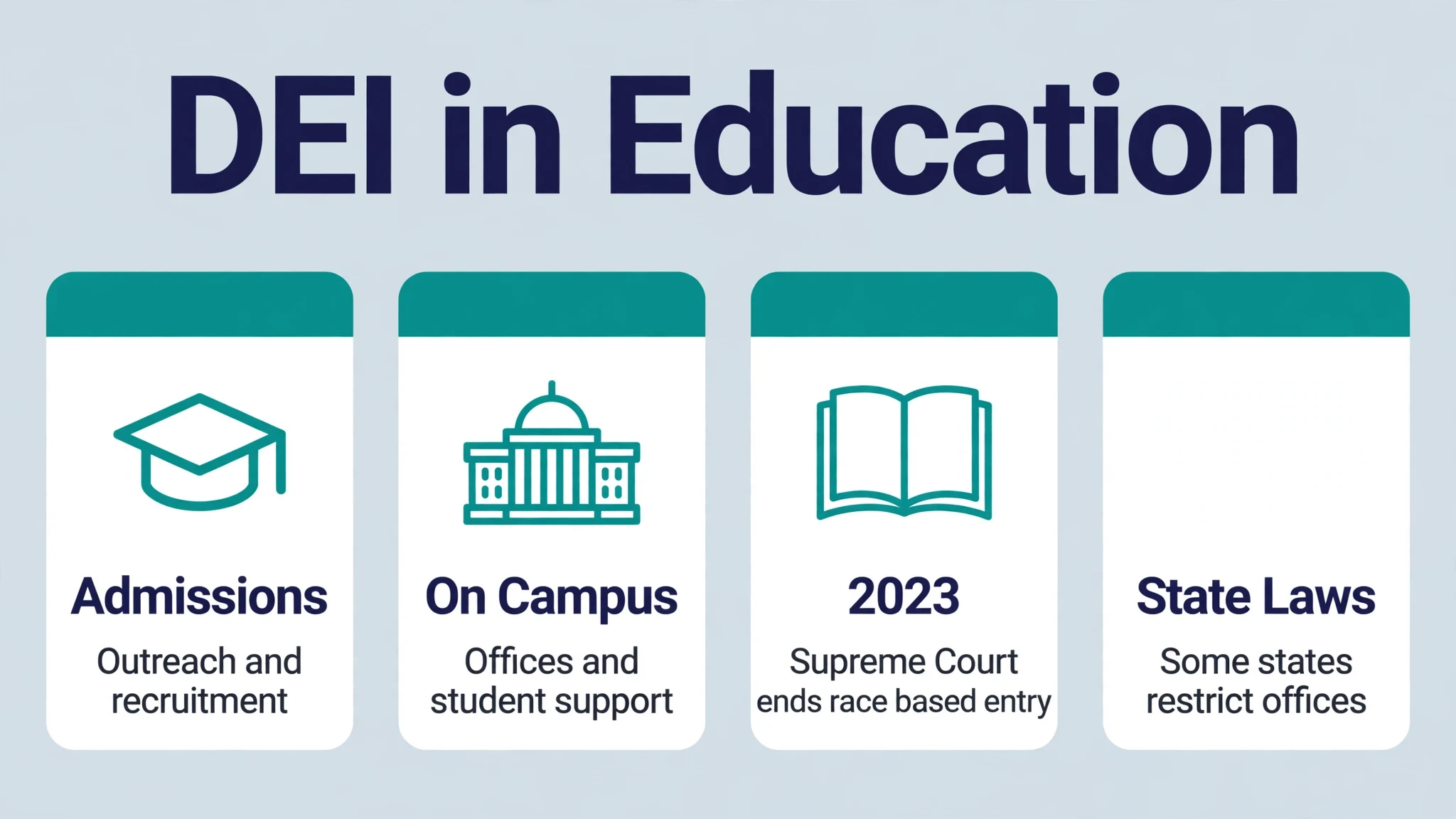
In universities and schools, the same letters cover admissions outreach and recruitment, offices serving particular student populations, diversity statements sometimes requested in faculty hiring, curricular reviews. And dedicated administrative roles and offices, which many American campuses expanded during the 2010s and early 2020s.
Education is also where the legal ground has shifted most visibly. In June 2023, the United States Supreme Court decided Students for Fair Admissions v. Harvard and v. UNC, holding 6 to 3 that the race conscious admissions programs at those universities violated the Equal Protection Clause. That ruling concerned admissions decisions specifically. Several states had already restricted or then moved to restrict DEI offices and programs at public universities: Florida’s measures in 2023. And Texas Senate Bill 17, effective 1 January 2024, prohibiting DEI offices at public colleges in that state, are the most cited examples. A number of states have since renamed, restructured or closed campus programs, while continuing largely unchanged in others. Anyone reading a specific university’s position needs that institution’s current documents, since the map differs sharply by state and by public or private status.
DEI Around the World
The acronym is American, but the underlying practices exist under different legal roofs elsewhere. And the map explains several of the term’s quirks.
In the United Kingdom, the standard term is EDI. And the practice sits under the Equality Act 2010. This prohibits discrimination across nine protected characteristics and imposes a Public Sector Equality Duty on public bodies to consider equality in their decisions. British universities, NHS trusts and councils run EDI offices as a matter of compliance as much as of values. This gives the British version a more statutory flavour than its American cousin.
In the European Union, the instruments are directives rather than acronyms. Pay transparency rules adopted in 2023 (the Pay Transparency Directive, to be transposed by member states by 2026) require larger employers to report gender pay gaps and act on unexplained ones. And board representation rules set targets for listed companies. European employers typically speak of “diversity and inclusion” inside this legal frame rather than of DEI as a branded program.
Canada runs a statutory employment equity system. The Employment Equity Act covers federally regulated employers and names four designated groups (women, Indigenous peoples, persons with disabilities and members of visible minorities) whose representation employers must analyse and address. Australia centres its system on the Workplace Gender Equality Act, with employers above a size threshold reporting gender equality indicators annually.
The comparison clarifies the American debate’s shape. Where other systems fold these goals into statute and reporting law, the United States built much of its version as voluntary corporate practice. This is why an executive order could switch the federal part of it off in a day while the statutory parts elsewhere continue regardless of the political weather.
DEI vs Affirmative Action vs Quotas
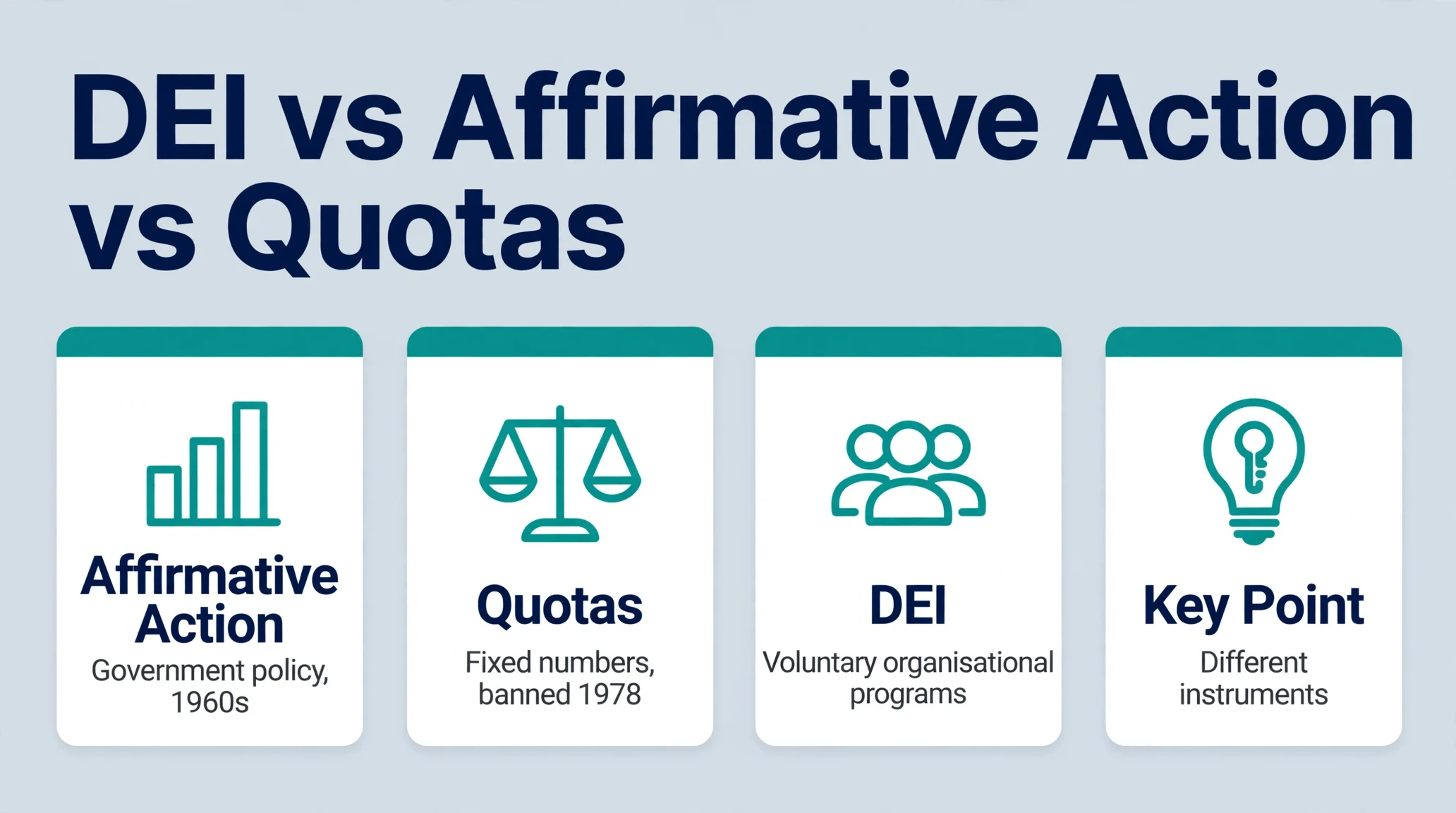
People use these three terms interchangeably in argument, and they mean different things in the record. So here are the distinctions as reference sources draw them.
Affirmative action is a set of government policies, dating from the 1960s, under which race, gender and similar characteristics could in specified contexts be considered in decisions. University admissions, federal contracting, and employment by federal contractors. It had legal force, arose from specific statutes and executive orders. And the Supreme Court’s 2023 decisions ended its university form. Its federal contractor form rested on Executive Order 11246 (1965). President Trump revoked it in January 2025, as the history below records.
Quotas are fixed numerical reservations: a set number or share of places assigned to a group. Quotas in university admissions were struck down by the Supreme Court as early as 1978 (Regents of the University of California v. Bakke), though that decision permitted race as one factor among others until 2023 narrowed the field further. In the DEI debate, “quota” is frequently used by critics as a characterisation of programs they oppose. Organisations running DEI programs generally state that they do not operate quotas. The documented distinction is that a quota is a mandated outcome number. This is a different instrument from outreach, process rules or training.
DEI, by contrast, is the private and institutional framework described in this article. Voluntary organisational programs, mostly without legal mandate, covering recruitment reach, internal process, training and culture. A company DEI program is not affirmative action in the legal sense. And a university admissions policy of the pre 2023 kind was not a DEI office, though the two shared goals in their proponents’ descriptions and shared critics in public argument. Keeping the instruments separate is the first step to understanding any specific dispute about them.
A Brief History of DEI
The framework assembled in layers over eighty years. The dated spine, as reference sources record it:
1948. President Truman orders the desegregation of the United States armed forces, an early federal act in the line the framework later draws on.
1961. Executive Order 10925 introduces the phrase “affirmative action” into federal policy, requiring federal contractors not to discriminate.
2 July 1964. The Civil Rights Act is signed, prohibiting employment discrimination under Title VII and discrimination in public accommodations and federally funded programs.
24 September 1965. Executive Order 11246 requires federal contractors to take affirmative action on employment without regard to race, colour, religion or national origin. It remains the contractor framework’s foundation for sixty years.
1978. Bakke strikes down admissions quotas while permitting race as one admissions factor, the settlement that governs university admissions for the next forty five years.
1987. The Hudson Institute’s Workforce 2000 report projects a more diverse American workforce, pushing corporate America to treat diversity as a management topic.
The 1990s: Managing Diversity
1990. Management scholar R. Roosevelt Thomas Jr. publishes influential work arguing for “managing diversity” beyond legal compliance, a bridge from civil rights enforcement toward the voluntary corporate framework.
2000s. Corporate programs consolidate under “Diversity and Inclusion” (D&I), with dedicated officers, training industries and reporting practices.
2010s. Equity joins the standard acronym in many organisations, DEI becoming the common headline form; universities expand DEI offices and roles.
2020 and 2021. Following the protests of 2020, corporate and institutional commitments expand sharply. Job platform data records DEI related hiring rising steeply (Glassdoor and Indeed both reported increases above 50 percent in DEI job postings in that period). Executive Order 13985 (20 January 2021) directs federal agencies to pursue racial equity reviews. And Executive Order 14035 (25 June 2021) formalises DEIA across the federal workforce.
29 June 2023. The Supreme Court’s Students for Fair Admissions decisions end race conscious admissions at Harvard and UNC and, by extension, comparable programs nationally. States including Florida and Texas move against DEI offices in public higher education.
2025: The Federal Reversal
20 and 21 January 2025. A new federal administration reverses the framework’s federal position within two days. Executive Order 14151 (20 January 2025) orders the termination of federal DEI programs and places DEI staff on administrative leave through agency directives in the following days. And Executive Order 14173 (21 January 2025) revokes Executive Order 11246 itself, with a 90 day compliance window running to 21 April 2025. Major companies publicly revise their programs in the same period. Reporting by Reuters and others documented changes at Walmart (November 2024), Meta (January 2025), Target and Amazon, while Costco’s shareholders voted to maintain their company’s approach and Apple publicly defended its program. Litigation over the 2025 orders followed; readers should check its current status against live reporting, as it has moved since.
That is the arc: civil rights law in the 1960s, corporate voluntary practice from the 1980s, the DEI acronym in the 2010s, rapid expansion in the early 2020s. And legal and political reversal from 2023 onward.
Why DEI Is Debated
Reference sources and the public record attribute the following stated positions to the two broad sides. They are recorded here as positions, in each side’s own framing, not as findings of this guide.
Supporters’ stated case. Proponents, including many companies, universities and civil rights organisations, say DEI programs exist to widen access to opportunity. To recruit from the full talent pool rather than familiar networks, to correct processes whose outcomes cannot be explained by merit criteria. And to build institutions where people of all backgrounds can contribute. In this framing, supporters present DEI as good management and unfinished civil rights work. And its defenders point to representation gaps in leadership, pay and admissions outcomes as the evidence that the work remains necessary.
Critics’ stated case. Critics, including state legislators, litigants in the recent cases and the authors of the 2025 executive actions, say some DEI programs treat people differently on the basis of race or other characteristics in ways they characterise as unlawful discrimination or as a lowering of merit standards. In this framing, the 2025 federal orders present themselves as restoring merit based and colourblind processes. And critics additionally dispute the effectiveness of common elements such as bias training. Supporters dispute both characterisations, arguing their programs operate within the law and that “merit” is exactly what biased processes fail to measure.
The debate is live, institution by institution and court by court. And its specific current state changes faster than any reference article can. What does not change is the definition this guide began with. This is why knowing precisely what the letters mean is the precondition for following the argument at all.
“DEI Hire” and the Language of the Debate
One phrase from the argument deserves its own entry, because searches for it drive many readers to the term. “DEI hire” is a critical label, documented in wide use from 2024, applied to a person in a prominent role to suggest they were appointed because of their identity rather than their qualifications. Commentators applied it in public discussion to figures including Vice President Kamala Harris during the 2024 campaign and Baltimore mayor Brandon Scott after the Francis Scott Key Bridge collapse, in both cases by critics of those officials.
Two documented responses accompany the label in the record. The people it targets, and their defenders, reject it as a dismissal of the person’s credentials and record. And frequently describe it as a slur on any member of an underrepresented group who reaches a senior position. Those who use it respond that they are criticising selection systems, not individuals. Reference coverage records the phrase as contested political language. It is not a job category, a program name or a term any organisation applies to its own hiring. Readers meeting it in the wild should understand it as a claim in an argument, attributed like any other.
The DEI Timeline
- 1964: Civil Rights Act signed (2 July).
- 1965: Executive Order 11246 establishes contractor affirmative action (24 September).
- 1978: Bakke ends admissions quotas, allows race as one factor.
- 1987: Workforce 2000 makes diversity a corporate management topic.
- 2000s: Programs consolidate under Diversity and Inclusion (D&I).
- 2010s: Equity joins the headline acronym; DEI becomes the common form.
- 2020 to 2021: Rapid expansion of commitments, roles and federal DEIA under Executive Orders 13985 and 14035.
- 29 June 2023: Supreme Court ends race conscious admissions (Students for Fair Admissions).
- 20 to 21 January 2025: Executive Orders 14151 and 14173 terminate federal DEI programs and revoke Executive Order 11246.
Common Misconceptions About DEI
Four misunderstandings recur so reliably that a reference guide should retire them directly.
“DEI is a law.” It is not. DEI is an umbrella term for organisational frameworks and practices, mostly voluntary. Laws surround parts of the territory, anti discrimination statutes such as Title VII, disability law, the former contractor rules under Executive Order 11246. And state laws restricting public programs, but no statute creates “DEI” as such. And the 2025 executive orders could end federal DEI programs precisely because they were executive practice rather than legislation.
“DEI is only about race.” The framework’s standard dimension lists are wider. Gender, age, disability, veteran status, religion, nationality and socioeconomic background appear alongside race and ethnicity in most organisational definitions. And several of its standard practices, accessibility foremost, concern disability directly. Public argument focuses overwhelmingly on race; the documented scope of the programs is broader.
“DEI ended in 2025.” What ended in January 2025, by executive order, was DEI programming inside the United States federal government, together with the contractor affirmative action framework of 1965. Private companies, universities in states without restrictions. And organisations in other countries made their own decisions in the same months. And the documented record shows them deciding in both directions. A specific organisation’s current position is a fact to check, not a wave to assume.
“A diverse hire is an unqualified hire.” This is the assumption inside the “DEI hire” label covered above. And the record treats it as a claim in the debate, not a definition. Programs describe their aim as widening pools and policing process. Critics reply that some applications compromise standards. The credentials of any individual appointee are a matter of their own documented record. A guide’s duty is to keep those layers separate, which this one has tried to do throughout.
Frequently Asked Questions
What does DEI stand for?
DEI stands for Diversity, Equity and Inclusion. It is an umbrella term for an organisation’s values, policies and practices in those three areas. Who is present (diversity), whether access and treatment are fair (equity). And whether people can participate fully (inclusion). Merriam-Webster defines it as a set of values and related policies and practices focused on establishing a group culture of equitable and inclusive treatment.
What is the difference between equity and equality?
Equality means the same treatment and resources for everyone. Equity, as the DEI framework uses the word, means fair treatment. This may involve different support for people in different circumstances so that everyone genuinely shares access. Reference sources commonly illustrate it with disability access: the same door for everyone is equality. A ramp alongside it is equity.
Is DEI the same as affirmative action?
No. Affirmative action was a set of government policies, dating from the 1960s, under which race and similar characteristics could legally be considered in specified decisions such as university admissions and federal contracting. DEI is a broader, mostly voluntary organisational framework of recruitment practices, internal processes, training and culture programs. The two are related in history and often discussed together, but they are different instruments. And the main legal pillars of affirmative action were ended by the Supreme Court in 2023 and by executive action in 2025.
Does DEI mean quotas?
A quota is a fixed number or share of places reserved for a group. Quotas in university admissions were ruled unlawful in 1978. Organisations that run DEI programs generally state that they do not use quotas, while some critics characterise some programs as quotas in effect. The documented distinction is that a quota mandates an outcome number; outreach, process rules, audits and training are different instruments.
What is a Chief Diversity Officer?
A Chief Diversity Officer (CDO) is the senior executive role many large organisations created to oversee their diversity, equity and inclusion programs, reporting, and related strategy. The role expanded rapidly around 2020 and 2021. And many companies restructured or reduced the function in later years as programs were revised.
What does DEIB or DEIA mean?
They are expansions of the acronym. DEIB adds Belonging, the felt experience inclusion is intended to produce. DEIA adds Accessibility, a form used formally by the United States federal government under Executive Order 14035 (2021) for its own workforce framework. The United Kingdom generally uses the ordering EDI, Equality, Diversity and Inclusion.
What is a “DEI hire”?
It is a critical label, in wide public use from 2024, applied to a person in a senior role to suggest they were appointed for their identity rather than their qualifications. It is contested political language, not a job category. Those it is applied to and their defenders reject it as a dismissal of the person’s record, while users of the phrase say they are criticising selection systems rather than individuals.
When did DEI start?
The practices have roots in the civil rights era. The Civil Rights Act of 1964 and Executive Order 11246 of 1965 are the legal foundations. And corporate diversity practice developed from the 1980s onward. The three letter acronym itself became the common headline form during the 2010s. No individual coined it; it assembled gradually from the earlier D&I (Diversity and Inclusion) terminology.
What changed for DEI in 2025?
In January 2025 the incoming United States administration issued Executive Order 14151 (20 January) terminating DEI programs across the federal government. And Executive Order 14173 (21 January) revoking Executive Order 11246, the 1965 foundation of federal contractor affirmative action, with a compliance window to 21 April 2025. A number of large companies publicly revised or ended programs in the same period, while others, including Costco and Apple, publicly maintained theirs. Litigation over the orders followed.
Conclusion
DEI is three ordinary English words doing heavy organisational work. And most confusion about them dissolves when the letters are kept separate. Diversity counts who is present, equity examines whether the process is fair to people who start from different places. And inclusion asks whether the people present can actually take part. Around those definitions sit decades of law, from the Civil Rights Act to the executive orders of 2025, a family of variant acronyms. And a live public argument conducted by supporters and critics in the terms recorded in this guide. The argument will keep moving, through courts, legislatures and boardrooms, and it will keep using these three letters. Knowing exactly what they mean, as the dictionaries and the dated record define them, is the part that stays useful whatever happens next.