Under a very long post, someone has written four letters and a semicolon: “tl;dr”. The same letters sit at the top of a long email, above a two sentence summary that saves you ten minutes. One term, two almost opposite meanings, which is what makes TL;DR worth a guide. The short version, first: TL;DR stands for “too long; didn’t read”. It began as a rude reply to writing that was not worth the reader’s time. And grew into the label writers put on their own summaries.
This guide follows the record: the two faces of the term, the semicolon, the 2002 post where the trail begins, and how to write one properly.
What Does TL;DR Mean?
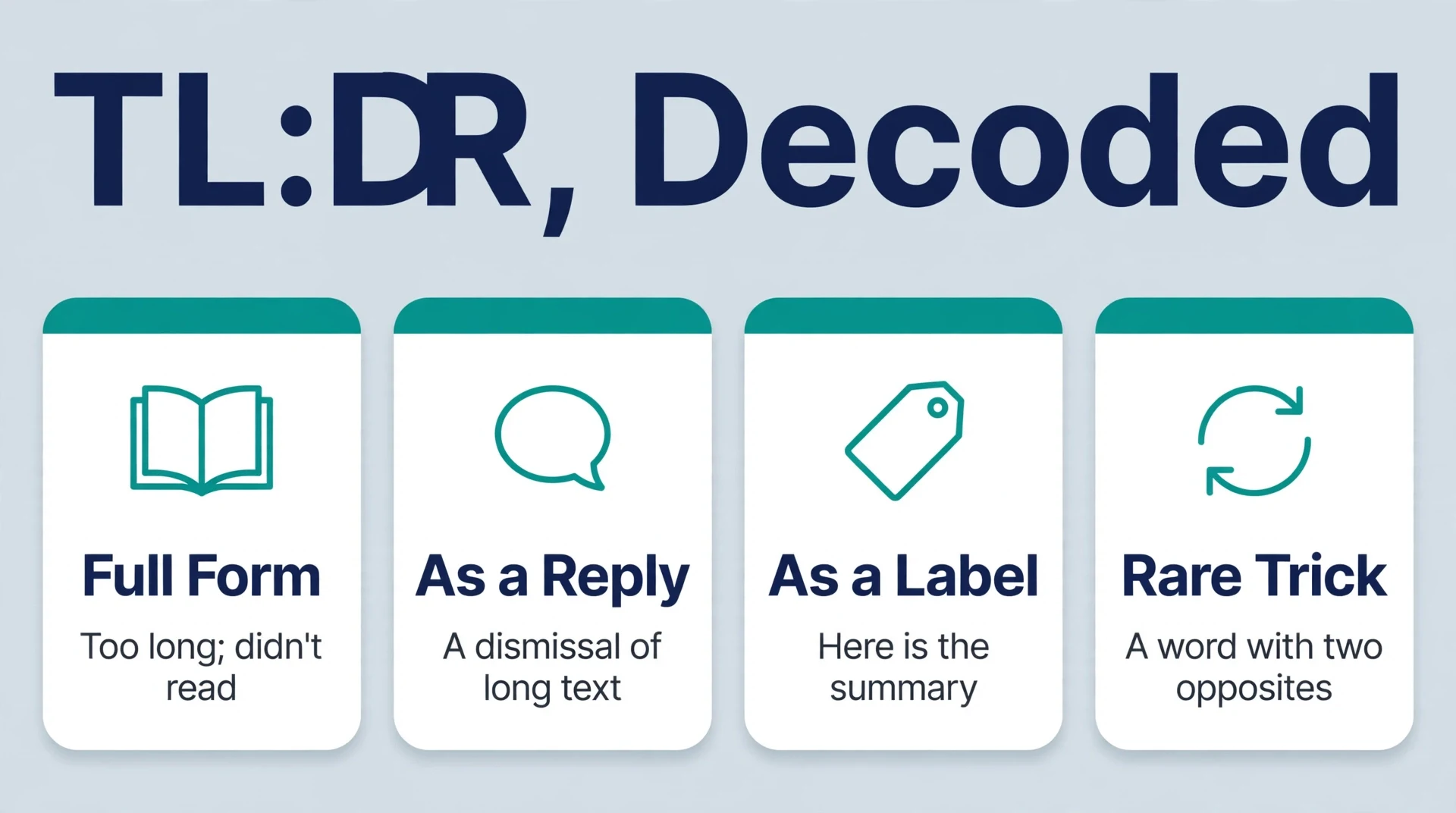
TL;DR is an initialism of the sentence “too long; didn’t read”, semicolon included. It is pronounced letter by letter, tee-el-dee-ar, because pronouncing it as a word is impossible and because the internet once tried anyway. This is how it acquired the joke pronunciation “teal deer”, a spelling of how the letters sound when said quickly.
The term’s dictionary life is unusually double sided. Merriam-Webster defines it first as the dismissal, used to say that a piece of writing is too long to be worth reading, and also records the summary sense. Dictionary.com carries the noun sense explicitly: a TL;DR is “a summary of a lengthy online post, text, or article”. Cambridge records both faces too, the criticism of something long, and the summary offered for it. Lexicographers have noted that this makes TL;DR something close to a contronym, a word that contains its own opposite. It is an accusation, an apology and an escape route at the same time.
That double life is the single most important thing to understand about the term:
As a reply, it is a complaint. Someone posts “tl;dr” under your essay and they are telling you the length defeated them, often rudely, sometimes as a joke at the expense of both of you.
As a label, it is a courtesy. The writer writes “TL;DR:” at the top or bottom of their own long text, followed by the short version. The same four letters now say the opposite of the complaint: I respect your time, here is the mercy copy.
Everything else about TL;DR, its history, its etiquette, its modern career inside AI tools, flows from that split. The phrase is the insult and the remedy in one package, the disease naming its own cure.
The Two Uses, Up Close
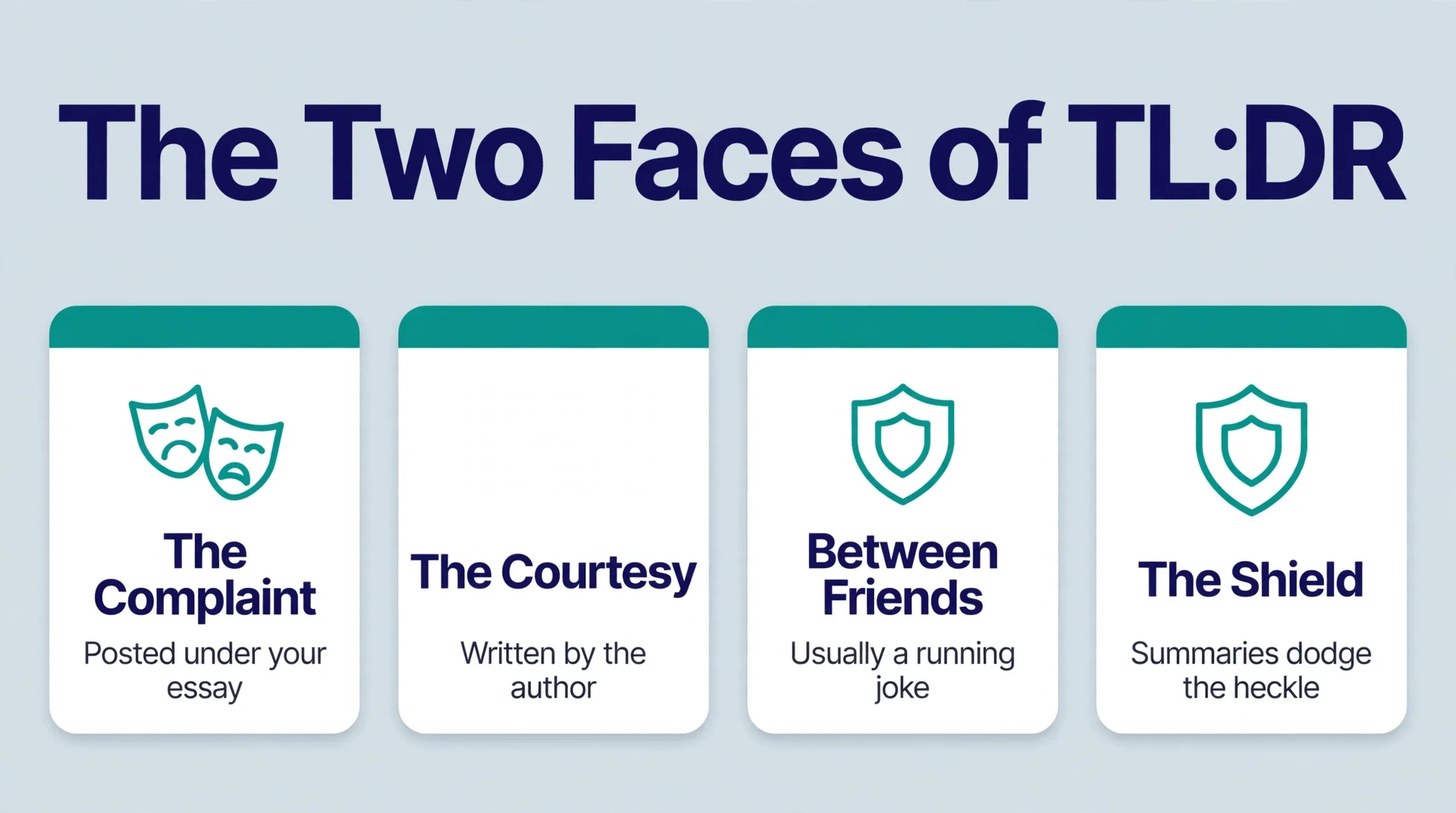
The dismissal came first, and its tone is easy to misread from outside the culture that made it. In early forum life, posting “tl;dr” was rarely a neutral observation about length. It carried a payload: your post was not merely long, it was long without earning it, bloated with repetition or self importance. Regulars used it as quality control, brutal but legible. And the fear of attracting it taught a generation of forum writers to front-load their points.
Used between friends, though, the same reply is affectionate. Commenting “tl;dr” on a close friend’s enormous, entirely readable post is a running joke format across the internet. The ruder the literal meaning, the funnier the use between people who both know it is false. Context and relationship decide which TL;DR you have received, the genuine complaint or the ceremonial one. And they are usually easy to tell apart by everything around them.
The Label Use
The label use is the dismissal, institutionalised and forgiven. Writers who had been on the receiving end began pre-empting the complaint by supplying the summary themselves. And the format hardened into a convention: the letters, a colon. And then the whole argument in one to three sentences, placed either at the very top (for scanners) or the very bottom (as a reward for finishers and a rescue for skimmers who jumped ahead). A good labelled TL;DR is not a teaser and not the first paragraph repeated. It is the post, compressed honestly, conclusions included. The convention spread from forums to Reddit, where it became close to obligatory on long personal stories, then to work email, journalism and documentation, anywhere a writer with something long to say met readers with something short on time.
It is worth pausing on how remarkable that journey is. Slang almost never gets promoted from heckle to standard practice. TL;DR was shouted at writers for years. And the writers’ answer was to adopt the heckle as their own section heading, at which point the insult lost its sting and became infrastructure.
The Third Use: TL;DR as Confession
Between the insult and the label sits a third, quieter use that modern speakers reach for constantly. TL;DR as the introduction to your own summary of your own life. “TL;DR of my week: the car broke, the roof leaked, we got the dog.” Nobody is being accused and no document is being summarised. The term has become a spoken frame meaning “here comes the compressed version”, a promise that the story will arrive pre-shrunk. It is the dismissal fully domesticated, the heckle turned into hospitality. And it is probably now the commonest spoken use of the term. When a phrase can open a family phone call, its conquest of the language is not in progress. It is complete.
Why the Semicolon?
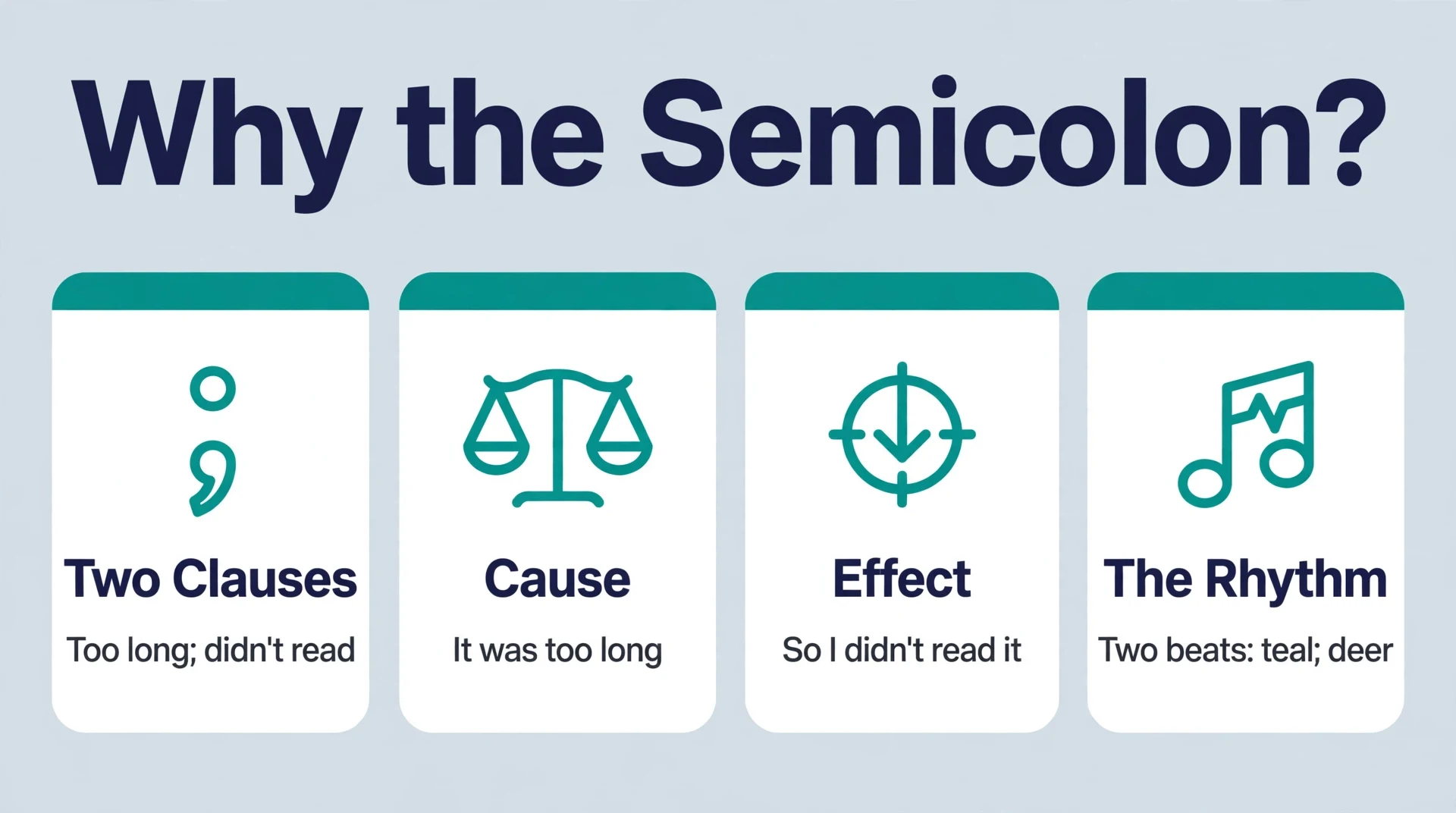
Of all the punctuation marks available, TL;DR keeps one of the rarest, and learners reasonably ask why. The answer is hiding inside the full phrase: “too long. Didn’t read” is two complete clauses, and English joins two closely related complete clauses with a semicolon. The phrase is a small compressed drama: a cause, then an effect. It was too long; therefore, I didn’t read it. The semicolon is the hinge the whole complaint swings on.
The abbreviation preserves it faithfully, TL;DR, and the typed variants show how much the mark matters to the term’s identity. Lowercase “tl;dr” is the form most associated with the summary label in modern use. “TLDR”, without the semicolon, is everywhere too, especially in search queries and casual typing where the punctuation is skipped for speed. Dictionaries accept it as a form of the same term. “Teal deer”, the joking respelling attested in forum culture by 2012, only works because the semicolon gives the phrase its distinctive two-beat rhythm: teal; deer.
There is a small irony here worth enjoying. A term invented to protest bad writing is itself punctiliously punctuated. The semicolon survived twenty years of keyboards, phones and character limits because removing it makes the abbreviation look wrong to the very people who type it fastest. Few protests about literacy have ever been so literate.
Where Did TL;DR Come From?
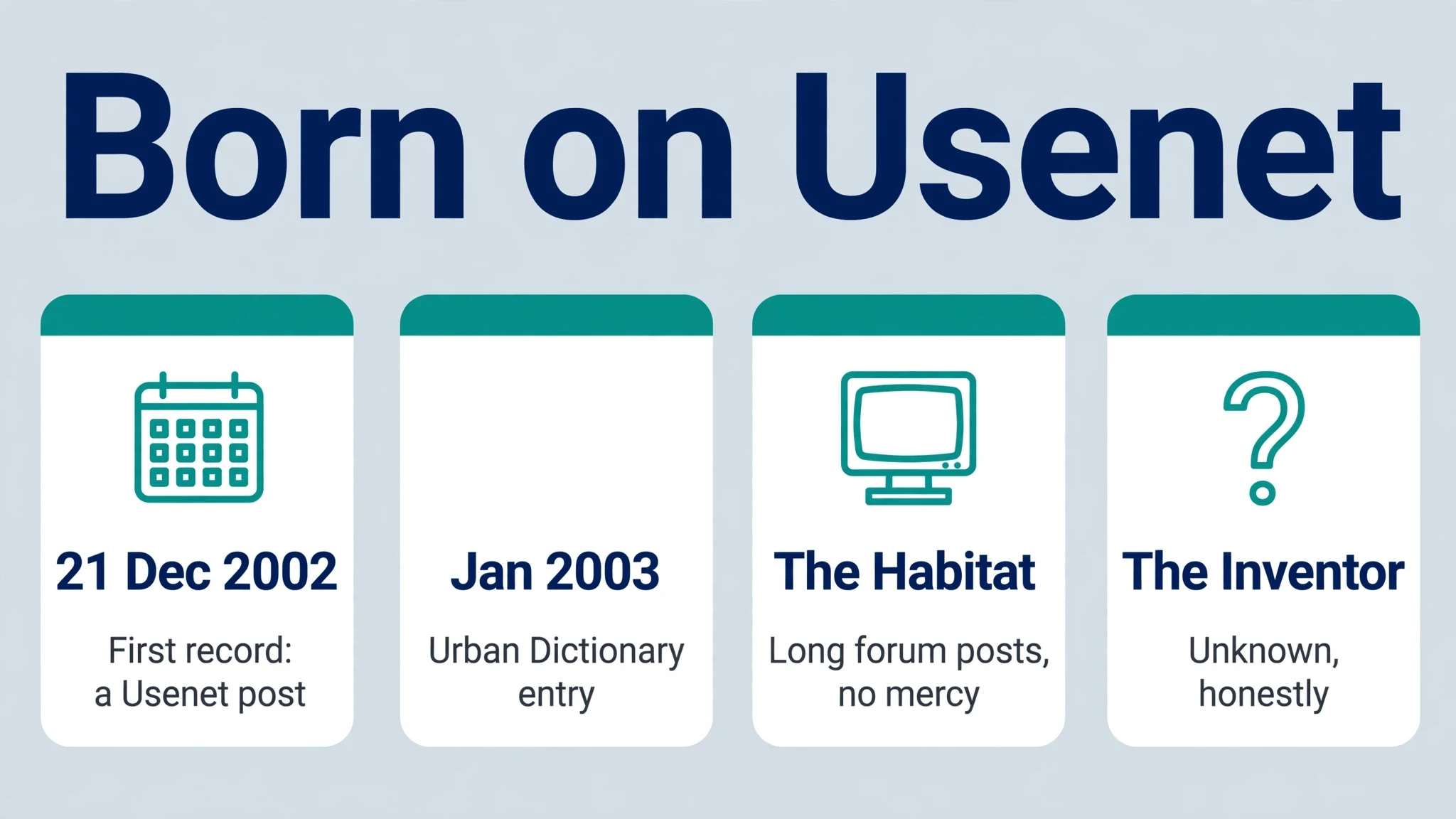
Like SMH and the rest of its era, TL;DR surfaces first in the archived record of the early 2000s internet. And its earliest documented appearance is unusually precise. The Oxford English Dictionary’s first citation for the term is a Usenet post in the group rec.games.video.nintendo dated 21 December 2002. Merriam-Webster’s dictionary independently gives its first known use as 2002. Urban Dictionary’s first entry followed in January 2003. Three independent reference points converging on the same winter gives TL;DR one of the best documented birthdays in slang.
What the record does not support is any more specific claim about a birthplace. You will find the invention credited to various famous forums of the era. And those attributions circulate confidently, but they are guesses layered on afterwards. No primary evidence pins the coinage to a particular board or a named inventor. The honest history is that the term appears in the archive already in use, on Usenet, in December 2002, presumably after circulating in the unarchived chat and forum culture of the time, like nearly every piece of internet language ever studied.
Its habitat explains its birth. Usenet and the forum web ran on long posts. Game guides, arguments, technical explanations, personal sagas, all in plain text with no formatting mercy. Reading was the price of participation, and TL;DR was born as the reader’s strike, the refusal to pay. Through the 2000s it lived in that culture and spread with it, acquiring the label sense as writers began supplying summaries to dodge the strike. By the time social media shortened everyone’s posts, TL;DR had already escaped. It had become the generic internet term for the relationship between length and attention itself, ready to be applied to books, meetings, contracts and life in general, usually as a joke, always recognisably.
How TL;DR Took Over
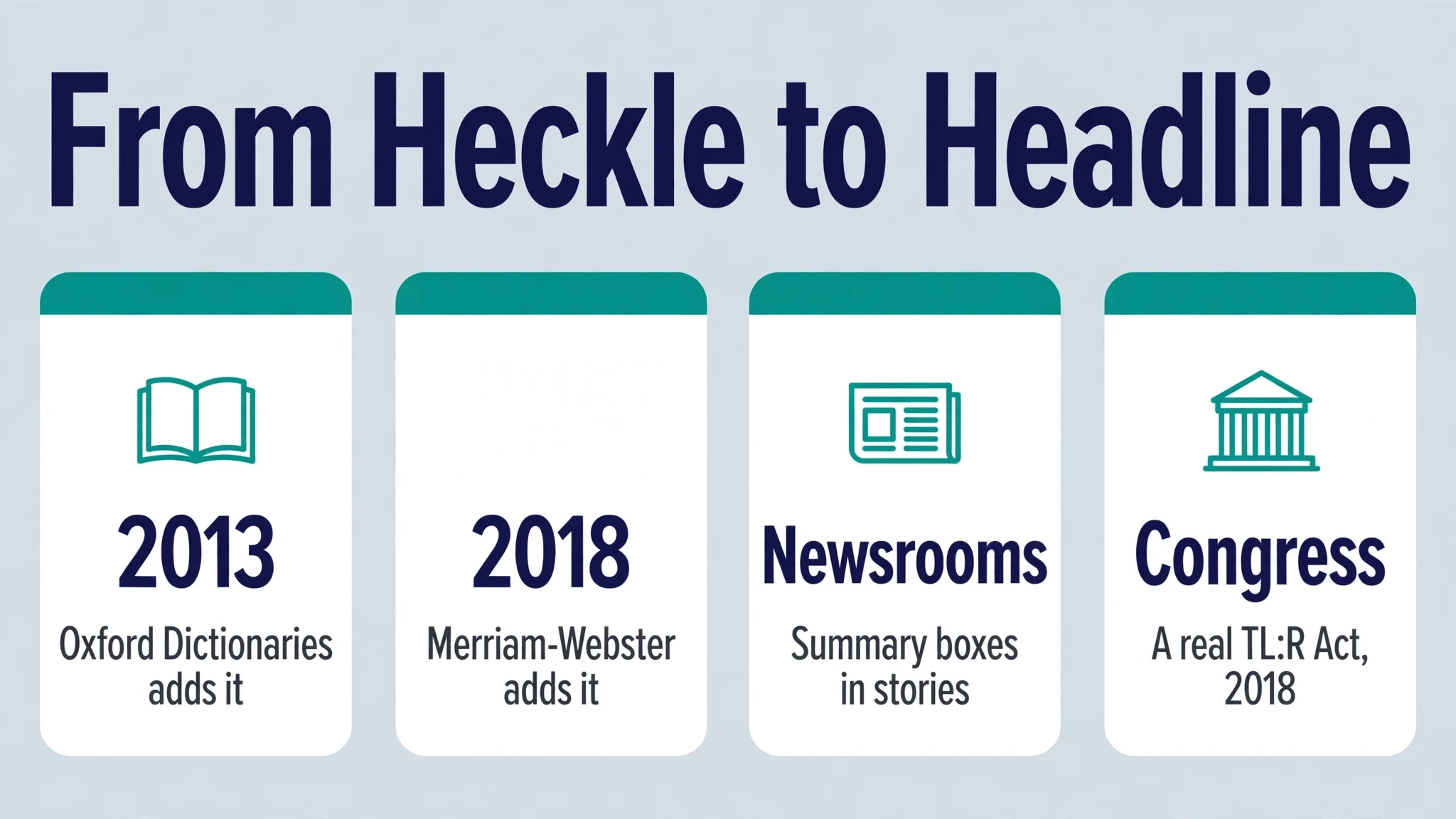
The takeover happened in three stages: dictionaries, journalism, and finally, wonderfully, legislation.
The dictionary stage has a trap in it, so here is the careful version. Oxford Dictionaries Online added TL;DR on 28 August 2013, with the two sense gloss the term still carries. That was Oxford’s contemporary-usage website, not the Oxford English Dictionary itself, and the two are routinely confused in retellings. The OED proper does now have an entry. But claims that it was added in the 2010s do not survive checking. Merriam-Webster added TL;DR in September 2018, in one of its periodic new-word announcements, formally installing the dismissal and the summary side by side. By then the term barely needed the honour; the honour was the dictionary catching up.
Journalism Adopts TL;DR
Journalism adopted it through the 2010s as both a format and a knowing nod. Major outlets including The New York Times, The Washington Post and Wired were using it unglossed in pieces about internet culture. And some news organisations went further, building TL;DR style summary boxes into long stories as an explicit service to scanners. A term invented to refuse journalism’s length problem became one of journalism’s formats for solving it. This is either a surrender or a merger, depending on your temperament.
Then, in March 2018, the term reached the United States Congress, in the form of a real bill actually titled the TL;DR Act, proposed in the House of Representatives. This would have required terms and conditions documents to carry a plain short summary. It did not become law, and it did not need to. Its existence is the certificate that TL;DR had crossed from forum slang into the general civic vocabulary, understood by legislators and headline writers alike. When a heckle from a Nintendo newsgroup becomes the title of an act of Congress, the takeover is complete and can simply be enjoyed.
How to Write a Good TL;DR
Since the label sense of TL;DR is now a working tool used in emails, reports and posts, it is worth learning properly. The difference between a good TL;DR and a bad one is the difference between a summary and a shrug.
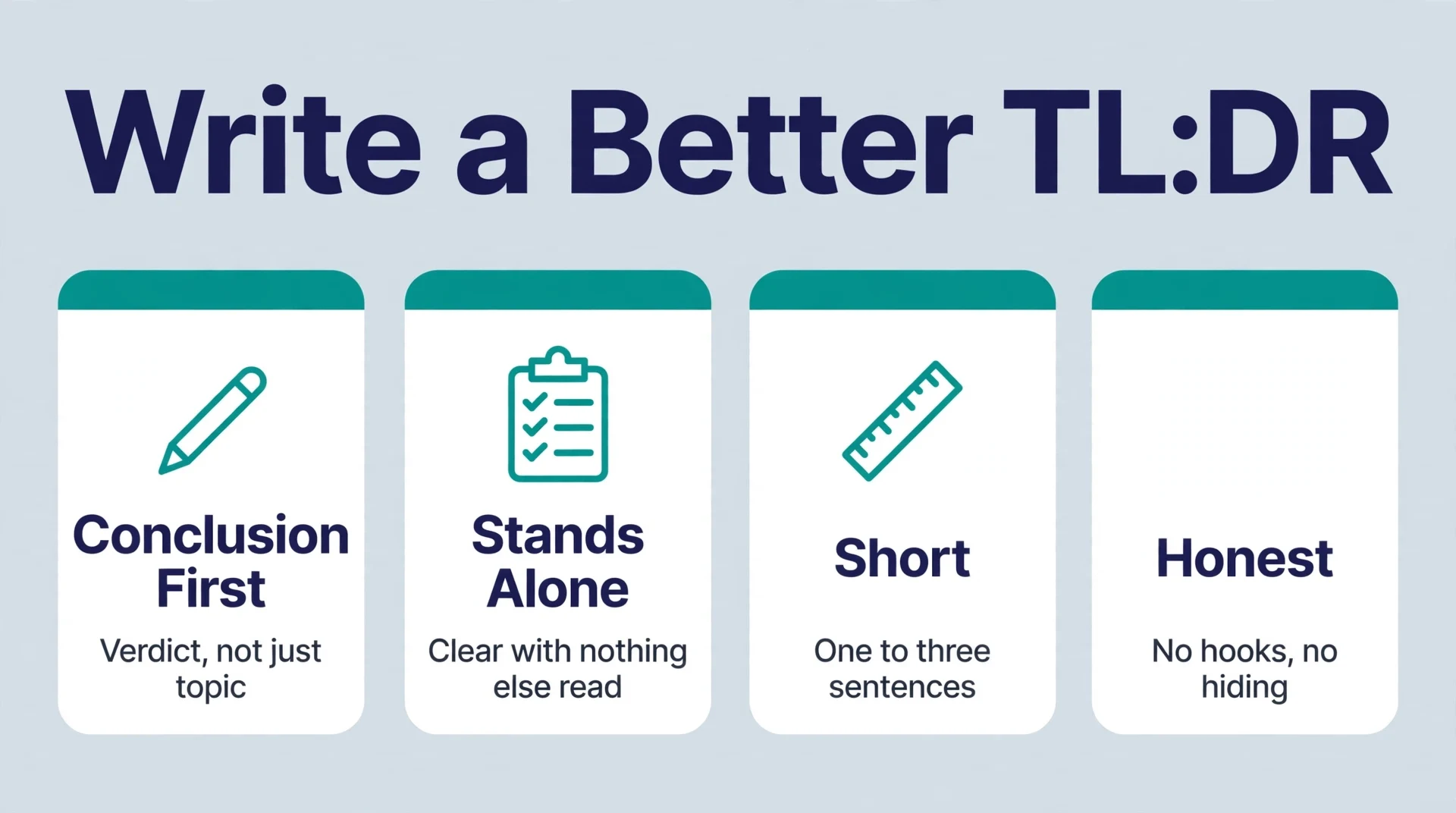
Put the conclusion in it. The most common failure is the TL;DR that describes the topic instead of the answer. “TL;DR: long post about my landlord” tells the reader nothing the title did not. The honest version carries the verdict. “TL;DR: my landlord kept the deposit illegally, I sent one formal letter citing the rule. And the full amount came back in nine days.” A summary that hides the ending is a trailer, not a summary. And readers can tell the difference instantly.
Write it as its own text. A TL;DR should be understandable by someone who reads nothing else, because that is its entire user base. Strip references to “as explained above”, define any essential term inline. And keep it to the length the format promises: one sentence ideally, three at the absolute most. If your TL;DR needs a TL;DR, the original text has a structure problem that no summary will fix.
Honesty Over Hooks
Honesty over hooks. The label’s credibility comes from a bargain: the reader gives the summary their trust. And the writer gives the summary their genuine conclusion, including the parts that complicate it. Forum culture enforced this brutally; a TL;DR that oversold the post beneath it was called out in the comments. And the format’s good name survived because the enforcement worked. Clickbait summaries break the bargain and, in inbox contexts, break trust in the writer personally.
Place it deliberately. Top placement serves scanners and earns goodwill in professional writing. Bottom placement rewards readers and preserves an argument’s build in essays and stories. Either is correct. What is not correct is burying it mid-document, where it functions as neither.
A worked pair makes the standard concrete. Bad: “TL;DR: it’s complicated, read the post.” That is the dismissal wearing the label’s clothes. Good: “TL;DR: the update broke the save system for anyone who played before March. The fix is to verify files once, and your progress is safe.” Verdict, mechanism, reassurance, twenty four words. That is the whole craft.
TL;DR Bots and the AI Era
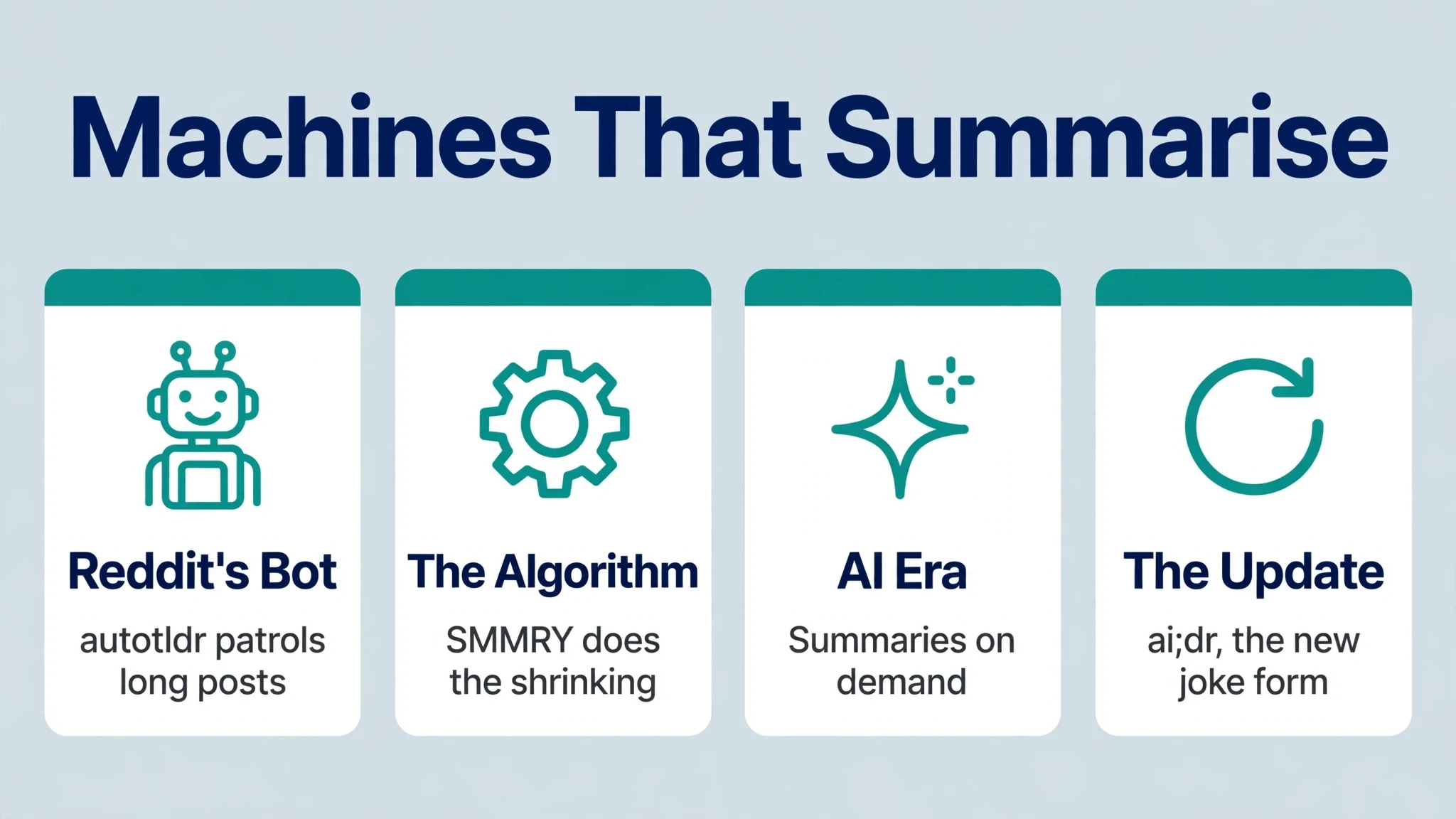
The label’s next career was automated. Reddit’s size made it the natural home of the summary bot. Autotldr, a long running bot built on the SMMRY summarisation algorithm, patrols long posts and comments with machine summaries, doing industrially what writers were doing by hand. Its presence normalised a profound idea. That summarising a text is a service that can be requested, expected and eventually automated. And that the reader’s time deserves defending by default.
Large language models completed the trajectory. The modern reader who pastes a document into an AI tool and asks for the gist is making TL;DR a verb with software on the other end. And the culture has noticed: the newer joke form “ai;dr” (“artificial intelligence. Didn’t read”) circulates as the era’s own update to the formula, a wink at a world where the summaries are written by machines and, some days, the long posts are too. Through all of it the term itself never changed jobs. It still names the bargain between length and attention; only the staff has changed.
There is one caution the AI era adds. A machine TL;DR is only as honest as its compression. And a summary the writer did not write can drop the caveat that changes the meaning. The forum-era rule survives as the reader’s protection. That summary is a courtesy, not a substitute, whenever the details carry consequences.
TL;DR at Work and School
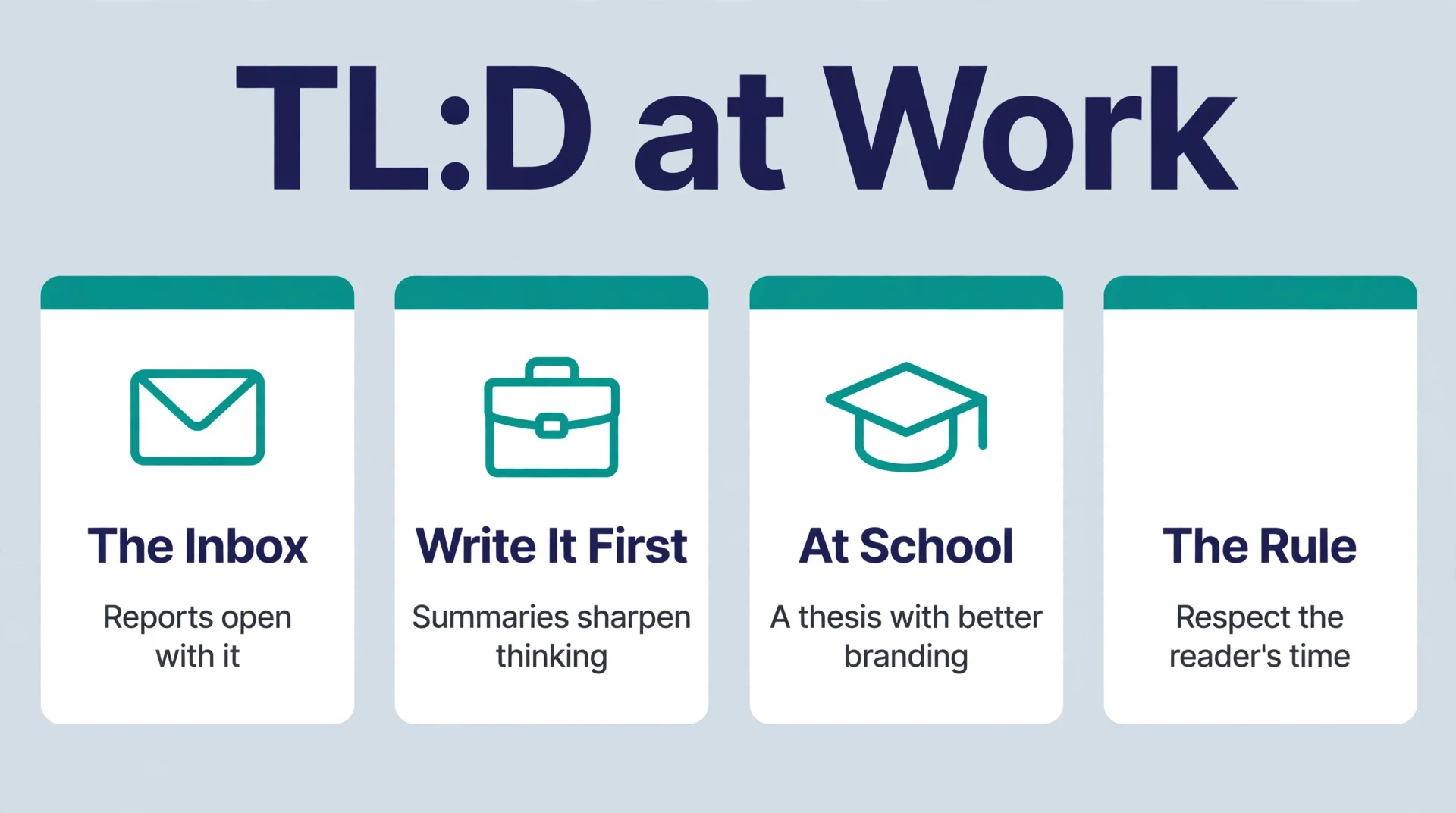
The label’s most complete victory is the workplace inbox. Long project updates, incident reports and decision documents now routinely open with a TL;DR line. And the convention has spread precisely because it solves a real organisational problem. The people who most need a document’s conclusion are the people with the least time to excavate it. Teams that adopt the format report the same small miracle the forums discovered, that writing the summary first often improves the document underneath it, because a writer who cannot summarise their own text usually has not finished thinking it through. The TL;DR line has quietly become a thinking tool wearing a slang costume.
School is the contested frontier. Students arrived fluent in the format and began attaching summaries to essays, requesting them from lecturers, and, in the ceremonial usage, leaving “tl;dr” on assigned readings as a review. Teachers divide on it the way the public divides on most student slang. Some ban the letters as impertinence, others deliberately teach summary writing through the format students already respect, on the reasonable theory that a TL;DR is a thesis statement with better branding. The second camp has the better of the argument. Compressing an argument into two honest sentences is a core academic skill. And the internet’s version of it is simply that skill with the fear removed.
BLUF: TL;DR’s Formal Cousin
The idea that the point should come first did not originate on the internet. And its most codified ancestor is military. BLUF, “Bottom Line Up Front”, is a standard of United States Army writing, codified in Army Regulation 25-50, requiring writers to put the conclusion at the very start of a document so a busy reader gets the decision-relevant message immediately. Staff officers were being trained to write TL;DRs, in everything but name, to generals drowning in paper, decades before Usenet existed.
The family resemblance is real: the executive summary in business, the inverted pyramid in journalism. And BLUF in the military are all the same technology, compressing a document into its consequence and placing the compression where a scanner cannot miss it. What the internet added was not the idea but the honesty about the reader. The formal versions pretend the full text will still be read. TL;DR names the actual behaviour, didn’t read, and serves it anyway. That candour is why the slang version colonised the formal settings that had quietly needed it for a century.
Teal Deer and the Spin-Off Family
Success made TL;DR a template, and templates get filled in. The gentle first variation was the joke pronunciation itself. “teal deer”, which turns the abbreviation into a small mythical animal and lets a reader deliver the dismissal as whimsy instead of scorn. Forum culture had the form by 2012. And it survives as the term’s affectionate nickname, deployed where the plain letters would land too cold.
The functional spin-offs followed the media. TL;DW is “too long; didn’t watch”, the video era’s entry, used both as a complaint under long videos and as the label on timestamped summaries in comments. TL;DL is “too long; didn’t listen”, for podcasts and voice messages, the one friend in every group chat summarising a nine minute audio for the rest. Others circulate as jokes on the pattern (tl;dp for posts. And the AI era’s ai;dr), most of them used once and understood instantly. This is the real evidence of the parent term’s strength. That formula, X;D-Y, is now generative grammar, a little machine for minting comprehensible slang on demand.
The family also includes the term’s use as an adjective and a mood. “The TL;DR version of my day” introduces any summary in speech. “Give me the TL;DR” is a request form understood far beyond the internet, including, now, in offices that would never have admitted a forum term into a meeting twenty years ago. And the standalone noun, “a tl;dr”, names the summary itself as an object a document either has or lacks. Each step in that journey, reply, label, template, everyday noun, moved the term further from insult and closer to infrastructure.
Does TL;DR Kill Reading? The Attention Debate
Every era of the term has attracted the same accusation. That the summary habit is training people not to read at all. The charge deserves a fair hearing, because it contains one true observation. A reader who takes only summaries of everything will miss nuance. And a culture that rewards compression will produce writers who pad less and also, sometimes, think less deeply in public. The summary is a floor, and floors can be mistaken for ceilings.
What the Record Shows
The record, though, points the other way on the larger claim. Those summary formats TL;DR displaced were not deep reading; they were abandonment. The forum reader who wrote “tl;dr” was not choosing between the full post and the summary. They were choosing between the summary and nothing, and the summary kept them in the conversation. Journalists who adopted TL;DR boxes found the same arithmetic. A reader who takes the summary and one section has read more of the story than the reader who bounced off its length entirely. BLUF exists in the Army for the identical reason, stated without embarrassment. A commander who reads only the bottom line has still received the message, while one defeated by the document has received nothing.
The mature position, the one the term’s own double life teaches, is that TL;DR is a door, not a destination. Used honestly, it routes readers: most take the summary and go, some take the summary and stay for the whole argument. And the long text survives to be read by exactly the audience that wants it. The writers who fear the format are usually not defending depth. They are defending the captive audience that length used to guarantee. And TL;DR’s twenty year career is the story of that guarantee expiring, to the general benefit of readers and the writers honest enough to earn them back.
How Long Is Too Long?
The question the term begs has no fixed answer, and that is the point the dismissal was always making. Length is relative to value and to setting. A 300 word message can be too long for a chat group. A 10,000 word investigation can be too short for its subject. Reading-speed maths gives rough scales, the average adult reads perhaps 200 to 250 words a minute in careful prose. So a 2,000 word post is an eight to ten minute commitment, a real request to make of a stranger’s lunch break.
But the number was never really the complaint. Nobody counts. Readers judge the ratio of length to payoff as they go. And TL;DR is the verdict when the ratio fails early and visibly. Slow openings, repetition, throat clearing, context the reader never asked for. That is why the classic defence against the dismissal is not brevity but momentum. And why genuinely long, genuinely earning texts collect the letters only as compliments. Too long was always a review, not a measurement.
Is TL;DR Rude?
It depends entirely on which TL;DR you send, and to whom. The matrix is simple once the two faces are separated.
Sending “tl;dr” as a reply is the risky one. To a stranger, it is a genuine complaint about their writing. And it lands as one: dismissive, a little theatrical, occasionally deserved. Between friends it is usually a ceremonial joke. In professional settings it is never correct aimed at a person. Replying tl;dr to a colleague’s document is the written equivalent of walking out of their presentation, whatever your intent.
Writing “TL;DR:” as a label on your own text is polite everywhere it has been adopted, including professional email, where it functions exactly like an executive summary and is received with gratitude. The courtesy calculus is completely reversed: the same letters that accuse as a reply assist as a heading.
Asking for one sits between the two. “Can I get the TL;DR?” to a friend is banter. Sent upward, to a manager about their own document, it needs softening into the plain request it is. “could you give me the two line version?” The concept is professional. The slang packaging is what requires the relationship to carry it.
Length, it should be said, is rarely the true offence in any of these exchanges. The dismissal has always really meant “longer than it earned”. This is why genuinely good long posts attract ceremonial tl;drs from admirers and bad short ones get ignored in silence. The term polices value, not word count. And it has been doing that job, as insult and as remedy, for over twenty years.
The TL;DR Timeline
- 21 December 2002: The earliest citation in the record. A Usenet post in rec.games.video.nintendo, later quoted by the Oxford English Dictionary as its first evidence of the term.
- January 2003: Urban Dictionary’s first entry appears.
- 2000s: The label sense develops on forums and then Reddit, as writers pre-empt the dismissal by summarising their own long posts.
- By 2012: The joke form “teal deer” is attested in forum culture.
- 28 August 2013: Oxford Dictionaries Online adds TL;DR (the contemporary-usage site, not the OED itself).
- 2010s: Journalism adopts the term and the TL;DR summary format; Reddit’s autotldr bot industrialises it with the SMMRY algorithm.
- March 2018: A bill actually titled the TL;DR Act is proposed in the US House of Representatives, calling for summaries of terms and conditions. It does not become law.
- September 2018: Merriam-Webster adds TL;DR to the dictionary.
- 2020s: AI summarisation makes the TL;DR a software feature, and the era coins its own variant, ai;dr.
Frequently Asked Questions
What does TL;DR mean?
TL;DR stands for “too long; didn’t read”. It has two opposite uses: as a reply, it is a dismissal meaning a text was too long to be worth reading. As a label at the top or bottom of a writer’s own text, it introduces the summary of that text. Dictionary.com defines the label sense as “a summary of a lengthy online post, text, or article”.
Is TL;DR rude?
As a reply to someone else’s writing, yes, it can be. It tells the writer their text was not worth finishing, though between friends it is often a standing joke. As a label on your own writing, it is the opposite of rude. It is a courtesy that respects the reader’s time, and it is welcome in professional email.
Why does TL;DR have a semicolon?
Because the full phrase joins two complete clauses: “too long; didn’t read”. The semicolon marks cause and effect, it was too long, so I did not read it. That abbreviation keeps the punctuation, and the joke pronunciation “teal deer” depends on its two-beat rhythm.
Where did TL;DR come from?
The earliest documented use is a Usenet post in rec.games.video.nintendo dated 21 December 2002, the Oxford English Dictionary’s first citation. Merriam-Webster also dates its first known use to 2002, and Urban Dictionary’s first entry followed in January 2003. Claims crediting one specific forum with inventing it are guesses without primary evidence.
What does “teal deer” mean?
“Teal deer” is the joke pronunciation of TL;DR, saying the letters quickly until they become two words. It is attested in forum culture by 2012 and is used affectionately, a softer way to deliver the dismissal or to name a summary. It means exactly what TL;DR means.
How do you write a good TL;DR?
Give the conclusion, not just the topic. Write it so it stands alone for someone reading nothing else. Keep it to one to three sentences; and be honest, including the caveats that matter. Place it at the top for scanners or the bottom as the finisher’s reward. A TL;DR that hides the ending is a trailer, not a summary.
What is the difference between TL;DR and a summary?
The summary is the general, older tool: any condensed restatement of a text. A TL;DR is a summary wearing its internet origin openly: extremely short, conclusion first, written in the author’s voice. And named for the reader who skipped. In professional settings the same job is done by the executive summary and the military’s BLUF format.
What does TL;DW mean?
TL;DW is “too long; didn’t watch”, the video-age spin-off of TL;DR. It is used as a complaint under long videos and, following the family pattern, as the label on summaries and timestamp lists in the comments. TL;DL, “too long; didn’t listen”, does the same job for podcasts and long voice messages.
Did Congress really introduce a TL;DR Act?
Yes. In March 2018 a bill titled the TL;DR Act was proposed in the US House of Representatives. It would have required terms and conditions to include a short plain language summary. It did not become law, but its title shows how completely the forum term had entered general vocabulary.
How do you pronounce TL;DR?
Letter by letter: tee-el-dee-ar. The phrase it shortens is said in full as “too long; didn’t read”, with a pause where the semicolon sits. The joke pronunciation “teal deer” exists precisely because saying the letters quickly produces it. And using it marks the speaker as fluent in the culture that coined both.
Conclusion
TL;DR is the rare insult that fixed the thing it mocked. Born on Usenet in the winter of 2002 as a reader’s refusal, it spent a decade being aimed at long posts, then performed the most elegant manoeuvre in the history of slang. It was adopted by the writers themselves, became the name of the summary every long text now owes its readers. And ended up in dictionaries, newsroom formats, an act of Congress that never quite passed. And the summarise button on half the software you own. Underneath the journey is a permanent truth about reading that the term simply said out loud first. Attention is finite, length must earn itself.
And the writer who respects the reader wins. Too long; didn’t read began as the end of a conversation. It became the beginning of one, the two honest sentences at the top that let the long version live. Every document you will ever send is still negotiating with those four letters and their stubborn little semicolon. And on balance, documents are better for it. There is a fitting final detail in the term’s design. It is itself the perfect TL;DR of the attitude it names, four letters and a punctuation mark doing the work of a whole theory of reading. The summary of the summary turns out to be the most durable text of all.