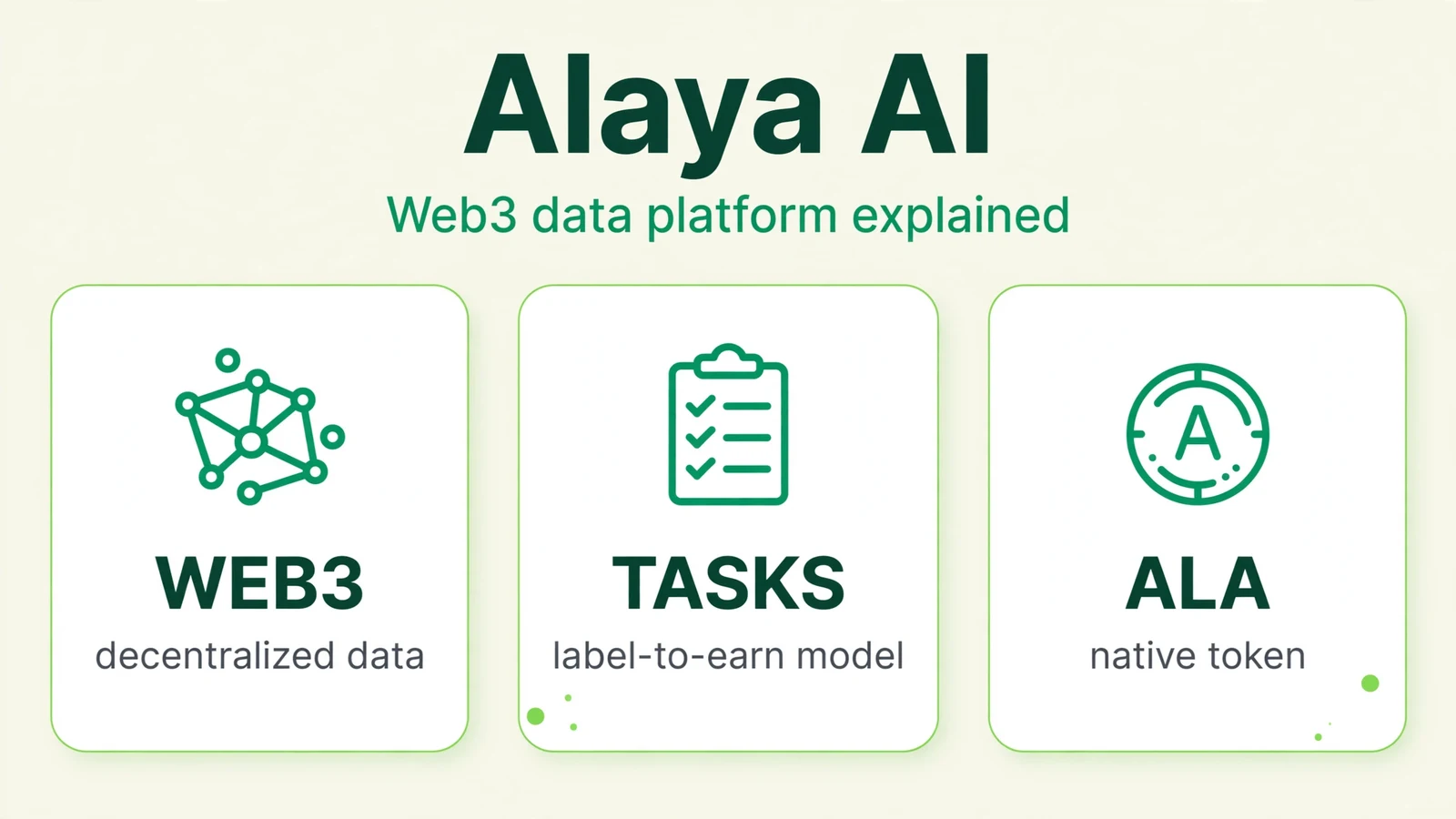
What if labeling a few images on your phone could earn you crypto? That is the pitch behind Alaya AI, a Web3-based decentralized platform where everyday people earn tokens by labeling the data that trains artificial intelligence. Founded in 2020 by a team based in New Zealand, it works like a gig economy app for AI data.
We looked into how the earning actually works. Companies that need high-quality training data post tasks, and a global community of users completes them, answering questions, tagging images, and sorting text, in exchange for AIA tokens recorded on the blockchain. With over 400,000 registered users and more than 20,000 daily active contributors, it blends gamification, NFTs, and automated quality control. Joining is free, and you even receive an NFT just for signing up.
In this guide we explain the tasks, the token economics, the risks, and whether Alaya AI is worth your time.
Quick Answer
Alaya AI is a Web3-based decentralized platform where everyday people earn crypto tokens by labeling data that trains artificial intelligence. Founded in 2020 by a team based in New Zealand, it works like a gig economy app for AI data: companies that need high-quality training data post tasks, and a global community of users completes them, answering questions, tagging images, and sorting text, in exchange for AIA tokens recorded on the blockchain. With over 400,000 registered users and more than 20,000 daily active contributors, it blends gamification, NFTs, and automated quality control to make data annotation open to anyone. Joining is free, and you even receive an NFT just for signing up.
What Is Alaya AI?
Every AI model you have ever used was trained on labeled data, and labeling that data has traditionally been done by specialized firms behind closed doors. Alaya AI flips that model. It is a decentralized AI data infrastructure platform that connects companies needing training data directly with a worldwide community of contributors, using blockchain to handle identity, rewards, and transparency.
The concept is simple to grasp if you have ever done gig work. Instead of driving or delivering, you complete small data tasks: label objects in a photo, answer a question to train a chatbot, classify a piece of text. Each completed task earns tokens, and the whole system runs without a single company owning your contributions.
What makes it Web3 rather than just another crowdsourcing site is the infrastructure underneath. Rewards are paid in tokens on-chain, contributors receive NFTs, and quality validation happens through decentralized algorithms instead of a central review team. The platform has grown into a decentralized autonomous community where users have a voice in product direction.
The numbers suggest real traction: hundreds of thousands of registered users, tens of thousands active daily, over 1,500 on-chain transactions per day, and partnerships with more than ten AI technology companies that buy the resulting datasets.
How Does Alaya AI Work?
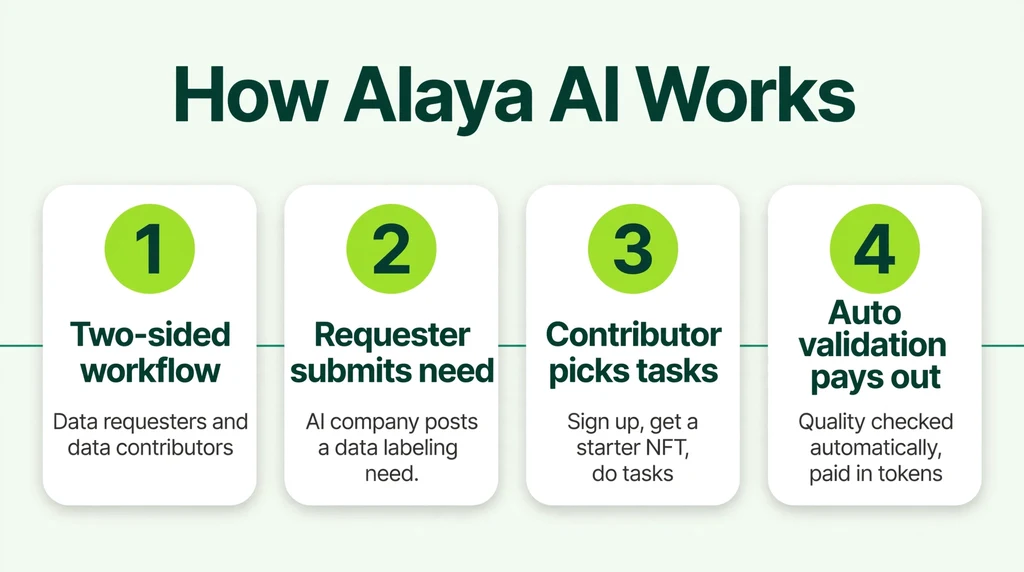
The workflow has two sides: data requesters and data contributors.
On the requester side, an AI company submits a data need, for example, ten thousand street photos with every traffic sign outlined, or five thousand customer questions categorized by intent. Alaya’s system automatically assigns these tasks to suitable users based on their history and profile.
On the contributor side, you sign up, receive a starter NFT, and start picking up tasks from the dashboard. Tasks are gamified: daily check-ins, streaks, and referral bonuses keep participation lively. You complete annotations through the platform’s tooling, and your work is validated automatically.
Validation is where the engineering gets interesting. Instead of human reviewers checking every label, the platform uses a normal distribution model to validate answers, automatically excluding statistical outliers. Proprietary algorithms cross-reference answers across users and weight them, so the system converges on correct labels without manual inspection. The validity threshold adjusts dynamically with sample size to avoid overcorrection.
Once validated, data goes through automated preprocessing: cleaning, deduplication, and privacy protection, including zero-knowledge encryption. The finished datasets are delivered to AI developers, and contributors are paid in tokens. A wallet connection is only required when you want to withdraw, so crypto beginners can start without touching blockchain tooling.
Underpinning all of this is the Micro Data Model, Alaya’s approach to getting more training value from less data through feature engineering and compression, which reduces the redundant labeling that makes traditional annotation so expensive.
What is easy to miss is why the decentralized approach can actually produce better data, not just cheaper data. Traditional annotation firms rely on a small pool of workers doing enormous volumes, which introduces fatigue errors and sampling bias: the dataset starts reflecting a handful of people’s judgments. By spreading tiny workloads across hundreds of thousands of contributors, Alaya gets fresher eyes on every sample and a diversity of perspectives that a single vendor team cannot replicate. The research literature on crowdsourced labeling has long shown that aggregated judgments from many non-experts often beat single-expert labels, and Alaya’s architecture is essentially built to exploit that finding at scale.
The token economics also deserve a closer look, because they solve a real incentive problem. In traditional gig annotation, workers are paid per task and therefore rush, which degrades quality. Alaya’s mix of base task rewards, accuracy-weighted bonuses, streak incentives, and referral income rewards the behaviors that produce good data: care, consistency, and community building. It is not a perfect system, and gaming attempts exist, but the validation algorithms are specifically designed to detect and down-weight low-effort patterns.
Key Features of Alaya AI
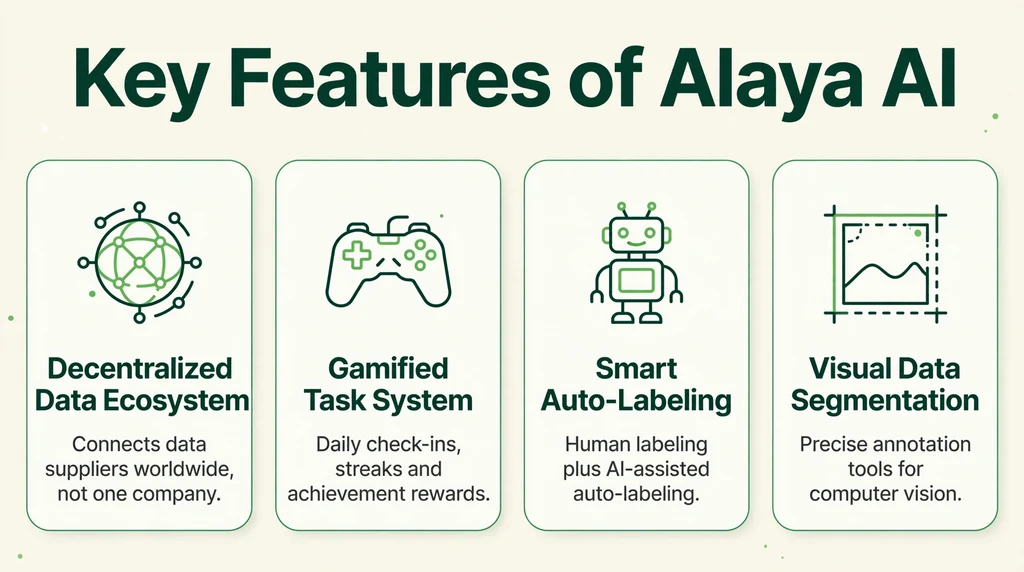
Decentralized Data Ecosystem
Instead of one company employing annotators, Alaya connects data suppliers worldwide through Web3 infrastructure. No single entity owns the contributed data, and the community participates in governance. This openness is the philosophical core that separates it from centralized labeling firms.
Gamified Task System
Annotation tasks come wrapped in game mechanics: daily check-ins, achievement streaks, leaderboards, and referral bonuses that let active users multiply earnings through their networks. The gamification is not decoration; it is the retention engine that keeps tens of thousands of contributors returning daily.
Smart Auto-Labeling
The platform combines human labeling with AI-assisted auto-labeling powered by reinforcement learning from human feedback. The system claims verification rates above 80 percent and can process both static images and dynamic visual data instantly, which dramatically cuts the cost per labeled sample.
Visual Data Segmentation
For computer vision tasks, the tooling supports precise annotation, including tracing exact object boundaries in images. Accurate segmentation is what teaches models to distinguish a pedestrian from a lamppost, and the platform’s tools are built specifically for this precision work.
Blockchain Rewards and NFTs
Contributors earn AIA tokens recorded on-chain, and every new user receives an NFT at signup. Tokens can be held, and with a wallet connection, withdrawn. The tokenization also extends to AI models themselves, with staking pools that let the community fund model development.
Privacy and Security
Data preprocessing includes zero-knowledge encryption, and the decentralized design means there is no central database of contributor activity to breach. For a platform built on thousands of strangers’ labor, this architecture is a meaningful trust feature.
Open Data Platform
Smaller AI developers can bootstrap custom datasets through the platform using token rewards instead of enterprise contracts. This lowers the barrier for early-stage teams that need specialized training data but cannot afford traditional data vendors.
Is Alaya AI Free?
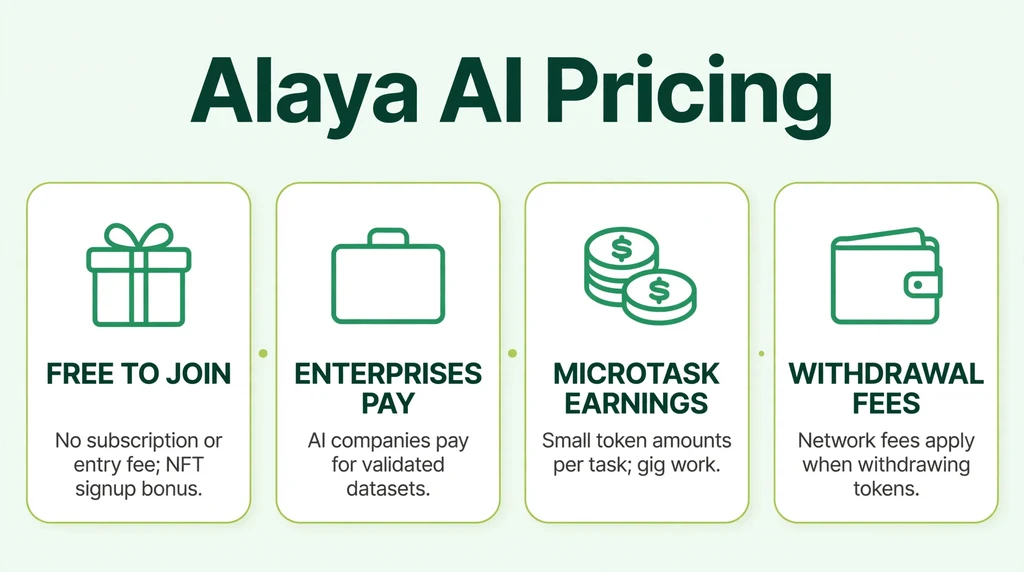
Yes, joining and contributing is free. There is no subscription, no entry fee, and you receive an NFT simply for signing up. The platform makes money from the enterprise side: AI companies pay for the validated datasets the community produces.
For contributors, the economics are those of microtask work. Individual tasks pay small token amounts, and meaningful earnings come from consistency, daily check-ins, streaks, and especially the referral system, which lets high-quality contributors scale income through their networks. This is gig work, not a salary, and expectations should be set accordingly.
One cost to be aware of is blockchain transaction fees when withdrawing tokens, which vary with network conditions. Until withdrawal, everything happens inside the platform, so casual contributors may never pay a cent. As with any crypto-adjacent earning, token values fluctuate, so think of rewards as variable rather than fixed income.
How to Use Alaya AI
- Sign up. Register on the platform with your email. You will receive a free NFT for joining, no crypto experience needed.
- Explore the dashboard. Browse available annotation tasks, which range from image labeling to question answering and text classification.
- Start with simple tasks. Pick beginner-friendly tasks to learn the annotation tools and build your accuracy history.
- Do daily check-ins. Log in daily to build streaks and unlock bonus rewards that compound over time.
- Focus on accuracy. The validation system weights careful contributors more highly, so quality beats speed for long-term earnings.
- Use referrals. Invite others through your referral link to multiply earnings as your network grows.
- Connect a wallet to withdraw. When you are ready to take tokens out, connect a compatible crypto wallet and follow the withdrawal flow.
- Track the token. Keep an eye on the AIA token’s value and network fees so you withdraw when it makes economic sense.
Is Alaya AI Safe?
Alaya AI appears to be a legitimate operation with a public team, real partnerships, and years of operating history since 2020. The gamified, transparent structure is a good sign, and the fact that you can participate without depositing money or connecting a wallet upfront removes the most common scam vectors.
That said, standard Web3 caution applies. Token rewards fluctuate in value, so treat earnings as speculative. Never share your wallet’s seed phrase with anyone, and be wary of impersonator sites or fake support accounts, which plague every popular crypto-adjacent platform. Only use the official domain and official channels.
On the data side, the tasks themselves are ordinary annotation work, labeling images and answering questions, with nothing inherently risky. The zero-knowledge encryption and decentralized design are genuine architectural advantages for privacy.
The bigger question is economic rather than safety-related: microtask platforms reward scale and consistency, and hourly-equivalent earnings are modest. Go in with clear eyes about it being supplemental income, and it is a reasonable side hustle. Expect a salary and you will be disappointed.
Finally, as with any platform where you earn tokens, keep records for tax purposes. Crypto earnings are taxable in most jurisdictions, and “it was just a game” is not a defense if amounts become significant.
One more risk worth naming honestly is platform dependence. Your reputation score, streak history, and referral network all live inside Alaya’s ecosystem. If the platform changed its reward structure, and crypto-adjacent platforms do adjust tokenomics, your accumulated advantages could dilute overnight. Diversifying across two or three earning platforms rather than going all-in on one is the prudent move for anyone treating this as more than a casual experiment.
There is also the question of how seriously to take the governance promises. Decentralized autonomous community sounds empowering, but in practice, early teams usually retain decisive control while the token distribution is still concentrating. That is normal for the category and not a red flag by itself, but evaluate governance claims on what token holders can actually vote on today, not on the roadmap’s aspirations.
Alaya AI Pros and Cons
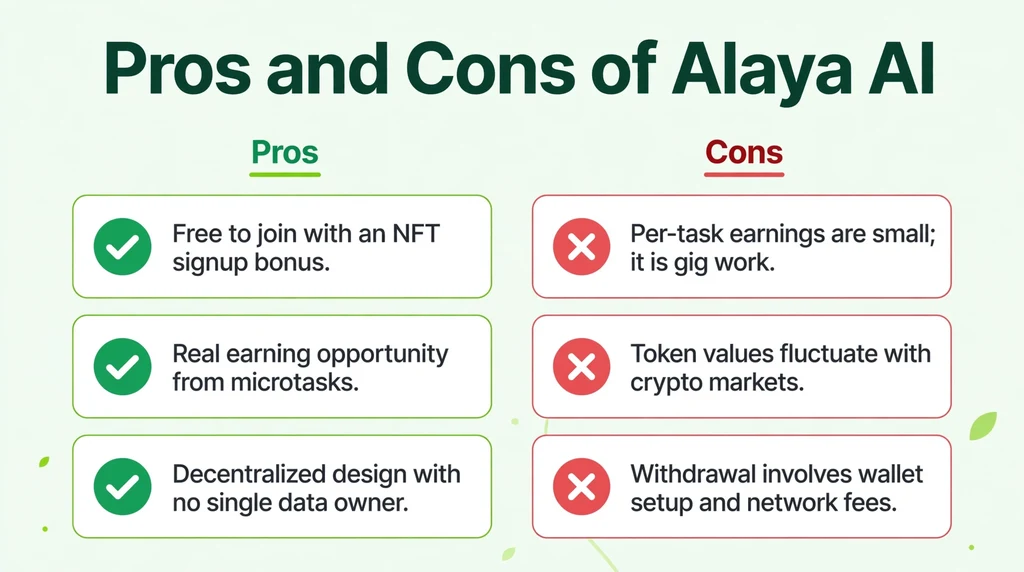
Pros:
- Free to join with an NFT signup bonus
- Real earning opportunity from microtasks
- Decentralized design with no single data owner
- Gamification makes repetitive work engaging
- Automated quality validation keeps standards high
- Open platform helps small AI developers afford data
- No crypto experience needed to start
Cons:
- Per-task earnings are small; it is gig work
- Token values fluctuate with crypto markets
- Withdrawal involves wallet setup and network fees
- Quality validation algorithms can feel opaque
- Referral-driven earnings favor network builders
- Regulatory treatment of token earnings varies by country
Alaya AI vs Alternatives
Against centralized annotation platforms like Scale AI or Appen, Alaya’s pitch is openness and community ownership versus enterprise polish. The incumbents offer steadier, contract-based work with clearer pay, while Alaya offers token upside, gamification, and no gatekeeping.
Against other Web3 data projects, Alaya differentiates with its automated validation engine and Micro Data Model, plus a longer operating history than most competitors in the space. Many Web3 data startups are whitepapers; Alaya has hundreds of thousands of users and live enterprise clients.
Against general gig platforms, the comparison is about what you are selling. Driving or delivery pays in fiat immediately; Alaya pays in tokens for cognitive microtasks you can do from a phone. Different labor, different reward profile.
There is also a less obvious competitor: doing nothing and waiting. The data annotation market is being reshaped by synthetic data and improving auto-labeling, which gradually reduces demand for human labels on routine tasks. Alaya’s bet, via the Micro Data Model and RLHF-assisted labeling, is that human judgment remains essential for edge cases, subjective judgments, and quality validation even as automation handles the easy bulk. Contributors should understand this trajectory: the highest-value human tasks are the ambiguous ones machines still get wrong, so developing skill at nuanced annotation, rather than raw speed, is the durable advantage.
Best Alaya AI Alternatives
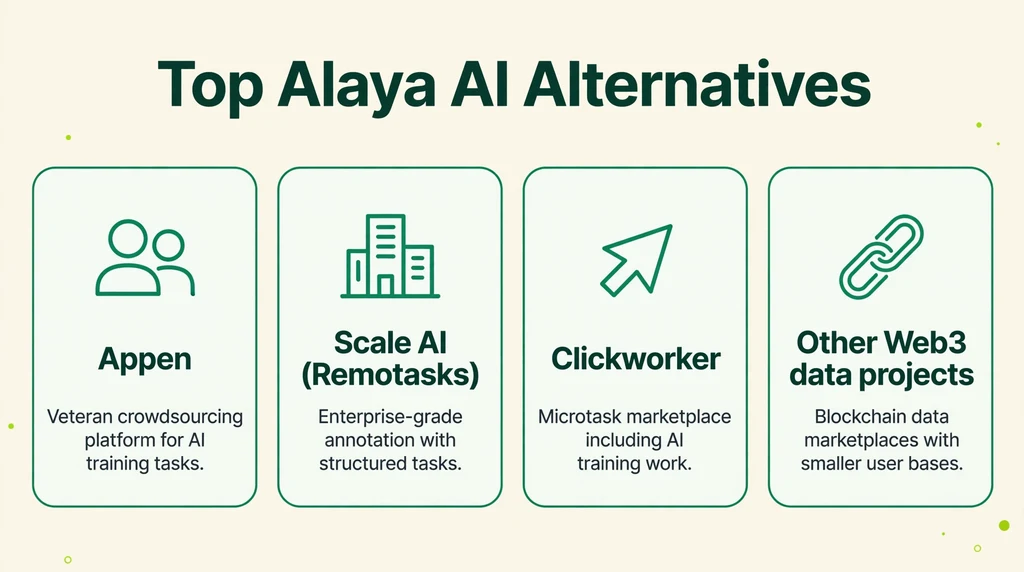
Appen: A veteran crowdsourcing platform for AI training tasks with fiat payouts. Best for contributors who want predictable, traditional gig payments.
Scale AI (Remotasks): Enterprise-grade annotation work with structured tasks. Best for serious annotators seeking steadier assignments.
Clickworker: General microtask marketplace including AI training work. Best for variety beyond pure annotation.
Other Web3 data projects: Several blockchain-based data marketplaces exist, though few match Alaya’s user base. Worth watching as the category matures.
Direct freelancing: Skilled annotators can find higher-paying data work on freelance platforms. Best for experienced contributors who outgrow microtask rates.
Who Should Use Alaya AI?
Alaya AI suits students, side-hustlers, and crypto-curious users who want to earn tokens from their phone in spare moments. It also fits small AI teams that need affordable, specialized training data without enterprise contracts.
It is less suited to anyone needing reliable primary income, to users uncomfortable with crypto mechanics, or to enterprises requiring the compliance certifications that centralized vendors provide.
Frequently Asked Questions About Alaya AI
- Is Alaya AI legit?
It appears to be. Founded in 2020 with a public New Zealand-based team, hundreds of thousands of users, and enterprise partnerships, it has the markers of a real operating platform rather than a short-lived scheme. Still, do your own research before investing significant time. - How do you earn money on Alaya AI?
You complete data annotation tasks, daily check-ins, and referrals to earn AIA tokens. Tokens can be withdrawn to a crypto wallet once you connect one, subject to network fees and market value. - Do I need crypto experience to join?
No. Signup is email-based, you get a free NFT automatically, and a wallet is only needed when you want to withdraw tokens. - What kind of tasks are available?
Image labeling and segmentation, question answering, text classification, and similar annotation work that trains AI models. Tasks vary with what enterprise clients request. - How much can you realistically earn?
Think gig-work levels, not a salary. Consistent contributors doing daily tasks and building referrals earn more, but per-task rewards are small and token prices fluctuate.
Final Thoughts
Alaya AI is an intriguing experiment in democratizing the least glamorous but most essential part of AI: the data labeling that makes models smart. By wrapping microtasks in game mechanics and settling rewards on-chain, it has built one of the largest annotation communities in the Web3 space. It will not replace your day job, but as a way to earn tokens from spare minutes while learning how AI training data actually gets made, it is genuinely interesting. Start free, stay consistent, and keep your expectations gig-sized.
Read this detailed Alaya AI review of its Web3 data platform and this technical explainer on Alaya AI and the AGT token for more depth.