Teachers, editors, and SEO teams all face the same question now: was this written by a person or a machine? Winston AI answers it. It is an AI content detector that scans writing from ChatGPT, Gemini, Claude, and other major models, highlights the exact sentences that look machine-made, and bundles a built-in plagiarism checker with every scan.
We evaluated what makes it different from the flood of basic detectors. The company positions itself as a leading detection tool with a large user base among educators, publishers, journalists, and SEO professionals who verify originality daily. Sentence-level highlighting, rather than a single vague score, is what makes its reports actually actionable.
A free 14-day trial covers 2,000 words, and paid plans start at $18 per month for heavier use. This guide explains how Winston AI works, how accurate it is, what it costs, and how it compares to rival detectors.
Quick Answer
Winston AI is an AI content detector that tells you whether a piece of text was written by a person or generated by artificial intelligence. It scans writing from ChatGPT, Gemini, Claude and other major models, highlights the exact sentences that look machine-made, and bundles a built-in plagiarism checker with every scan. A free 14-day trial covers 2,000 words, while paid plans start at $18 per month for heavier use.
What Is Winston AI?
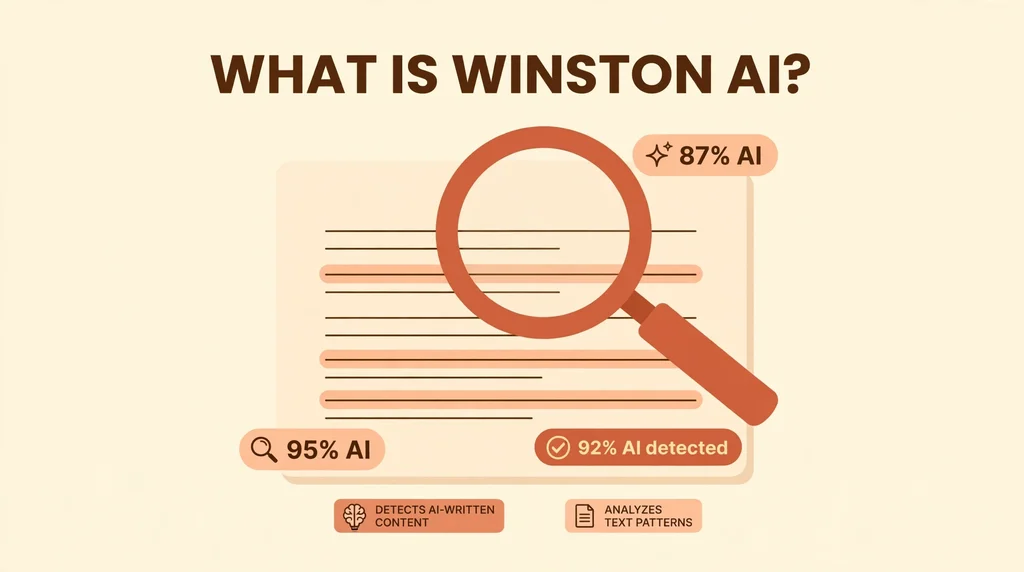
Winston AI is an AI detection platform hosted at gowinston.ai. Its main job is simple: look at a piece of text and judge whether a human wrote it or an AI model produced it. The company calls itself a leading AI content detection tool, with a large user base among educators, publishers, journalists and SEO professionals who verify content originality every day.
What makes Winston AI different from a basic detector is how much it packs into one dashboard. Alongside AI text detection, you get a full plagiarism checker covering more than 400 billion web pages and academic papers. It can also scan images and documents through OCR, detect AI-generated images and deepfakes, and produce shareable reports for clients or teachers.
The tool claims a 99.98 percent accuracy rate for detecting AI-generated text, based on its own testing across thousands of documents. Independent reviewers found it strong on long-form content, though like every detector it can stumble on heavily edited or paraphrased text. It works with all the major language models, including ChatGPT, GPT-4, Google Gemini, Claude and Llama.
Think of Winston AI as a quality control station for written content. Schools check student submissions with it, publishers verify freelance work before it goes live, and marketing teams make sure outsourced articles read like a human wrote them.
How Does Winston AI Work?
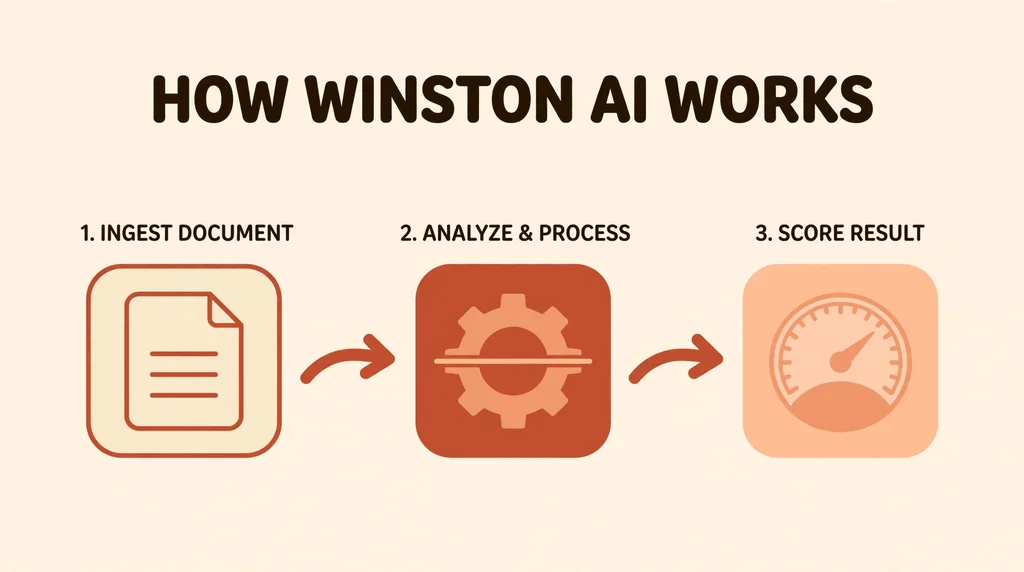
Under the hood, Winston AI uses natural language processing and machine learning trained to spot the fingerprints of AI writing. When you submit text, the system analyzes patterns such as grammatical structure, word choice randomness (perplexity) and sentence length variation (burstiness). AI text tends to be more predictable and uniform, while human writing jumps around in rhythm and vocabulary.
You can submit content in several ways: paste text directly, upload a Word file or PDF, import from a URL, or scan an image with the built-in OCR. The scan takes seconds, and the results page shows a human score from 0 to 100 with a color-coded map highlighting which sentences look AI-generated.
Text Analysis Engine
The core engine gives you two things at once: an overall AI detection score and a sentence-by-sentence breakdown. That second part is where Winston AI earns its reputation. Instead of a single mysterious number, you see exactly which lines triggered the detector and can judge whether the flag makes sense. Reviewers praise this transparency because it turns the result into something you can discuss with a student or a client rather than a black box verdict.
The engine also reports separate confidence signals for the major AI models, so you can see whether the text resembles ChatGPT, Gemini or Claude output. It handles long documents well, including full books, and supports many languages beyond English, including French, Spanish, German, Portuguese, Italian and Simplified Chinese.
Plagiarism and OCR Scanning
Every scan can include a plagiarism check that searches a massive index of web pages and academic documents for copied passages, showing you the sources for each match. This two-in-one design is a big reason schools and publishers pick Winston AI: one scan covers both AI authorship and copied content.
The OCR feature extends scanning to content that is not plain text. Upload photos, scans of printed pages or even handwritten notes, and the tool extracts the text before running detection. For teachers dealing with photographed homework, that removes a tedious manual step.
AI Image and Deepfake Detection
Winston AI goes beyond text with a dedicated image detection module. It can tell whether a picture was likely generated by tools such as Midjourney, DALL-E, Stable Diffusion or Meta AI, and its newer forensic mode analyzes deepfakes and manipulated photos. The forensic pipeline checks compression artifacts, noise patterns and metadata to map which regions of an image look suspicious.
The results arrive as a structured forensic report with an origin verdict, a confidence level and a per-region breakdown. Few AI detectors offer anything close to this depth on the visual side, which makes Winston AI unusually complete for teams that deal with both written and visual content.
Key Features of Winston AI
- AI text detection: Flags AI-generated writing with a claimed 99.98 percent accuracy rate, covering ChatGPT, GPT-4, Gemini, Claude, Llama and other major models.
- Sentence-level highlighting: Shows an AI prediction map that marks each sentence as likely human or likely AI, so you can see exactly what triggered the score.
- Plagiarism checker: Compares content against more than 400 billion web pages and academic papers, with source matching so you can inspect every flagged passage.
- OCR scanning: Extracts text from images, scanned documents and handwriting, then runs full AI detection on the result.
- AI image and deepfake detection: Identifies images generated by Midjourney, DALL-E, Stable Diffusion and Meta AI, with a forensic mode that maps manipulated regions.
- Readability score and writing feedback: Grades how readable your text is and offers suggestions to help polish drafts before publishing.
- Shareable reports: Export results as a PDF or share them through a link, so clients or teachers can review the findings without logging in.
- HUMN-1 certification: Higher plans include a website certification badge that signals your published content passed human-authorship checks.
- Chrome extension: Scan text on any web page by right-clicking, which is handy for quick checks while browsing or researching.
- Integrations and team tools: Works with Google Docs, Microsoft Word and Google Classroom, and paid tiers add team member seats with collaborative reporting.
Is Winston AI Free?
Winston AI does not offer a permanent free plan, but it does give you a free 14-day trial with 2,000 credits and no credit card required. That is enough to run a handful of real scans and decide whether the accuracy meets your needs before spending anything.
Also see our guides on Joyland AI, Spicy AI for more AI tools in this space.
- Free trial ($0): 2,000 credits for 14 days, AI content detection, AI image and deepfake detection, document and OCR scanning, plus email and chat support.
- Essential ($18/month, or $10/month billed annually): 80,000 credits per month, writing feedback, shareable PDF reports, and full document and OCR scanning.
- Advanced ($29/month, or $16/month billed annually): 200,000 credits per month, advanced plagiarism detection, up to 5 team members, and HUMN-1 website certification.
- Elite ($49/month, or $26/month billed annually): 500,000 credits per month, advanced plagiarism detection, unlimited team members, HUMN-1+ certification, and top-up credits.
Paid plans run on a monthly credit system, and each scan consumes credits based on how much content you check. Annual billing cuts the effective monthly price by roughly a third, which is worth considering if you scan content daily. Pricing can change, so confirm the current numbers on the official pricing page before you subscribe.
Which plan fits you? Start with the free trial on your typical documents. Solo bloggers usually land on Essential, daily users like teachers and editors get more from Advanced, and publishers with heavy volume belong on Elite.
How to Use Winston AI
- Create your account at gowinston.ai. Sign up with your email to activate the free 14-day trial. No credit card is needed, and you get 2,000 credits to start scanning right away.
- Choose what to scan. From the dashboard you can paste text, upload a document such as a Word file or PDF, import content from a URL, or upload an image for OCR text extraction.
- Pick your check type. Decide whether you want AI detection only or a combined scan that also runs the plagiarism checker. Combined scans cost more credits but give you the full picture.
- Run the scan. Hit the scan button and wait a few seconds while Winston AI analyzes the content and builds your results report.
- Read the human score. The dashboard shows an overall score from 0 to 100. A high human score means the text reads like a person wrote it. Scroll through the sentence-level map to see which specific lines were flagged.
- Review plagiarism matches. If you ran the combined scan, check the flagged passages against the listed sources. Decide whether each match is a real problem or a common phrase.
- Share or export the report. Generate a PDF or a shareable link from the Projects tab, where all your past scans stay saved for future reference.
Is Winston AI Safe?
Winston AI presents itself as a privacy-conscious platform. The company states that it is GDPR compliant and that your scanned content is never used to train AI models. That matters because you are often uploading other people’s writing, and you want a clear promise that the text is not feeding a training dataset.
On the practical side, reports stay saved in your Projects tab until you delete them. Reviewers note that data is retained while the related report exists, so if you handle sensitive material, delete old reports you no longer need. Use a strong unique password for your account, as you would with any cloud tool.
The bigger safety question is really about trust in the results. Winston AI is well established and used by hundreds of thousands of people, including academic institutions. Still, no AI detector is perfect. False positives happen, especially with short texts or heavily edited AI writing. Treat the score as strong evidence rather than absolute proof before making high-stakes decisions.
Avoid pasting highly sensitive personal information into any online scanner, and keep your own backups of important documents instead of relying on the Projects tab as storage.
Winston AI Pros and Cons
Pros
- Strong claimed accuracy: A 99.98 percent detection claim backed by large-scale internal testing, with solid independent reviews on long-form content.
- Sentence-level transparency: The prediction map shows exactly which sentences look AI-generated instead of hiding behind one number.
- Two tools in one: AI detection plus a full plagiarism checker means one subscription covers both originality checks.
- OCR and file support: Scans Word files, PDFs, images and even handwriting, which few competitors handle this smoothly.
- Image and deepfake detection: The forensic image module goes far beyond what most text detectors offer.
- Professional reporting: Shareable links, PDF exports and HUMN-1 certification make it easy to present results to clients or institutions.
Cons
- No permanent free plan: After the 14-day trial ends, you must pay to keep scanning.
- Credit limits: Every plan caps monthly credits, and you cannot simply buy more mid-cycle on lower tiers, so heavy months can leave you stuck.
- False positives exist: Real-world accuracy varies on short or heavily edited text, and a detector score should never be treated as courtroom proof.
- No built-in humanizer: It flags AI-sounding text but does not rewrite it for you, so you will need a separate tool for that step.
- Subscriptions are non-refundable: You can cancel to stop future billing, but you stay subscribed until the end of the current cycle.
Winston AI vs Alternatives
How does Winston AI compare with the detectors people usually consider alongside it? GPTZero is the best-known rival, popular in education for its straightforward scoring. Originality AI targets publishers and agencies with site-scanning features. Winston AI matches them on core text detection while pulling ahead on extras like OCR, image forensics and the combined plagiarism workflow.
| Feature | Winston AI | GPTZero | Originality AI |
|---|---|---|---|
| Primary focus | AI detection plus plagiarism | AI detection for education | AI detection for publishers |
| Claimed accuracy | 99.98% | High on vendor benchmarks | High on vendor benchmarks |
| Free option | 14-day trial, 2,000 credits | Limited free scans | Free trial credits |
| Paid price | $18 to $49/month | From about $15/month | From about $15/month |
| Plagiarism checker | Yes, built in | Limited or add-on | Yes, built in |
| AI image detection | Yes, with deepfake forensics | No | No |
| Sentence-level highlighting | Yes | Yes | Yes |
| OCR support | Yes | Limited | Limited |
| Best for | Educators, publishers, SEO teams | Teachers and students | Agencies and web publishers |
Best Winston AI Alternatives
GPTZero. The most famous name in AI detection, built with classrooms in mind. It offers simple scoring, writing reports and educator-focused features. A good pick if your main use case is checking student work and you want the tool teachers talk about most.
Originality AI. A favorite among content agencies and web publishers, combining AI detection with plagiarism and fact-checking tools. It also offers website scanning, which suits teams managing large content operations better than one-off document checks.
Copyleaks. An enterprise-grade platform with AI detection, plagiarism checking and API access. It integrates with learning management systems, making it a strong choice for institutions that need detection built into their existing software.
Turnitin. The long-standing standard for academic integrity, now with AI writing detection added to its similarity reports. If your school or university already uses Turnitin, its AI features come as a natural extension rather than a separate purchase.
ZeroGPT. A free and simple AI detector that works well for quick one-off checks. It lacks the depth of Winston AI, with no OCR or image forensics, but it costs nothing and answers the basic question fast.
To choose between them, match the tool to your workflow. Pick Winston AI when you want detection, plagiarism, OCR and image checks in one place. Choose GPTZero or Turnitin for classroom use, Originality AI for publishing pipelines, and ZeroGPT for a fast free check.
Who Should Use Winston AI?
Winston AI fits anyone whose work depends on knowing whether content is genuinely human. It is built for volume and accountability: the reports, the sentence-level detail and the plagiarism database all serve people who check other people’s writing or publish at scale.
- An educator or academic administrator checking student essays, theses and assignments for AI-generated or copied content.
- A publisher or editor verifying freelance submissions before they go live on your site or in print.
- An SEO professional or content marketer auditing outsourced articles to protect your site from low-quality AI filler.
- A recruiter or hiring manager screening writing samples and take-home assignments for authenticity.
- A student who wants to self-check an essay for accidental plagiarism or overly AI-sounding passages before submitting.
- A journalist or researcher verifying the authenticity of documents and images, including spotting deepfakes.
It is a weaker fit for casual users who only need an occasional quick check, since the free trial expires and there is no permanent free tier. Writers looking for a tool that rewrites flagged text will also need to look elsewhere, because Winston AI detects but does not humanize. For everyone in the list above, though, it is one of the most complete options available.
Frequently Asked Questions About Winston AI
How accurate is Winston AI?
Winston AI claims a 99.98 percent accuracy rate for detecting AI-generated text, based on its own testing across thousands of documents. Independent reviewers confirm it performs strongly on long-form content from ChatGPT, Gemini and Claude. Like all detectors, it is less reliable on very short or heavily paraphrased writing.
Is Winston AI really free?
Yes. There is no permanent free plan. You get a free 14-day trial with 2,000 credits and no credit card required, enough to test the tool on real documents. After that: Essential at $18 per month, Advanced at $29 per month or Elite at $49 per month, with lower effective prices on annual billing.
Can Winston AI detect ChatGPT content?
Yes. Winston AI is trained to detect content from ChatGPT and GPT-4, along with Gemini, Claude, Llama and other major language models. Its own testing shows it can even flag human-edited AI drafts by finding the predictive text structure underneath the edits.
Does Winston AI detect AI-generated images?
Yes, and this is one of its standout features. Winston AI can identify images created by Midjourney, DALL-E, Stable Diffusion, Meta AI and similar generators. Its forensic mode goes further, analyzing deepfakes and manipulated photos with per-region breakdowns.
Does Winston AI check for plagiarism?
Every plan includes plagiarism detection that compares your text against a database of more than 400 billion web pages and academic papers. Advanced and Elite plans unlock the more thorough advanced plagiarism detection with detailed source matching.
Final Thoughts
Winston AI earns its place among the top AI detectors by doing more than the basics well. The sentence-level prediction map turns a mysterious score into something you can inspect and discuss. The built-in plagiarism checker, OCR scanning and image forensics mean one subscription covers checks that would otherwise need three separate tools.
The trade-offs are honest ones. There is no free-forever tier, credits cap every plan, and no detector, this one included, should be treated as infallible proof in high-stakes decisions. Go in with the free trial, run your typical documents through it, and see how the scores line up with your own judgment. If they do, Winston AI is easy to recommend as the detection workhorse of a content integrity workflow.
For more information, visit Winston AI official site, AI detection on Wikipedia.