Quick Answer
Novel AI is an AI-powered creative writing assistant that generates fiction from your prompts. It trains its own large language models (Euterpe, Erato and Krake) specifically for storytelling, uses a Lorebook to keep characters and worldbuilding consistent, and can create anime-style illustrations of your scenes. A free Paper trial offers 100 generations, and paid plans start at $10 per month.
What Is Novel AI?
Developers built Novel AI from the ground up as an AI story generator for fiction writers. Hosted at novelai.net, it pairs custom-trained language models with dedicated worldbuilding tools. As a result, novelists, roleplayers and fanfiction authors can turn rough ideas into full narratives. Instead of answering questions like a chatbot, this AI story writer continues your prose. It keeps your characters, voice and plot consistent as the story grows.
What sets Novel AI apart is that it does not borrow a general-purpose model. Instead, the platform trains its own models, named Euterpe, Erato and Krake, on fiction and literature. Consequently, its text generation leans toward descriptive narrative and natural dialogue rather than essays or code. That fiction-first training is the reason so many writers reach for it when a general assistant feels too stiff for creative work.
Around that core sits a full toolkit. For example, the Lorebook stores your cast and settings, while an Author’s Note steers tone and focus. Additionally, AI modules mimic famous prose styles, and anime-style image generation illustrates your characters and scenes. A text-to-speech mode even reads your story aloud. Together they make Novel AI feel less like a gadget and more like a dedicated creative writing assistant.
How Does Novel AI Work?
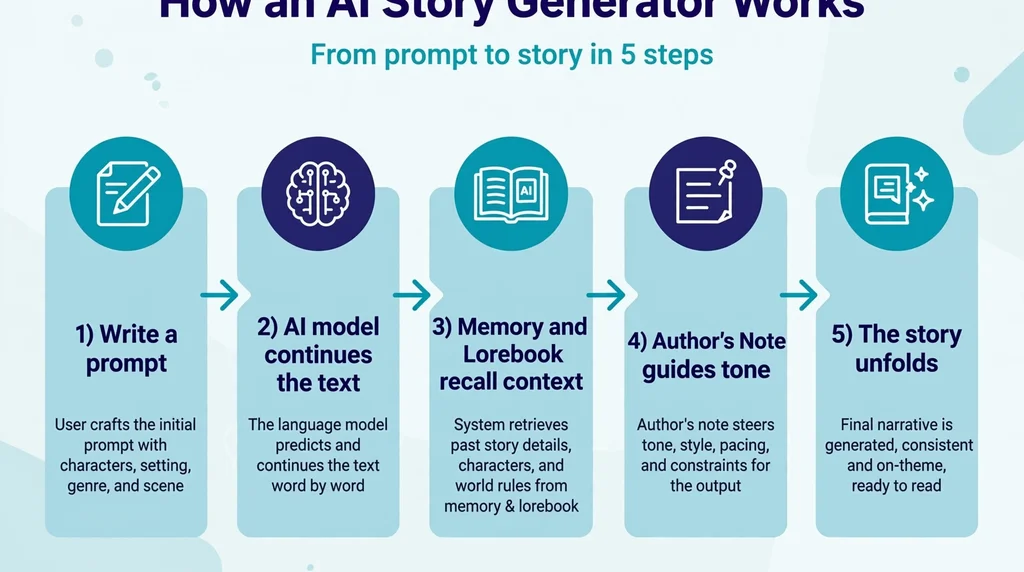
The workflow is simple on the surface. You write a few sentences, a scene or a full page. Then the language model predicts what should come next, continuing your narrative one generation at a time. Each time you press generate, the AI reads your current prompt, the recent story context, your Author’s Note and any matching Lorebook entries. Finally, it writes the next chunk in a matching voice.
Models and Memory System
Under the hood, Novel AI runs its own family of large language models. Euterpe is the flagship model for rich, creative prose. Meanwhile, Erato and Krake offer different balances of style and capability. Each model works within a context window. The memory system reserves part of that window for your story so far. Depending on your plan, between 1024 and 2048 tokens or more stay in the AI’s active memory. That is how it remembers recent plot beats and character names.
The real consistency engine is the Lorebook. First, you create entries for characters, places, magic systems or backstory. Then you attach trigger keywords. Whenever those keywords appear, the AI pulls that entry into context automatically. The Author’s Note is a short instruction box that sits close to the model’s output, perfect for reminders like “write in first person” or “slow, atmospheric pacing.” AI modules layer famous-author or genre styles over your draft. Finally, image generation lets you illustrate scenes with anime-inspired visuals that spend Anlas credits.
You stay in the driver’s seat throughout. If a generation drifts off track, you can retry for a new continuation. Alternatively, edit the AI’s text directly, or branch the story to explore different directions. Advanced controls like phrase bias let you nudge the model toward or away from specific words. Moreover, you can tune the lore, memory and Author’s Note settings per story. This blend of automation and control is what makes Novel AI a true creative writing assistant rather than a one-shot text spinner.
Key Features of Novel AI
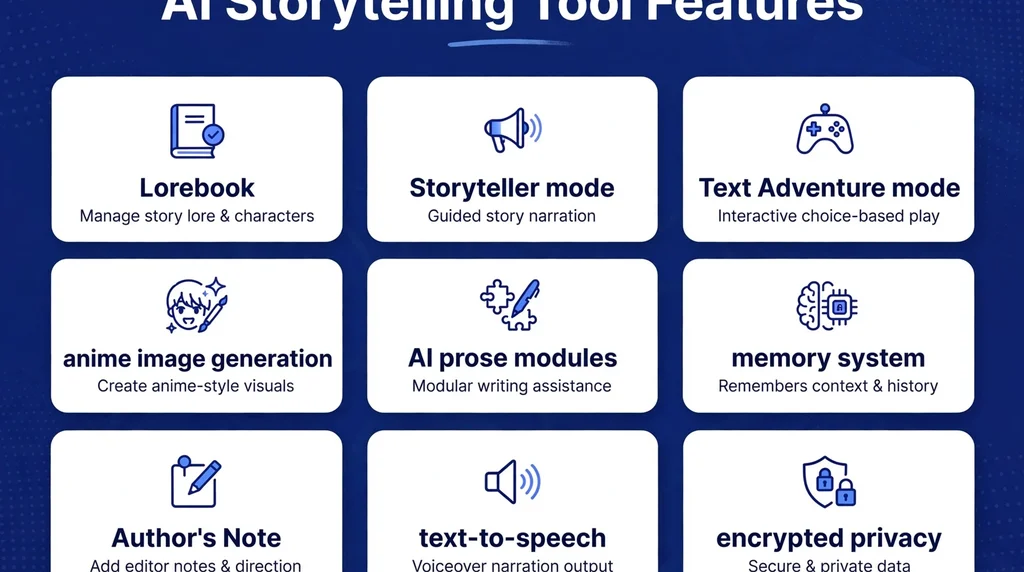
- Custom fiction models: Euterpe, Erato and Krake are large language models trained specifically on fiction, producing stronger narrative prose and dialogue than general chatbots.
- Lorebook: Stores characters, locations and worldbuilding entries that the AI references automatically for long-term consistency.
- Memory system: Keeps 1024 to 2048 or more tokens of story context in active memory depending on your tier, so the AI remembers what happened recently.
- Author’s Note: A short instruction field that guides tone, style and focus, sitting closer to the output for maximum influence.
- AI modules: Style packs that let writers mimic the prose of famous authors or specific genres with a single toggle.
- Image generation: Creates anime-style illustrations of characters and scenes from text descriptions, powered by Anlas credits.
- Two writing modes: Storyteller mode for traditional narrative, and Text Adventure mode for interactive, RPG-style stories.
- Text-to-speech: Narrates your stories aloud, useful for proof-listening or enjoying your fiction hands-free.
- Creative freedom: Permits mature and dark fiction themes without heavy-handed content filters, a major draw for many writers.
- Encrypted storage: The platform stores stories on servers with encryption, keeping private drafts out of other people’s hands.
Is Novel AI Free?
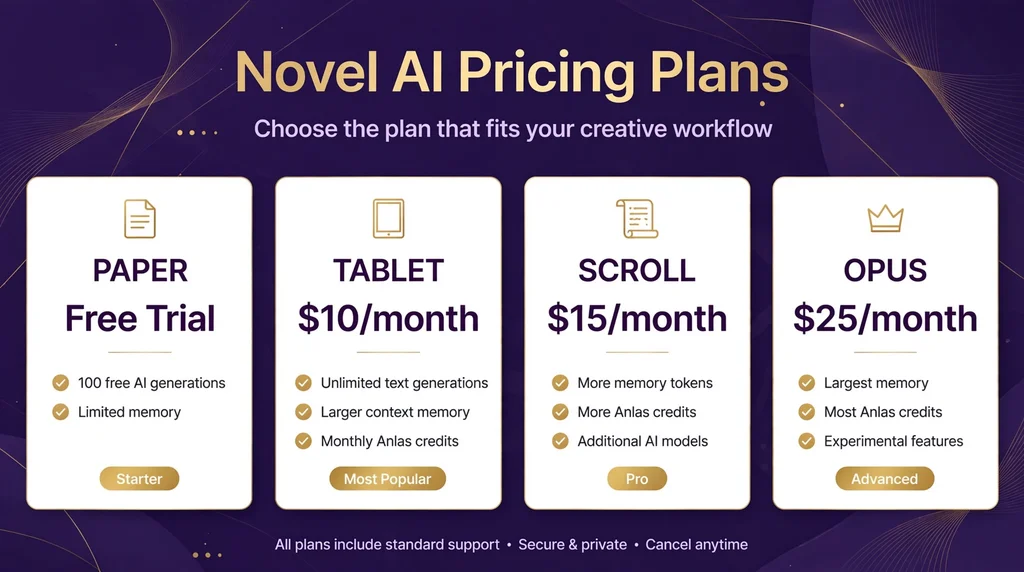
Novel AI offers a free trial tier called Paper, which includes 100 free AI generations so you can test the platform before paying. Once you use those up, you need a subscription for continued access. Here is the NovelAI pricing breakdown:
Also see our guides on Joyland AI, Spicy AI for more AI tools in this space.
- Paper (free trial): 100 free AI generations. Enough to try the story generator, but limited memory and features.
- Tablet ($10/month): The entry-level paid plan with unlimited text generations, larger context memory and a monthly allowance of Anlas credits for image generation.
- Scroll ($15/month): More memory tokens, more Anlas credits and access to additional AI models and customization options.
- Opus ($25/month): The premium plan with the largest memory, the most Anlas credits and experimental features not available on lower tiers.
Paid tiers unlock the full experience. You get bigger memory windows, priority access to models, and image generation credits. You also unlock the advanced settings that make long stories stay coherent. For writers who produce daily, Opus pays for itself in output quality on long projects. Text generation itself is unlimited on paid plans. However, the main thing to budget is Anlas, the credit currency spent on AI images. Each tier includes a monthly Anlas allowance, and you can buy more if you illustrate heavily.
Which plan should you pick? Start with the Paper trial to learn the interface, move to Tablet if you write casually, and choose Scroll or Opus if you work on long novels where extra memory tokens genuinely improve consistency. Because plans are monthly with no long commitment, you can scale up for a big project and scale back down afterward.
How to Use Novel AI
- Sign up at novelai.net. Create an account and start with the free Paper trial, which gives you 100 AI generations to explore.
- Pick your mode. Choose Storyteller mode for traditional narrative writing, or Text Adventure mode for interactive, choice-driven storytelling.
- Start a new story. Give your story a title, set the genre and write an opening prompt: a paragraph describing your setting, characters and the scene where things begin.
- Generate and steer. Write a little, press generate, and let the AI continue. Use retry to see alternative continuations, and edit anything you do not like directly.
- Build your Lorebook. Add entries for your main characters, locations and rules of your world, with trigger keywords so the AI recalls them automatically.
- Set your Author’s Note and memory. Add tone guidance such as “witty dialogue, slow pacing” and tune the context settings to taste.
- Illustrate and narrate. Use Anlas credits to generate anime-style images of key scenes, and turn on text-to-speech to hear your story read aloud.
Is Novel AI Safe?
Novel AI stores stories on its servers with encryption. Therefore, your drafts are not sitting around in plain text for anyone to browse. The company positions itself as privacy-friendly: your fiction stays yours, and you are not training public models with your private writing. Standard precautions still apply. For example, use a strong unique password and avoid pasting sensitive personal information into any online writing tool.
The safety question most people ask is really about content. Writers know Novel AI for creative freedom, including mature and dark fiction themes. It avoids the heavy-handed filters found on many mainstream tools. Consequently, it works as an adult-oriented platform. Writers exploring horror, romance or gritty drama will find room to work. However, parents should know the developers did not design the platform as a kid-safe space. If you share an account with a younger writer, supervise how it is used.
A few practical tips round out the safety picture. First, review the platform’s privacy policy and terms of service before committing to a paid plan. Pay special attention to how long the platform retains data. Additionally, keep backups of important stories on your own device, as with any cloud tool. Treat generated content as a draft: you own your creative decisions. However, always verify originality before publishing anything commercially, since Novel AI includes no plagiarism checker.
Novel AI Pros and Cons
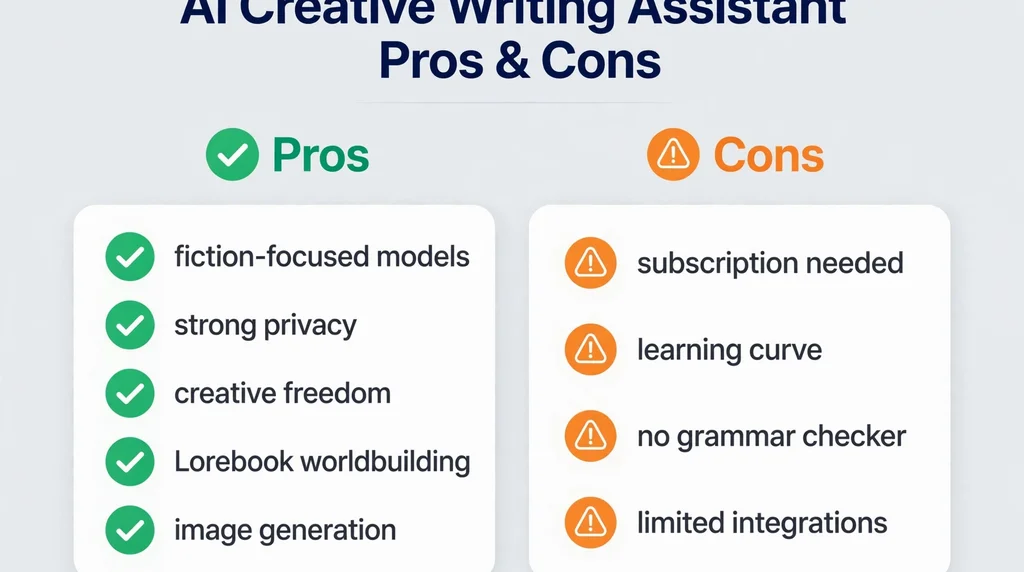
Pros
- Fiction-focused models: Developers trained Euterpe, Erato and Krake on literature, so the prose reads like fiction rather than a homework answer.
- Lorebook consistency: Characters and worldbuilding stay coherent across long stories without you re-explaining everything.
- Creative freedom: The platform allows mature and dark themes, giving writers of romance, horror and gritty drama real room to work.
- Strong privacy: Encrypted story storage keeps private drafts protected.
- Multimedia extras: Anime-style image generation and text-to-speech narration turn a story into a richer experience.
Cons
- Subscription required: The free trial is only 100 generations; serious use means paying $10 or more per month.
- Learning curve: The Lorebook, Author’s Note and context settings take time to master before results feel great.
- No grammar or plagiarism checker: You will need a separate tool to polish and verify your final draft.
- Limited integrations: There are few connections to publishing platforms or writing apps.
- Image credits cost extra: Heavy image generation burns Anlas credits on top of the subscription.
Novel AI vs Alternatives
How does this AI story writer stack up against its best-known rivals? AI Dungeon pioneered interactive AI storytelling and leans into game-like adventures with a generous free tier. In contrast, developers built Sudowrite around assisting novelists with drafting tools like scene expansion and brainstorming. Novel AI sits between them. It is more writer-focused than AI Dungeon and more fiction-native than a general assistant. Above all, it stays uniquely strong on long-term worldbuilding through the Lorebook.
| Feature | Novel AI | AI Dungeon | Sudowrite |
|---|---|---|---|
| Primary focus | Fiction writing and worldbuilding | Interactive text adventures | Novel drafting assistance |
| AI models | Own models (Euterpe, Erato, Krake) | Multiple models incl. third-party | Multiple models incl. third-party |
| Free tier | 100 free generations (trial) | Free with ads and limits | Limited free trial credits |
| Paid price | $10 to $25/month | From $10/month | From $10/month |
| Image generation | Yes, anime-style (Anlas) | Limited | No |
| Best for | Novelists, roleplayers, fanfiction | Casual adventure players | Serious novelists |
Best Novel AI Alternatives
AI Dungeon. The original interactive AI storytelling game. You type actions and the AI narrates what happens next, making it ideal for open-ended adventures and roleplay. It offers a free tier supported by ads, with premium plans unlocking stronger models and multiplayer scenarios.
Sudowrite. A writing assistant designed specifically for novelists, with tools for expanding scenes, brainstorming plot twists and rewriting passages. It is less of a free-form storyteller and more of a drafting coach, which suits authors who want structured help finishing a manuscript.
KoboldAI. A free, open-source front end that runs AI story generation on your own hardware or with community models. It appeals to technical users who want full control and no subscription, though setup is more involved than signing up for a hosted service.
Jasper. A general-purpose AI writing platform geared toward marketing copy, blogs and business content. It can draft fiction in a pinch, but its templates and tone controls are built for marketers, not novelists, so creative writers usually find it less satisfying than a fiction-first tool.
Character.AI. A chatbot platform focused on conversing with AI personas rather than co-writing narratives. It shines for dialogue practice, roleplay conversations and character exploration, but it lacks the Lorebook-style worldbuilding and long-form story tools that define Novel AI.
To choose between them, match the tool to your goal. For example, pick Novel AI for novel-length fiction with deep worldbuilding. Choose AI Dungeon for playful interactive adventures, or Sudowrite for structured drafting help. KoboldAI suits free and private experimentation. Meanwhile, Jasper works for marketing copy, and Character.AI fits character-driven conversation.
Who Should Use Novel AI?
Novel AI suits people who write fiction for love or for a living. Specifically, it is an excellent fit if you are:
- A novelist or short-story writer who wants a brainstorming partner that speaks in narrative prose.
- A roleplayer or game master who needs living worlds, NPCs and plot hooks on demand.
- A fanfiction author expanding favorite universes with original characters and arcs.
- A NaNoWriMo participant looking for momentum when the blank page fights back.
- A worldbuilder who enjoys crafting detailed settings and wants an AI that actually remembers them.
It is a weaker fit for nonfiction writers, students needing essays, or anyone who wants built-in grammar checking and plagiarism detection. If your main need is polishing business copy, a marketing-focused AI writer will serve you better.
Frequently Asked Questions About Novel AI
What can you use it for?
Writers use Novel AI for fiction: novels, short stories, fanfiction and roleplay scenarios. For instance, they use it to beat writer’s block, brainstorm plots, and develop characters. They also generate anime-style illustrations of scenes. Its Lorebook keeps long stories consistent, making it popular with novelists and worldbuilders.
Is Novel AI really free?
Novel AI is not permanently free. The Paper tier is a free trial with 100 AI generations so you can test the platform. After that, you need a paid plan: Tablet at $10/month, Scroll at $15/month or Opus at $25/month. Paid plans add unlimited text generations, larger memory and image credits.
Novel AI vs AI Dungeon: which is better?
It depends on your goal. Novel AI is better for writers crafting novels and long fiction, thanks to its fiction-trained models and Lorebook. AI Dungeon is better for casual, game-like interactive adventures with a free tier. Choose Novel AI for serious creative writing and AI Dungeon for playful text-adventure fun.
Can Novel AI write NSFW content?
Writers know Novel AI for creative freedom, and it allows mature and dark fiction themes without heavy-handed filters, unlike many mainstream AI tools. As a result, it stays popular with adult writers of romance, horror and gritty drama. The platform therefore orients toward adult users rather than children.
What is the Lorebook in Novel AI?
The Lorebook is Novel AI’s worldbuilding database. You create entries for characters, locations, magic systems and backstory, each with trigger keywords. When those keywords appear in your story, the AI automatically pulls the matching entries into context, so it remembers your world’s facts without constant reminders.
Is there a mobile app available?
Novel AI runs entirely in a web browser at novelai.net, so it works on desktop computers, tablets and phones without any download. There is no official native mobile app to install; you simply log in through your browser and write from anywhere with an internet connection.
Final Thoughts
Novel AI earns its reputation as one of the most writer-focused AI tools available. Its fiction-trained models produce genuinely readable prose. Moreover, the Lorebook solves the consistency problem that plagues long AI-assisted stories. Extras like image generation and text-to-speech make the creative process more fun. The subscription cost and learning curve are real. Nevertheless, dedicated fiction writers find them easy to justify.
If you write stories and want an AI story generator that thinks like a novelist rather than a chatbot, start with the free Paper trial. Spend those 100 generations on a story you care about. Additionally, build a small Lorebook. You will quickly know whether Novel AI deserves a place in your writing routine.
For more information, visit NovelAI official site, large language models.