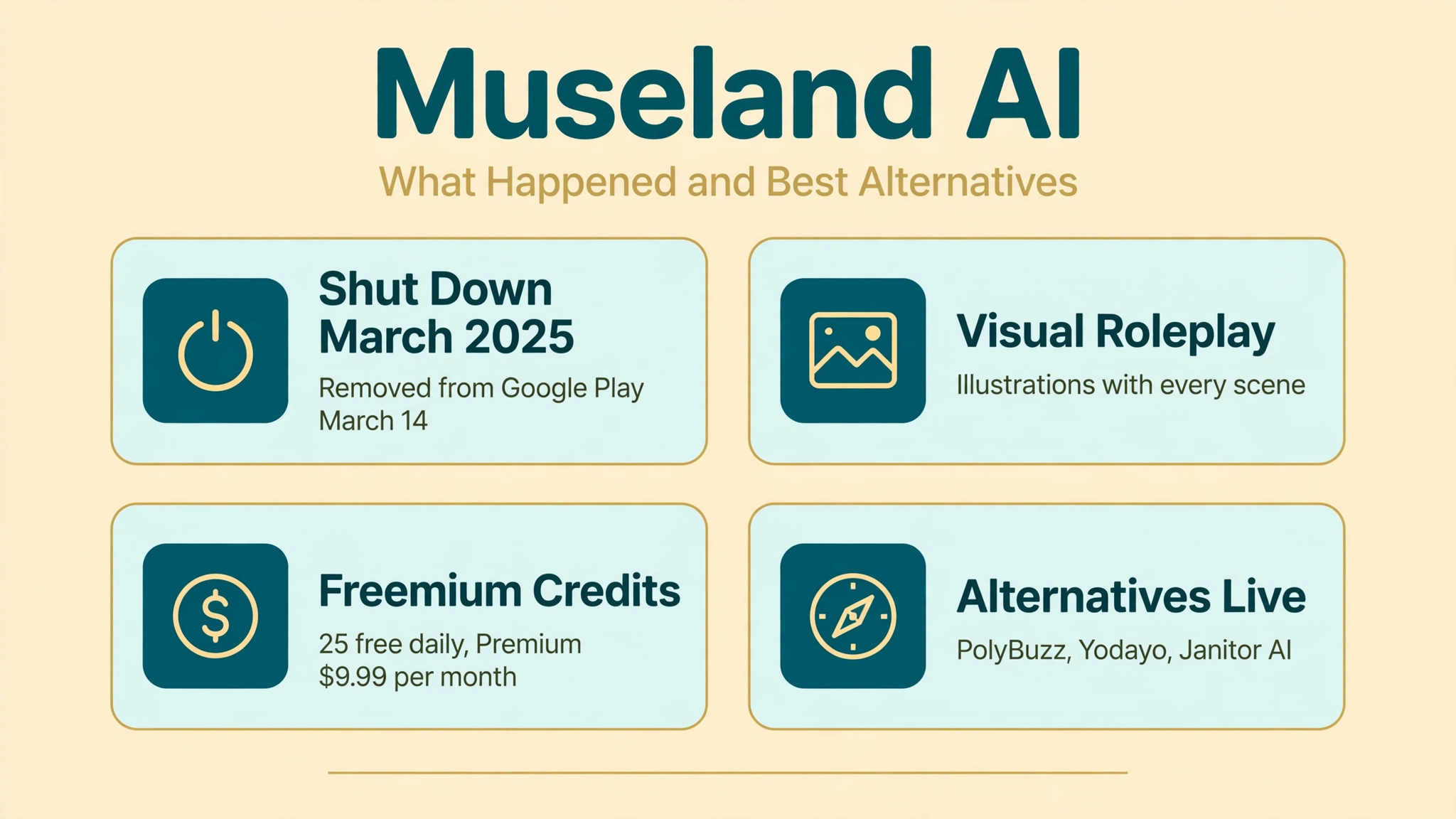
If you are searching for Museland AI in 2026, here is the direct answer: the platform shut down in March 2025 and is no longer operational. Museland AI was an AI character chat and interactive storytelling app, listed as “Museland AI – AI Character Chat” by developer ZULUTION INTELLIGENCE PTE. LTD., famous for pairing roleplay dialogue with AI-generated illustrations in every scene. It was removed from Google Play on March 14, 2025, and the servers went dark the same month.
We researched what happened by reviewing shutdown timelines, app store records, and community retrospectives. The closure was attributed to financial and operational constraints: generating images and animations for every reply carried massive compute costs that the freemium credit model could not sustain. There is no verified way to recover old chats, and unofficial APKs claiming to revive the app are unsafe.
In this guide, we document what Museland AI was, why it closed, what it cost while it lived, and, most usefully, where its community went. If you loved its visual storytelling style, the alternatives below will feel like home.
Quick Answer
Museland AI was an AI roleplay platform that combined character chat with comic-style AI illustrations generated alongside each reply. It offered custom character creation, emotional voice lines, community-shared characters and scenes, and millions of pre-made roleplay episodes across fantasy, romance, adventure, and crime genres. It ran on a freemium credit system (25 free daily credits; Premium around $9.99 per month) before shutting down in March 2025 for financial and operational reasons. It cannot be revived with an APK, and old chats are not recoverable. A detailed Museland AI shutdown review confirms the timeline and the credit-system controversies that marked its final year.
What Was Museland AI?
Museland AI was a character-chat and interactive-storytelling app that stood out in a crowded field by making visuals a first-class citizen. Where most AI chatbots were text in a blank window, Museland attached an AI-generated illustration to the ongoing scene, so every exchange felt like a panel in a living comic. Characters responded based on defined personality traits, backstory, and mood, and the art shifted with the dialogue.
The platform served several audiences at once. Creative writers used it as a brainstorming companion for dialogue and plot ideas. Roleplay enthusiasts explored immersive fictional scenarios across genres. Fans of popular franchises found characters inspired by well-known worlds. And people seeking interactive companionship got emotional, personalized conversations with memory that carried across sessions, enabling long-term story arcs and relationship building.
It was available on iOS, Android, and web browsers, so users could start a story on a phone and continue on a tablet. At its peak, the community was vibrant: players uploaded characters and scenes for others to remix, creating a lively ecosystem of artists and storytellers. For many users, it was less a utility and more a creative partner.
How Did Museland AI Work?
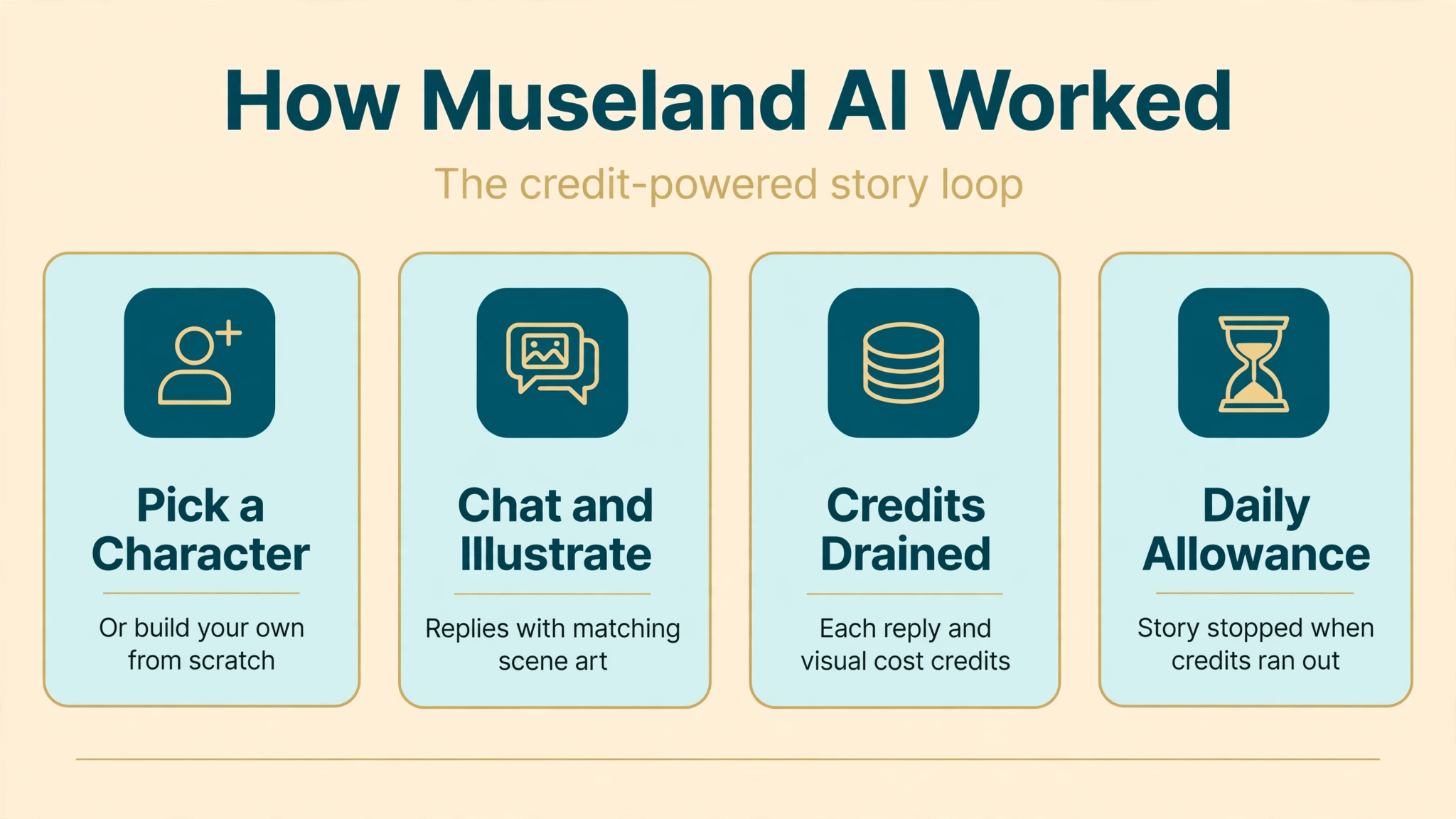
The core loop was simple. You chose a character or scenario, or built your own from scratch, defining appearance, backstory, personality traits, and even voice. Then you chatted. The AI generated replies shaped by the character definition and conversation history, while a parallel image model produced illustrations matched to each scene’s mood and content.
Every message cost credits, and visuals burned them fastest. A text reply sipped credits while an illustrated scene or voice-enabled exchange gulped them, which became the platform’s most controversial design decision. Free users received a small daily allowance, and when credits ran out mid-story, the session simply stopped until more credits arrived or were purchased.
Behind the scenes, the app combined natural language processing, large language models, generative image capabilities, and personality-driven response models. That full-stack approach is exactly what made each session feel alive, and exactly what made the service so expensive to operate.
Key Features of Museland AI
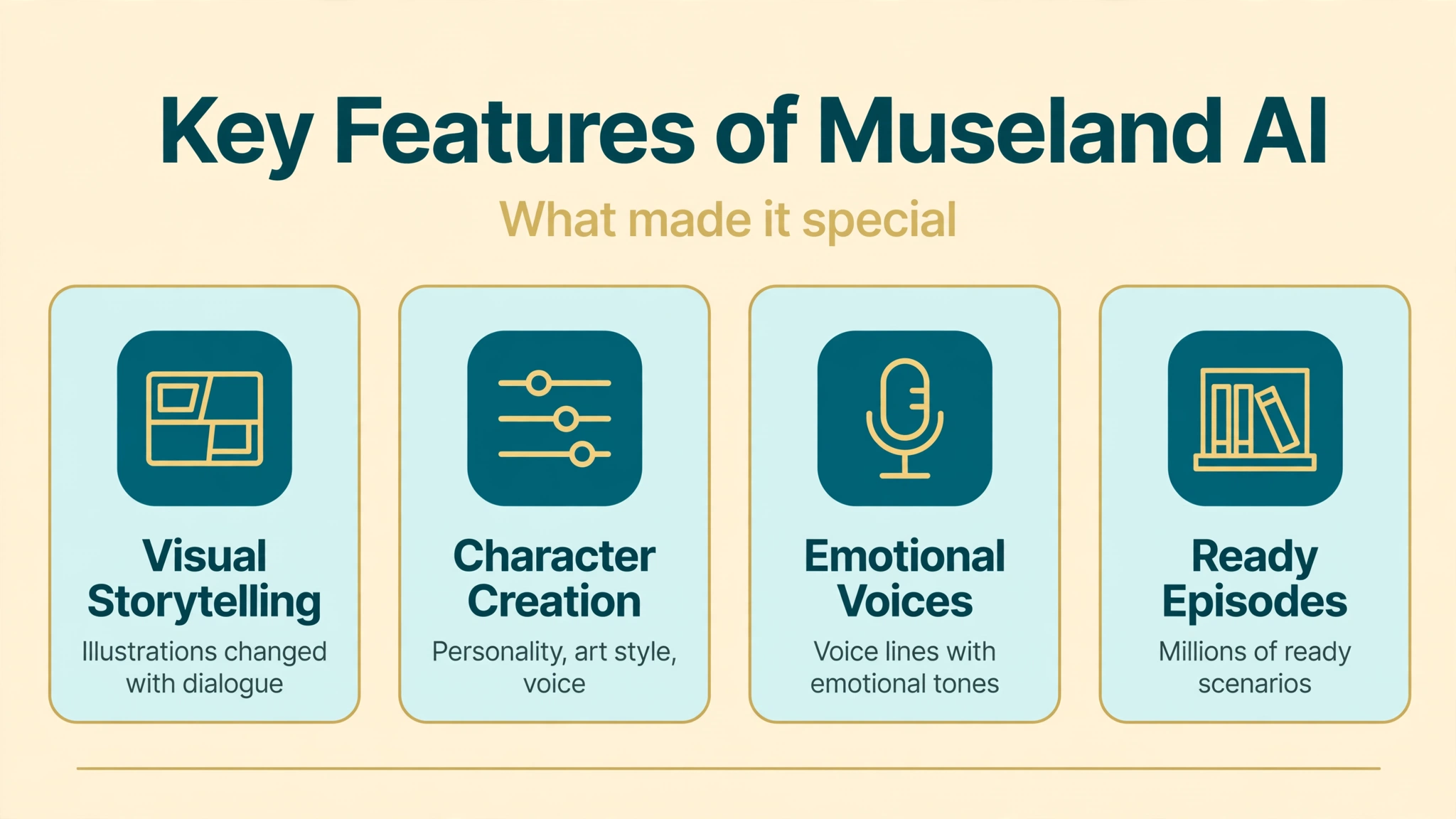
- Visual storytelling: Every reply could include AI-generated illustrations that changed with mood and dialogue, the platform’s signature feature.
- Character creation: Design characters from scratch, including personality, art style, backstory, and voice.
- Emotional voices: Select characters responded with voice lines and emotional tones.
- Community sharing: Upload characters and scenes for others to use, remix, and build upon.
- Pre-made episodes: Millions of ready-to-play roleplay scenarios across fantasy, romance, adventure, and crime.
- Cross-session memory: The AI remembered past chats, enabling long-term story arcs and evolving relationships.
- Cross-platform access: Native iOS and Android apps plus a web version with synced progress.
- Genre breadth: From love stories to fantasy adventures to crime mysteries, with franchise-inspired characters for fandoms.
Was Museland AI Free?
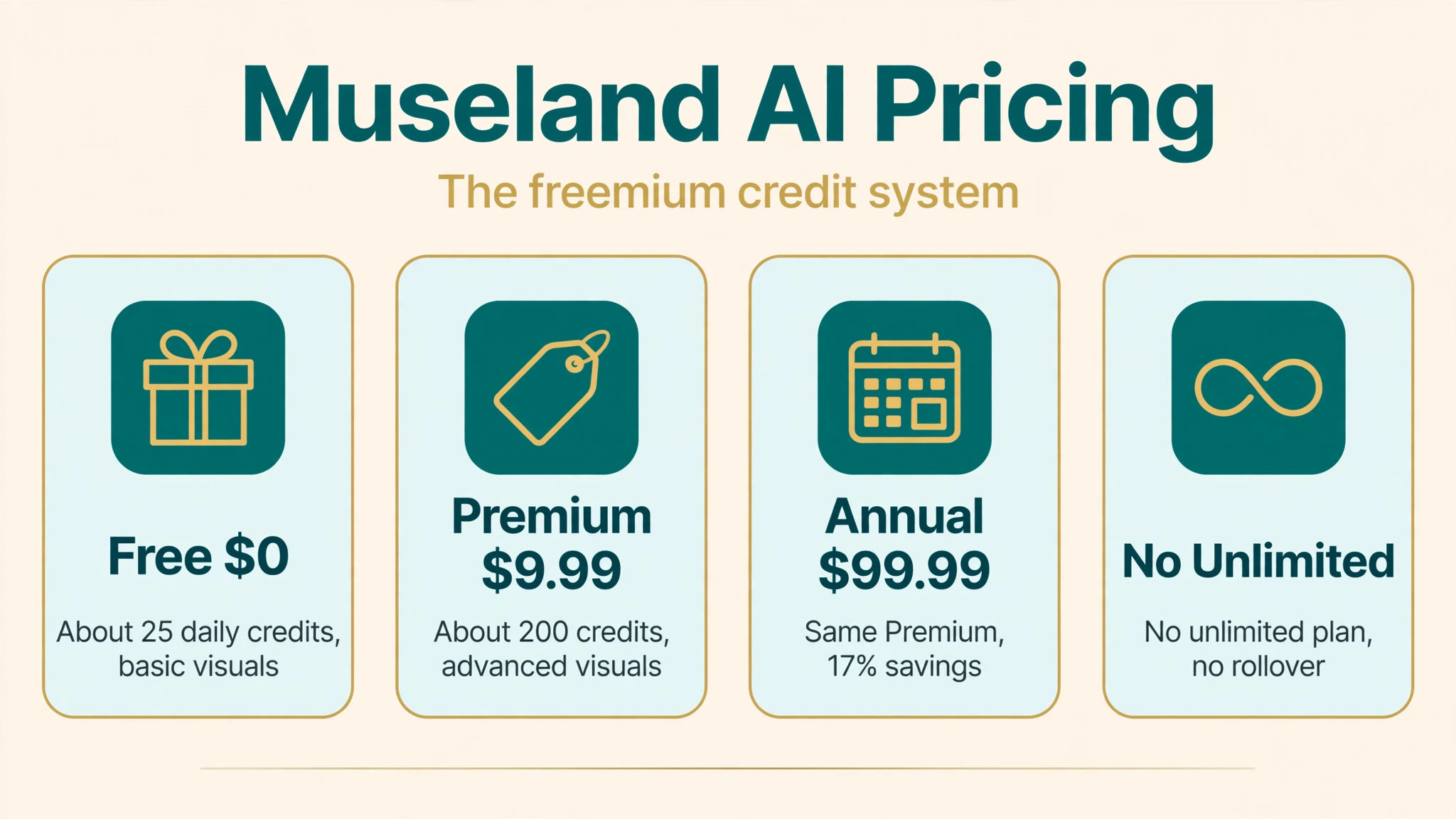
Museland AI ran on a freemium credit system. Free users received a daily credit allowance, reported between 25 and a few thousand credits depending on account type and era. Each AI reply or visual scene consumed credits, with multimedia interactions draining the balance far faster than plain text. For casual 15 to 20 minute sessions, the free allowance sufficed; for serious long-form storytelling, it ran out quickly.
- Free plan ($0): Daily credit allowance (commonly 25 credits), basic visuals, limited memory. Enough for short chats and creative bursts.
- Premium (~$9.99 per month): Around 200 credits per month, advanced visuals, better voice quality, and the ability to download characters and scenes.
- Annual plan (~$99.99 per year): Same Premium benefits with roughly 17 percent savings versus monthly billing.
The credit model earned Museland its “cheater” reputation among power users, who felt it put a paywall on imagination by cutting stories off mid-scene. Suggested fixes like credit rollovers or a flat unlimited plan were never implemented before the shutdown, and the frustration contributed to user churn in its final year.
Why Did Museland AI Shut Down?
Museland’s beauty was also its downfall. Generating an illustration for every scene meant enormous GPU costs on top of standard language-model inference. The freemium credit model attracted users but could not cover server bills, compute time, and licensing fees. According to community reports, a Reddit post confirmed the shutdown was due to “financial and operational constraints.”
The closure followed a familiar pattern in the AI roleplay market. High compute costs drain small studios fast, freemium models convert too few users to paid plans, and dependence on third-party AI models creates fragile systems when partnerships change. Several creative AI platforms collapsed under similar pressures around the same period, in what many now call the AI correction of 2025.
The shutdown was abrupt. Users trying to log in found servers offline, and community threads turned into digital memorials with screenshots of favorite characters and fan art. Petitions for a revival went nowhere. An in-app notice had framed it as a temporary infrastructure upgrade, but as months passed with no return, the community accepted the closure as permanent.
There is a wider lesson here for anyone invested in niche AI platforms. When a service’s core value depends on expensive real-time generation, its survival hinges on converting free users to paid plans faster than server bills grow. Museland never solved that equation, and users who had poured months into characters and communities learned the importance of data portability the hard way. For a deeper account of the final months, this Museland AI retrospective documents the timeline, the final app version, and the APK safety warnings.
Is It Safe to Download Museland APKs Now?
No. With the official service offline, any “Museland AI” APK or app you find today is unofficial by definition, and security reviewers consistently warn that such files are common malware vectors. Even a byte-perfect copy of the final legitimate build (version 3.42.0) would be useless, because the AI backend it talked to no longer exists. There is no interactive content to restore.
The risks are concrete: credential harvesting through fake login screens, adware and spyware bundled into repackaged installers, and phishing sites that mimic the old Museland branding to steal payment details. If you have already installed one, uninstall it, run a reputable mobile security scan, and change any passwords you entered.
The same caution applies to websites claiming “Museland AI free” or “unlocked” access. They cannot deliver what they promise, because there is nothing left to unlock. Treat the name as retired and put your energy into a living alternative instead.
Museland AI Pros and Cons
Pros
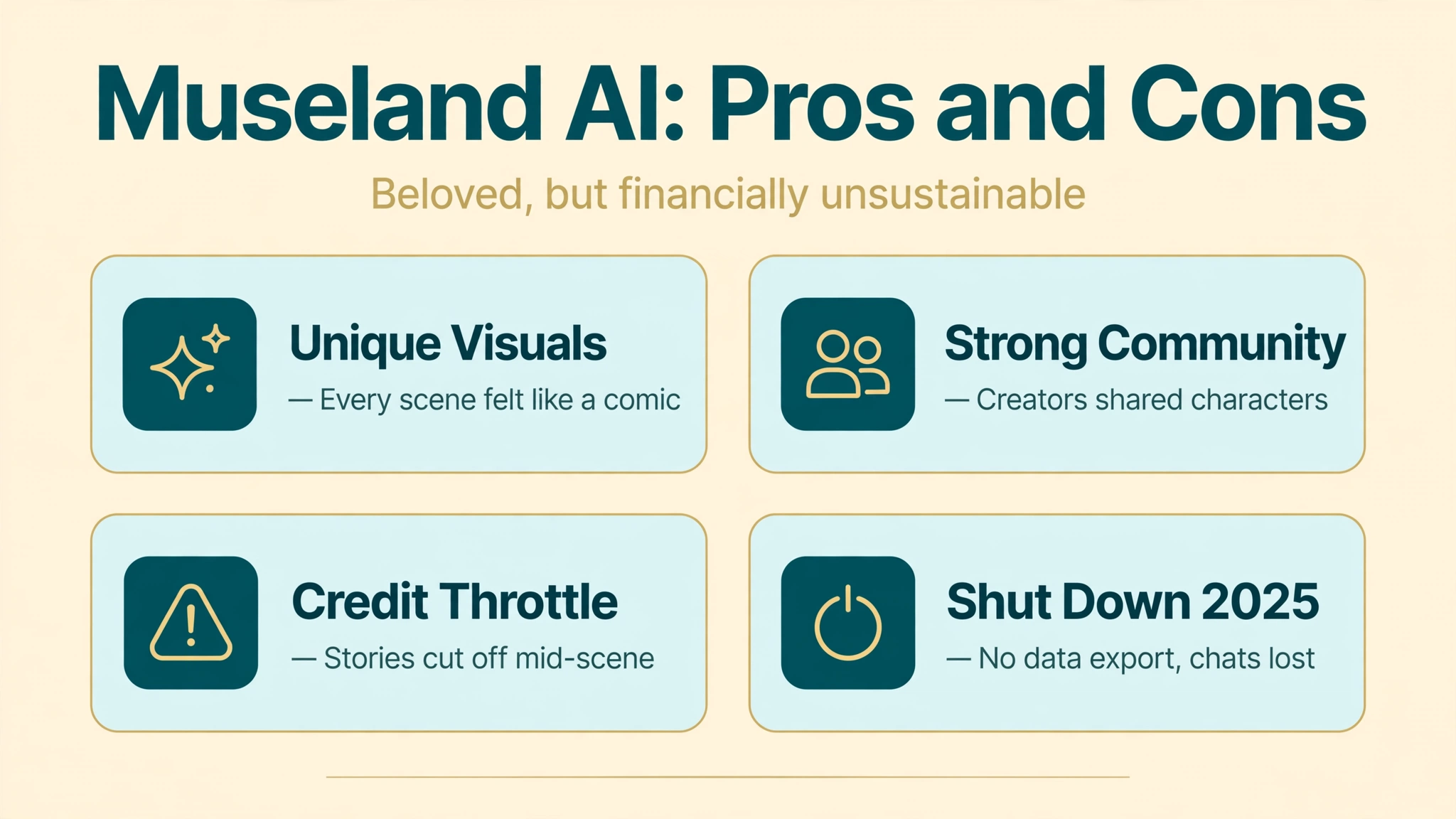
- Unique visual storytelling: illustrations with every scene made roleplay feel alive.
- Deep character customization, from art style to voice to personality.
- Strong community of creators sharing characters and episodes.
- Cross-platform sync across iOS, Android, and web.
- Enormous library of pre-made scenarios across many genres.
Cons
- Credit system throttled long sessions and earned a “cheater” reputation.
- Visuals drained credits far faster than text, punishing the signature feature.
- No unlimited plan and no credit rollover, despite years of user requests.
- Financially unsustainable, leading to the abrupt March 2025 shutdown.
- No data export: users lost characters, chats, and communities overnight.
Museland AI vs Alternatives
What made Museland special was the combination of roleplay and generated visuals in one flow. Most alternatives nail one half of that equation. PolyBuzz AI comes closest on the visual side, pairing a huge character library with voice conversations and AI image generation. Our PolyBuzz AI Review: Features, Pricing & Safety covers its visual features in detail.
Janitor AI beats Museland on conversation depth and memory, with 2.5 million-plus characters and long-context roleplay, but it is text-first without Museland’s automatic scene illustrations. For writers who cared more about the words than the pictures, it is arguably an upgrade. See our Janitor AI: Free Character Chatbot? Full Guide for the full picture.
Character.AI offers the most sustainable long-term home, with a massive user base and unlimited messaging, but it lacks both Museland’s visual storytelling and its creative permissiveness. Yodayo deserves a special mention for anime-style art generation that echoes Museland’s aesthetic, making it the natural next stop for fans of the art-first vibe.
Best Museland AI Alternatives
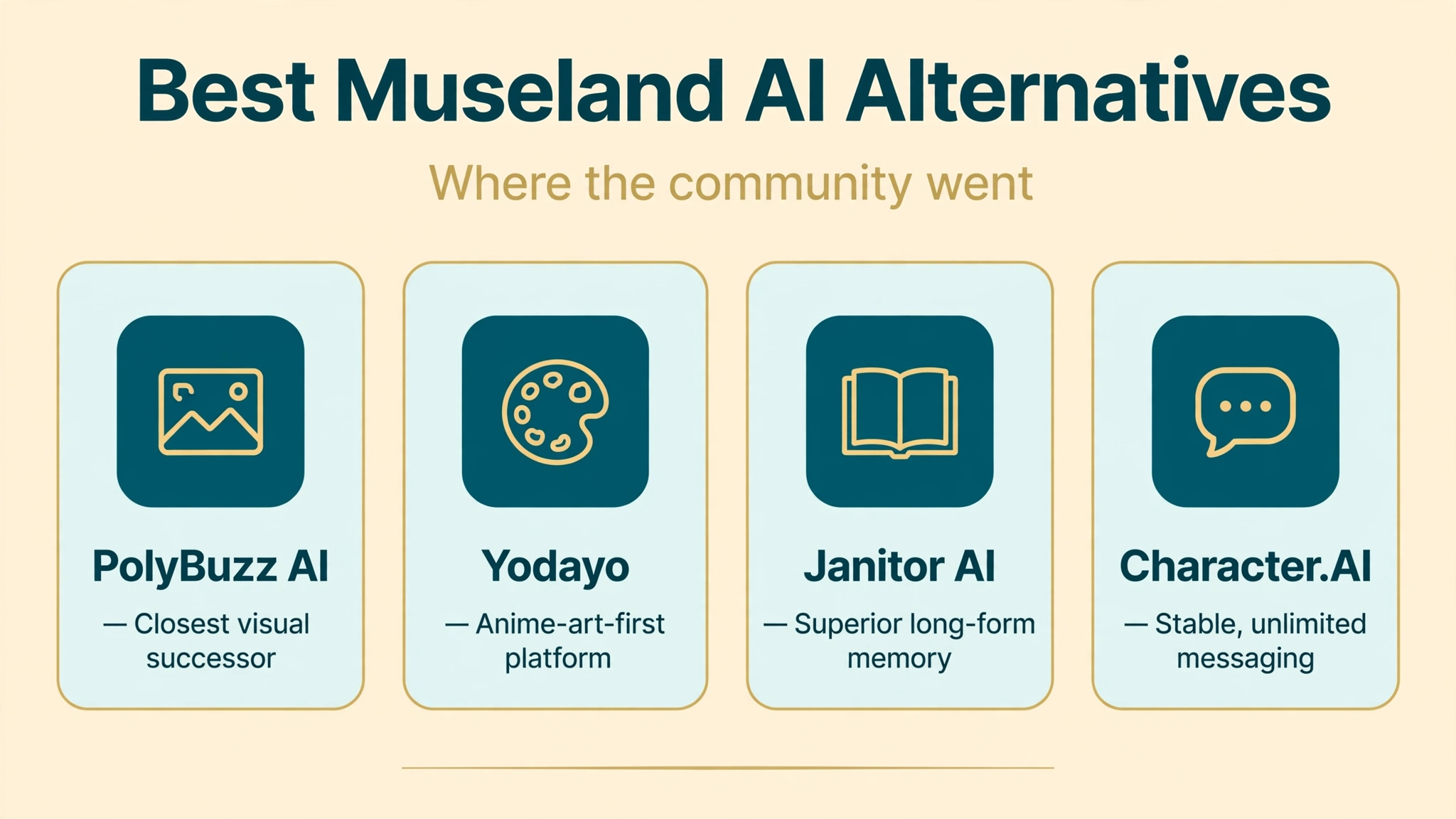
PolyBuzz AI. The closest visual-storytelling successor, with 20 million-plus characters, voice chat, and AI image generation. Best for users who miss Museland’s multimedia feel.
Yodayo. An anime-art-first AI platform with image generation at its core. Best for fans of Museland’s expressive, illustrated aesthetic.
Janitor AI. Superior memory and consistency for long roleplays, with a huge community character library. Best for story-first users. Our Chub AI Guide: Character Cards, Models & Pricing covers a related power-user platform in the same orbit.
Character.AI. The largest character chat platform with unlimited free messaging. Best for a stable, long-term home, though filtered and text-focused.
Talkie AI and Joyland AI. Lively, mobile-friendly roleplay apps with strong communities. Best for casual, on-the-go storytelling.
Who Should Read This Guide?
This guide is for former Museland users trying to understand what happened to their app, and for anyone who keeps finding the name recommended in old threads and wonders whether it is worth downloading. If you lost characters or stories in the shutdown, the sections on chat recovery and APK safety give you the definitive answers.
It is also for visual-storytelling fans hunting for a true successor. No single app replicates Museland exactly, but the alternatives above cover its different strengths, so match the recommendation to what you loved most: the art, the writing, or the community. Writers may lean toward Janitor AI for its memory, artists toward Yodayo or PolyBuzz for their visuals, and casual roleplayers toward Character.AI for its stability.
Can You Get Your Museland Chats Back?
Unfortunately, no. There is no verified public recovery route for Museland chats or characters. Retrospectives report that no export button was offered before access ended, and with the servers decommissioned, there is nowhere left to recover data from. Anyone claiming to restore your old Museland account is running a scam.
What you can do is preserve what you still have: screenshots of favorite scenes, copied character definitions, and any local backups or downloaded content from when the app worked. Rebuild your best characters on a new platform using those notes; personality descriptions and example dialogue transfer well. And take the broader lesson with you: on any AI platform, periodically export or screenshot work you care about, because niche apps can vanish with no warning.
FAQs
What was Museland AI?
Museland AI was an AI character chat and interactive storytelling app, listed as “Museland AI – AI Character Chat” by ZULUTION INTELLIGENCE PTE. LTD. It paired roleplay dialogue with AI-generated illustrations, offered deep character customization, and hosted millions of pre-made episodes across genres like fantasy, romance, adventure, and crime.
Why did Museland AI shut down?
It shut down in March 2025, reportedly due to financial and operational constraints. Generating images for every scene carried huge compute costs that the freemium credit model could not sustain. It was removed from Google Play on March 14, 2025.
Is Museland AI still working in 2026?
No. The servers are offline and the apps were delisted. Any site or APK claiming to offer working Museland AI is unofficial and unsafe, and cannot restore the original service.
Can I download a Museland AI APK safely?
No. Unofficial APKs are common malware vectors, and even a genuine old build cannot function without the retired backend. Do not install them, and do not enter credentials into clone sites.
What is the best Museland AI alternative?
PolyBuzz AI best replicates the visual storytelling approach, Yodayo matches the anime-art aesthetic, and Janitor AI offers superior memory for long roleplays. Character.AI is the most stable long-term option with unlimited free messaging. The right pick depends on which half of Museland you valued more: if it was the illustrations, start with PolyBuzz or Yodayo; if it was the writing, start with Janitor AI.
Conclusion
Museland AI deserved its devoted following, and its closure still stings for the community it built. It proved that AI roleplay could be visual, emotional, and genuinely co-creative, not just text in a box. But its signature feature was also its fatal flaw: illustrating every scene cost more than its business model could bear, and when the money ran out, the lights went off with no way for users to take their creations with them.
If you are mourning it, the healthiest move is to pick the successor that matches what you loved and rebuild there, this time keeping your own backups. The visual AI storytelling Museland pioneered did not die with it; it scattered across a new generation of platforms that learned, sometimes the hard way, what sustainability actually requires.
Discover More: