Your best friend beats you at a game by one point. Or eats the last slice of pizza you were saving. You look at your phone, and there it is: “ihy.” Your stomach drops for half a second. Then you laugh, because you know exactly what it means.
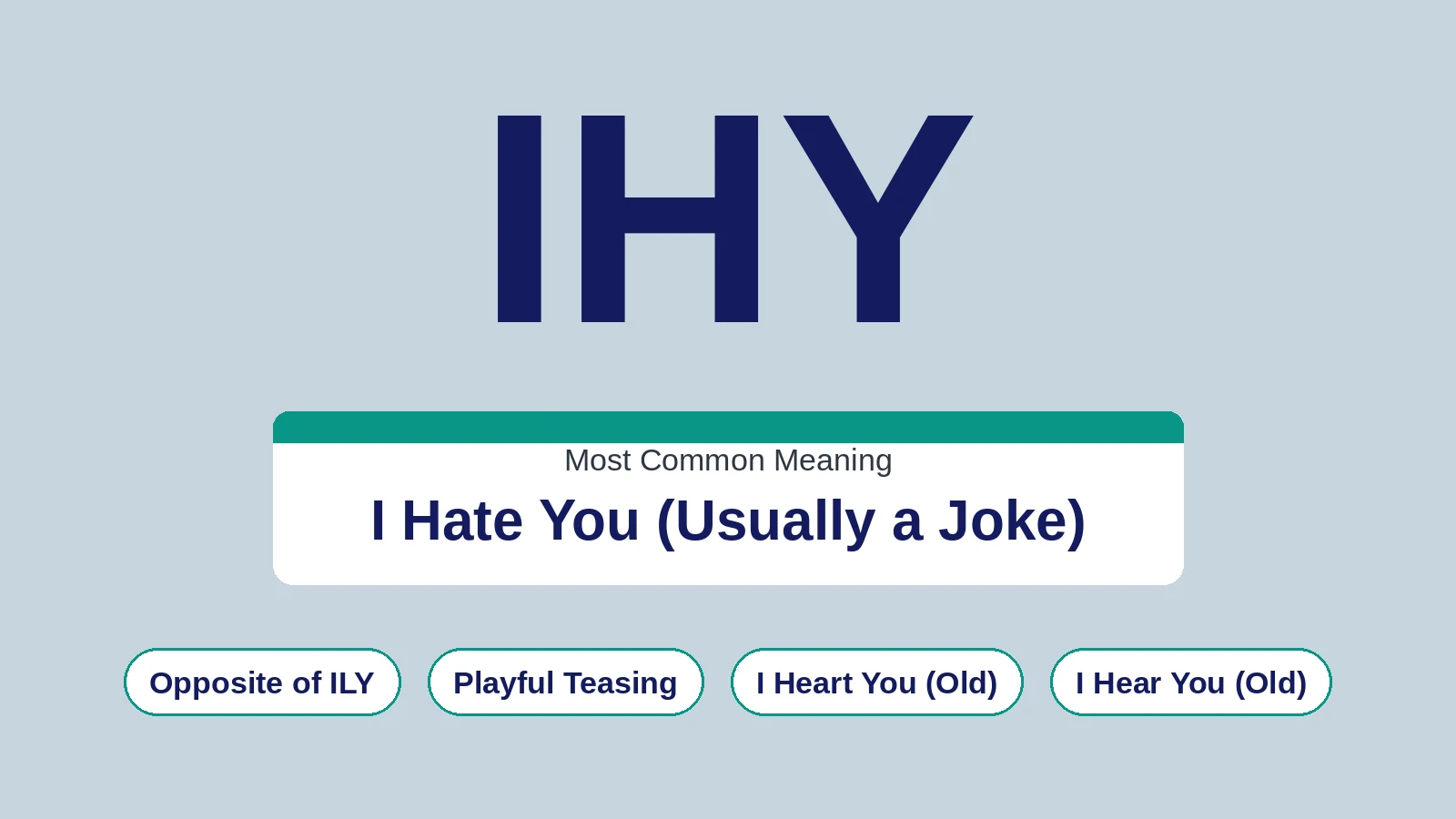
IHY means “I hate you.” That sounds harsh, and the words are harsh. But in real chats, IHY is almost never serious. It is a dramatic, playful jab that friends send when someone does something mildly annoying, lucky, or funny. Think of it as fake anger with a smile behind it.
This guide is based on how IHY is actually used in texts and comments today. Every meaning below was checked against real usage and documented slang references like Dictionary.com. You will find the tone clues, the older meanings, real examples, and replies you can copy. By the end, you will never misread an “ihy” again.
IHY Meaning in Text at a Glance
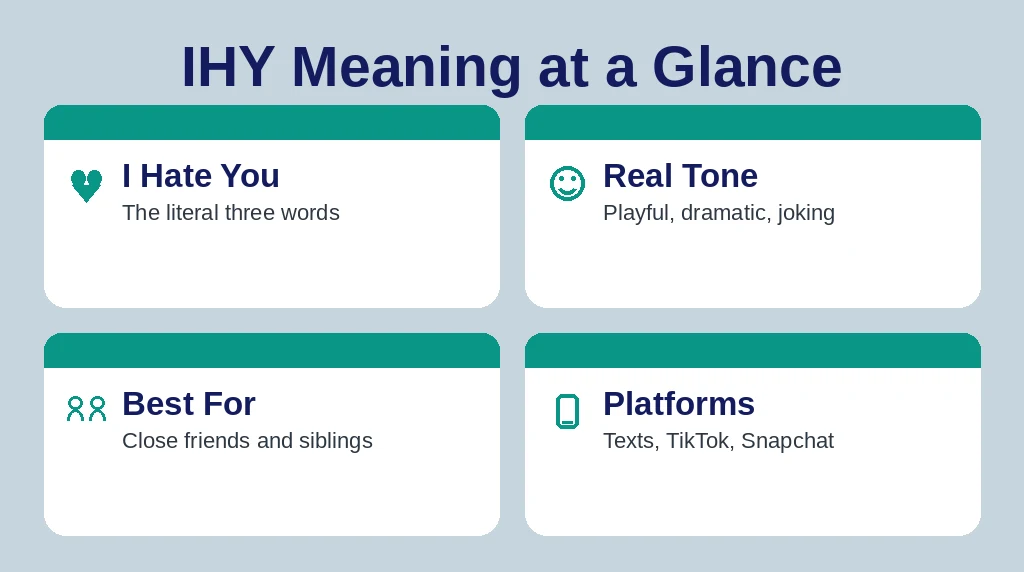
Short on time? Here is the fast version. IHY stands for “I hate you,” and in modern texting it works as an exaggerated joke far more often than a real insult. Friends fire it off after a lost game, a stolen snack, a spoiler, or a truly terrible pun. It is informal slang for close relationships only, so it never belongs in serious or professional messages.
| Detail | Explanation |
|---|---|
| Most Common Meaning | I hate you (almost always said as a joke) |
| Full Form | I hate you (an initialism, spelled out letter by letter) |
| Tone | Playful, dramatic, sarcastic, mock-annoyed |
| Common Platforms | Text messages, Snapchat, TikTok, Instagram, Discord |
| Formal or Informal | Informal only, close friends and family |
What IHY Really Means in a Text
IHY is hyperbole in three letters. The sender is not confessing real hatred. They are turning a tiny frustration into a big dramatic statement, because the exaggeration is the joke. When a friend texts “ihy” after you send an embarrassing photo of them, the real message is “I cannot believe you did that,” delivered with a grin.
That is why IHY shows up right after small, funny “betrayals.” You won the game you both know was luck. You finished the fries you were supposed to share. You spoiled the ending of a show, beat their high score, or told a joke so bad it hurt. A plain “that is annoying” would be forgettable. IHY makes it a moment.
IHY was built as the mirror image of ILY, which means “I love you.” The two abbreviations look almost identical, and that tiny difference powers the humor. Swapping love for hate, for one dramatic second, is a classic friend-group move. Many people even send the pair together, “ihy but ily,” when they want the teasing and the affection in the same breath.
You will usually see it in lowercase, “ihy,” often standing alone as its own message. It can also appear as IH8U or IHU, which say the same words with different spelling. The standalone style matters: IHY usually works as a complete reaction, not as part of a longer sentence. It lands, the other person laughs, and the chat moves on.
Once in a while, IHY is genuinely serious. A real “I hate you” does exist, and the tone section below shows you exactly how to spot the difference. The short rule is simple: in a friendly chat with no real conflict behind it, read IHY as a joke first.
Other Meanings of IHY You Might See
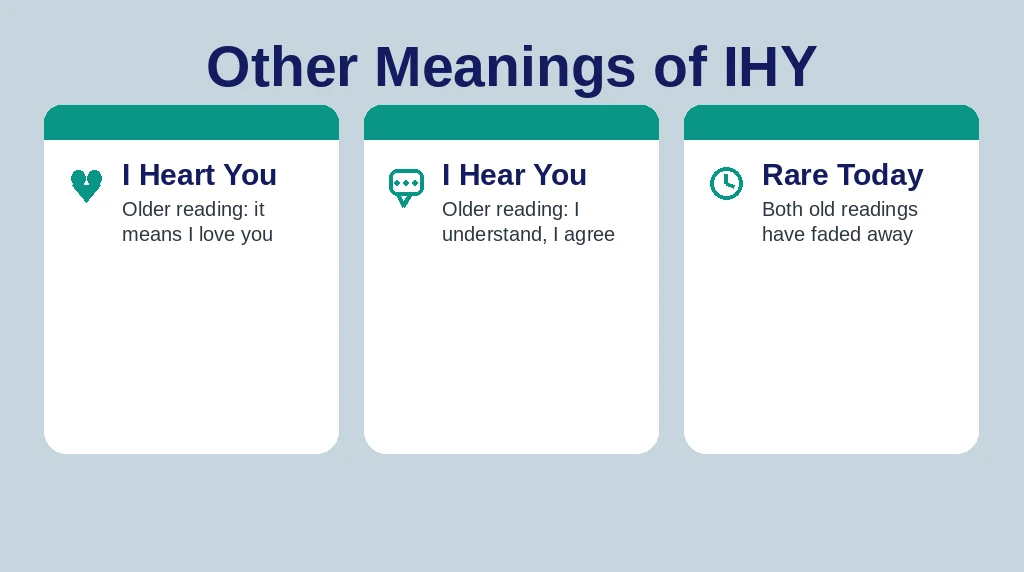
IHY has two older readings, and both come from the early chat era. Slang references note that alongside “I hate you,” IHY sometimes stood for “I heart you” and “I hear you” around the mid-2000s. Both readings faded as “I hate you” took over, so you will rarely meet them today, but they explain some older posts and screenshots.
| Meaning | Context | Tone | Example |
|---|---|---|---|
| I Heart You | Older chat slang, mid-2000s | Affectionate, means I love you | “You got me tickets? ihy!” |
| I Hear You | Older chat slang, mid-2000s | Understanding, agreement | “Work has been brutal. ihy, same here.” |
If you spot IHY in a recent message, do not reach for these older meanings first. “I hate you,” said as a joke, is the default reading now. The heart and hear readings only make sense in older conversations, or when the surrounding words are purely warm or purely understanding, with no teasing anywhere in sight.
How Context Changes the Meaning
Four quick signals tell you which IHY you are looking at. First, check what happened just before it. A lost game, a bad pun, or a lucky win points to the joke. A real argument points the other way. Second, look at the sender. Close friends and siblings use IHY as a love language. A near stranger almost never does. Third, read the emojis and punctuation, because 😭, 😂, and exclamation marks soften it, while a flat period can sharpen it. Fourth, watch what comes next. If the chat carries on like normal, it was a joke.
Watch how the same three letters shift across these short exchanges:
- “You ate my fries. ihy 😭” is pure theater. The sender wants their fries mourned, not a fight.
- “ihy, how did you beat my score AGAIN” is mock outrage mixed with genuine respect for the win.
- “Do not talk to me. ihy.” after a serious betrayal is the rare literal version, and it reads cold.
- “ihysm for that jump scare” stretches the joke even further: I hate you so much, said while laughing.
IHY on TikTok, Snapchat, and in Regular Texts
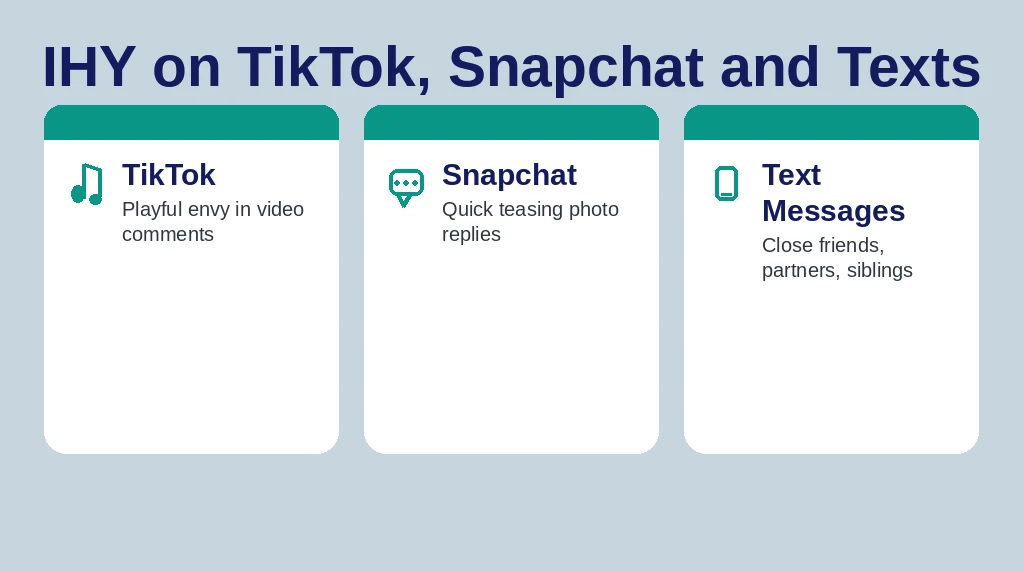
On TikTok and Instagram, IHY shows up in comments under videos that trigger playful envy or frustration. Someone posts a perfect vacation, a flawless dance, or a prank that lands too well, and the replies fill with “ihy” from fans who mean it as a compliment in disguise. Creators read it as engagement gold, because nobody types “ihy” under a video they did not care about.
Snapchat and regular text messages are where IHY lives most naturally. Streaks, quick photo replies, and running jokes give it the shared context it needs. Between partners, close friends, and siblings, a bare “ihy” after a teasing photo is often closer to “I love you” than to any real complaint. The closer the relationship, the safer and funnier the joke lands.
Real Conversation Examples
Person A: “I just beat your high score by two points”
Person B: “ihy 😭 that score took me all weekend”
Meaning: Person B is joking. The tiny loss feels huge for one dramatic second, and the crying emoji confirms it is play, not anger.
Person A: “Guess who got the last concert ticket”
Person B: “ihy. I have been refreshing that page for an hour”
Meaning: Person B is playfully jealous. The “hate” is aimed at the situation and the luck, not at Person A, and the chat stays friendly.
Person A: “I told your brother about the surprise party, sorry”
Person B: “ihy, you had ONE job”
Meaning: Person B is mock-scolding a real mistake. It is annoyed, but the exaggerated style keeps it in teasing territory between close friends.
Is IHY Serious or Just a Joke?
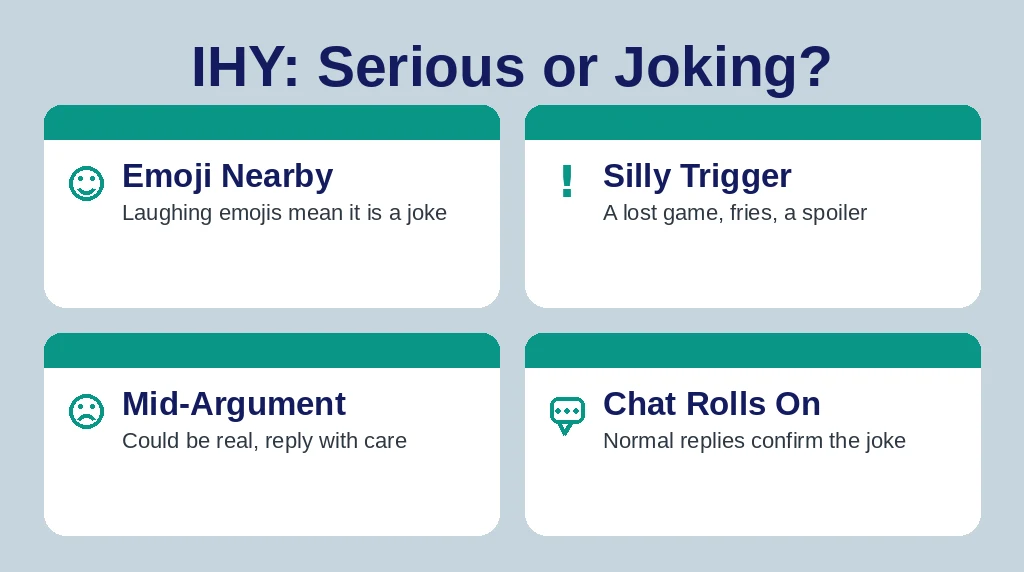
This is the question that matters most, because the words alone look so harsh. The honest answer: IHY is a joke the large majority of the time. Dictionary references describe it as typically used with irony, and everyday usage backs that up. Real hatred usually arrives in full sentences, not in a three-letter abbreviation borrowed from chat slang.
Playful IHY has clear fingerprints. It follows a small, silly trigger. It often travels with emojis like 😭, 😂, 😤, or 💀. It gets an instant, relaxed reply, and the conversation continues like nothing happened. The sender may even follow it with “jk” or a compliment, because the whole point was the dramatic pause, not an actual wound.
Serious IHY looks different. It appears in the middle of a real conflict, after hurtful news or a genuine betrayal. There are no softening emojis. The messages around it are cold, short, or suddenly silent. If IHY arrives with a period, after an argument, from someone who has gone quiet, treat it as real and respond with care instead of a joke.
Your relationship is the tiebreaker. Between best friends who roast each other daily, IHY is basically punctuation. From someone you barely know, or someone already upset with you, the same three letters carry real weight. When you truly cannot tell, the next section gives you a safe way to ask.
How to Reply When Someone Sends IHY
The best reply matches the sender’s energy. Fire a playful comeback at the joke version, go sweet when it is clearly affectionate teasing, and check in gently when the tone feels off.
Playful Comebacks
- “ihyt 😭” (I hate you too) to keep the joke bouncing
- “you love me, stop lying”
- “fair. I would hate me too after that win”
- “add it to the list, it is getting long”
Sweet and Affectionate Replies
- “ily too, drama queen”
- “hate you more 💛” when the teasing is mutual
- “sorry not sorry, but I got you snacks” to close the joke warmly
Replies When You Are Unsure
- “wait, joke ihy or serious ihy?”
- “are we good? that one felt real”
- “ihy as in fries-level or actual problem level?”
When to Use IHY
IHY fits chats with close friends, siblings, and partners who already tease each other. It works after small, funny frustrations: a lost bet, a stolen bite of food, a spoiler, a lucky win, or a joke so bad it deserves punishment. It also works as mock jealousy under a friend’s good news, where “ihy” really means “I am happy for you and slightly furious it is not me.” Use it when the relationship is strong enough that nobody will read it literally.
When to Avoid IHY
Skip IHY with coworkers, teachers, clients, and anyone you do not know well, because the joke depends on shared history you do not have yet. Avoid it during real arguments, bad news, or apologies, where it can confirm the worst reading instead of landing as humor. Never send it to someone who is already upset with you, and never use it in writing that could be screenshotted without context. If the words “I hate you” would hurt in full, the abbreviation will hurt too.
Common Mistakes People Make With IHY
Taking it literally and panicking. Most first-time readers see “I hate you” and assume a friendship just ended. In a friendly chat, it almost never means that. Check the trigger, the emojis, and the sender before you worry, because the joke reading is the default.
Confusing IHY with ILY. The two abbreviations differ by one letter and mean opposite things. Sending “ihy” when you meant “ily” turns a sweet message into a dramatic insult. Read your text once before sending, especially in warm moments.
Using it with the wrong audience. IHY only works where teasing is already the local language. Sent to a new friend, a coworker, or a relative who takes words at face value, it reads as genuine rudeness and can start the exact conflict you meant to joke about.
Slang That Shows Up Next to IHY
IHY belongs to a small family of love-and-hate abbreviations. Knowing the relatives helps you read whole conversations at once, especially the playful ones where love and hate trade places every other message.
| Term | Meaning | Main Difference |
|---|---|---|
| ILY | I love you | The warm original that IHY was built to mirror |
| IHU | I hate you | Same words, shorter alternate spelling |
| IH8U | I hate you | Same words, with the number 8 doing the sound work |
| IHYSM | I hate you so much | The stretched, extra-dramatic version for bigger jokes |
| IHYT | I hate you too | The standard playful reply, not a standalone opener |
Where IHY Came From
IHY grew out of early internet chat culture. According to Dictionary.com, it emerged by the mid-2000s as a deliberate opposite of ILY, the already popular short form of “I love you,” and it began appearing in online slang glossaries around 2006. That was the era of chatrooms and instant messengers, when short forms spread fast and ironic opposites were a favorite joke format.
The same references note that the softer readings, “I heart you” and “I hear you,” circulated in that period and then faded, leaving “I hate you” as the surviving meaning. No single creator is credited with IHY, and no exact first use is documented, so treat any precise birthday for it with suspicion.
Quick Recap
- In most texts, IHY means “I hate you,” sent as a dramatic joke rather than a real insult.
- It was built as the playful opposite of ILY, and the two differ by a single letter.
- Emojis, a silly trigger, and a chat that continues normally all confirm the joking reading.
- A cold context, a real argument, or a flat “ihy.” can mean it is serious, so check before joking back.
- Keep IHY for close friends who tease you back, and reply by matching the sender’s energy.
Frequently Asked Questions
What does IHY mean in text?
IHY means I hate you in texting slang, but friends almost always send it as a playful, dramatic joke.
What does IHY stand for?
IHY stands for I hate you, an initialism built as the playful opposite of ILY, which means I love you.
Is IHY rude?
IHY can sound rude to strangers or coworkers, but between close friends who tease each other it usually lands as harmless joking.
Is IHY serious or a joke?
IHY is a joke in most friendly chats, especially with emojis nearby, and only rarely a real sign of anger.
How should you reply to IHY?
Reply by matching the playful energy, sending back a joking IHYT, an emoji, or a light comeback in the same tone.
Final Thoughts
IHY looks like the harshest message a friend can send, yet it is usually one of the softest. Read it as dramatic teasing first, especially after a tiny trigger like a lost game or a stolen fry. Watch the emojis, the timing, and your history with the sender, and the real meaning shows itself almost every time. Keep your own IHYs for the people who already trade jokes with you, and the three letters will keep landing as affection instead of insult. For the documented history of the term, Dictionary.com’s IHY entry traces how it grew out of chat culture.
Related slang guides: FFS meaning in text, MYB meaning in text, and TS meaning in text.