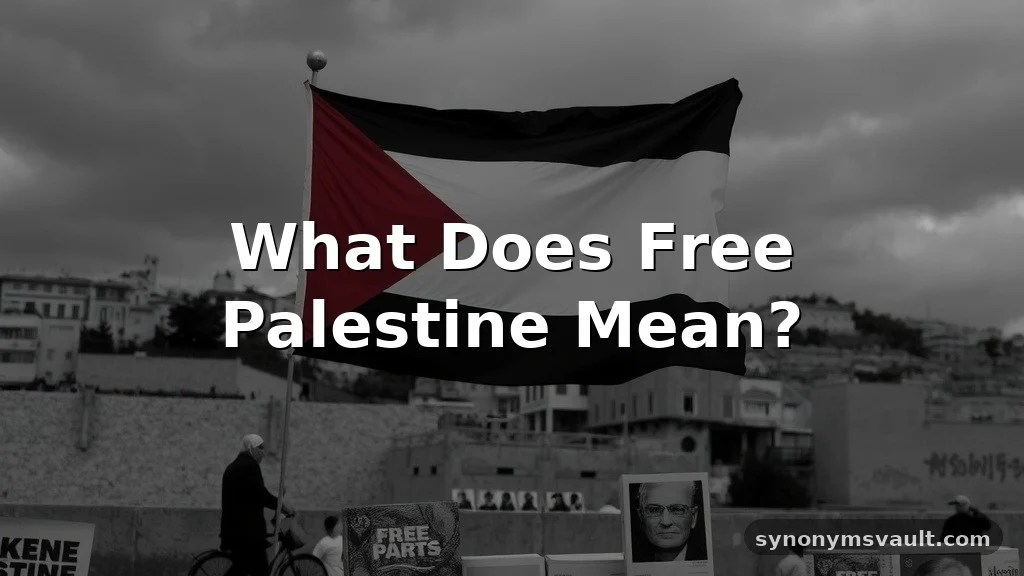
Two words. A long history. A phrase that can carry very different meanings depending on who says it and where it is used.
“Free Palestine” is widely used as a political and humanitarian slogan connected to the Israeli-Palestinian conflict. For many speakers, it expresses support for Palestinian freedom, rights, self-determination, and political sovereignty. The phrase is also used in protests, social media, public campaigns, and cultural discussions. Its meaning can vary, so the words should be understood in their historical and political context rather than treated as having one universal interpretation.
The history behind the phrase reaches back through the British Mandate, the 1947 UN partition plan, the 1948 war and Palestinian displacement, and the 1967 war and subsequent Israeli occupation of the West Bank and Gaza. The United Nations has documented these major stages in the history of the Palestine question.
In 2026, “Free Palestine” remains highly visible in global public debate, including protests and discussions involving artists, activists, and political groups.
Definition & Meaning
Free Palestine is a political slogan commonly used to express support for Palestinian freedom, rights, self-determination, independence, or sovereignty. The exact meaning can differ between speakers and movements.
In simple terms:
Free Palestine = a call for Palestinians to have freedom, rights, dignity, and self-determination.
For some people, the phrase refers specifically to Palestinian statehood and an end to Israeli occupation. Others use it more broadly as a statement of solidarity with Palestinians and opposition to restrictions, displacement, or unequal political conditions. Because the slogan is not a detailed political program, its meaning cannot always be determined from the three words alone.
The UN recognizes the Palestinian people’s right to self-determination and has documented the historical development of the Palestine question, including the 1947 partition plan, the 1948 war and displacement, and the 1967 occupation of the West Bank and Gaza.
Full Form and Meaning
Free Palestine is not an acronym, so it does not have a traditional “full form.”
The phrase simply consists of:
- Free — freedom, liberation, or the ending of political control, depending on the speaker.
- Palestine — referring to Palestine as a historical, geographic, national, or political entity.
Commonly understood meaning:
“Free Palestine” = a call for freedom and self-determination for the Palestinian people.
The phrase can carry different political meanings, so its intended message is best understood from the speaker, context, and accompanying demands rather than from the slogan alone.
Defining the Core Meaning
At its simplest level, the slogan is a call for the liberation of the Palestinian people. When someone says this, they are generally expressing a desire for Palestinians to live with self-determination, human rights, and freedom from military control. It is an expression of solidarity with a group of people who have lived through decades of conflict and displacement.
To understand the phrase, you have to look at the geography and the history of the region. The territory involves the West Bank, the Gaza Strip, and historical areas that are now part of modern Israel. The call for freedom often refers to the end of the occupation of these territories.
It is not just one thing to everyone. For some, it means the creation of a sovereign state. For others, it focuses on the right of return for refugees who were displaced during past conflicts.
Think of it as a broad umbrella term. You might see it on a poster at a peaceful march in London or as a trending topic on X. In these spaces, it acts as a shorthand for a complex set of demands.
It is a way to signal that the speaker believes the current conditions for Palestinians are unjust and that a fundamental change is required. It is not a request for a minor policy tweak but a demand for systemic change that recognizes the dignity and rights of all people living in the region.
Historical Context and Evolution
The roots of this phrase go back to the mid-20th century, specifically following the events of 1948. This period is known by many as the Nakba, or the catastrophe, which resulted in the displacement of hundreds of thousands of people. Over the decades, the language used to describe the situation has evolved.
In the early years, the focus was often on armed struggle and pan-Arab nationalism. As the decades passed, the focus shifted toward international law, human rights, and the concept of statehood.
The term gained significant momentum during the late 1980s with the first Intifada, a mass uprising against Israeli control. During this time, the global community began to take more interest in the plight of the people living in the West Bank and Gaza.
The slogan became a way to bridge the gap between local resistance and international awareness. It allowed people across the globe to identify with the struggle even if they were thousands of miles away from the conflict.
Today, the movement has become global. It is no longer confined to the Middle East. It has been adopted by various human rights organizations and grassroots groups worldwide.
The evolution of the term reflects the changing nature of communication. In the past, you would need to read a newspaper or listen to a radio broadcast to understand the context. Now, with social media, the phrase travels instantly, often accompanied by images or personal stories that make the historical abstract feel very real and immediate.
Usage Across Modern Platforms
In the digital age, the phrase appears everywhere. If you are scrolling through TikTok or Instagram, you will see it used as a hashtag to categorize content related to the conflict.
It serves as a digital marker that tells the algorithm and other users exactly what a post is about. It helps people find others who share their views.
In gaming communities, you might see it in player names or clan descriptions. This can sometimes lead to heated debates in text chats, where players from different backgrounds clash over their political beliefs. In these high-tension environments, the phrase is often used as a statement of identity.
Consider this dialogue between two friends:
“I saw you shared that post about the protests. What do you think it really achieves?”
“I think it brings attention to the humanitarian crisis. When I post, I am just showing that I care about the rights of the people suffering there.”
“I see.
It just feels like a very heavy topic for a social media feed.”
“It is, but that is the point. If we don’t talk about it, people might forget it is happening.”
This exchange shows how the term is used in casual settings. It is rarely just a slogan; it is an invitation to discuss a topic that the speaker feels is being ignored. Whether in a group chat or a public forum, the phrase is meant to disrupt the status quo and force a conversation.
Addressing Common Misconceptions
There is a lot of confusion regarding what this phrase implies for the future of the region. A common misconception is that the slogan is inherently anti-Semitic.
While some people may use the term with hateful intent, it is important to clarify that for the vast majority of activists, the goal is justice and equality, not the harm of Jewish people. The movement is focused on political policies and human rights, not on attacking a religion or an ethnic group.
Another misunderstanding is that the slogan implies a single, unified political plan. People often ask if it means a one-state or two-state solution. The truth is that the slogan is intentionally broad.
It does not dictate a specific legislative path. Some people who support the movement want a single democratic state where everyone has equal rights. Others support the two-state solution, where Israel and a new Palestinian state exist side by side.
Context is everything. When you hear the phrase, it is helpful to look at the specific intent of the person saying it. Is it being used to advocate for human rights?
Or is it being used to dehumanize others? Most of the time, the phrase is used by people who feel that the current status of the Palestinian people is untenable and that international intervention is required to bring about a fair resolution.
Similar Terms and Alternatives
There are many phrases used in this space that serve similar functions. Depending on the specific goal of the speaker, they might choose different words to convey their message. It is helpful to know these to understand the nuances of the conversation.
| Term | Typical Context |
|---|---|
| End the Occupation | Focuses on military and legal control |
| Human Rights for All | Broad, humanitarian focus |
| Self-Determination | Focuses on the right to have a state |
| Justice for Palestine | Focuses on legal and moral redress |
These terms are not identical. For example, saying “End the Occupation” is a very specific political demand. It speaks to the presence of military forces in areas like the West Bank.
In contrast, “Free Palestine” is more of a moral or aspirational statement. When someone uses these terms, they are often trying to be more precise about what they want to see changed.
If you are trying to be more specific in your own writing or conversations, you might find that these alternatives help you communicate your point more clearly. They allow you to move away from slogans and toward specific policy discussions, which can be more productive in certain settings.
How to Respond to the Term
Responding to the use of this phrase can be tricky, especially if you are not sure where the other person is coming from. Your response should depend on your relationship with the person and the context of the setting.
If you are in a casual setting, you might choose to ask a question to learn more. You could say, “I have seen that phrase a lot lately.
What does it mean to you personally?” This shows you are interested in their perspective without immediately taking a side or becoming defensive.
In a professional setting, it is usually best to avoid political slogans altogether. If a colleague brings it up, you might say, “I prefer to keep our conversations focused on our work, but I recognize that this is a very important global issue.” This keeps the boundary clear while remaining polite.
If you are concerned about the intent behind the phrase, you could ask, “What kind of solution do you think is best for the region?” This shifts the conversation from a vague slogan to a discussion of ideas and potential outcomes. Remember, the goal is often to understand the other person’s values rather than to win an argument.
Regional and Cultural Differences
The way this phrase is perceived changes significantly depending on where you are in the world. In the Middle East, it is a constant, daily reality.
It is not a slogan; it is the subject of news reports, family dinners, and political life. The language used there is often more intense because the consequences of the conflict are felt directly.
In Western countries, the phrase is often used as a tool of political activism. It is a way for citizens to pressure their governments to change foreign policy. In these regions, the debate is often framed through the lens of international law and human rights.
There are also regional slang variations. In some Arabic-speaking communities, the sentiment is expressed through poetry, music, or specific cultural references that do not translate directly into English slogans. These expressions are deeply tied to the history of the land and the experiences of the people who have lived there for generations.
Understanding these cultural differences helps you realize that a slogan is just the tip of the iceberg. Behind every hashtag is a vast history of cultural expression and resilience.
Online Communities and Dating Apps
On platforms like Tinder or Hinge, you might see this phrase in a bio. This is a clear indicator that the user is politically active and considers these issues central to their identity.
For some, this is a green flag, as they want to connect with someone who shares their values. For others, it might be a point of friction if their own political views are different.
On Twitter or X, the phrase is used to signal alignment. It is a way to filter the feed. If you see someone using this, you can generally predict the types of news stories and opinions they will share.
If you are interacting with someone who uses this phrase online, the best approach is to be respectful. If you want to engage, do so with curiosity. If you don’t want to engage, it is perfectly fine to move on.
You do not need to respond to every political statement you see online. Sometimes, the most professional or mature response is to acknowledge the difference in perspective and continue with your day.
Hidden Meanings and Tone
Tone is everything. The phrase can be said with hope, with anger, or with deep sadness. It can also be used in a way that is meant to provoke or offend.
Because of this, it is impossible to define the phrase by the words alone. You have to listen to how it is said and understand the context in which it is being used.
Some people argue that the phrase is used to mask more extreme views. This is why it is often controversial. When someone says it, they might be accused of harboring hidden agendas.
This is where the debate becomes very heated. It is important to remember that humans are complex. Just because a phrase is used by some to express extreme views does not mean that every person using it shares those views.
If you find yourself in a heated discussion, try to focus on the specific points being made rather than the slogan itself. If someone says, “Free Palestine,” ask them what that means in terms of human rights. By focusing on the substance, you can often bypass the charged nature of the slogan and get to the heart of the disagreement.
Professional Communication
In most professional settings, using political slogans is discouraged. Offices are places where people from all walks of life come together to work toward a common goal. Bringing in highly charged political topics can create an environment where some people feel excluded or uncomfortable.
If you feel strongly about the issue, consider how you can express your values in a way that is constructive. You could donate to humanitarian aid organizations, volunteer your time, or educate yourself through reputable sources. For more information on the complexities of the region, you can consult the United Nations Information System on the Question of Palestine, which provides extensive documentation on the history and legal status of the conflict.
If a colleague brings up the topic in a professional setting, you have every right to pivot the conversation back to business. You can be kind and professional while maintaining your boundaries.
A simple “I don’t discuss politics at work” is a perfectly acceptable way to handle the situation. Remember that your professional reputation is built on your ability to work with a diverse group of people, regardless of their personal political views.
Frequently Asked Questions
1. Is the phrase Free Palestine always political?
Yes, it is inherently political because it calls for a change in the status of a territory and the rights of its people.
2. Does everyone who uses the phrase want the same thing?
No, the phrase is a broad umbrella that covers many different visions for the future, ranging from two-state solutions to other forms of governance.
3. Can I use this phrase if I am not Palestinian?
Yes, many people around the world use the phrase to express solidarity with human rights and the desire for justice.
4. Is the phrase considered hate speech?
The phrase itself is not considered hate speech. However, it can be used in ways that are hateful or offensive, depending on the speaker’s intent and tone.
5. Why is there so much debate surrounding this slogan?
The debate exists because the conflict itself is long-standing, deeply emotional, and involves competing claims to land and history.
6. How should I respond if someone uses the phrase in a way I find offensive?
You can choose to disengage, or if you feel comfortable, you can ask for clarification on what they mean to better understand their position.
7. Is it okay to avoid the topic entirely?
Absolutely. You are not obligated to have an opinion or engage in every political debate you encounter, especially if it makes you uncomfortable.
Conclusion
Understanding the phrase Free Palestine is about more than just knowing a definition. It is about recognizing that language is a powerful tool used to express deep-seated values and concerns. Whether you see it on a protest sign, a social media post, or hear it in a conversation, it represents a call for change and a plea for dignity.
By approaching these conversations with curiosity, respect, and a commitment to understanding the nuance, you can navigate these complex topics with confidence. You do not need to have all the answers to be an informed participant in the global conversation.
The most important thing is to listen to the people involved, value their human rights, and remain open to learning about the diverse perspectives that shape our world. By doing so, you contribute to a more thoughtful and informed society.