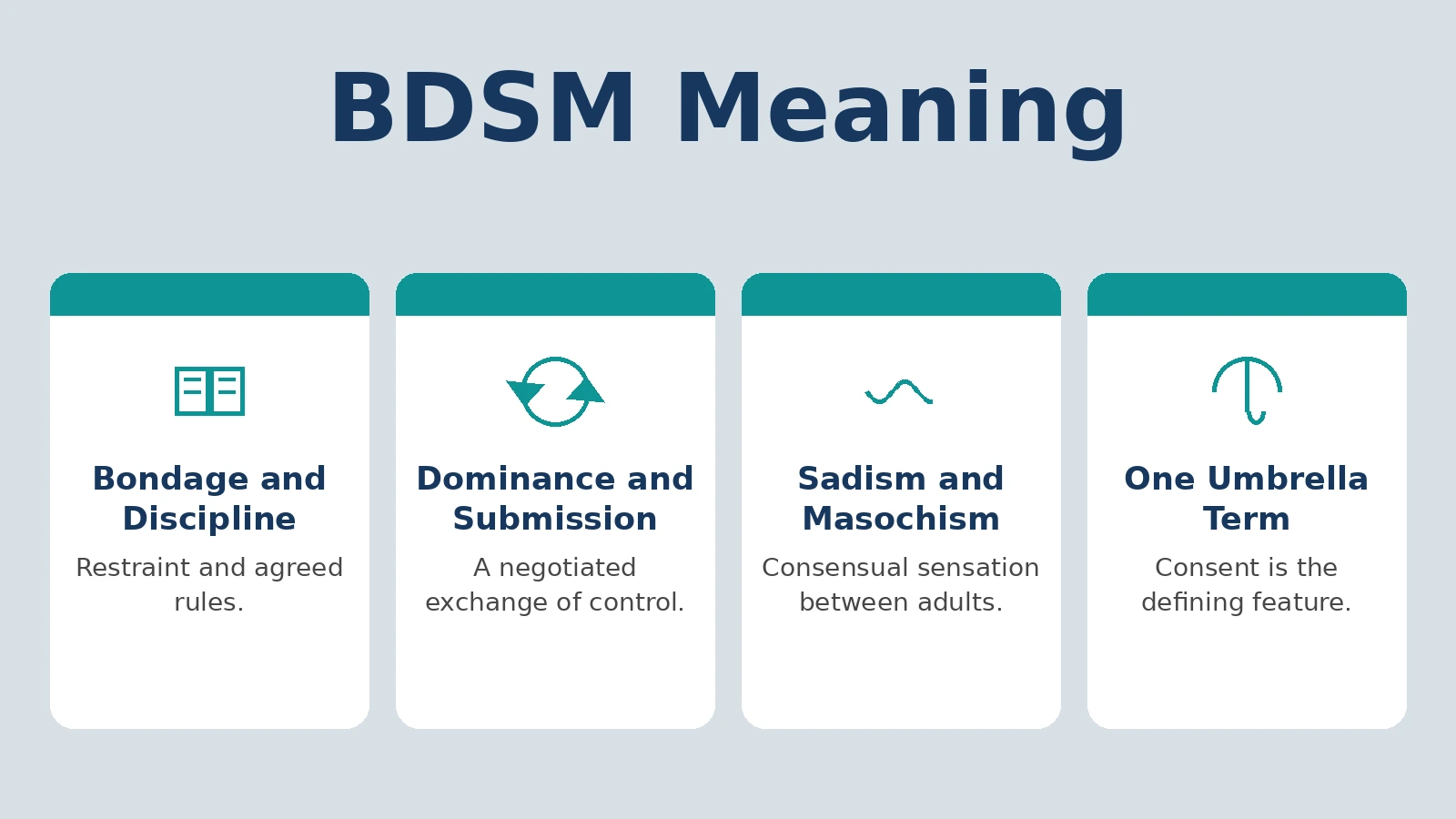
BDSM is an initialism for a family of consensual adult practices built around restraint, control, sensation, and negotiated power exchange. Its four letters compress six words: bondage and discipline, dominance and submission, and sadism and masochism. Dictionaries treat it as an umbrella term rather than a single activity. Clinicians, meanwhile, judge the interests it names by consent and wellbeing, not by the interests alone.
Yet the word is widely misunderstood. Popular fiction and casual jokes often skip the one element practitioners call non-negotiable: informed consent between adults. This guide explains the term the way a reference work should. It breaks down the acronym, traces the history of the words, and sets out the consent frameworks the community itself uses. It also covers what the DSM-5 says, what national research has found, and the myths that most often distort the definition.
What Does BDSM Mean?
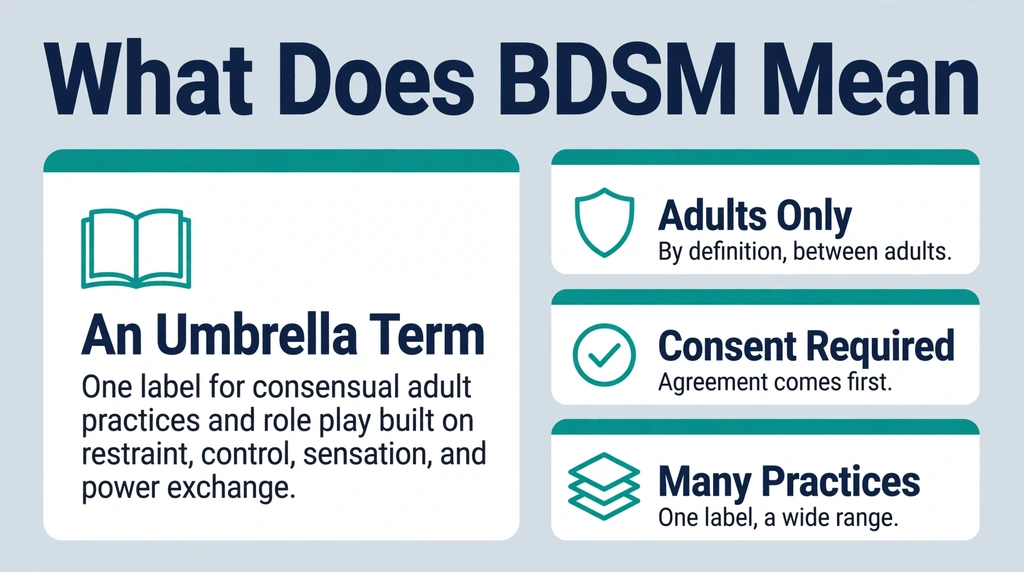
At its simplest, BDSM is an umbrella term. It gathers several kinds of consensual adult practice and role play under one short label. Merriam-Webster defines it as “sexual activity involving such practices as the use of physical restraints, the granting and relinquishing of control, and the infliction of pain.”
That dictionary wording is a useful starting point. Still, practitioners and researchers both stress two qualifiers. First, the activities happen between adults. Second, everyone involved agrees to take part. Without that agreement, the same acts fall outside the term entirely.
A note on the word itself: BDSM is always written with capital letters and spoken letter by letter. It behaves as a label, not as an ordinary word. Writers also use it as a modifier, as in BDSM community or BDSM practices, and both uses follow the same definition.
One more distinction helps. The term is used both by the people it describes and by outsiders describing them. Self-description tends to stress the consent frameworks covered later in this guide. Outside description, especially in news headlines, often stresses only the most visible activities. Much confusion around the word comes from that gap between the insider and outsider versions of the same label.
One Term, Many Practices
The umbrella covers a wide range of interests. Some people focus on restraint. Others focus on rules, rituals, or an ongoing exchange of control within a relationship. Still others are mainly interested in intense sensation.
Because the range is so broad, the label says little about any one person. Two people who both use the term may share almost no activities. The acronym names a territory, not a checklist.
Researchers add one more distinction. For some adults, these interests are an occasional activity. For others, they form part of a lasting identity or the structure of a relationship. Studies that measure only behavior and studies that measure identity therefore produce very different numbers, a point the research section returns to.
Where BDSM Sits Inside the Word Kink
BDSM also sits inside a larger informal category called kink. Kink is the broader umbrella for sexual interests that fall outside the conventional. BDSM is one well-known part of that umbrella, not a synonym for the whole.
The informal opposite is vanilla, a slang word for conventional preferences. Writers use both slang terms loosely, but reference works keep BDSM narrower. It refers to the specific cluster of practices named by its letters.
Register matters here as well. Kink and vanilla are casual slang, while BDSM is the term used in dictionaries, clinical manuals, and court reporting. When a newspaper or a textbook needs a precise label, BDSM is usually the word it reaches for. That is one reason the initialism, rather than any slang rival, became the standard headword.
What the Letters in BDSM Stand For
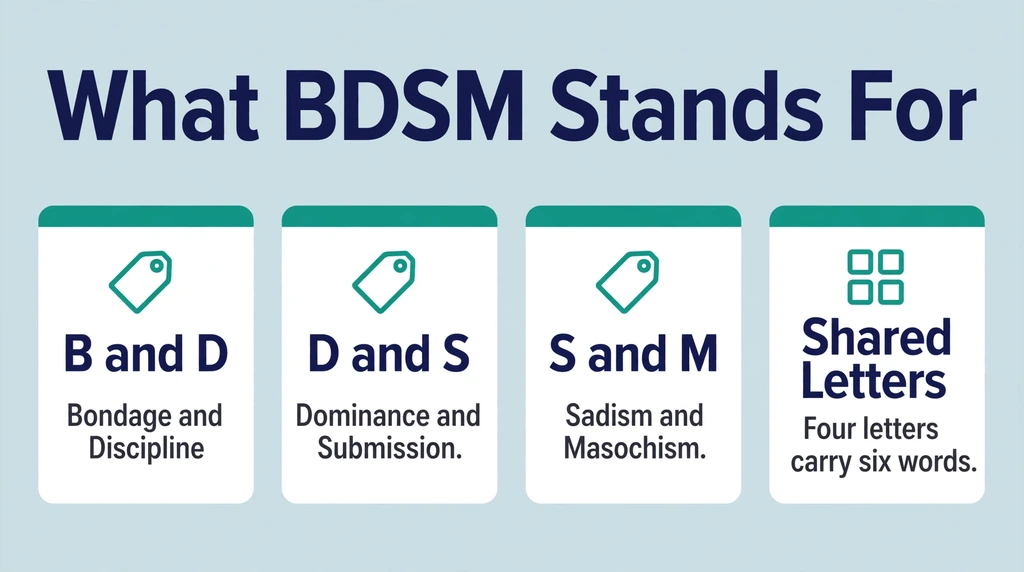
BDSM is a compound initialism. It was built by stacking three older abbreviations on top of each other: B&D, D/s, and S&M. The middle letters do double duty, which is why four letters can carry six words.
This structure confuses many readers at first. The D covers both discipline and dominance. The S covers both submission and sadism. Once you see the three pairs, the whole word becomes easy to read.
Earlier reference works sometimes tried to simplify the expansion. A few sources give only bondage, discipline, sadism, and masochism, following the spelling most literally. The three-pair reading is the one the community and most modern references use, because it includes the power-exchange pair that the shorter expansion leaves out.
Readers may also meet the older pairs standing alone. S&M was the common umbrella in print for much of the twentieth century. B&D and D/s appeared as specialized labels in personal ads and community publications. BDSM won out because it folded all three into a single searchable, printable word.
Bondage and Discipline
Bondage, in this context, means consensual physical restraint. It is the B of the first pair. Discipline refers to agreed rules, protocols, and consequences that structure a dynamic between partners.
Both halves depend on prior agreement. The restraint exists because the restrained person has agreed to it. The rules exist because everyone involved has accepted them in advance.
The two halves also feel different in practice. Bondage is physical and visible, a matter of restriction. Discipline is behavioral, a matter of expectations and structure. Pairing them links the body’s limits to the relationship’s rules, which is why the community has long treated them as one theme.
Dominance and Submission
The second pair describes an exchange of control. One partner, the dominant, takes the lead within limits that both sides set. The other partner, the submissive, voluntarily yields that control within the same limits.
This exchange can last for a single occasion or shape an ongoing relationship. Some people prefer one role consistently. Others, often called switches, take different roles on different occasions. Merriam-Webster notes that the letters D and S have also been read this way, as dominance and submission, alongside discipline and submission in the older expansions.
Scholars usually call this arrangement power exchange, and the phrase is worth understanding precisely. The authority is granted by the submissive partner, not seized by the dominant one. It is limited in scope, limited in time, and revocable. A grant that cannot be withdrawn is not an exchange at all, which is why consent language saturates writing about this pair.
Sadism and Masochism
The third pair concerns sensation, including pain. In everyday language, sadism means enjoying another person’s suffering, and masochism means enjoying your own. Inside BDSM, both words are narrower. They describe consensual sensation that the receiving partner has agreed to and can stop.
That narrowing matters for clear writing. A consensual scene and an act of cruelty share surface features but not meaning. Consent and context are what separate the clinical vocabulary of BDSM from the everyday insult.
Psychology adds a further caution. In clinical writing, sexual sadism and sexual masochism name patterns of arousal, whether or not a person ever acts on them. The BDSM pair names something social instead: negotiated activity between partners. The same two words therefore do different work in a clinic and in a community glossary, and confusing the two registers causes much of the public muddle around this term.
The History of the Term BDSM
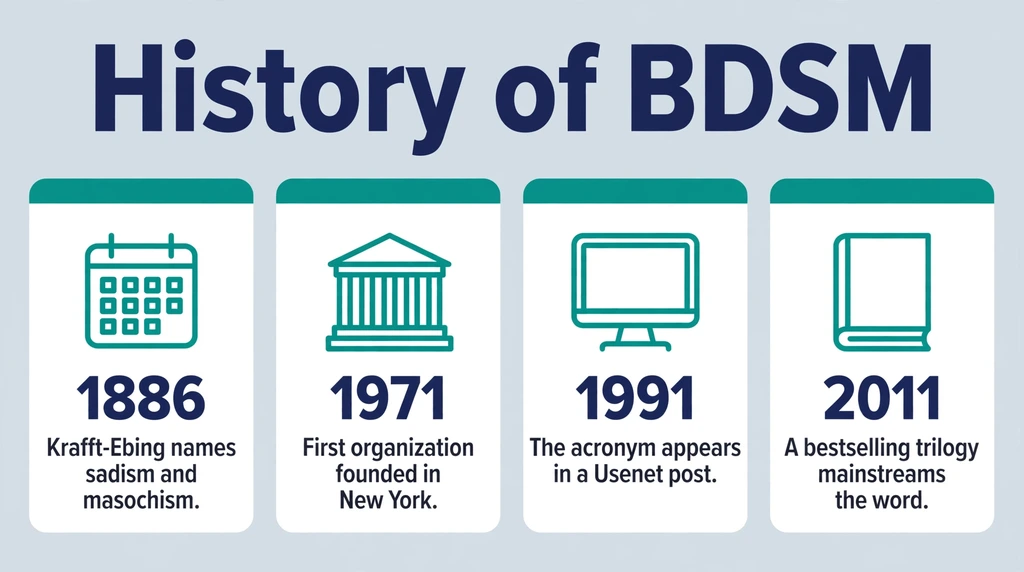
The practices are old, but the vocabulary is surprisingly recent. The component words came from nineteenth-century medicine. The combined acronym, by contrast, is an artifact of the early internet.
Two Writers Gave the Words Their Names
The word sadism comes from the Marquis de Sade, the French author whose writings explored cruelty and power. The word masochism comes from Leopold von Sacher-Masoch, an Austrian author who lived from 1836 to 1895. His 1870 novella Venus in Furs told of a man who longed to submit to a dominant woman.
Neither writer coined the clinical terms. That step belonged to Richard von Krafft-Ebing, a German psychiatrist. In his 1886 book Psychopathia Sexualis, he turned both names into medical labels. He treated the interests as pathologies, a framing that later generations of clinicians would steadily revise.
The book itself explains the era’s caution. Krafft-Ebing wrote it as a forensic reference for doctors and judges, built from case studies. He even rendered the most explicit passages in Latin, hoping to discourage lay readers. Sexology began, in other words, as a guarded professional literature. The words escaped anyway, and they have lived in public language ever since.
Short Forms, Ads, and Organized Communities
Short forms such as S&M circulated long before the full acronym existed. According to the Glossary of BDSM, such abbreviations have roots in classified personal advertisements. Editors demanded euphemisms, so writers compressed stigmatized words into initials.
Meanwhile, organized communities began to form. The Eulenspiegel Society, founded in New York City in 1971, is described as the first BDSM organization in the United States. It began as an informal association and support group for masochists, and sadists joined it within the same year. Groups like it published newsletters, taught safety, and argued that consent separated their activities from abuse.
These organizations matter to the word’s history for a practical reason. They created the meeting places, print and digital, where a shared vocabulary could settle. Terms such as SSC and RACK, covered below, emerged from exactly these circles. The acronym BDSM itself was assembled by the same culture of newsletters, bulletin boards, and discussion groups.
1991: The Acronym Appears Online
The Oxford English Dictionary traces the earliest evidence for BDSM to 20 June 1991. On that date, an anonymous user used the initialism in a reply within the Usenet newsgroup alt.sex.bondage. Merriam-Webster likewise gives 1991 as the term’s first known use.
During the 1990s, the combined acronym spread through online groups. It was reposted between 1995 and 1997 in the forum soc.subculture.bondage-bdsm, among other venues. It gradually replaced sadomasochism as the general label. Writers preferred it because it covered more ground and foregrounded roles and dynamics, not sensation alone.
The word reached a mass audience in the 2010s. E. L. James’s Fifty Shades trilogy, which began in 2011, pushed the acronym into everyday conversation. By 2014, the trilogy had reportedly sold more than 100 million copies. Scholars of counseling note a mixed legacy. The books widened curiosity and acceptance, yet their version of BDSM departs from the negotiated consent that real communities describe. Community educators spent much of the decade correcting the difference, and the corrections themselves spread the vocabulary further.
Consent Comes First: SSC and RACK
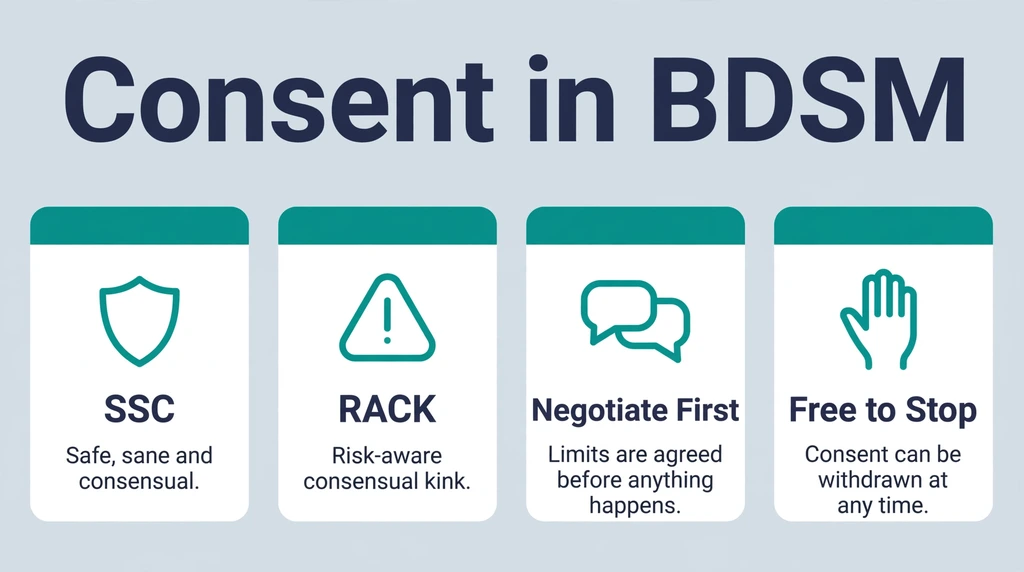
Ask practitioners what defines BDSM, and most start with consent rather than any activity. The organized community built explicit ethical frameworks for a practical reason. Mainstream institutions offered none, so members wrote their own and taught them to newcomers.
Two frameworks dominate the discussion. Both are acronyms, and both put consent at the center. They differ mainly in how they talk about risk.
Safe, Sane and Consensual
The older framework is SSC, short for safe, sane and consensual. David Stein coined the phrase for New York’s Gay Male S/M Activists, or GMSMA. His own account places it in a committee statement from August 1983, although many later sources date the coinage to 1984.
Each word carries a specific job. Safe means risks to health should be identified and prevented where possible. Sane means activities should be undertaken in a sound, sensible state of mind. Consensual means everyone involved gives full, informed consent.
Stein’s purpose was openly defensive. He wanted a bright line between consensual S/M between partners and the abusive behavior the public associated with the word sadomasochism. He later explained that SSC was meant as a minimum standard, not a complete theory of ethical practice.
The phrase traveled well. GMSMA grew into one of the largest organizations of its kind, and its three-word motto became the default summary taught to newcomers across the community. For years, SSC functioned almost as a definition of the scene itself: if an activity failed any of the three tests, it was simply not welcome.
Risk-Aware Consensual Kink
In 1999, Gary Switch proposed an alternative: RACK, or risk-aware consensual kink. He introduced it in a post to The Eulenspiegel Society’s Usenet list, TES-Friends. He then set the idea out in an essay, “Origin of RACK,” published in Prometheus in 2001. Some writers expand RACK slightly differently, as risk-accepted consensual kink.
Switch argued that nothing is completely safe, including crossing the street. He compared BDSM to mountain climbing, where risk is part of the appeal. In both pursuits, risk is managed through study, training, technique, and practice. Under RACK, the ethical test is not whether an activity is labeled safe. The test is whether participants understand the risks and accept them with full information.
Later writers have proposed refinements. In 2014, researchers suggested the 4Cs: consent, communication, caring, and caution. The new label changed the emphasis, not the foundation.
In practice, the two main frameworks now coexist rather than compete. Community guides commonly present SSC as the plain-language summary for newcomers. RACK appears as the fuller description for activities where risk cannot honestly be called small. The choice between them is mostly a choice about how to describe risk, not about whether consent is required.
Negotiation: The Frameworks in Daily Use
Both slogans describe the same working routine. Partners discuss expectations before anything happens. They state limits, including health considerations that a partner needs to know. They also revisit the agreement, because consent given once is not consent given forever.
Three features recur in community teaching. Agreements are specific rather than blanket. Signals to pause or stop are settled in advance. And the conversation continues afterward, so problems surface while they are still small. The frameworks are abstract, but the routine they mandate is concrete and verbal.
What Both Frameworks Share
Despite their differences, SSC and RACK rest on the same ground. Activities are discussed and negotiated beforehand. Limits are stated clearly. Participants agree on a signal, often a word, that stops everything at once.
Most importantly, consent can be withdrawn at any time. That single feature draws the line this whole article depends on. BDSM, by its community’s own definitions, requires ongoing agreement. Abuse is defined by its absence.
BDSM and Mental Health: The DSM-5 Distinction
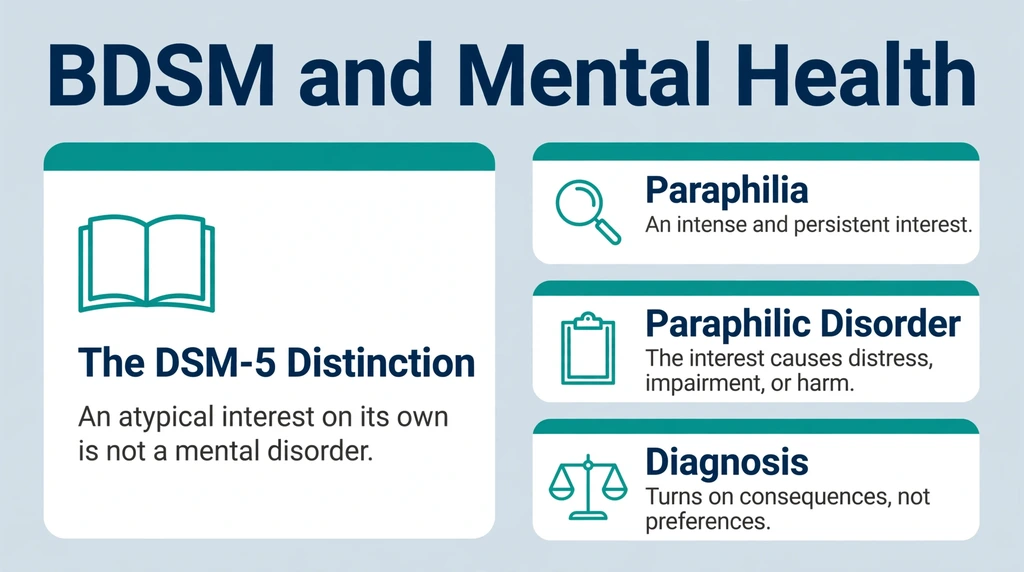
For much of the twentieth century, psychiatry grouped these interests with mental illness. The modern manual takes a different and more careful position. Understanding it requires one distinction that the DSM-5 draws very deliberately.
An Interest Is Not a Disorder
The DSM-5, published by the American Psychiatric Association in 2013, defines a paraphilia as an intense and persistent sexual interest that differs from interest in mature, consenting partners. The manual then states the key point plainly: paraphilias are not, in themselves, mental disorders.
A paraphilic disorder is something narrower. It is a paraphilia that currently causes distress or impairment to the person who has it. It also covers cases where satisfying the interest has entailed personal harm, or risk of harm, to others.
In other words, an interest alone is not a diagnosis. The manual says a paraphilia by itself does not automatically justify or require clinical intervention. Distress, impairment, or harm is what moves an interest into clinical territory.
Why the Change Matters
The distinction was a deliberate reform, not a technicality. Earlier editions of the manual folded dysfunction into the definition of the interests themselves. Critics argued that this muddled two separate questions: what a person is interested in, and whether that interest is causing a problem.
The DSM-5 also allows a paraphilic disorder to be recorded as in full remission. That status applies when the interest has stopped causing dysfunction for a sustained period. The design makes the manual’s logic visible. Interests are treated as durable traits, while disorders are treated as states that can begin and end.
For readers, the practical effect is simple. A headline that calls BDSM a disorder is using the vocabulary of 1986, not of 2013. The current manual does not support that sentence.
What This Means for BDSM
The DSM-5 names eight paraphilic disorders. Two of them, sexual sadism disorder and sexual masochism disorder, sit closest to the BDSM vocabulary. The other six concern different targets and behaviors, including voyeurism, exhibitionism, and fetishism. Even there, diagnosis turns on consequences, not preferences. Clinicians look for suffering, impaired functioning, or urges acted on with a nonconsenting person.
A consensual adult interest, without those features, stays on the non-disorder side of the line. This is why current clinical guidelines advise therapists to treat kink as a characteristic to understand, not a symptom to cure. The older assumption that interest equals illness no longer reflects the manual.
Clinicians add one nuance worth knowing. When distress does appear, it often grows out of stigma, secrecy, or a partner’s disapproval rather than the interest itself. Treatment then addresses the distress and its sources. It does not aim to remove a consensual preference that harms no one.
Professional guidance has caught up with the manual. A set of clinical guidelines for working with clients involved in kink, published by Sprott and colleagues in 2023, sets out what therapists should know before treating such clients. Its premise matches the DSM-5 position: the interest is background to understand, while the presenting problem is what therapy is for.
How Common Is BDSM? What Studies Found
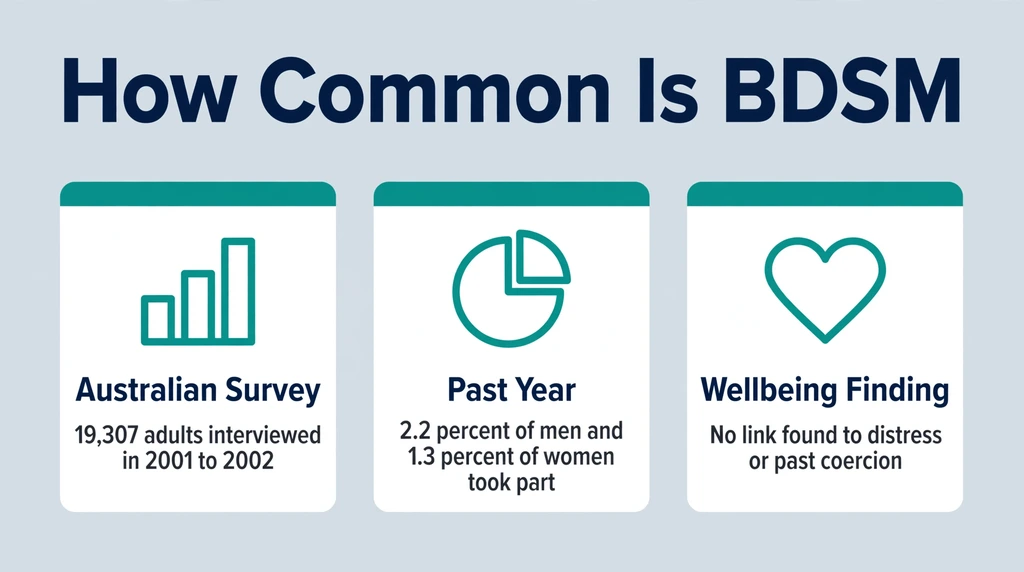
Counting participation is genuinely difficult. Surveys ask different questions, and stigma still discourages honest answers. Even so, one national study remains the standard reference point for researchers.
The measurement problem deserves a sentence of its own. A survey can ask about behavior in the past year, about lifetime experience, or about identity. Each question counts a different population, and the three figures cannot be compared directly. Much of the disagreement between headlines about how common BDSM is comes from mixing those categories without saying so.
The Australian National Survey
In 2001 and 2002, researchers interviewed 19,307 Australians aged 16 to 59 by telephone. The project, published by Richters and colleagues in 2008, formed part of the Australian Study of Health and Relationships. It remains one of the few large, representative surveys to ask about BDSM directly.
Among sexually active respondents, 2.2 percent of men and 1.3 percent of women had been involved in BDSM during the previous year. Participation was more common among gay, lesbian, and bisexual respondents than among heterosexual respondents.
The survey’s size is what makes it valuable. Small studies recruit through clubs or websites and describe those worlds well. A national sample cannot do that, but it can say how an interest is distributed across a whole population, which is the question most readers actually ask.
What the Same Study Found About Wellbeing
The team also tested the stereotypes directly. Participants were no more likely than others to report a history of sexual coercion. They were not significantly more likely to be unhappy or anxious. Their involvement showed no significant link to sexual difficulties either.
One result ran against the stereotype entirely. Men who had engaged in BDSM scored significantly lower on a scale of psychological distress than other men. The authors’ overall picture was of ordinary respondents with an uncommon interest.
Beyond One Survey
Other research points in a similar direction, though each study measures something slightly different. A 2013 Dutch study, published in the Journal of Sexual Medicine, compared practitioners with a control group on personality measures. It described the practitioners’ profile as comparatively balanced, with higher subjective well-being than the controls reported.
Surveys of fantasies report higher figures than surveys of recent behavior, which is expected. Interest, identity, and practice are three different measurements. Careful writers keep them separate, and careful readers should too.
Common Myths About BDSM
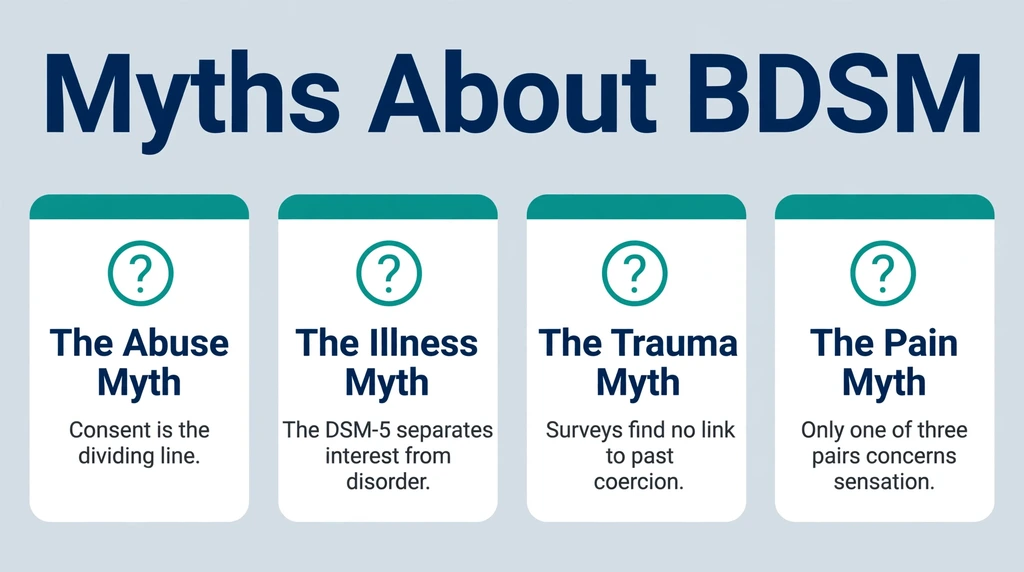
Few sexual terms attract as much folklore as this one. The myths below recur in headlines, fiction, and everyday conversation. Each one fails against the definitions and research already covered.
Myth: BDSM Is Just a Polite Word for Abuse
Fact: the community’s own frameworks were built to separate the two. SSC was coined specifically to distinguish consensual activity between partners from abusive behavior. Negotiation, limits, and the right to stop are structural features, not decorations. Where consent is absent or ignored, practitioners themselves say the label no longer applies.
Myth: People Who Enjoy BDSM Are Mentally Ill
Fact: the DSM-5 explicitly separates an interest from a disorder. A paraphilia becomes a paraphilic disorder only when it causes distress, impairment, or harm to others. The Australian national data point the same way. Participants showed no excess of anxiety or unhappiness, and the men in the sample showed less distress than average.
Myth: The Interest Always Comes From Childhood Trauma
Fact: researchers have tested this assumption rather than assuming it. In the Australian survey, people who had practiced BDSM were no more likely to report past sexual coercion than anyone else. That finding does not prove every individual history is simple. It does show that trauma is not the general explanation the myth claims.
Myth: BDSM Is Only About Pain
Fact: pain belongs to only one of the three letter pairs. The acronym also covers restraint, rules, rituals, and the exchange of control. Many people who use the term are interested in power dynamics or structure and not in intense sensation at all. The umbrella is wider than its most dramatic corner.
Consider what the other pairs describe. Protocols, forms of address, and agreed service are matters of structure, not sensation. Restraint is a matter of stillness. A definition built only on pain would miss most of what the six words actually list.
Myth: Fifty Shades Shows How BDSM Really Works
Fact: the trilogy is fiction, and specialists treat it that way. Counseling scholars note that the books spread awareness while modeling a version of BDSM that skips the community’s consent practices. Real frameworks such as SSC and RACK begin with explicit negotiation. Readers who treat the novels as a manual miss the term’s defining feature.
Myth: Everyone Involved Does Everything in the Acronym
Fact: BDSM is an umbrella label, and people adopt the parts that fit them. Someone interested in dominance and submission may have no interest in sadism or masochism. Roles vary too, and many participants switch roles by occasion. The six words describe a combined territory, not a membership checklist.
Myth: BDSM Is a Recent Internet Fad
Fact: the acronym is young, but its ingredients are not. The clinical words date to 1886, organized groups to 1971, and the consent motto SSC to the early 1980s. The internet supplied the four-letter label in 1991 and a faster distribution network. It did not invent the subject the label describes.
BDSM in Everyday Language
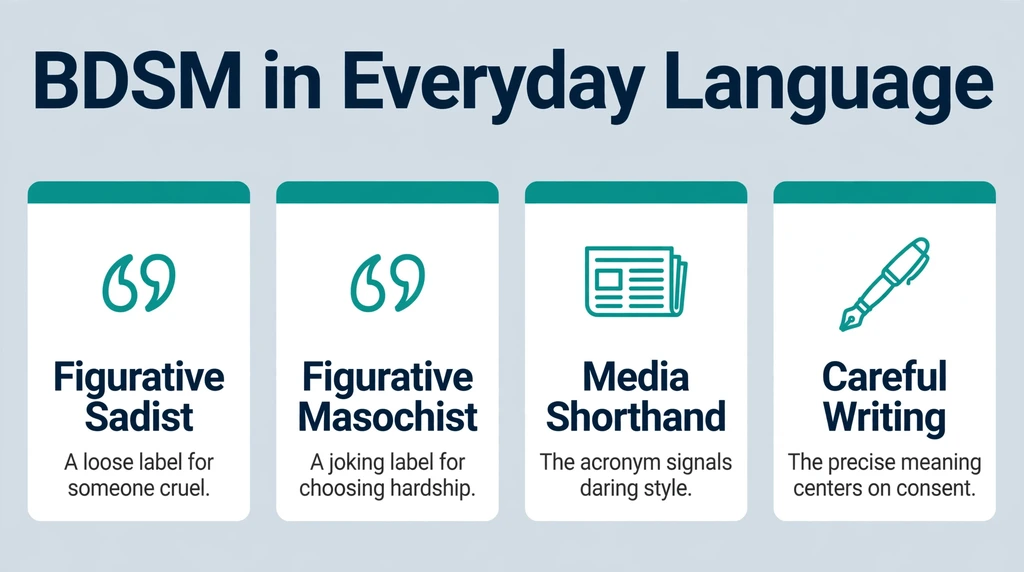
Like many clinical terms, BDSM and its component words have leaked into ordinary speech. The borrowed uses are looser than the definitions above. Recognizing them helps readers separate metaphor from meaning.
Figurative Sadists and Masochists
English speakers call a cruel manager a sadist and describe brutal traffic as sadistic. A friend who signs up for a dawn marathon in the rain gets teased as a masochist. Dictionaries record these extended senses, and nobody using them means the clinical terms.
The jokes work because the literal meanings are widely known. Still, the figurative senses skip the element that defines the literal ones in BDSM: consent. A sadistic commute, unlike a scene, is neither negotiated nor stoppable.
Related Terms Readers Meet
General articles often use a handful of role and activity words without defining them. Dominant and submissive name the two sides of the power-exchange pair. Top and bottom are looser synonyms used in much community writing. Play is the community’s ordinary noun and verb for the activities themselves, as in the phrase ethical play.
None of these words changes the definition of the headword. They simply fill in the roles that the acronym’s middle pair describes. A reader who knows them can follow most reference and news writing on the subject.
The role words also travel on their own. Dominant and submissive describe personalities in office talk, hierarchies in animal behavior, and dynamics in team sports. Those uses borrow the pair’s basic geometry, one side leading and one side yielding. Only inside BDSM writing, though, do the words imply a negotiated and revocable arrangement between adults.
The Acronym as Cultural Shorthand
In headlines, fashion, and entertainment, the acronym often works as shorthand for daring or transgressive style. A designer collection or a music video may be described as BDSM-inspired on the strength of leather and straps alone. The visual reference is real, but the practices and ethics behind the term are absent.
This shorthand explains why the word feels familiar even to people who cannot expand it. It also explains the steady demand for plain definitions. Cultural visibility has outrun public understanding, which is the gap a reference guide exists to close.
Frequently Asked Questions
What does BDSM stand for?
BDSM combines three pairs of terms: bondage and discipline, dominance and submission, and sadism and masochism. The shared middle letters let four letters carry six words. The compound replaced the narrower word sadomasochism during the 1990s.
Is BDSM a mental illness?
No. Under the DSM-5, a paraphilia is an atypical sexual interest, and an interest alone is not a disorder. A paraphilic disorder requires distress, impairment, or harm to others. Consensual adult interests without those features are not diagnosed.
What is the difference between BDSM and abuse?
Consent is the difference. BDSM, by its community’s definitions, involves adults who negotiate activities, set limits, and can stop at any time. Abuse involves coercion or disregard for another person’s agreement. The frameworks SSC and RACK exist to keep that line explicit.
What do SSC and RACK mean?
SSC means safe, sane and consensual, a motto coined by David Stein in the early 1980s. RACK means risk-aware consensual kink, proposed by Gary Switch in 1999. Both demand informed consent. They differ in whether risk should be minimized by definition or understood and accepted knowingly.
When did the term BDSM first appear?
The earliest recorded evidence dates to 20 June 1991, in a Usenet discussion group devoted to bondage. The words inside the acronym are much older. Sadism and masochism entered medicine in 1886, in Krafft-Ebing’s Psychopathia Sexualis.
Is kink the same thing as BDSM?
Not exactly. Kink is the wider informal umbrella for sexual interests outside the conventional. BDSM names one specific cluster inside that umbrella: restraint, discipline, dominance, submission, sadism, and masochism. All BDSM falls under kink, but much kink is not BDSM.
Why is it sometimes written D/s?
In community writing, the capital and lowercase letters mirror the roles they name. The dominant side is written with a capital D, and the submissive side with a lowercase s. The convention is a small visual reminder of the power exchange the pair describes.
Is BDSM legal?
There is no single global answer, because law is written country by country and case by case. Community frameworks such as SSC and RACK are ethical standards, not legal ones, and they offer no guarantee in any jurisdiction. Readers who need a legal answer for a specific place should consult that place’s law rather than a definition guide.
Final Thoughts
BDSM is best understood as a piece of vocabulary before it is anything else. It is a compound initialism that merges three older pairs of terms into one umbrella. Its recorded history runs from nineteenth-century medical books to a Usenet post in 1991 and then to global bestsellers.
Two findings anchor any honest summary. First, the community that uses the term defines it through consent, formalized in frameworks such as SSC and RACK. Second, modern psychiatry agrees that the interest itself is not an illness. For the dictionary record itself, see the Merriam-Webster entry on BDSM, which dates the word’s first known use to 1991. Read with those two anchors in place, the term becomes clear, specific, and far less mysterious than its reputation suggests.
That clarity is the real trend in the word’s history. Each era replaced a vaguer label with a more precise one: clinical coinages in 1886, compressed initials in the ads, a consent motto in 1983, and a combined acronym in 1991. The vocabulary kept sharpening because the people using it needed distinctions that older words blurred. Knowing the distinctions is most of what knowing the term means.