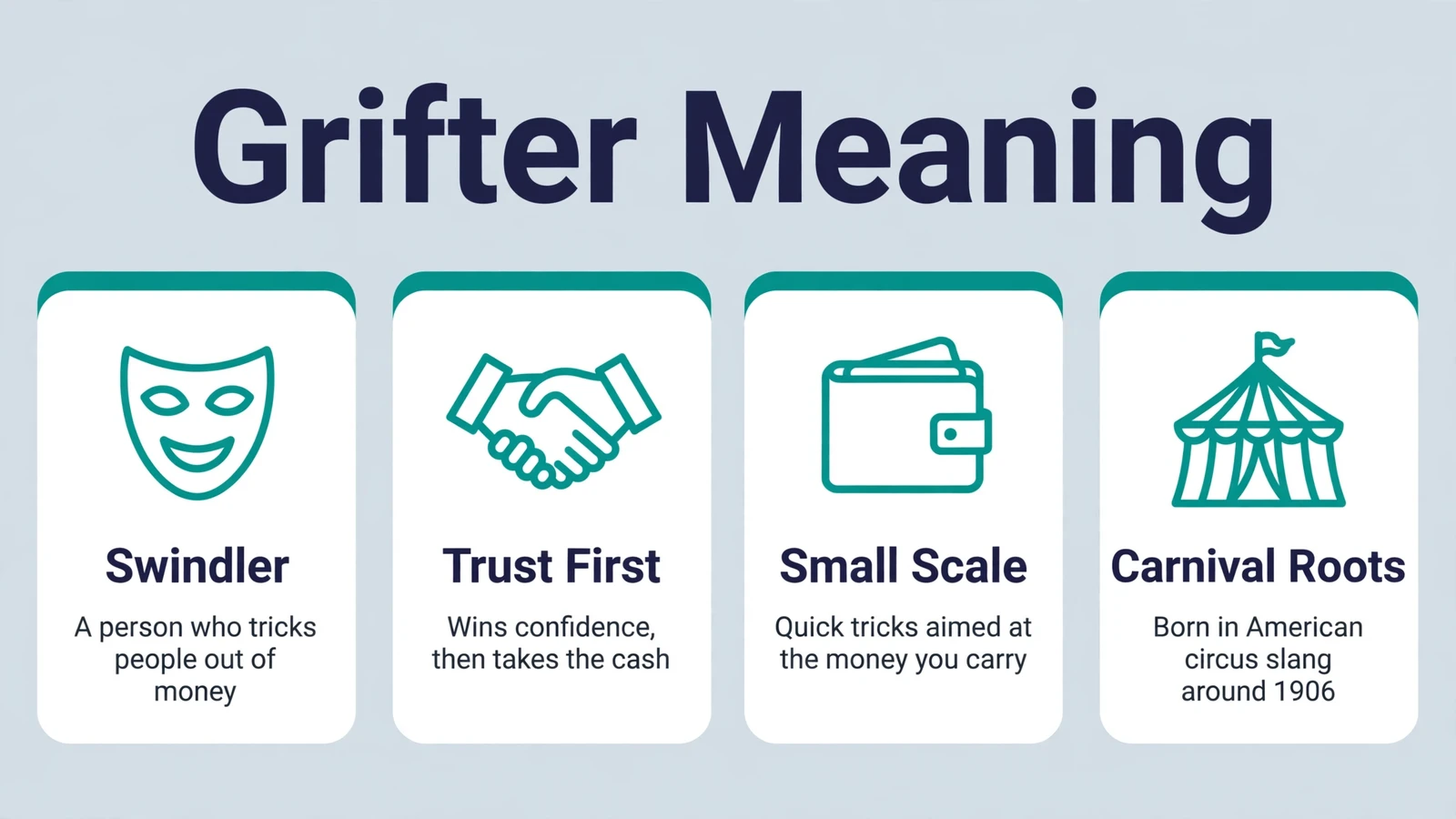
A charming stranger at the fair offers you a simple bet. Follow one card with your eyes, he says, and double your money. Minutes later your wallet is lighter, he has melted into the crowd, and you cannot quite explain what happened. You have just met a grifter.
A grifter is a swindler who tricks people out of money. Instead of force, a grifter uses charm, patter, and staged situations, so the victim hands the money over willingly. The loss only becomes clear once the grifter is gone.
Dictionaries sum the word up in a single line, but its story runs from carnival midways to modern inboxes. This guide explains what grifter means, where the word came from, and how it differs from con artist, scammer, and fraudster. It also walks through the classic grifts that built the word’s reputation, plus the warning signs that still give a grifter away.
What Does Grifter Mean?
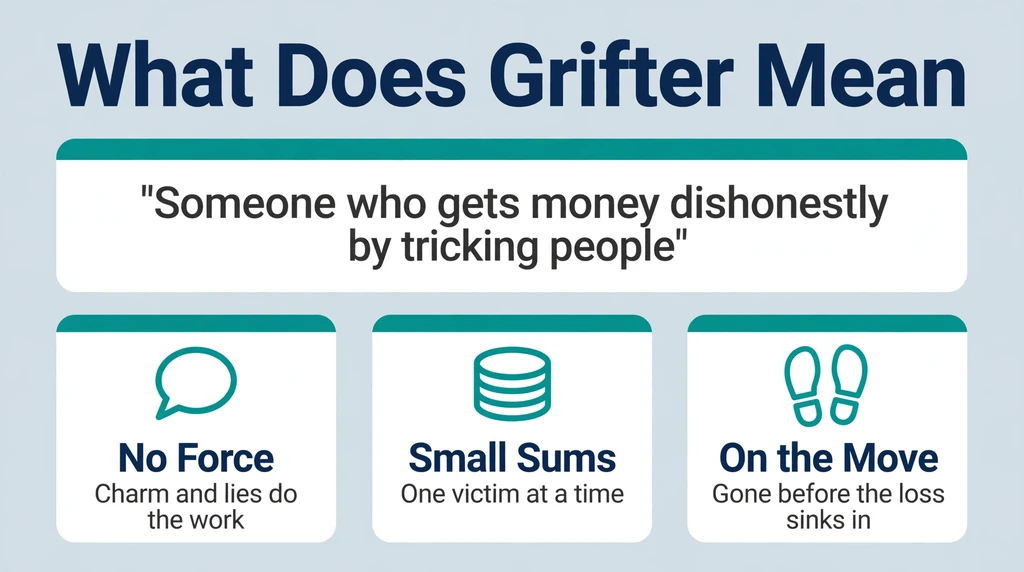
Cambridge Dictionary defines a grifter as “someone who gets money dishonestly by tricking people.” Collins puts it just as plainly: a person who swindles another out of money. Both dictionaries label the word mainly American and informal.
Headlines use the family flexibly today. *Grift* can name the scheme itself, the habit of running schemes, or even the money a scheme brings in. That is why a report might call a fake charity “a grift” and its founder “a grifter” in the same breath.
That short definition hides a specific flavor, though. A grifter is not just any thief, and the next two points show why the word paints a clearer picture than *thief* alone.
The Core Definition
At its core, the word points to a person who earns a living through trickery. The classic grifter works small and personal. He runs a rigged game, tells a convincing story, or sells something that does not exist.
Scale matters in the picture the word paints. A grifter usually takes modest sums from people one at a time. The bank robber and the corporate embezzler belong to other categories of crime, even though all three steal.
A Thief Who Asks Nicely
Merriam-Webster calls a grifter a thief of a particular sort. A grifter obtains money or property through cleverness and deceit, and does not usually resort to physical force or violence.
The same dictionary note lists the company the word keeps. A grifter might be a pickpocket, a crooked gambler, a scammer, or a con artist. In every case, the victim cooperates, at least at first, because the trick makes handing over money seem smart, safe, or profitable.
What Counts as a Grift?
The word fits a wide range of tricks, as long as deception does the heavy lifting. Rigged games of chance are the oldest example. Fake sales qualify too, from the watch that stops working in a week to the investment that never existed.
Impersonation is another staple, since borrowed authority opens wallets quickly. It is also the bridge to the modern phone and inbox scams taken up later in this guide. So are false promises of prizes, cures, or inside knowledge. If the victim parts with money because a story felt true, the act was a grift, whatever costume it wore.
Pronunciation and Word Forms
Say it as GRIF-ter. Cambridge gives the British pronunciation as /ˈɡrɪf.tər/ and the American as /ˈɡrɪf.tɚ/. The word is a countable noun, so one grifter and two grifters both work.
The family around it is small and useful. *Grift* is the act itself, and it works as both a noun and a verb, as in “to grift money from strangers.” Someone who lives this way is said to be *on the grift*.
Where Did the Word Grifter Come From?
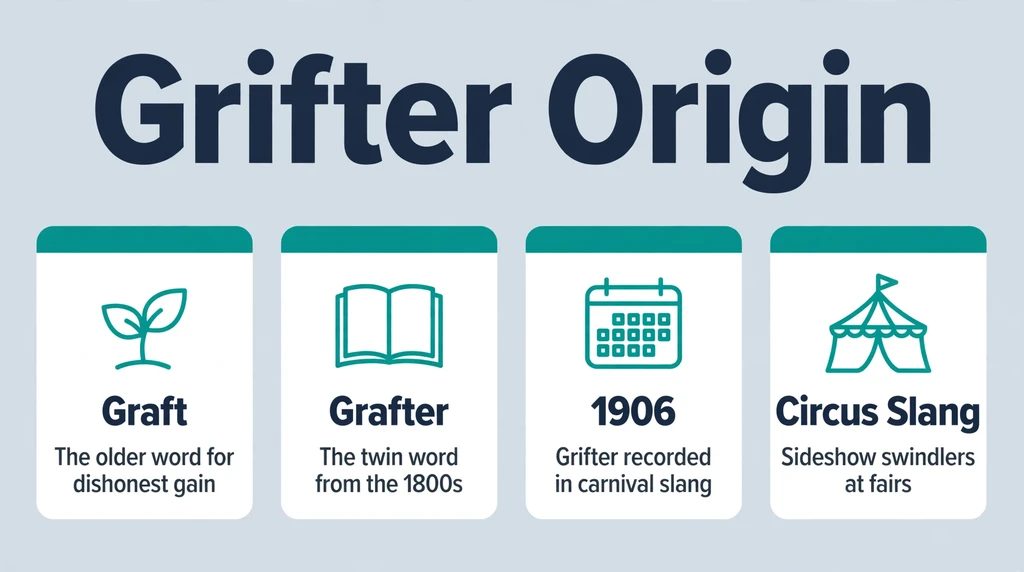
The word was born in American slang in the first years of the 1900s. Its first home was the underworld of traveling shows, where swindling was a trade with its own vocabulary.
From Graft to Grift
The strongest clue is the older word *graft*. In American slang, graft meant acquiring money in dishonest or questionable ways, and a *grafter* was a person who did it. Merriam-Webster dates *grafter* to the middle of the 1800s, when it first meant simply a thief.
Against that background, *grift* looks like a reshaped *graft*. Merriam-Webster calls this the most plausible etymology for the murky term, and the Online Etymology Dictionary agrees that *grifter* is probably an alteration of *grafter*. The trail starts early: Merriam-Webster gives 1902 as the first known use of the verb *grift*, while Etymonline records the noun *grifter* in 1906. Dictionaries differ by a few years here and there, which is normal for slang that lived in speech before print.
Carnival and Circus Slang
Etymonline is specific about the setting. *Grifter* began as carnival and circus slang for a confidence trickster. Older dictionaries kept that address in the definition itself, describing a grifter as someone who runs a sideshow attraction, especially a gambling game, at a circus or fair.
Period writers drew a line between the two twin words. The grafter might be an insider, abusing a job or a public office in the ordinary course of business. The grifter kept to the other side of the street, working the sideshow crowds with quick, showy tricks, then moving on with the show. That contrast explains the word’s flavor to this day: the grifter is an outsider and a performer, not an official with a stamp.
Words like this lived in speech long before print, so the paper trail is thin. The Oxford English Dictionary’s earliest trace of *grift*, as the Columbia Journalism Review notes, is a 1914 dictionary of criminal slang. Underworld words often surface first in exactly such glossaries, compiled by the police reporters and prison writers who listened for a living.
The Drifter Blend Theory
You may also hear that *grifter* blends *graft* with *drifter*. The idea fits the life neatly, since midway swindlers drifted from town to town.
Treat that story as a popular theory, not a proven origin. Slang dictionaries repeat it, yet the major etymological sources support only the link to *graft* and *grafter*. The article you are reading therefore uses the graft line as the origin and keeps the blend as a footnote.
How the Meaning Widened
The word did not stay on the midway. Etymonline notes that *grifter* gradually stretched to cover any non-violent criminal. From there it widened again into everyday speech about anyone who seems to live off other people’s trust.
Modern use reaches well past card tricks. Commentators now aim the word at online scammers, fake investment gurus, and public figures accused of turning followers into income. The setting changed, but the accusation stayed the same: money earned through a performance of trustworthiness.
Grifter vs Con Artist: What Is the Difference?
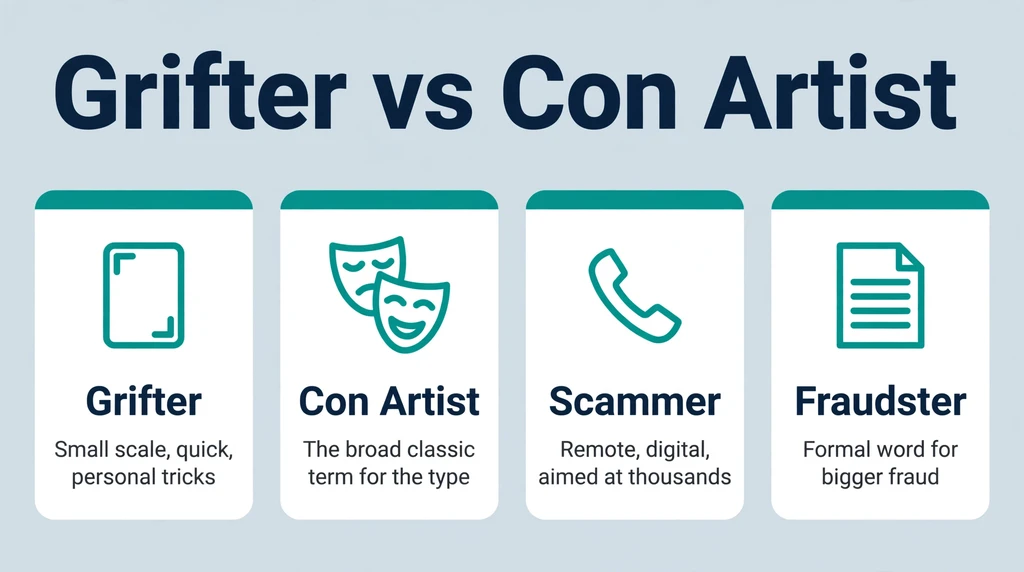
These words overlap so much that dictionaries treat some of them as synonyms. Cambridge, for example, lists *con artist* as the synonym for *grifter*. Still, each word has its own center of gravity, and choosing the right one sharpens your writing.
Con Artist
*Con artist* is the broad, classic umbrella term. It shortens *confidence artist*, a person who wins your confidence and then cashes it in. The phrase *confidence man* itself dates to 1849, when New York newspapers applied it to William Thompson, who talked strangers into lending him their watches and then walked off with them.
A con artist can work at any scale, from a street trick to an elaborate staged fraud. Every grifter is a kind of con artist, yet not every con artist feels like a grifter. The mastermind of a year-long fake investment firm sounds like a con artist; the card sharp at the fair sounds like a grifter.
Scammer
*Scammer* is the modern, digital-first word. A scam usually runs at a distance, through email, texts, calls, or social media, and it often targets thousands of people at once. The scammer stays anonymous and may never meet a victim.
Grifter, by contrast, still suggests a person working a persona in real time. The overlap is real, though, and dictionaries place *scammer* inside the grifter’s circle. When the trickster builds a fake identity and charms victims one by one online, many writers now call that person a grifter too.
Hustler
*Hustler* overlaps with grifter more loosely. A hustle can be a swindle, and reference works list *hustle* among the synonyms of *grift*. Yet the word also praises energy: a hard worker with three jobs may call herself a hustler with pride.
Context decides which sense you hear. Paired with rigged games or vanished deposits, hustler means the dishonest kind. Paired with long hours and ambition, it usually means the tireless kind.
Fraudster
*Fraudster* is the formal member of the family. Journalists and lawyers favor it because it names the crime, fraud, rather than the performance. It often attaches to larger or more institutional schemes, such as loan fraud, insurance fraud, or a rigged company.
You will rarely hear *fraudster* used for a street hustler with three cards. Its tone is courtroom and headline, while *grifter* keeps its midway dust.
Grafter and Charlatan
Two neighbors deserve a quick note. A *grafter*, the grifter’s older twin, suggests an insider profiting from a position, especially in politics. A *charlatan* sells fake expertise, such as miracle cures or secret knowledge. The charlatan fakes being an expert, while the grifter runs a trick; the two often overlap in the same person.
A Simple Way to Keep Them Straight
Think of it as four questions. Was there a performance and a persona? Probably a grifter or con artist. Did it arrive by phone or inbox, aimed at thousands? Scammer fits best. Is the setting a courtroom, a company, or a bank? Fraudster is the natural choice. And was the person abusing an official position? That is the grafter’s home ground.
How Grifts Work: The Short Con and the Long Con
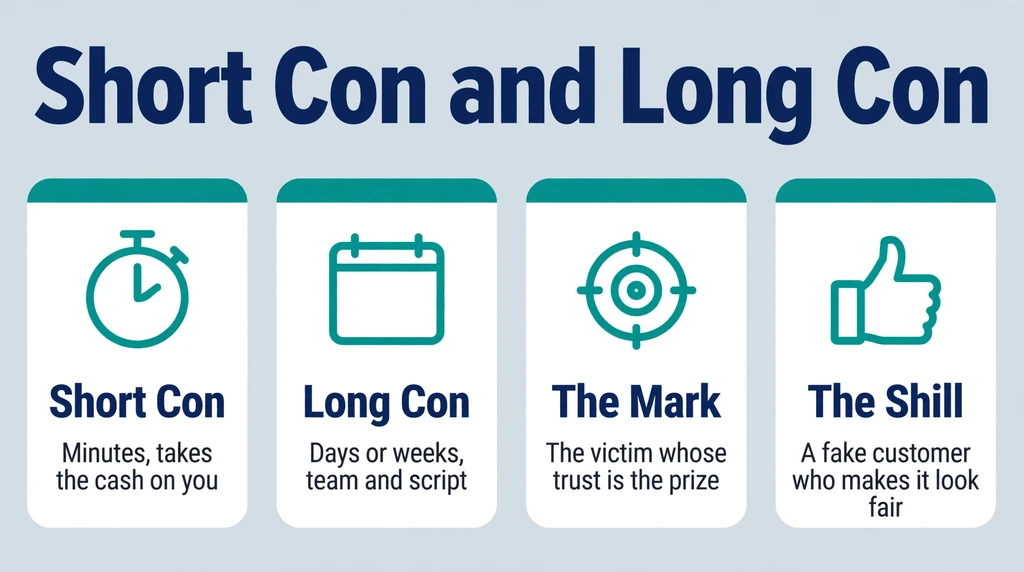
Grifters themselves divide their trade by time. Almost every classic scheme belongs to one of two families, the short con and the long con. Knowing the difference helps you see why some tricks take thirty seconds and others take a season.
The Short Con
A short con is a fast swindle. It takes minutes, sometimes seconds, and it targets the money or valuables the victim is carrying. The whole design favors speed: a quick story, a small stake, an easy exit.
Street games and quick-change tricks live here. So do most fairground swindles from the word’s early days. Because the take is small, the short-con grifter needs volume, which is why crowds, fairs, and busy stations were natural hunting grounds.
The Long Con
A long con, also called a big con or, in Britain, a long game, plays out over days or weeks. It may involve a team of swindlers, plus props, rented offices, costumes, and scripted lines. The target is a large sum, often money the victim must withdraw from a bank or borrow from family.
Fiction loves the long con because it has plot, rehearsal, and theater. Real long cons exist too, but they demand patience and organization, so they are rarer than their screen versions suggest.
The Supporting Cast
Both families rely on the same vocabulary. The victim is the *mark*, the person whose trust and money are the prize. A *shill* is an accomplice posing as a bystander or a lucky customer, whose easy win makes the game look honest.
Watch for the pattern underneath. The grifter first builds confidence, then offers the mark a chance that feels safe or secretly profitable. Once the money moves, the grifter vanishes, and shame often keeps the mark quiet afterward. That silence is part of the business model.
Why the Mark Says Yes
It is tempting to blame foolishness, but researchers who study confidence tricks point elsewhere. These schemes are engineered to press normal human buttons: greed, yes, but also compassion, vanity, politeness, and simple trust. A well-built story gives the mark a role to play, and people protect a story they feel part of.
Many classic cons add one more hook. They invite the mark to share in a slightly shady bargain, such as splitting found money or beating a rigged system. Afterward, that small complicity makes victims reluctant to report the loss. The grifter is not only stealing money; he is also buying silence in advance.
Classic Grifts You May Still Meet
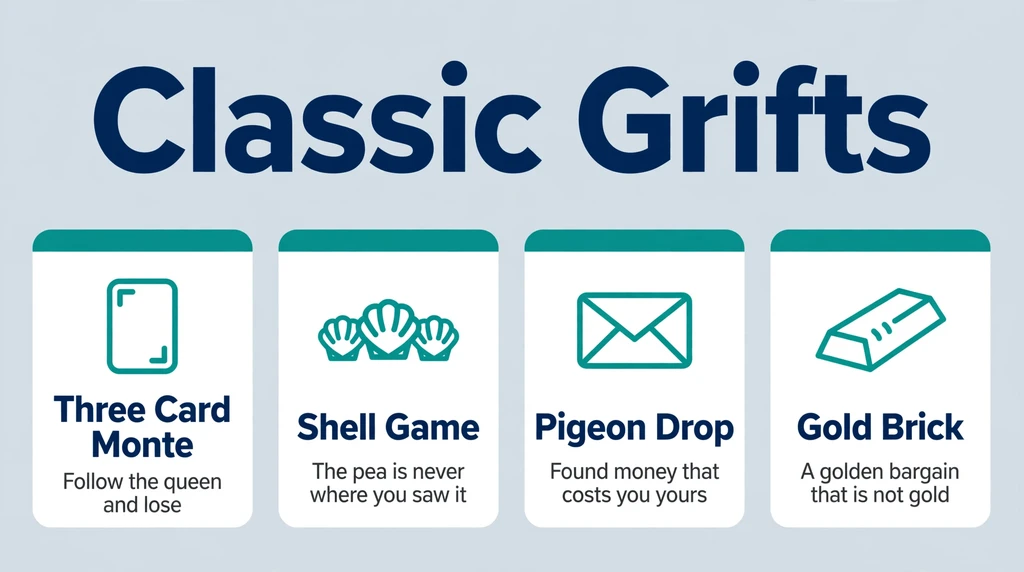
The famous schemes are older than the word *grifter* itself. They survive because they exploit habits that have not changed: greed, haste, politeness, and the wish to believe a good story. Each one below is described in outline, the way historians describe them, so you can recognize the shape.
Three-Card Monte
The dealer shows three cards, one of them a queen, then flips them face down and slides them around. Your job sounds simple: follow the queen and bet on her position.
The game is unwinnable by design. Sleight of hand decides where the queen really is, so the mark loses whenever the dealer chooses. Early on, a shill may win a bet or two, which makes the game look beatable and pulls real money from the crowd.
The Shell Game
Three-card Monte is the card table version of a much older trick. In the shell game, a pea hides under one of three shells or walnut halves, and the operator shuffles them at speed.
Its mechanics mirror Monte exactly. In the end, the operator’s fingers, not your eyes, decide the outcome. This trick has been fleecing fairgoers for centuries, and its name has become a general metaphor for any deceptive rearrangement.
The Pigeon Drop
This short con needs two operators and one envelope. One appears to find money in front of the mark and offers to share it. A second, playing a helpful stranger, suggests they all add good faith money to the envelope for safekeeping while things are settled.
Inside the envelope the mark guards, there is only cut paper instead of cash. Meanwhile, the pair leave with the mark’s own money. The trick works because the mark believes they are sharing a lucky secret, not walking into a theft.
The Gold Brick
Western con men loved the gold brick. A mark was shown a heavy brick, supposedly solid gold from a mine or a robbery, and offered it at a fraction of its value because the seller needed to move fast and quietly.
In truth, the brick was base metal with a golden surface, or gold only where the mark was invited to test it. Its scheme survives in spirit whenever a stranger offers an asset far below its price and insists the bargain stay secret and quick.
The Spanish Prisoner and Advance Fees
In the classic Spanish Prisoner story, a stranger asks for money to bribe guards and free a wealthy prisoner, promising a huge share of the fortune in return. No such prisoner exists, of course.
Strip away the costume and you get the advance-fee pattern. Modern versions promise a prize, an inheritance, or a business fortune, but first you must pay a fee, a tax, or release charges. The requested payment is the real product; the fortune is only bait.
Rigged Carnival Games
Finally, remember where the word grew up. Older dictionaries define the grifter through the dishonest gambling device at the carnival, and that was no accident. Midway games were built to look winnable while the operator quietly controlled the odds.
The modern descendants are less charming: rigged prize offers, fake lotteries, and too-easy investment games online. The booth changed, but the controlled outcome did not.
Grifts in the Digital Age
The midway closed, but the trade moved rather than died. Modern grifts run the same scripts through email, messaging apps, and social feeds, and the old vocabulary moved with them.
Old Scripts, New Screens
Notice how neatly the classics translate. The advance-fee letter now arrives as an email about an inheritance or a frozen account. Prize hooks arrive by text. And the friendly stranger who once worked a fairground now works a comment thread, while the shill is a row of fake accounts praising the offer.
Scale is the real change. A carnival grifter needed a crowd in front of him, while a digital one can test a story on ten thousand inboxes before breakfast. Dictionaries register the shift too: Merriam-Webster illustrates the verb with an email scammer grifting thousands of dollars from unwitting victims.
Technology also forges the costume. Caller ID can be faked, so a call may display your bank’s name while a stranger holds the phone. Logos, uniforms, and official seals now cost nothing to copy, which is why verification through your own channels matters more than how genuine something looks.
The Persona Grift
One branch stayed personal. In the persona grift, the trickster builds a character over weeks: a romantic partner, a mentor, a trader with a golden touch. The relationship itself is the stage set, and each payment feels like help, love, or loyalty rather than a purchase.
This is the long con wearing modern clothes, and it explains the word’s current flavor. When people today call someone a grifter, they often mean exactly this: a performer who converts trust and attention into steady income from the audience itself.
How to Spot a Grifter
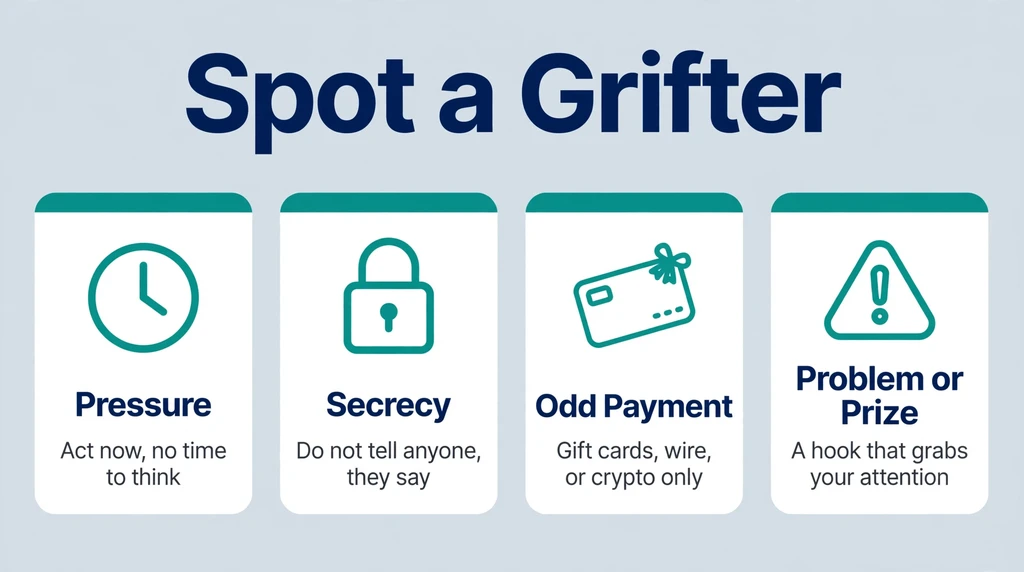
New tricks appear constantly, but the pressure points stay familiar. Consumer protection experts make the same point: the story changes, while the mechanics repeat. The signs below work on the street, on the phone, and online.
The FTC’s Four Signs
The US Federal Trade Commission teaches four signs that expose most scams. First, scammers pretend to be from an organization you know, such as a bank, a government agency, or a famous company. Second, they say there is a problem or a prize, because both hooks demand attention.
Third, they pressure you to act immediately, before you can think or check. Fourth, they tell you to pay in a specific way, such as a gift card or a money transfer service. Any one sign deserves caution; two together should end the conversation.
Pressure and Secrecy
Speed is the grifter’s oldest tool. A decision made in a rush is a decision made without questions, so the offer always expires soon and the emergency cannot wait until tomorrow.
Secrecy is the partner tool. You may be told not to mention the deal to your bank, your family, or the police. That instruction is never for your protection. It exists to cut off the second opinion that would kill the trick.
Strange Ways to Pay
Follow the money and the trick shows itself. Legitimate organizations do not demand gift cards, wire transfers, or cryptocurrency as the only way to pay a debt or claim a prize. The FTC states the rule plainly: only scammers insist on payment methods like these, because they are hard to trace and nearly impossible to reverse.
The same logic covers the fake check trick. Never deposit a check and send part of the money back to someone. When the check bounces, the bank will hold you responsible for what you sent.
Slow Down and Verify
The counter-move is boring, which is why it works. Stop, leave the conversation, and check the claim through a channel you find yourself. Call the number on your bank card, not the number the stranger gave you.
Talking to someone you trust breaks the spell as well, which is precisely why grifters discourage it. If money has already gone, report the fraud quickly; in the United States, reports go to the Federal Trade Commission at ReportFraud.ftc.gov. Fast reporting gives banks and investigators their best chance to help.
If You Already Paid
Speed matters after a loss, too. Contact your bank or card issuer at once, because early calls give them the best chance to freeze or recover funds. For a gift card, call the company that issued it, keep the card and the receipt, and ask what can still be done.
Save everything: messages, numbers, receipts, and screenshots. Then file the report with the FTC and, for larger losses, your local police. A paper trail will not undo the trick, but it protects you if the same operator tries a second act, a common follow-up in which the “recovery” offer is itself another grift.
Grifters in Books, Film, and Comics
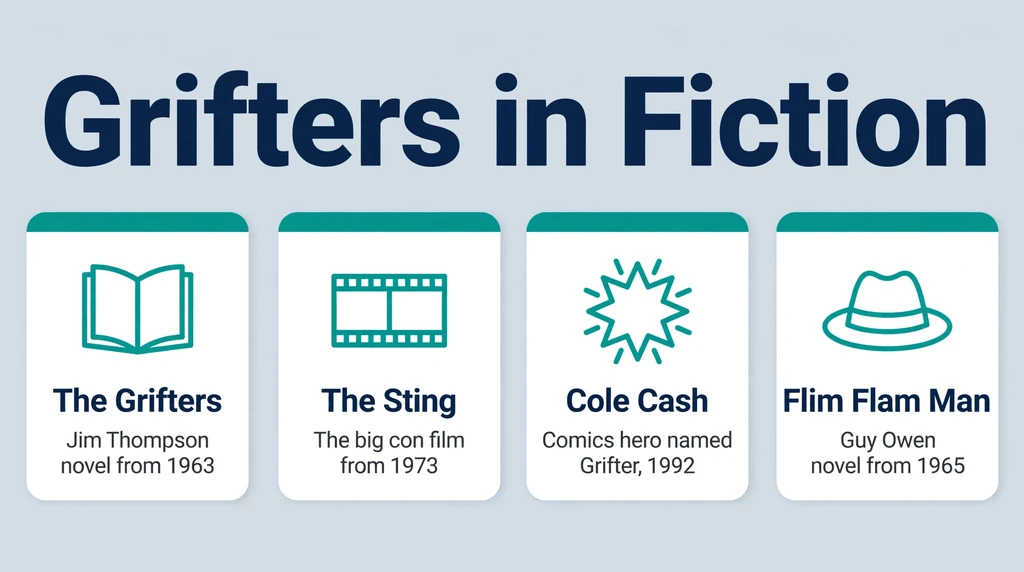
Fiction adores the grifter, because the type offers charm, skill, and danger without gore. Three landmarks show how deeply the word settled into popular culture.
The Grifters: Thompson’s Novel and the 1990 Film
Crime writer Jim Thompson built a novel around the type in 1963. His *The Grifters* follows small-time operators whose tricks keep failing against bad luck and worse family ties. Thompson knew the milieu and wrote it cold, without glamour.
The story reached the screen in 1990. Stephen Frears directed, Martin Scorsese produced, and Donald E. Westlake adapted the novel. John Cusack, Anjelica Huston, and Annette Bening play the central trio, and Huston’s performance earned an Academy Award nomination. The film remains the word’s defining portrait: stylish people, shabby stakes, real damage.
The Sting and the Big Con
*The Sting*, from 1973, gave the long con its most famous outing. Its heroes build an entire fake betting parlor to fleece a mob boss, which is the big store setup that con historians list among the classic long games.
An early scene even runs a pigeon drop, the envelope trick described above. Few films teach the vocabulary of the grift as painlessly as this one does.
The Flim-Flam Man
Regional English gave the type its own name. A flim-flam man is a swindler whose nonsense patter does the work, and *flim-flam* itself is listed among the synonyms of the grift.
Guy Owen’s 1965 novel *The Ballad of the Flim-Flam Man* made the figure famous, followed by the 1967 film with George C. Scott as Mordecai Jones. His Jones runs the pigeon drop and three-card Monte through the rural South, insisting he only robs people who were hoping to cheat someone else first.
A Superhero Named Grifter
Comics borrowed the word for a very different figure. Grifter, real name Cole Cash, first appeared in *WildC.A.T.s* #1 in August 1992, created by artist Jim Lee and writer Brandon Choi for Lee’s WildStorm imprint. His codename trades on the word’s outlaw flavor, although the character is a soldier and operative turned masked hero, not a swindler.
Lee sold WildStorm to DC Comics in 1999, and the character moved with it. He later headlined his own series in DC’s 2011 New 52 relaunch. For many readers, this gun carrying hero is now the first Grifter they ever meet.
Grifter in a Sentence
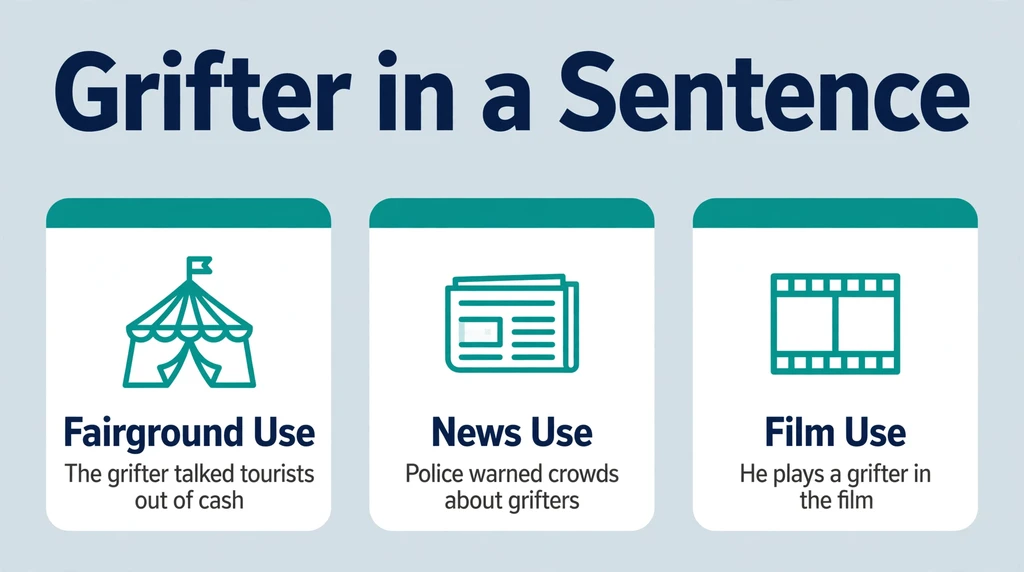
The word sits comfortably in news reports, reviews, and everyday speech. Notice how often an adjective such as *small-time*, *professional*, or *charming* travels with it.
- The grifter at the fair talked tourists out of their cash with a rigged card game.
- She realized the friendly investor was a grifter only after he vanished with her deposit.
- Police warned market visitors to watch for grifters working the weekend crowds.
- In the film, he plays a grifter whose charm always arrives one step ahead of the truth.
- The email looked official, but a grifter had written it to harvest bank details.
- Old carnival grifters moved from town to town with the show and never stayed long.
- The so-called charity turned out to be run by grifters who kept every donation.
- A skilled grifter never threatens anyone; the victim hands over the money smiling.
- After three towns and two arrests, the grifter finally retired his card trick.
- Reporters described the fake guru as a grifter who sold hope by subscription.
- Neighbors later learned that the handyman was a grifter who collected deposits and never returned.
- Her memoir describes two restless years spent traveling with a band of grifters.
Register and Common Companions
One register note: *grifter* is informal and mostly American. It suits journalism, fiction, and conversation, while formal legal writing usually prefers *fraudster* or a specific charge.
Certain companions show up constantly. Writers call someone a *small-time grifter* when the stakes are petty, a *petty grifter* with the same idea, or a *professional grifter* when trickery is plainly the person’s trade. You will also meet the plural in roundups and warnings, since grifters historically worked crowds, fairs, and, in our century, whole platforms at once.
Synonyms and Related Terms
Several near synonyms circle the same territory, each with a slightly different shade.
- Swindler is the plain, general term and the safest choice in neutral writing.
- Con artist stresses the performance and the trust that makes it work.
- Hustler is broader; it can mean a fraud, but also simply an aggressive go-getter.
- Trickster sounds lighter and older, closer to folklore than to crime reports.
- Sharper is an old-fashioned word for a cheat, especially at cards.
- Chiseler is dated slang for a petty cheat who shaves small amounts from others.
- Defrauder is the dry, formal option, common in legal and financial writing.
- Slicker is informal shorthand for someone smooth, practiced, and not to be trusted.
- Flim-flam man is another period term, naming the swindler after his nonsense patter.
The shared root idea never changes. Every one of these words describes someone who profits because other people believed a performance.
Frequently Asked Questions
What is a grifter in simple words?
A grifter is a person who tricks people into giving up money. The grifter lies, charms, or stages a situation so that the victim pays willingly. It is theft by persuasion rather than by force.
Is a grifter the same as a con artist?
Almost. Dictionaries treat the words as near synonyms, and every grifter is a kind of con artist. *Grifter* adds a flavor of small scale, travel, and street level performance, while *con artist* covers the grand staged fraud as well.
What is the difference between a grifter and a scammer?
A scammer usually works remotely and at scale, using messages, calls, or fake websites aimed at many people at once. A grifter traditionally works a persona in person, one victim at a time. Modern usage blurs the line when an online trickster builds the same one-to-one relationship.
Where does the word grifter come from?
It comes from American slang of the early 1900s, first recorded in carnival and circus settings. Most etymologists treat *grift* as an alteration of *graft*, the older word for dishonest gain, making *grifter* a reshaping of *grafter*.
What does grift mean as a verb?
To grift is to obtain money or property through trickery. A person might grift cash from tourists or grift donations through a fake charity. The noun *grift* can mean the scheme itself or the money it brings in, and people who live by it are described as being *on the grift*.
Are grifters violent?
Typically not. Reference works stress that grifters rely on cleverness and deceit and do not usually use physical force. The harm is financial and emotional, and it can still be severe.
How can you tell if someone is a grifter?
Look for pressure, secrecy, and odd payment demands. A stranger who insists you act now, keep the deal quiet, and pay by gift card, wire, or crypto is following the classic pattern. Slowing down and checking the story independently defeats most attempts.
What is a female grifter called?
The same word. *Grifter* does not change with gender, and writers use it for women and men alike, just as *con artist* does. The older term *con woman* exists as a direct counterpart to *con man*, but plain *grifter* is the common choice today.
Final Thoughts
A grifter is a swindler with a stage, even when the stage is only a sidewalk, a phone call, or a feed. The word carries its carnival birthplace inside it: quick hands, quicker talk, and a crowd that never notices the switch.
That history is also the defense. Once you know the pattern, built on trust, urgency, and a payment that cannot be undone, the performance loses its power. It also explains why the word refuses to retire: every era produces performers who sell trust they never earned, and English keeps the old carnival label ready for them.
So the next time the word crosses your screen, you will know exactly what it charges. Not mere dishonesty, and not theft at gunpoint, but a living earned by turning confidence into cash and being gone before the spell breaks. For a deeper dive into the word’s tangled family history, Merriam-Webster’s entry on grift traces its long argument with *graft*, and it is well worth the read.