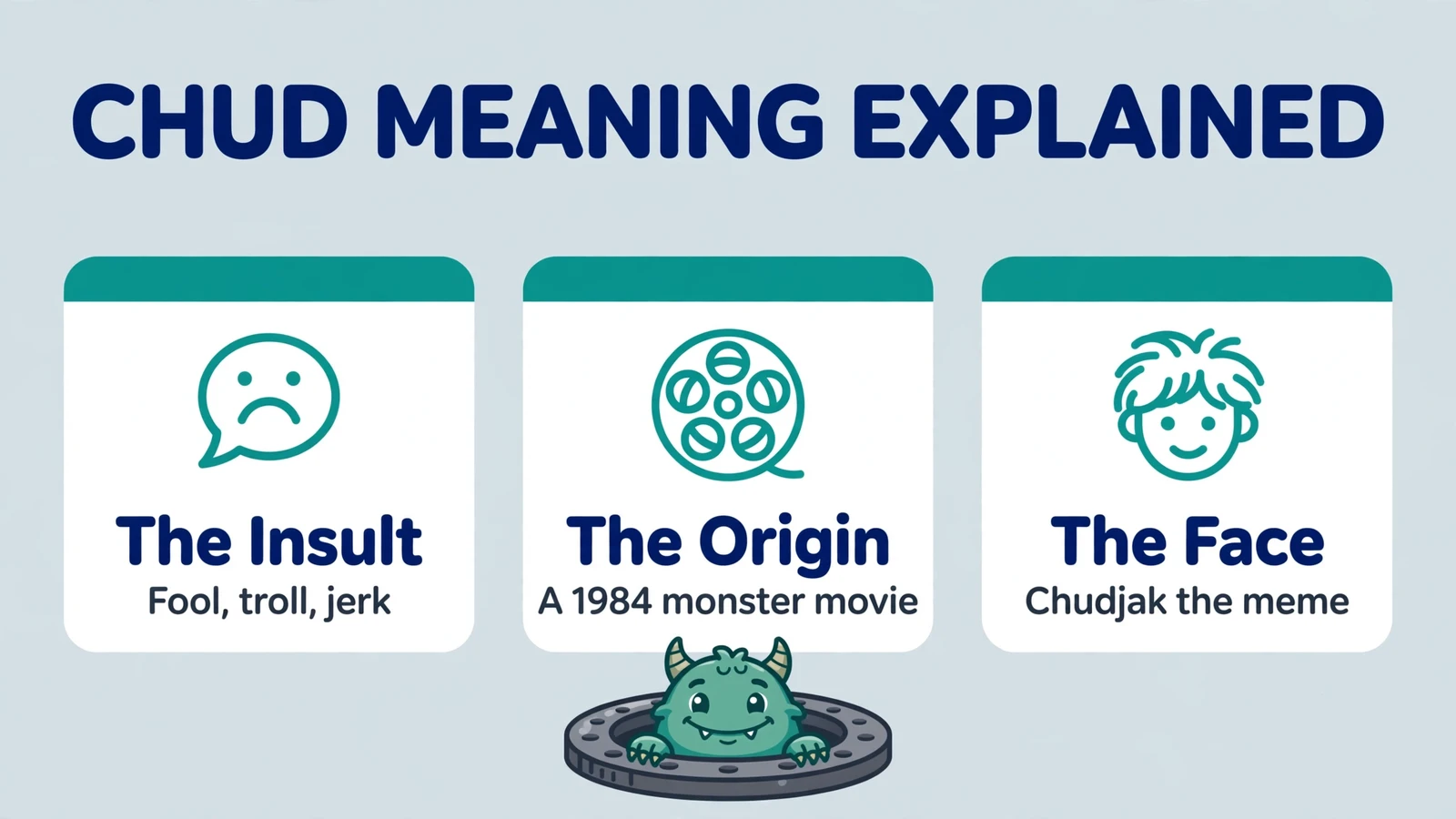
Chud is a slang insult for a person, usually a man, who is seen as a boorish loser. Rude, unintelligent, or unpleasant to be around. Merriam-Webster calls it a generalized term of disparagement, roughly a blend of fool, troll and jerk. The word is pronounced “chuhd” and rhymes with mud.
It is a strange word with a strange journey. It began as the name of sewer monsters in a 1984 horror film, spent years as a minor insult, became a political label in the 2010s, gained a cartoon face. And now gets used by teenagers for a brother who will not leave the sofa.
This guide traces that whole journey from the record. The dictionaries that now define the word, the film that named it. And the meme archives that tracked its spread. Below you will find every current sense of chud, where each one came from. And how to tell them apart, checked against real sources.
Chud at a Glance
- Modern meaning: an insult for a boorish, unlikable or foolish person, usually a man; roughly fool, troll or jerk
- Pronunciation: /tʃʌd/, “chuhd”, rhymes with mud, blood and thud
- Political sense: used in online political arguments, mainly by left-leaning posters, for a man they perceive as far right or reactionary. Partly reclaimed by its targets as an ironic self-label
- Origin: the 1984 horror film C.H.U.D., where the letters stood for Cannibalistic Humanoid Underground Dwellers
- Meme form: Chudjak, a cartoon face used across the political spectrum and beyond
- Current trend: the word has softened into a general, often self-deprecating word for a loser or disappointment
- Not related to: Chad, despite the similar sound; the medieval Chud peoples; or the British word for chewing gum
What Does Chud Mean Today?
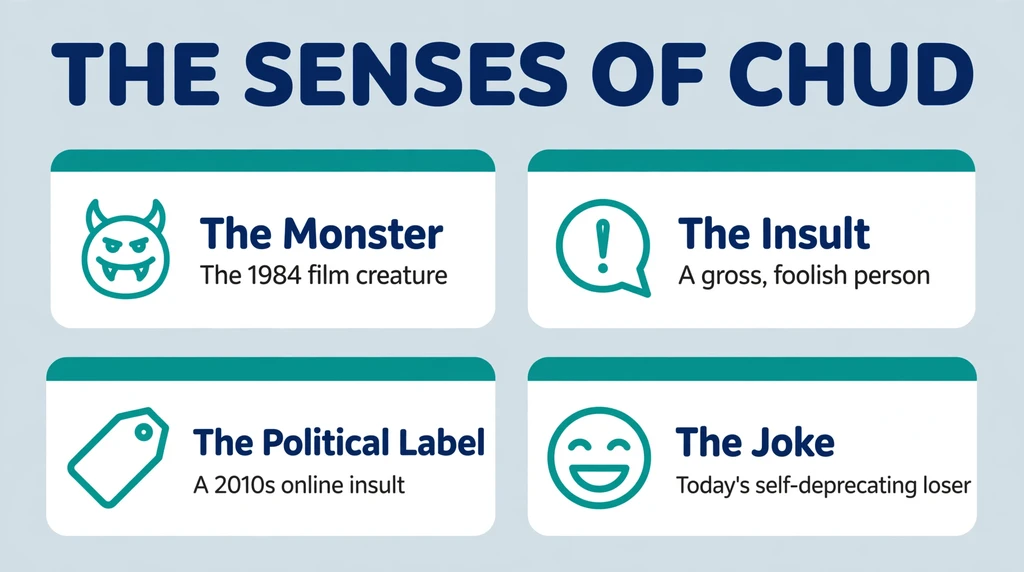
Start with the sense you are most likely to meet now. In current everyday slang, calling someone a chud means calling them a loser in a particular flavour. Unlikable, useless, a bit gross, going nowhere. Dictionaries record the target as usually a man, and the tone as scornful but frequently joking.
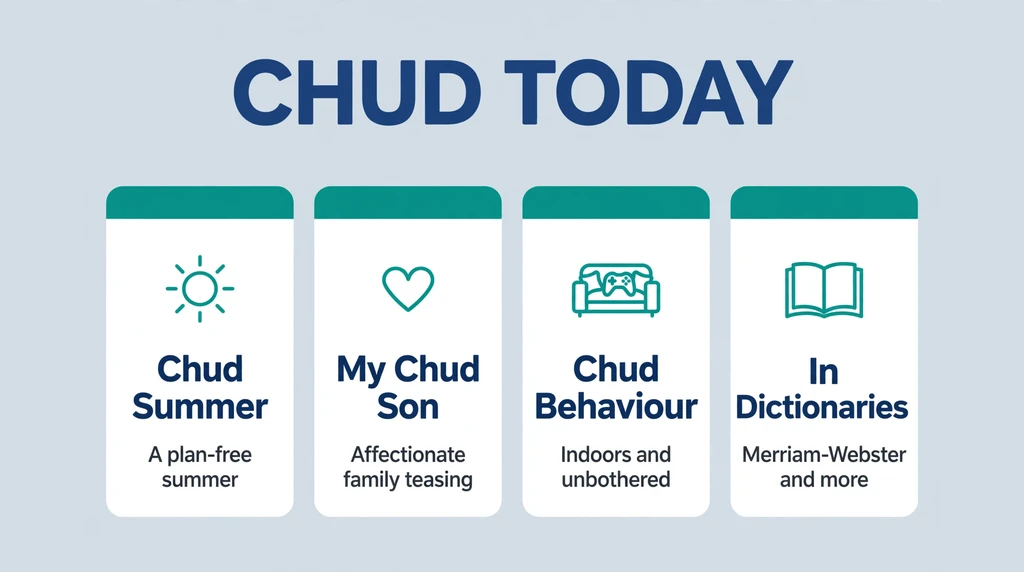
The word today is often aimed inward or at people the speaker knows. “My chud son” is a phrase parents and older siblings post with affectionate despair about a teenager who games all day. Students talk about having a “chud summer”. A summer of staying in, no internship, no travel, no plans, a phrase documented by The Cornell Daily Sun. A college “Chud-off” competition in Richmond, Virginia, crowned the most chud-like participant. And one entrant defined the current meaning on the spot as someone who stays inside, never does anything with their life, and is unemployed and unbothered.
That is a long way from the word’s fiercest years. Linguists call the process semantic bleaching. A sharp insult loses its edge through overuse and irony until it becomes a general put-down you can aim at yourself. Chud has bleached so thoroughly that recent slang round-ups for Generation Alpha list it alongside words like 6-7 and chopped, as ordinary youth vocabulary rather than political vocabulary.
The dictionary definition still matters, though, because the older senses have not disappeared. Depending on who is speaking, and where, the same four letters can carry the modern loser sense, the political sense described next, or a knowing reference to a forty year old monster movie. Context does the work.
The Political Meaning, Explained
For most adults who know the word at all, chud is a political insult. And this section explains that sense carefully and neutrally, the way a dictionary should.
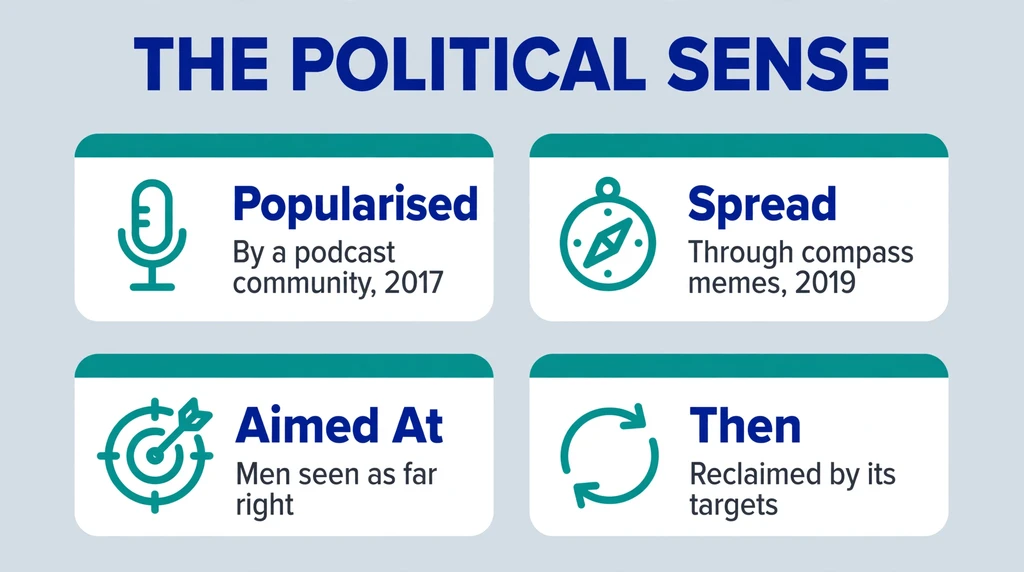
In online political discourse, left-leaning posters have used chud mainly as a label for men they perceive as far right or reactionary in their views. And more loosely for anyone they find ignorant or boorish in political argument. Merriam-Webster’s slang entry describes exactly this. In political contexts, the word is “often used specifically as a left-wing insult for someone (usually a man) on the far right.”
Where the Political Sense Came From
Where did that sense come from? Not from the film directly. The community around Chapo Trap House coined and popularised the political use in the late 2010s, a left-wing comedy and politics podcast. According to Wiktionary’s etymology, the community deliberately wanted an insult for right-wingers that was not borrowed from any existing slur. And settled on the old monster word. Dictionary.com points to a 2017 podcast episode titled “From Russia with CHUD” as an early marker. And the term spread widely through political compass memes in 2019 and onto forums like 4chan.
Then the word changed hands. Both Dictionary.com and Wiktionary record that some of the people the insult targeted began using it about themselves, ironically and even proudly. A true chud, in that in-group usage, is a compliment meaning someone who holds unfashionable views without apology. Reclamation of insults is a familiar pattern in slang history, and chud followed it almost to the letter.
Two cautions belong here. First, the political sense was a repurposing, not the word’s invention. The film title dates to 1984 and generic insult uses are documented from the early 2000s, as the next sections show. Second, in political spaces the word remains a genuine insult with a target. Whether it lands as banter or abuse depends entirely on who says it to whom. This is true of most strong slang.
How the political sense spread
The podcast community gave the word its political charge, but memes gave it mileage. In 2019, political compass memes, the grid format that sorts people into ideological quadrants and caricatures each one, adopted chud as the label for one whole corner’s worst inhabitant. Formats like that travel farther than any podcast. People who have never heard the source copy, edit and repost them. From there the word moved through 4chan, where users aimed it both at political opponents and, in the word’s emerging second career, at the forum’s own stereotypical user, the figure Chudjak was drawn to represent.
The spread had an unusual feature: nobody owned it. Coined by one side, drawn by the other side, reclaimed by its targets. And finally adopted by teenagers with no politics in it at all, chud passed through so many hands that its meaning became genuinely public property. That is why dictionaries now need several senses to cover a four letter word. And why any honest answer to “what does chud mean” has to start with “it depends who is talking”.
Where the Word Comes From: The 1984 Film C.H.U.D.
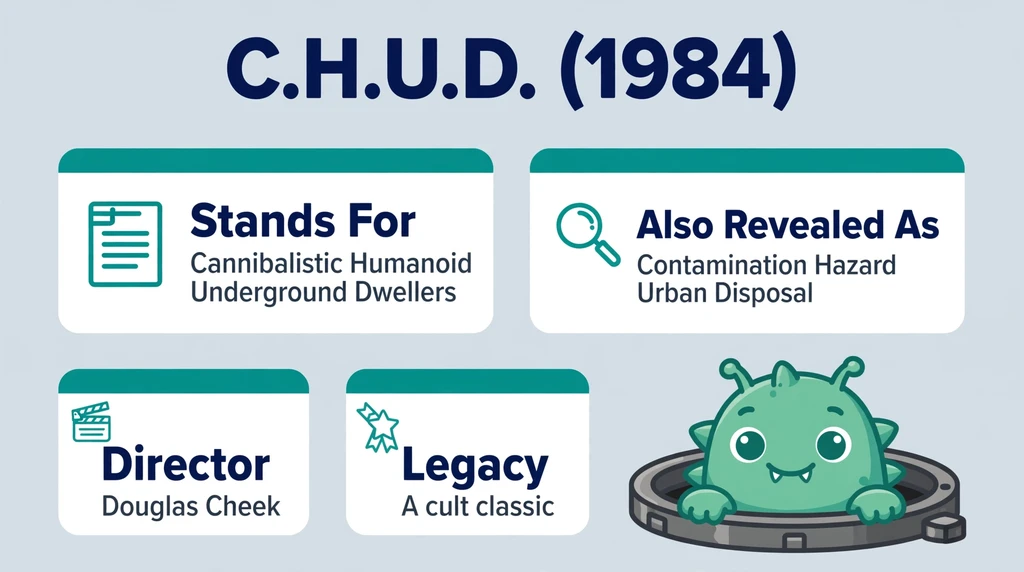
Every sense of chud grows out of a low budget horror film. C.H.U.D. was released on 31 August 1984, directed by Douglas Cheek, written by Parnell Hall. And starring John Heard, Daniel Stern and Kim Greist. It was made for about 1.25 million dollars and earned roughly 4.7 million at the box office, respectable numbers for a creature feature. And it has lived on as a cult film ever since. A sequel, C.H.U.D. II: Bud the C.H.U.D., followed in 1989.
The premise is pure 1980s New York anxieties. People are disappearing in the city. And the trail leads underground, to the sewers and tunnels, where mutated former humans are living and hunting. The creatures are the C.H.U.D.s. In the film’s famous reveal, the acronym stands for Cannibalistic Humanoid Underground Dwellers.
The Title’s Second Meaning
The film also plays a small trick with its own title. Later in the story, the government’s files reveal that the letters stand for something else. Contamination Hazard Urban Disposal, the secret project whose toxic waste created the creatures in the first place. Both expansions are part of the lore, and both still get searched for today, which is why “what does C.H.U.D. stand for” remains one of the most common questions about the word.
Why did this particular monster name survive when a thousand others did not? Partly the sound: short, blunt, and funny to say. Partly the image: a chud was not glamorous evil, it was squalid, underground and repulsive. This made the word a ready made shorthand for a person considered gross or beneath notice. When later generations needed a fresh insult, the word was sitting in the culture’s attic, waiting.
The film’s afterlife kept the word in circulation. The creatures became a standing reference for anything squalid lurking beneath a city, the kind of joke traded by comedy writers and film fans for decades. A much quoted Simpsons gag even has Homer fleeing through New York from “pimps and chuds”. The sequel in 1989, home video, and endless late night cable repeats did the rest. By the time the internet needed the word, C.H.U.D. was not a hit anyone had to explain. It was furniture in the culture’s basement.
The Forgotten Middle Years: Chud Before Politics
Between the film and the podcast, chud lived a quiet second life as generic slang for a disgusting or stupid person. And this era matters because it corrects the most common myth about the word: that a 2010s podcast invented it.
Dictionaries of record document the trail. Wiktionary’s citations show the word used on Usenet in the early 2000s and in print through the following decade, always in the same broad sense of a repulsive or contemptible person. The first Urban Dictionary entry for chud dates to 28 February 2003, defining it as a stupid and ugly person. Urban Dictionary is a low authority source, anyone can post there, but the date aligns with the Usenet record. And together they establish that the insult sense is years older than its political fame.
Pop culture kept the word warm, too. The film’s creatures became a standing joke about things lurking under cities, the kind of reference comedy shows and film nerds traded for decades. When the Chapo Trap House community reached for an insult in the late 2010s, they were not inventing a word from nothing. They were reviving one that had meant “gross underground creature” and then “gross person” for over thirty years.
Understanding this middle era explains the word’s later flexibility. A term that had already drifted from monster, to gross person, to political label, had one more drift left in it. And the internet was about to give the word a face.
Chudjak: The Face of the Word
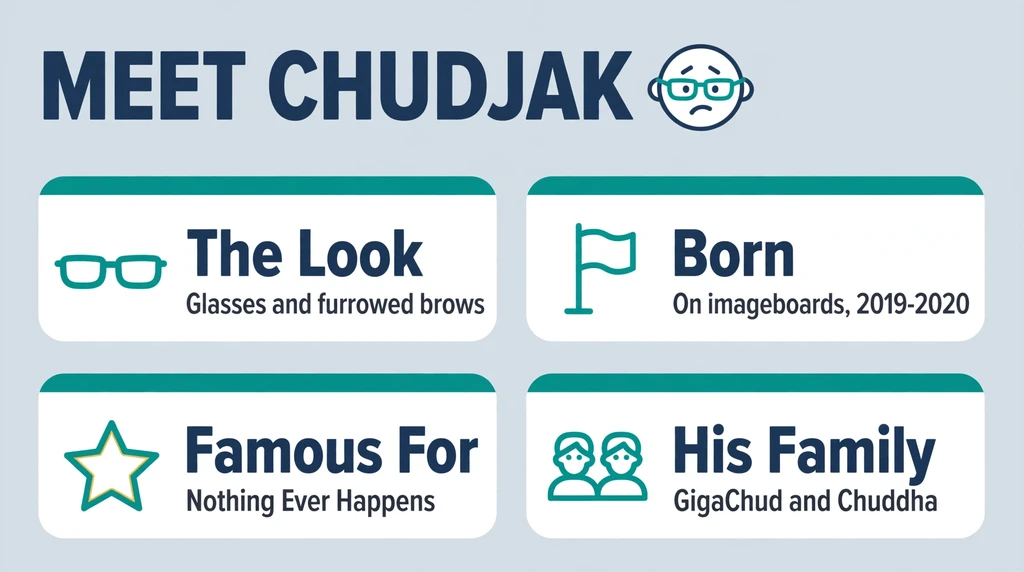
If you have seen chud online recently, you have probably seen it as a drawing. Chudjak is a cartoon character in the Wojak family of meme faces. Short black hair, furrowed brows, square rimmed glasses, a weak receding chin. He is drawn to look perpetually aggrieved. And he stars in thousands of memes, most famously the format captioned “Nothing Ever Happens”, in which Chudjak smugly predicts that no big event will change anything at all. The catchphrase itself circulated on 4chan’s /pol/ board in the early 2010s as the pessimistic opposite of “It’s Happening”. And the character later became its mascot.
The Earlier Faces
The character’s own history is layered. An early front facing version, called Le /pol/ Face, appeared on 4chan in 2019 as a caricature of the stereotypical user of its politics board. The now familiar side facing Wojak style version, Chudjak, was created on Bunkerchan, a left wing imageboard, around late August 2020, that is, the face was drawn by critics of the people it depicts. And then, following the word’s own pattern, was adopted by everyone: the people it mocked, their opponents. And eventually general meme culture with no politics attached. Offshoots multiplied, including GigaChud (a mashup with the hyper masculine GigaChad), Chudcel, Chudette and Chuddha.
One part of this history is serious, and a responsible guide should state it plainly. Meme historians at Know Your Meme and reporting by the Daily Dot have established that its creator modelled the original face on the perpetrator of the 2019 El Paso Walmart shooting, a real mass murder in which 23 people were killed. Most people who post Chudjak memes today do not know this, and the character has drifted far from its source. But the origin is documented, the character has also surfaced in genuinely extremist material. And it is the reason some people find the meme disturbing rather than silly. Knowing it does not oblige you to feel any particular way about a cartoon. It does mean the face is not as innocent as it looks.
The Chud Family: GigaChud, Chudcel, Chuddha and Friends
A successful meme face spawns relatives, and Chudjak spawned a clan. GigaChud fuses him with GigaChad, producing a muscle bound Chudjak played sometimes as a joke about unlikely confidence, sometimes as an unironic avatar. Chudcel blends chud with incel vocabulary, a label aimed at men seen as both politically chud-like and romantically unsuccessful. And is used almost entirely as an insult. Chudette is the rare female variant. Chuddha is the serene remix: Chudjak redrawn as a serene Buddha-like figure, the joke being that the character famous for declaring that nothing ever happens has achieved enlightenment about it. And this calmer version went widely viral in 2024. There is even an Avatar Chud. And a running series of weekly shirt variants in the Wojak communities that keep the base face in constant circulation.
The derivatives tell the same story as the word itself. A character designed as a hostile caricature became a flexible doll that every corner of the internet dresses for its own jokes, including jokes at nobody’s expense at all. When a meme reaches that stage, its original meaning matters less than its availability. And Chudjak is nothing if not available.
Chud vs Chad: The Internet’s Favourite False Etymology
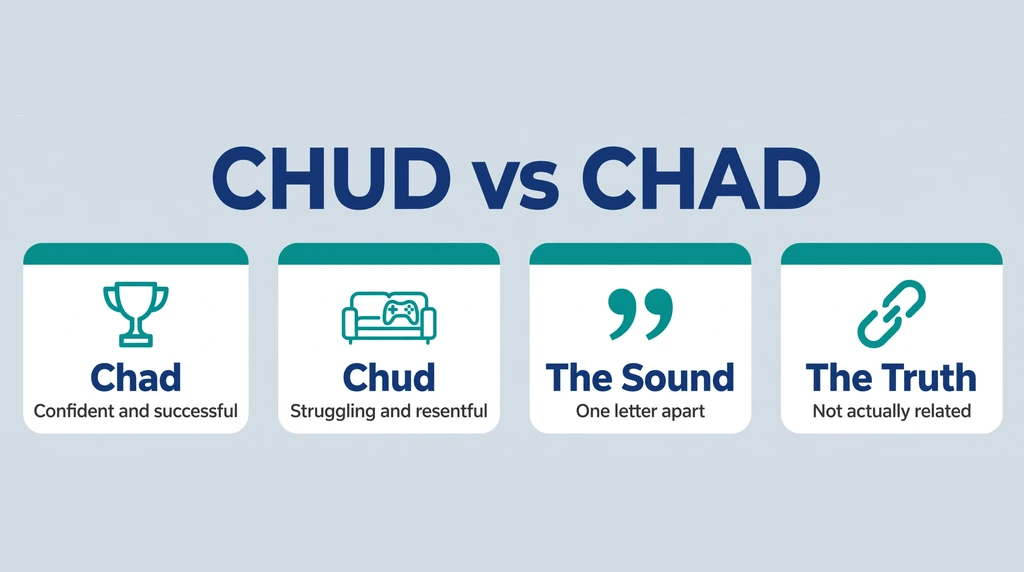
Ask the internet about chud and someone will tell you it is the opposite of Chad. In meme culture, that is functionally true. Chad, and his exaggerated form GigaChad, is the confident, attractive, successful man of internet mythology. A chud is his shadow: unsuccessful, unattractive, resentful, going nowhere. The two words are paired constantly, in versus memes, in the portmanteau GigaChud. And in everyday slang where being called one or the other is a whole verdict on a person.
As language, though, the pairing is a coincidence, and the dictionaries are explicit about it. Wiktionary states that slang chud is etymologically unrelated to Chad. And also unrelated to the similar sounding chuzz, chode and chungus. Chad comes from American campus slang with its own separate history; chud comes from a 1984 monster movie. The words met in memes because they sound like opposites and differ by one letter, not because they share a root.
It is a tidy example of how internet etymology works. A false connection that feels true will outrun the real one. The real one, in this case, involves radioactive sewer mutants, which is arguably better.
How Chud Is Used Now
The word lives in several places at once, and each habitat shades the meaning slightly differently.
On X (formerly Twitter), chud survives in both its political sense, in argument threads. And its bleached sense, in jokes about oneself and one’s friends. On Reddit, it appears in slang and meme communities, often entirely detached from politics. On TikTok, younger users overwhelmingly meet the modern senses. Chud as loser, chud summer, my chud son, delivered as punchlines in videos about doing nothing, badly. In the Soyjak and Wojak meme world (imageboards and sites like Soyjak.party), Chudjak remains a stock character. And derivatives like Chuddha and the weekly shirt variants keep the face in circulation. On newer platforms the political sense lingers mainly among adults who were online in the late 2010s.
The practical rule for reading the word is generational. From a teenager, chud almost certainly means a lazy loser, possibly themselves. A political account may still mean the 2010s insult in full force. From a film fan, it may simply mean the monsters. The clearest sign of the word’s final landing spot is where dictionaries now catalogue it. Slang round-ups aimed at explaining Generation Alpha list chud near the very top of the terms adults ask about, in the company of 6-7, chopped, unc and clanker rather than any political vocabulary. Explaining chud has itself become a genre. Newspaper explainers, dictionary updates and school newsletter warnings all treat it as youth slang to be decoded, the same treatment words like skibidi received a year earlier. A word that began as a warning label ended as homework for parents.
The word has not settled, and honest dictionaries now list the senses side by side. This is what this guide has done.
Chud in the Wild: How People Actually Use It
Abstract senses are easier to grasp through the patterns dictionaries and forums record. In political threads, the classic use is a dismissal. A poster quotes an opponent’s argument and answers simply that he is a chud. This ends the discussion by labelling rather than rebutting. In the reclaimed usage recorded by Wiktionary, the polarity flips. “Unlike all those cuckservatives in Congress, this guy’s a true chud” is praise inside that community, meaning the man holds his positions without flinching.
In the bleached modern sense, the examples are domestic. “My chud son hasn’t left his room since June” is a joke about a beloved slacker, not an enemy. “I’m a worthless chud” is self mockery after a wasted weekend. “Chud behaviour” and “chud energy” describe a whole style of living: indoors, unbothered, unambitious, faintly feral. And the word has been newsworthy enough in this journey to earn a full explainer in The New York Times. This is usually the final stop for a slang term’s trip from the underground to the mainstream.
Notice what changes across those examples and what does not. The target is always a man, or a male coded character. The sneer is always present, but its temperature drops from political hostility to family teasing. And the speaker’s own position flips freely, which is something few insults survive. Chud did, because each community that picked it up found it useful for its own purposes.
Is Chud an Insult? Is It Offensive?
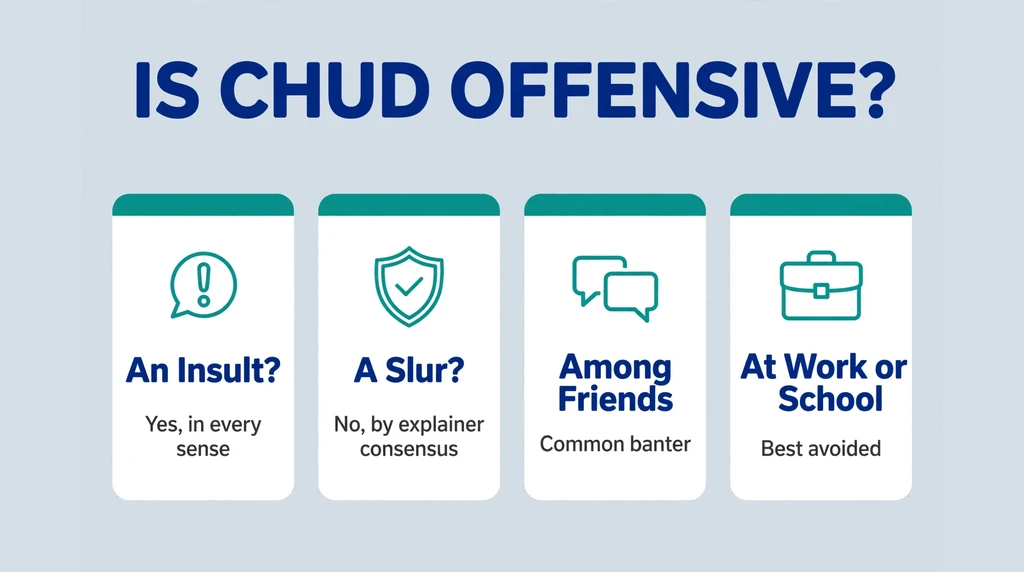
Yes, chud is an insult. That is the one thing every sense of it agrees on, from the monster to the meme. Calling someone a chud is never a compliment in the speaker’s own voice, except in the reclaimed in-group usage where its targets apply it to themselves as a badge.
Is it a slur? By the standard explainer consensus, no. A slur targets people for who they are, by race, sexuality, disability or similar protected characteristics. Chud targets behaviour, appearance, politics and perceived failure. It is a pejorative, in the same family as jerk, loser and troll. This is exactly the company Merriam-Webster places it in. That does not make it kind. It can be bullying when aimed at a real person, and in political contexts it is meant to wound. In the workplace, at school, or anywhere the target has not agreed to the joke, it is a word to avoid.
Severity, roughly: far milder than genuine slurs and profanity, roughly on the level of calling someone a loser to their face, with an extra sneer. Among friends, and about oneself, it is now common banter. Aimed at a stranger’s politics or appearance, it is an attack, and readers will receive it as one.
Words Like Chud: Synonyms and Neighbours
Because this is a thesaurus at heart, here is where chud sits among its neighbours, and what shades separate them. Merriam-Webster’s own synonym set for the broad sense is fool, troll and jerk. And each misses something chud has. Fool is about intelligence only, troll is about behaviour online, and jerk is about manners. Chud adds appearance, lifestyle and failure to the charge sheet, which is why it stings more colourfully.
Loser is the closest plain English equivalent of the modern sense. And the bleached chud is nearly interchangeable with it, minus the film history. Wasteman, in British slang, covers similar ground with a local accent. Soy boy and its meme descendant the Soyjak target perceived softness and enthusiasm rather than failure. They overlap with chud in political meme wars but aim at a different flaw. NPC accuses the target of having no inner life or original thought, a colder and more dehumanising charge than chud’s. Doomer is not an insult so much as an archetype, the young pessimist who has given up. And Doomer and Chudjak are cousins in the Wojak family album. Normie is the outsider label the whole cluster defines itself against. The ordinary person who belongs to none of these categories.
None of the neighbours has chud’s range. That, in the end, is the finding of this whole guide. One word doing the work of a monster, an insult, an ideology label, a cartoon and a family joke, with the exact meaning supplied fresh by every speaker who uses it.
Not That Chud: Words It Is Not
A few unrelated words share the spelling, and search results mix them together. For the record:
- The historical Chud (also Chude) were Baltic Finnic peoples referred to in medieval East Slavic chronicles, in what is now Estonia, Karelia and northwestern Russia. Lake Peipus is still called Chudskoye, “Lake of the Chud”, in Russian. This is a transliteration coincidence with no connection to the slang word.
- Chud, in British and New Zealand slang, can mean chewing gum (with the derivative chuddy). Also unrelated; its roots run through chew and cud, not through cinema.
- Chud as a verb existed in old dialect English meaning to champ or bite. And a West Country dialect chud appears in Shakespeare’s King Lear meaning “I could”. Historical curiosities only.
- Chud is not a typo for Chad, and neither word comes from the other, as covered above.
Chud Timeline: The Word, Decade by Decade
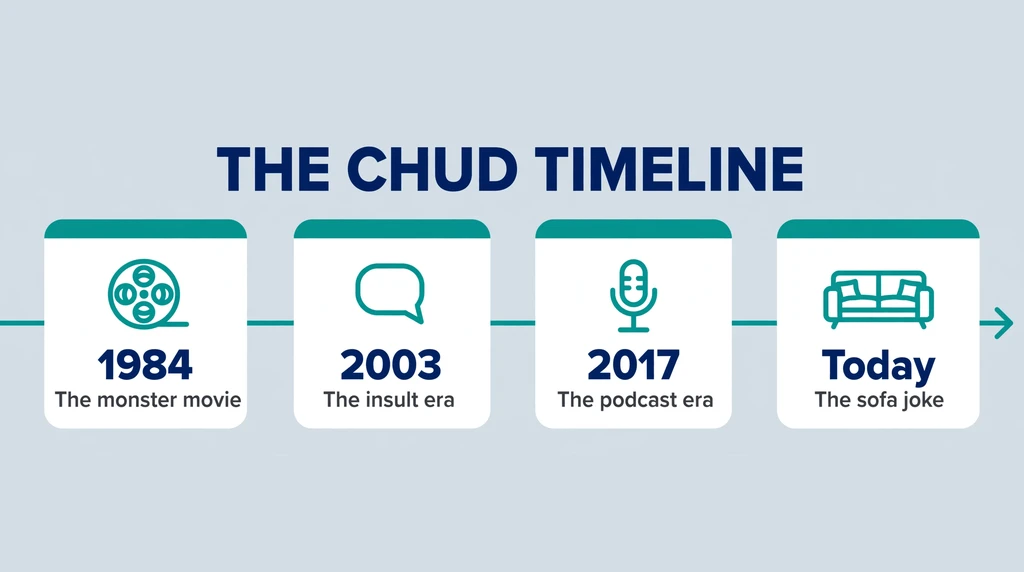
- 1984: C.H.U.D. is released. The monsters under New York give the culture a new word, though almost nobody uses it as slang yet.
- 1989: The sequel, C.H.U.D. II: Bud the C.H.U.D., keeps the title in video shops and late night television.
- Early 2000s: The word circulates on Usenet and early forums as a word for a gross or contemptible person. Urban Dictionary’s first entry dates to 28 February 2003.
- 2017: The Chapo Trap House podcast airs “From Russia with CHUD”, the marker Dictionary.com gives for the political sense taking off.
- 2019: Political compass memes carry the word across the internet. Le /pol/ Face, the drawing that will become Chudjak, appears on 4chan.
- 2020: The Wojak style Chudjak is created on the left wing imageboard Bunkerchan. And the face detaches from any single board or viewpoint.
- 2024: Chuddha, the serene remix of the character, goes mainstream, and “Nothing Ever Happens” becomes a general purpose reaction meme.
- Mid 2020s: The bleaching completes. Students coin “chud summer”, a Virginia college runs a Chud-off, dictionaries list the general loser sense. And The New York Times publishes an explainer. The word now belongs to everyone, which is to say it wounds almost no one the way it used to.
Why Did This Word Survive?
Most slang dies within a year. Chud has survived forty, in four different forms, and the reasons are a small lesson in how words live.
It sounds like what it means. Chud is one blunt syllable ending in a thud, a rhyme for mud and dud. English speakers instinctively trust sound symbolism: short, heavy words feel like insults. And chud feels like one before you know its history. Even the monster connection helps. A word secretly meaning “sewer mutant” carries its disgust built in.
It kept changing jobs. Film title, underground insult, political weapon, meme face, family joke. Each generation that picked the word up found a new use for it. And each use advertised the word to the next generation. Words that serve many masters outlive words with one.
Funny at Every Stage
It was funny at every stage. The monster was funny. The political label was, to its users, funny. And the face is funny. The chud son is funny. Humour is slang’s best preservative, because people repeat what makes them laugh long after they stop meaning it.
It got documented. Dictionaries and encyclopaedias now anchor the word. Full slang entries in Merriam-Webster and Dictionary.com, a dedicated Wikipedia article, a New York Times explainer. Once a word is written down by the record keepers, it stops depending on any single community to remember it. Chud’s paperwork is complete.
It arrived in the right economy. The 2010s and 2020s rewarded exactly what chud is: a short, screenshot friendly label with a face attached. Political argument moved onto image platforms, attention spans shrank. And vocabulary that could carry an argument in four letters and one drawing outcompeted vocabulary that needed a paragraph. Chud was pre adapted to that world by accident: brief like a hashtag, expressive like a cartoon. And old enough to feel discovered rather than manufactured. Slang rarely gets a fairer wind than that.
Grammar, Forms and Pronunciation
Chud is a countable noun: one chud, many chuds. The adjective forms recorded by Wiktionary are chuddy and chudly. And the noun chuddiness exists as a joking measure of the quality (“peak chuddiness”). In sentences it behaves like other person insults: it takes an article (“a total chud”), works in the plural. And is often softened with possessives in the modern familiar use (“my chud brother”). The pronunciation never changes: “chuhd”, one syllable, the u of mud. Only the film title is spelled aloud, C.H.U.D.. And only when the speaker means the monsters specifically, or wants the retro reference to land.
Frequently Asked Questions
What does chud mean?
Chud is a slang insult for a person, usually a man, considered boorish, foolish or unlikable. Merriam-Webster defines it as a generalized term of disparagement similar to fool, troll or jerk. In current youth slang it often just means a loser or disappointment, frequently said about oneself.
What does C.H.U.D. stand for?
In the 1984 film C.H.U.D., the letters stand for Cannibalistic Humanoid Underground Dwellers, the mutated creatures living under New York City. The film also reveals a second meaning inside the story: Contamination Hazard Urban Disposal, the government project that created them.
Where does the word chud come from?
From the 1984 horror film C.H.U.D. The monster name passed into slang for a gross or repulsive person by the early 2000s, was repurposed as a political insult by the Chapo Trap House podcast community in the late 2010s. And has since softened into a general word for a loser.
Is chud an insult or a slur?
It is an insult, but not considered a slur. It targets behaviour, politics and perceived failure rather than a protected characteristic. This places it with words like jerk, loser and troll. It can still be hostile or bullying depending on how people use it.
Who coined the word chud?
Nobody coined the word itself; it comes from the 1984 film. The community around the left wing podcast Chapo Trap House coined and popularised the political sense in the late 2010s. This wanted a fresh insult unrelated to existing slurs.
What is the difference between chud and Chad?
In memes, they are opposites: Chad is the confident, successful ideal, and a chud is the unsuccessful loser. Linguistically, the words are unrelated; Chad comes from campus slang, chud from the film C.H.U.D.. And Wiktionary states they share no etymology.
What is a Chudjak?
Chudjak is a Wojak style cartoon character with short black hair, glasses and a furrowed brow, used to caricature a stereotypical forum poster. He is best known for the “Nothing Ever Happens” meme. Meme historians have documented that its creator modelled the face on the perpetrator of the 2019 El Paso shooting, an origin most users are unaware of.
What does chud summer mean?
Chud summer is self-deprecating student slang for an unproductive summer: staying home, no internship, no travel, no plans. It is part of the word’s newer, softened sense, where chud means a loser in a joking rather than hostile way.
How do you pronounce chud?
Chud is pronounced “chuhd”, a single syllable rhyming with mud, blood and thud. The film title is spelled out letter by letter, C.H.U.D., but speakers say the slang word as one word.
Can chud be used positively?
Yes, in two ways. Some of the people the political insult targeted have reclaimed it as an ironic badge of honour. And younger speakers use it affectionately or self-deprecatingly about friends, siblings and themselves. In a stranger’s mouth, though, it remains an insult.
Conclusion
Few words have lived as many lives as chud. It named sewer mutants in a 1984 cult film, drifted into slang for a gross person, was sharpened into a political insult in the late 2010s, acquired a cartoon face with a darker origin than most users know. And finally softened into the word a generation reaches for when someone, often themselves, is being a disappointment on the sofa. If someone calls you a chud today, the odds are good they mean the sofa version.
The journey from the sewers of New York to the family group chat is, in its own odd way, the whole history of internet slang in one four letter word. Words like this are why slang dictionaries can never be finished. The moment a meaning is pinned down, the internet has already taught the word a new trick. Chud has performed that trick four times in forty years. There is no reason to think it has performed it for the last time. And every reason to check back in a decade and find this guide one sense out of date.