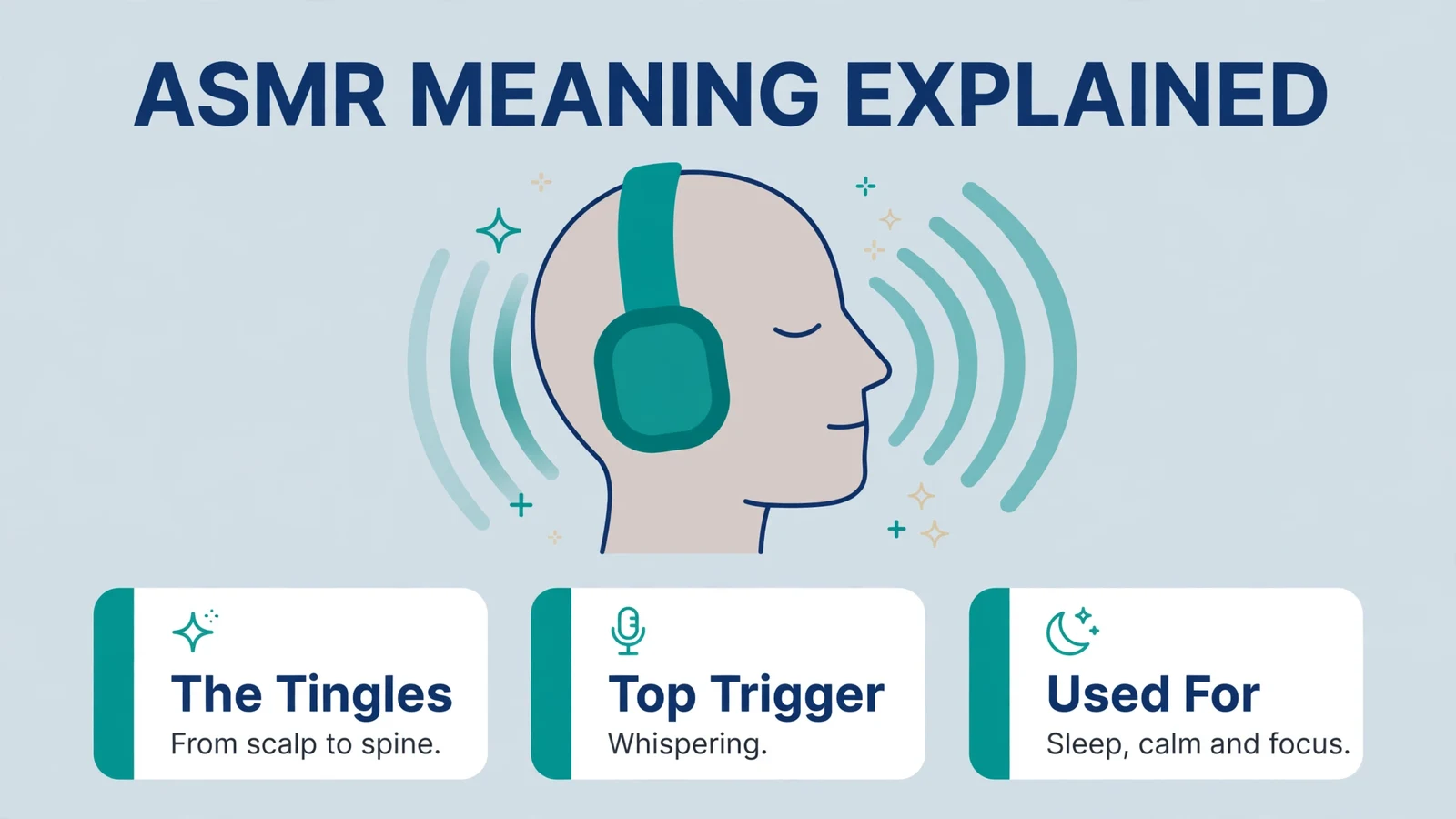
Someone whispers into a microphone, and a feeling starts at the top of your head and rolls slowly down your neck. That feeling has a name: ASMR, short for autonomous sensory meridian response. It is a tingling sensation triggered by gentle sounds and sights, such as whispering, soft tapping and crinkling paper. Many people feel it as a deep, pleasant calm.
Millions now fall asleep to ASMR videos every night. Scientists have measured the effect in laboratories. And the name itself was invented in 2010 by a woman who chose every word of it with care.
This guide explains ASMR from the record: the peer reviewed studies, the researcher interviews. And the community that named a feeling the whole internet now knows. Below you will find what each word means, what ASMR feels like, the triggers that cause it, the science behind it. And the myths that surround it, each checked against real sources.
ASMR at a Glance
- Full form: Autonomous Sensory Meridian Response
- What it is: A tingling sensation that starts on the scalp and spreads down the neck and spine, triggered by gentle sounds and sights
- Term coined: 2010, by Jennifer Allen
- Strongest trigger: Whispering (75% of experiencers in the first study)
- Most common uses: Relaxation (98%), sleep (82%), stress relief (70%)
- First scientific study: Barratt and Davis, 2015
- Measured effect: Heart rate drops about 3 beats per minute in experiencers while watching
- The creators: Called ASMRtists; the biggest channels have millions of subscribers
- Not: A medical condition, a diagnosis, or a proven therapy
What Does ASMR Stand For?
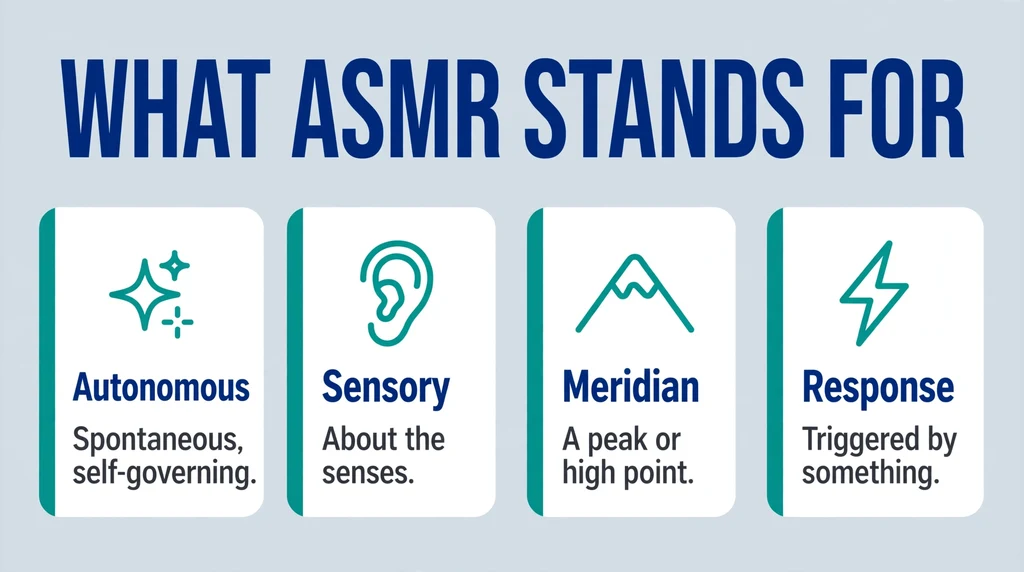
ASMR stands for autonomous sensory meridian response. It is not an old medical term. It was coined in 2010 by Jennifer Allen, a member of the early online community of people who experienced the sensation and had no word for it.
Allen chose the words deliberately. People had been describing the feeling online since at least 2007, in a SteadyHealth forum thread titled “Weird sensation feels good”. But the names they used, such as “brain orgasm” and “head tingle”, made the experience sound sexual or strange. Allen wanted a clinical, neutral name, so she built one:
- Autonomous: spontaneous and self-governing. The response happens on its own, with or without your control.
- Sensory: to do with the senses. The response is about sensation, hearing and sight rather than thought.
- Meridian: a peak, a climax, or a point of highest development. Allen picked this word on purpose, to replace “orgasm” in the older community names.
- Response: an experience triggered by something, inside you or around you. No trigger, no response.
The result sounds like something from a textbook, and that was the point. Under its serious name, the feeling could be discussed openly, searched for, studied. And eventually turned into one of the largest media genres on the internet. When people ask for the ASMR full form, this is it. And the story behind the name explains why it sounds the way it does.
What Does ASMR Feel Like?
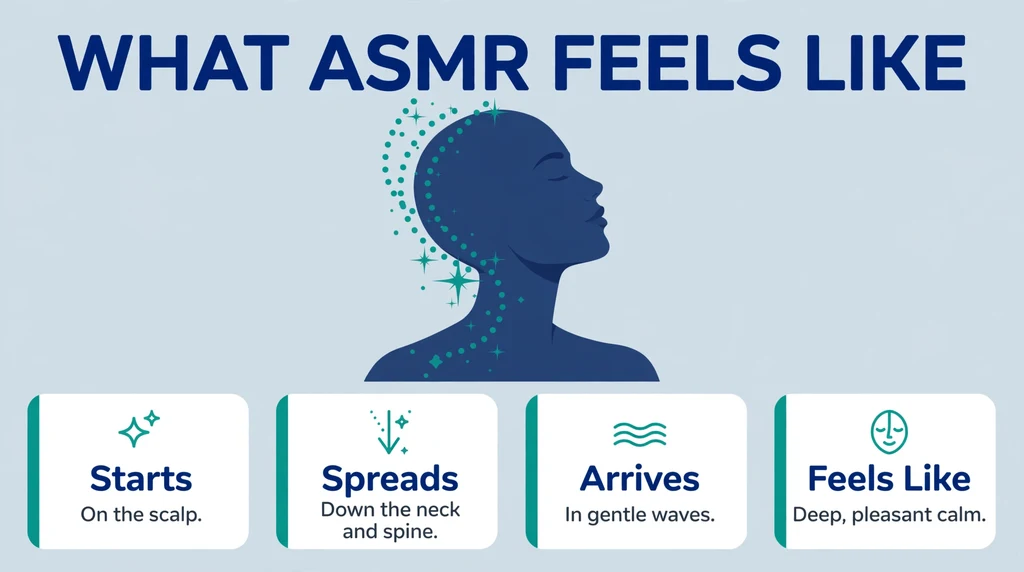
ASMR is, above all, a physical feeling. Researchers describe it as a tingling, static-like or wave-like sensation that typically begins on the scalp, at the crown of the head. And spreads down the back of the neck, across the shoulders and sometimes along the spine and into the limbs. Fans simply call it “the tingles”.
The feeling comes in gentle waves rather than one sharp jolt. It is usually accompanied by a positive emotional state. Relaxed, soothed, slightly euphoric, as if someone you trust is taking very good care of you. A session can last as long as the triggers keep coming, and the calm often lingers after the tingles fade.
A few things surprise newcomers:
- The tingle has an address. It starts on the scalp, not randomly in the body. That scalp first pattern is one of the most consistent findings in the research.
- Not everyone gets the tingles, and that is normal. Plenty of viewers watch ASMR purely for the calm atmosphere and never feel a single tingle. Sensitivity to ASMR appears to be a trait some people have and others do not, not a skill you failed to learn.
- It is not a constant state. ASMR is a response to triggers. Remove the whispering or the tapping, and the sensation fades.
Not Everyone Feels the Tingles
If you have ever felt a pleasant shiver down your scalp while someone softly read to you, brushed your hair, or explained something slowly and carefully just for you, you may have experienced ASMR long before you knew the word for it.
Experiencers describe the sensation arriving in waves. A trigger lands, the tingles rise on the scalp, peak gently, and fade, then the next trigger starts another wave. Intensity varies from a faint pleasant shimmer to a full body wash of calm that viewers chase video after video. Some people tingle only from one narrow trigger family, a specific voice, one style of tapping, while others respond to almost everything in the genre.
It helps to separate the two experiences people bundle under the word ASMR. The first is the tingle itself, the physical signature sensation. The second is the state around it: drowsy, safe, unhurried calm. Videos are built to deliver both, but they are independent. A viewer can get the calm without the tingle. And many regular viewers do, which is why audience numbers are far larger than the number of true tinglers. When researchers measure ASMR, the mood and heart rate effects show up in experiencers. When platforms count views, they are counting everyone who simply enjoys feeling soothed.
ASMR Triggers: The Sounds and Sights That Cause the Tingles
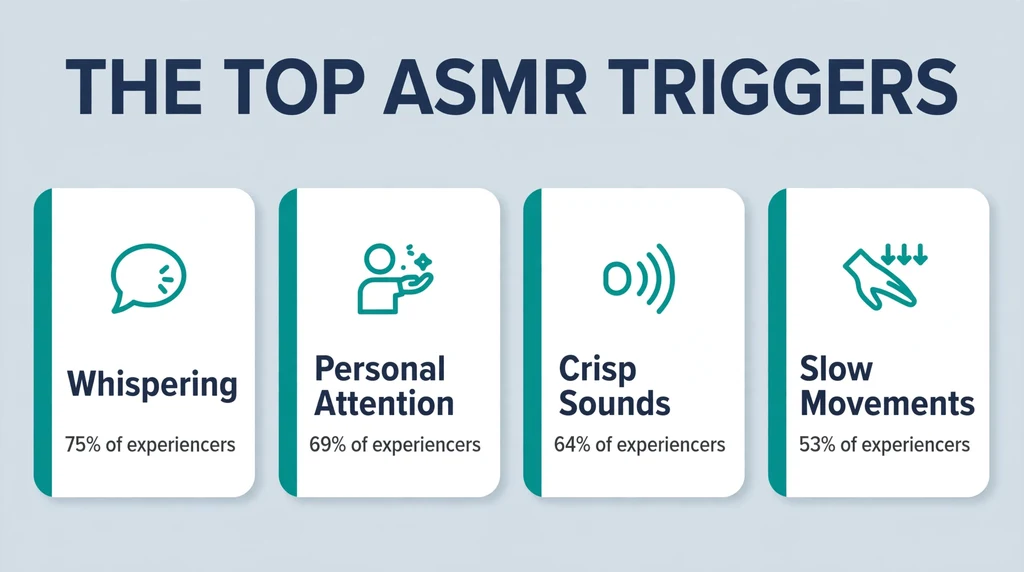
A trigger is any stimulus that reliably produces the ASMR response. Triggers are the working core of the whole phenomenon, and they have been measured. The first peer reviewed study of ASMR (Barratt and Davis, 2015, Swansea University) surveyed 475 members of the ASMR community and ranked the triggers by how many people responded to them.
Whispering (75%)
The strongest trigger in the study, reported by three quarters of participants. Soft, close whispering, especially recorded up close with sensitive microphones, is the signature sound of ASMR. Variations include soft spoken speech (a low, gentle speaking voice rather than a true whisper) and inaudible whispering, where the words cannot quite be made out and only the breathy sound remains.
Personal attention (69%)
The feeling that someone is focusing entirely on you. In videos this is simulated through eye contact with the camera, gentle direct address. And roleplays: a haircut, a doctor’s examination, a makeup session, a spa treatment, the famous cranial nerve exam. The performer pretends to care for the viewer, and the viewer’s brain responds as if the care were real.
Crisp sounds (64%)
Clean, sharp, delicate noises: fingernails tapping on wood or glass, pages turning, scissors snipping, a brush sweeping a microphone, keyboard typing, paper and plastic and foil crinkling slowly. Crisp sounds are recorded as close to the microphone as possible so every detail registers.
Slow and repetitive movements (53% and 36%)
Slow hand movements, hand fluttering in front of the camera, watching someone fold towels, paint, write, or complete any careful repetitive task. There is also a beloved accidental category: unintentional ASMR, found in ordinary videos never made for the purpose. The painter Bob Ross, with his soft voice and gentle brush sounds on The Joy of Painting, is the community’s patron saint of unintentional ASMR, decades before the term existed.
Binaural and ear to ear recording
Most modern ASMR is recorded with binaural setups, two microphones spaced like human ears, sometimes mounted inside a dummy head. Sounds pan from ear to ear, tap one “ear” then the other, or brush across the microphones. Through headphones, the effect is startlingly physical, as if someone is whispering directly beside you. Mouth sounds, ear cleaning simulations and microphone brushing all live in this category, as does the large “no talking” genre. This is triggers only, with no voice at all.
Everyone’s trigger list is different. One person’s perfect trigger is another person’s irritation. This is why the genre has thousands of variations, from classic whispering to the fast, aggressive trigger compilations that spread on TikTok.
A Short History of ASMR
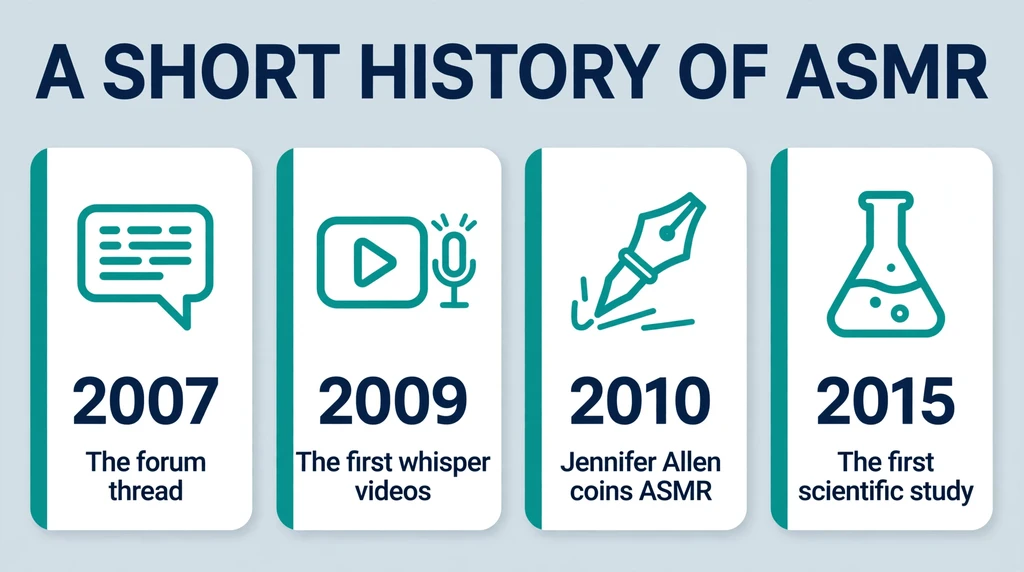
The sensation is old. The name, the community and the genre are new, and their story has clear milestones.
2007: the meeting point. On the health forum SteadyHealth, a thread titled “Weird sensation feels good” collects strangers who have all felt the same unnamed tingling since childhood, often triggered by soft voices or watching someone work carefully. For the first time, people who thought the feeling was theirs alone find each other.
2009: the first videos. Whisper videos begin appearing on YouTube, made by people who simply liked soft voices. The channel WhisperingLife is widely credited with the first intentional ASMR video in 2009, a black screen and a whispered greeting. Whether or not it was literally first, the format was born: one voice, one microphone, close and quiet.
2010: the name. Jennifer Allen coins “autonomous sensory meridian response” and organises the community around it. A searchable name changes everything: videos can be labelled, forums can form, and a scattered feeling becomes a genre.
The Craft Era, 2011 to 2014
2011 to 2014: the craft era. Dedicated creators build audiences: GentleWhispering (Maria), ASMRrequests, Heather Feather and others. Production leaps from laptop webcams to studio binaural microphone rigs shaped like human heads. Roleplays become longer and more elaborate.
2015: science arrives. Barratt and Davis publish the first peer reviewed study in the journal PeerJ, documenting triggers, uses and the flow-like nature of the experience. ASMR moves from internet curiosity to a research topic.
2017: a million subscribers. Gentle Whispering becomes the first ASMR channel to pass one million subscribers. By 2018, more than 13 million ASMR videos have been published on YouTube.
2019: the mainstream moment. Michelob Ultra airs an ASMR advert during the Super Bowl, with Zoë Kravitz whispering and tapping a beer bottle into binaural microphones. IKEA, Dove Chocolate and other major brands run ASMR campaigns. Celebrity ASMR interviews become a staple magazine format.
Today: everywhere. ASMR lives on YouTube, TikTok and streaming platforms, in formats from hour long roleplays to 30 second trigger clips. The creators, called ASMRtists, run professional channels with millions of subscribers. And researchers in several countries continue to study what exactly the tingles are.
What Does the Science Say About ASMR?
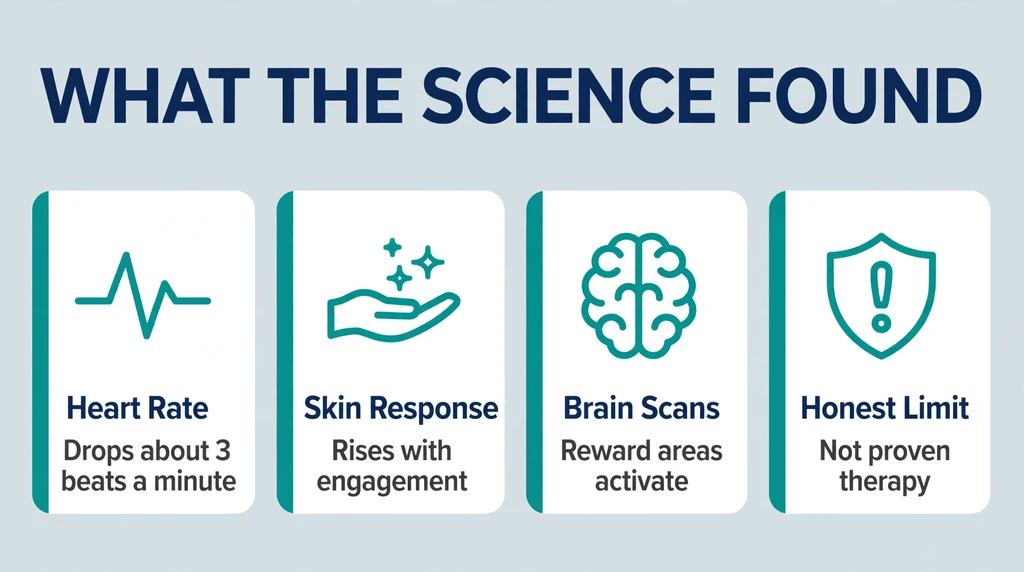
ASMR research is young and small, but it is real: peer reviewed, measured in laboratories. And refreshingly honest about its own limits. Here is what has actually been found.
The body calms down, measurably
The best known study is Poerio and colleagues (2018), from the University of Sheffield, published in PLOS ONE. Across a large online experiment and a laboratory study, people who experience ASMR felt a genuine lift in pleasant mood from ASMR videos, and control viewers did not. In the lab, experiencers watching ASMR showed a reduced heart rate, by about 3 beats per minute on average. And at the same time increased skin conductance, a sign of emotional engagement.
That combination is the signature of ASMR: the body of someone deeply relaxed, with the alertness of someone emotionally involved. Calm, but not switched off.
The brain looks wired a little differently
Brain imaging studies point the same way. Resting state fMRI research by Smith, Fredborg and Kornelsen found that the default mode network, the brain system active during rest and self reflection, is connected differently in people who experience ASMR, with weaker links in some classic nodes and blending with regions outside the network. The pattern resembles findings in synesthesia research. And it suggests ASMR sensitivity is a stable trait of brain organisation, not imagination.
When researchers scanned people during actual tingles (Lochte and colleagues, 2018), activity rose in regions tied to reward (the nucleus accumbens), self awareness and social cognition (the medial prefrontal cortex), emotion and body awareness (the insula and dorsal anterior cingulate). In plain terms: during the tingles, the brain’s reward and caring systems light up together. That study was small, ten participants and no control group, and its authors said so. Later work (Smith and colleagues, 2019) confirmed that ASMR videos activate sensation, emotion and attention areas in experiencers but not in matched controls.
What science cannot tell you yet
Three honest limits, straight from the researchers and science reporters who cover them:
- Nobody knows how many people experience ASMR. There is no accepted prevalence figure. Any website quoting a tidy percentage is ahead of the evidence.
- There are no diagnostic criteria. ASMR is not a condition to be diagnosed, and studies use self identified experiencers.
- It is not proven therapy. The Associated Press’s science summary puts it plainly. There is not yet enough evidence to recommend ASMR as a stand alone treatment for anxiety, depression or insomnia, however much individual fans swear by it.
ASMR vs Misophonia vs Frisson: Three Easy Confusions
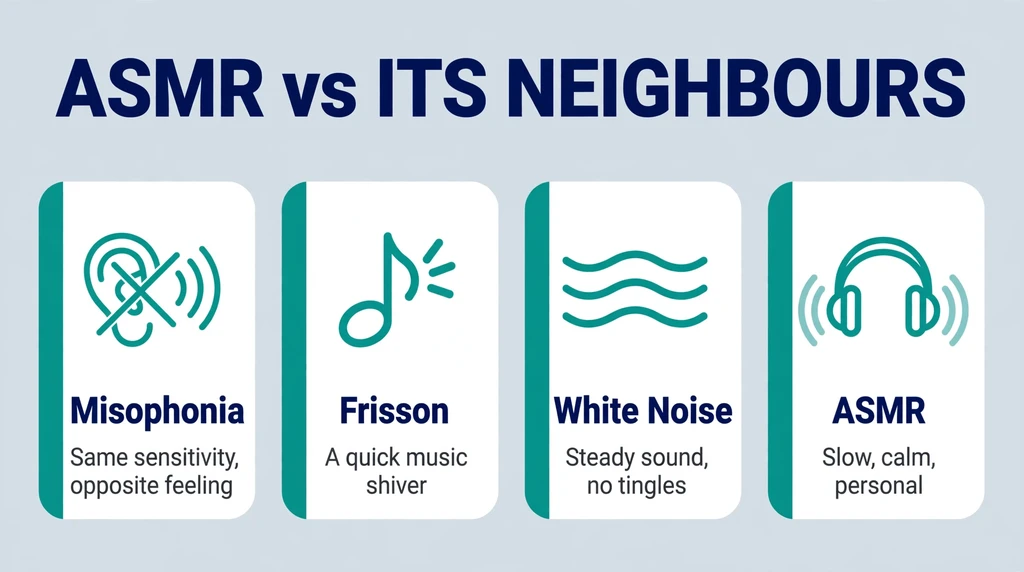
ASMR is often confused with its neighbours. They are related, and genuinely different.
Misophonia is a strong negative emotional response to specific human sounds, such as chewing, lip smacking or tapping: irritation, anger, even distress. ASMR is the mirror image, pleasure and calm from gentle human sounds. Strangely, the two overlap: research (Janik McErlean and Banissy, 2018) found that people who experience ASMR score higher on misophonia measures than controls. And in one large misophonia study, about half the participants also reported ASMR. Scientists describe the pair as possible opposite ends of a single sound sensitivity spectrum: same sensitivity, opposite direction.
Frisson is the quick shiver of goosebumps from music, awe or an emotional peak, sometimes called aesthetic chills. It feels related to ASMR but behaves differently: frisson is brief and intense, ASMR is slow and sustained. Frisson raises heart rate, ASMR lowers it. And over 90 percent of people who experience both say they feel clearly different (Fredborg, Clark and Smith, 2018).
White noise is a steady background sound used to mask distractions. It has no triggers, no personal attention and no tingles. People use it for sleep for a different reason: consistency, not sensation.
What Do People Use ASMR For?
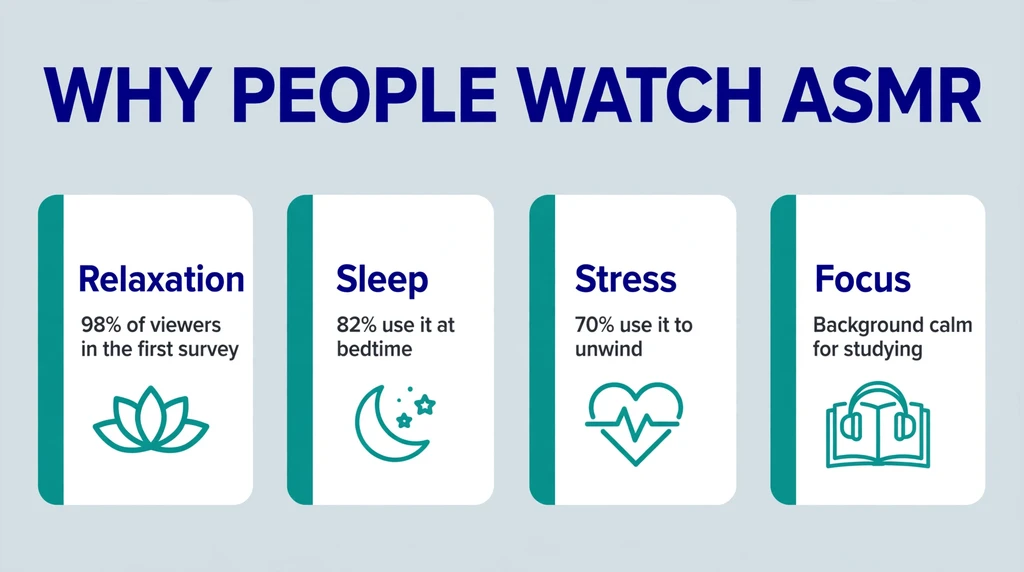
The 2015 Barratt and Davis survey asked the community directly. And the pattern has stayed consistent ever since. 98 percent used ASMR for relaxation, 82 percent used it to help them sleep. And 70 percent used it to cope with stress. Smaller numbers use it for focus while studying, for company and comfort, or simply because they enjoy the sounds.
Notice what those numbers are: people reporting what they use ASMR for, and what they feel it does for them. That is real experience, worth reporting accurately, and it matches the laboratory evidence of calmer heart rates and lifted mood. It is not the same as proof that ASMR treats insomnia, anxiety or low mood as a medicine would. The honest summary, and the one this site will stand behind, is:
- ASMR reliably relaxes the people who experience it, in their reports and in measured physiology.
- For sleep, it is one of the most popular free aids in the world. And for many people it clearly works as part of a bedtime routine.
- For anxiety and stress, it is a self help tool, not a treatment. Anyone struggling seriously should treat ASMR as a comfort, and talk to a professional about the condition itself.
Used with those expectations, ASMR is harmless for the overwhelming majority of people. The main side effects are lost time down a very pleasant rabbit hole. And occasional irritation when a trigger does the opposite of what it promises.
How to Experience ASMR: A Beginner’s Guide
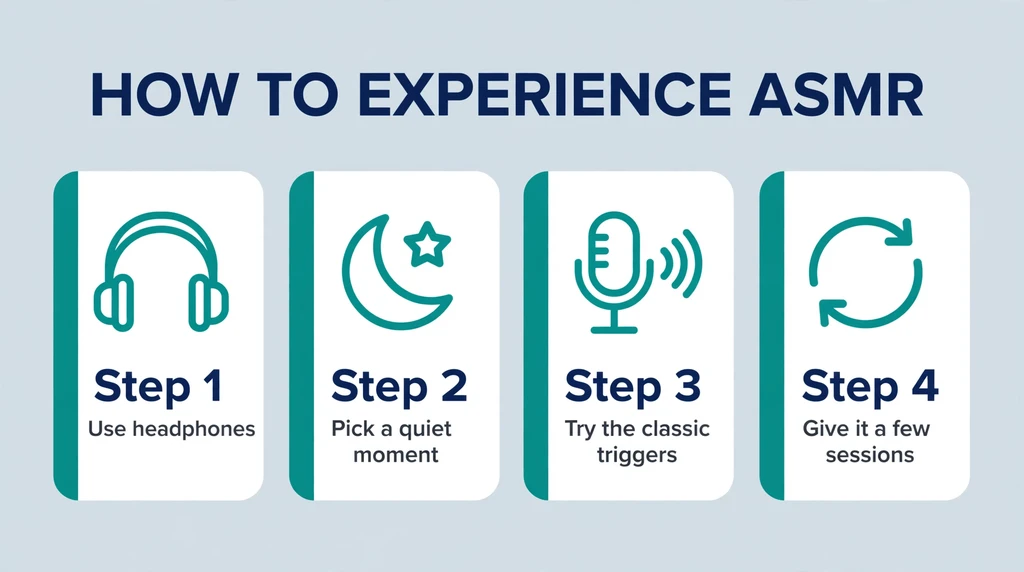
If you have never felt the tingles, here is the method experienced viewers and the research both point to.
1. Use headphones. Binaural recording is half the effect. Laptop speakers flatten the ear to ear detail that makes ASMR feel physical.
2. Pick a quiet moment. Bedtime is the classic slot, and not by accident: low light, no interruptions. And a mind already winding down is the state where ASMR lands best.
3. Start with the classics. Search for whispering, personal attention roleplays, or gentle tapping, the three strongest trigger categories in the research. Give each style a fair few minutes rather than judging in ten seconds.
4. Try different formats. Roleplay not for you? Try no talking trigger videos. Voice irritating? Try crinkling, brushing or page turning. The genre is enormous, and trigger taste is personal, almost like food taste.
5. Give it more than one session. Many experiencers report that their response got stronger with familiarity. Your brain learns what to listen for.
6. Accept the possible answer. You may feel deep calm without any tingles, which still counts as the videos working as most viewers use them. Or you may feel nothing at all. Given the brain wiring findings, that likely says something about your neurology, not your effort. There is no technique that guarantees ASMR, and anyone who promises one is selling something. Patience is the whole secret: the response rewards slow attention, which is rather the point of it.
The People Who Make It: ASMRtists
A person who creates ASMR content is called an ASMRtist, a blend of ASMR and artist. And the word has stuck because the craft is real: microphone technique, sound design, set dressing, acting for roleplays. And hours of editing out every stray noise.
The founding generation built the genre from bedrooms. GentleWhispering, run by Maria, is usually named first: her soft spoken and whispered videos defined the classic style. And in 2017 hers became the first ASMR channel to reach a million subscribers. ASMR Darling (Taylor Darling) became one of the most popular classic channels of the same era, known for long, gentle roleplays. Later creators such as Gibi ASMR brought bigger productions and characters. The biggest channels today count their audiences in the millions. And celebrity ASMR interviews, where actors whisper and handle objects for magazines like W, have made the format familiar far beyond YouTube.
The culture has its own small landmarks. An International ASMR Day marked by the community each April, research hubs such as ASMR University run by Dr Craig Richard. And endless friendly argument about the correct way to pronounce the acronym (most say each letter: A-S-M-R; some say “az-mer”).
Common Myths About ASMR
Myth: ASMR is a medical condition. No diagnosis of ASMR exists in any medical manual. It is a perceptual experience, like enjoying music. Nothing about it needs treating.
Myth: ASMR is sexual. This is the myth the name itself was invented to kill. The research is blunt: heart rate drops during ASMR, the opposite of arousal. And in the Barratt and Davis survey only 5 percent of participants reported any sexual use, with 84 percent actively disagreeing that they used it that way. A small adult offshoot of the genre exists, as adult offshoots of everything exist. But it is not what ASMR means.
Myth: ASMR releases oxytocin or endorphins, proven. You will read this on wellness sites. The direct hormonal evidence is not there yet. The reward brain areas activating during tingles makes such claims plausible sounding. This is exactly why honest guides should not print them as fact.
Myth: everyone can feel ASMR with the right video. The imaging evidence says sensitivity is partly wired. Many people never tingle, and some people actively dislike the sounds.
Myth: ASMR is a new internet fad. The genre is young, but the sensation is described from childhood by people now in middle age. And proto-ASMR, soft voices and careful sounds, delighted audiences long before YouTube. The internet did not invent the feeling. It named it, and then it industrialised it.
Why Is ASMR So Popular?
The scale still surprises people who have never opened the genre. By 2018, more than 13 million ASMR videos had been published on YouTube alone. And searches for ASMR have ranked among the platform’s largest lifestyle categories for years. Three forces built that audience.
First, sleep. The modern world has a sleep problem and a phone in every bedroom. ASMR offered a free, pleasant, endlessly varied sleep aid at exactly the moment streaming video became universal. And bedtime viewing turned into a nightly habit for millions.
Second, the attention economy inverted. Almost everything online shouts. ASMR whispers. In a feed of outrage and noise, content designed to lower your heart rate is genuinely different. And the contrast itself became the appeal. Brands noticed: the Michelob Ultra Super Bowl advert, IKEA’s dorm room ASMR campaign and magazine celebrity ASMR series all borrowed the format’s intimacy to sell ordinary products.
Third, it is social comfort on demand. The personal attention at ASMR’s core, a kind voice focused entirely on you, answers a real loneliness. Fans describe favourite ASMRtists the way earlier generations described late night radio hosts. As familiar presences who are simply there, calmly, whenever needed. Scientists may keep debating the edges of the phenomenon, but the audience voted long ago.
Types of ASMR Videos
Spend an evening in the genre and you will find it has formats as distinct as television genres.
Roleplay ASMR. The flagship format. The creator plays a character, a doctor giving a cranial nerve exam, a barber, a makeup artist, a librarian, a travelling tailor measuring you for a suit, and treats the camera as you. Roleplays run from ten minutes to over an hour and lean hardest on the personal attention trigger.
No talking ASMR. Triggers only: tapping, scratching, crinkling, brushing, water sounds, in long unbroken sequences. This is the sleep format, built for people who want the sounds without a storyline. And it is among the most searched styles in the genre.
Fast and aggressive ASMR. The TikTok era format: rapid trigger changes, quick hand movements, snappy tapping, unpredictable patterns, often in short clips. It divides opinion perfectly. Some viewers find the pace thrilling; classic fans find it the opposite of relaxing.
Unintentional ASMR. Videos never made for ASMR at all. Bob Ross painting, old instructional films, someone quietly unboxing, repairing or building something, a soft spoken interview. Many fans say the unintentional kind hits hardest precisely because nobody is performing.
Live ASMR. Creators stream triggers in real time, taking requests in chat. The social, unscripted element adds the feeling of a real person in the room. This is itself a personal attention trigger.
Real Life ASMR: The Triggers You Already Know
Long before the genre, the sensation lived in ordinary moments. This is why so many people recognise it instantly when it is described. Classic real world triggers include:
- A hairdresser washing your hair, or a barber working slowly and carefully
- Someone whispering to you in a library, cinema or classroom
- A teacher, doctor or optician speaking softly while concentrating on you
- Watching someone write, draw, paint or fix something with total focus
- A parent or grandparent reading aloud in a low, unhurried voice
- Having your back traced, your hair brushed, or your face gently touched
These moments explain the genre’s central mechanic better than any definition. ASMR videos are simulations of being quietly, kindly paid attention to. The microphone and the roleplay are technologies for bottling an experience that used to happen only by accident.
How ASMR Videos Are Made
The calm on screen hides real production craft. Most established ASMRtists record with binaural microphone setups. Two sensitive microphones set apart at ear distance, often inside silicone ears on a dummy head. So sounds arrive at each ear the way they would in life. Room treatment matters enormously, because a microphone that can catch a fingernail tap will also catch the refrigerator, the traffic and the creator’s stomach. Creators speak of recording at 3 a.m. for the silence.
Editing is the second half of the art. Removing every mouth click that is too sharp, every breath that peaks, every accidental knock, while keeping the performance natural. Roleplays add costumes, props and sets. It is, in short, a film production discipline aimed at making almost nothing happen, beautifully.
How Do You Say ASMR, and How Is the Word Used?
Most speakers pronounce ASMR letter by letter, A-S-M-R. Said quickly as a word, it sometimes comes out as “az-mer”, and you will hear both. In writing, the acronym is almost always capitalised, because the lowercase letters would be unreadable.
Grammatically, ASMR works as a noun for the sensation (“I get ASMR from whispering”), as a noun for the genre (“she watches ASMR at night”). And as an adjective (“an ASMR video”, “an ASMR voice”). In texting and comments you will also see it used loosely as praise for anything soft and satisfying. A quiet café, rain on a window, someone peeling potatoes in a cooking video. That loose usage is not the technical meaning, but it shows how completely the word has entered everyday language. If a friend texts you “this song is so ASMR”, they mean it is gentle, close and calming, the feeling, not the acronym.
Where ASMR Research Goes Next
The science is catching up with the culture, slowly and properly. Open questions on researchers’ lists include a reliable estimate of how many people experience ASMR, a standard way to measure the response in the lab. And larger, better controlled brain imaging studies to replace the pioneering small ones. On the media side, live ASMR, spatial audio and virtual reality formats are pushing the personal attention trigger further. This will give scientists new versions of the phenomenon to test.
What is unlikely to change is the core finding that started the field. A real, measurable, pleasant response to gentle attention and sound, felt by millions. And now carrying a name everyone can search for.
Frequently Asked Questions
What does ASMR stand for?
ASMR stands for autonomous sensory meridian response. The term was coined in 2010 by Jennifer Allen, who chose clinical sounding words on purpose so the sensation would be taken seriously and not confused with anything sexual.
What does ASMR mean in simple words?
ASMR is the pleasant tingling feeling that starts on your scalp and spreads down your neck and back when you hear or see gentle triggers, like whispering, soft tapping or someone paying close attention to you. People watch ASMR videos to relax and fall asleep.
Is ASMR real, scientifically?
Yes, in the ways that have been tested. Laboratory studies show that people who experience ASMR show a lowered heart rate and increased skin conductance while watching ASMR videos. And brain scans show activity in reward and emotion regions during the tingles. The research is still young and based on small studies, so scientists are careful about bigger claims.
Is ASMR good for sleep?
It is one of the most popular sleep aids online. In the first community survey, 82 percent of participants said they used ASMR to help them sleep. And its measured calming effect fits that use. It is not a proven medical treatment for insomnia. But as a bedtime relaxation routine it clearly works for many people.
Why do I feel nothing when I watch ASMR?
Probably because ASMR sensitivity varies by person. And brain imaging suggests it is partly a matter of how your brain is wired. Many people enjoy the calm of ASMR videos without tingles, and some people find the sounds annoying instead. Feeling nothing does not mean you are doing anything wrong.
Is ASMR bad for you?
There is no evidence that ASMR is harmful for typical viewers. The realistic risks are mild: spending longer than planned watching videos, or finding particular sounds irritating if you lean toward misophonia. It is a relaxation tool, not a medicine, and not a substitute for professional help with anxiety, depression or insomnia.
Who invented ASMR?
Nobody invented the sensation, which people have felt for centuries. But Jennifer Allen invented the term ASMR in 2010 and organised the early community. The genre on YouTube grew from whisper videos that began around 2009. And the first peer reviewed study followed in 2015.
What is an ASMRtist?
An ASMRtist is a creator who makes ASMR content: the word blends ASMR with artist. Well known ASMRtists include GentleWhispering and ASMR Darling, whose channels helped define the genre and grew to millions of subscribers.
What is the difference between ASMR and frisson?
Frisson is the brief shiver of goosebumps you get from music or an emotional peak, while ASMR is a slower, sustained tingling from quiet, personal triggers like whispering. They even move the body in opposite directions: frisson raises heart rate and ASMR lowers it.
Can ASMR help with anxiety?
Many viewers use ASMR for stress and anxiety relief, and studies do show genuine calming effects while watching. It has not been proven as a treatment for anxiety disorders. So it works best as a comfort tool alongside, not instead of, professional care when anxiety is serious.
Does ASMR work without headphones?
It can, but headphones are strongly recommended. Most ASMR is recorded binaurally, with sounds placed for each ear, and speakers flatten that effect. Many of the subtler triggers, especially ear to ear whispering, only land properly through headphones or earbuds.
Conclusion
ASMR began as a nameless feeling described on a health forum. A pleasant tingle at the crown of the head, set off by a soft voice or a careful pair of hands. Given a name in 2010, it became a genre, an industry and a small but genuine field of science. The research now confirms the core of what fans always said. For the people wired to feel it, ASMR is real, measurable calm. And if you came here simply asking what ASMR means, you now have the whole picture. Autonomous sensory meridian response, four careful words for one gentle feeling. And the next time a soft voice on a screen makes the top of your head tingle, you will know exactly what to call it, and why it works. That is more than most of the internet can say about the things it loves.