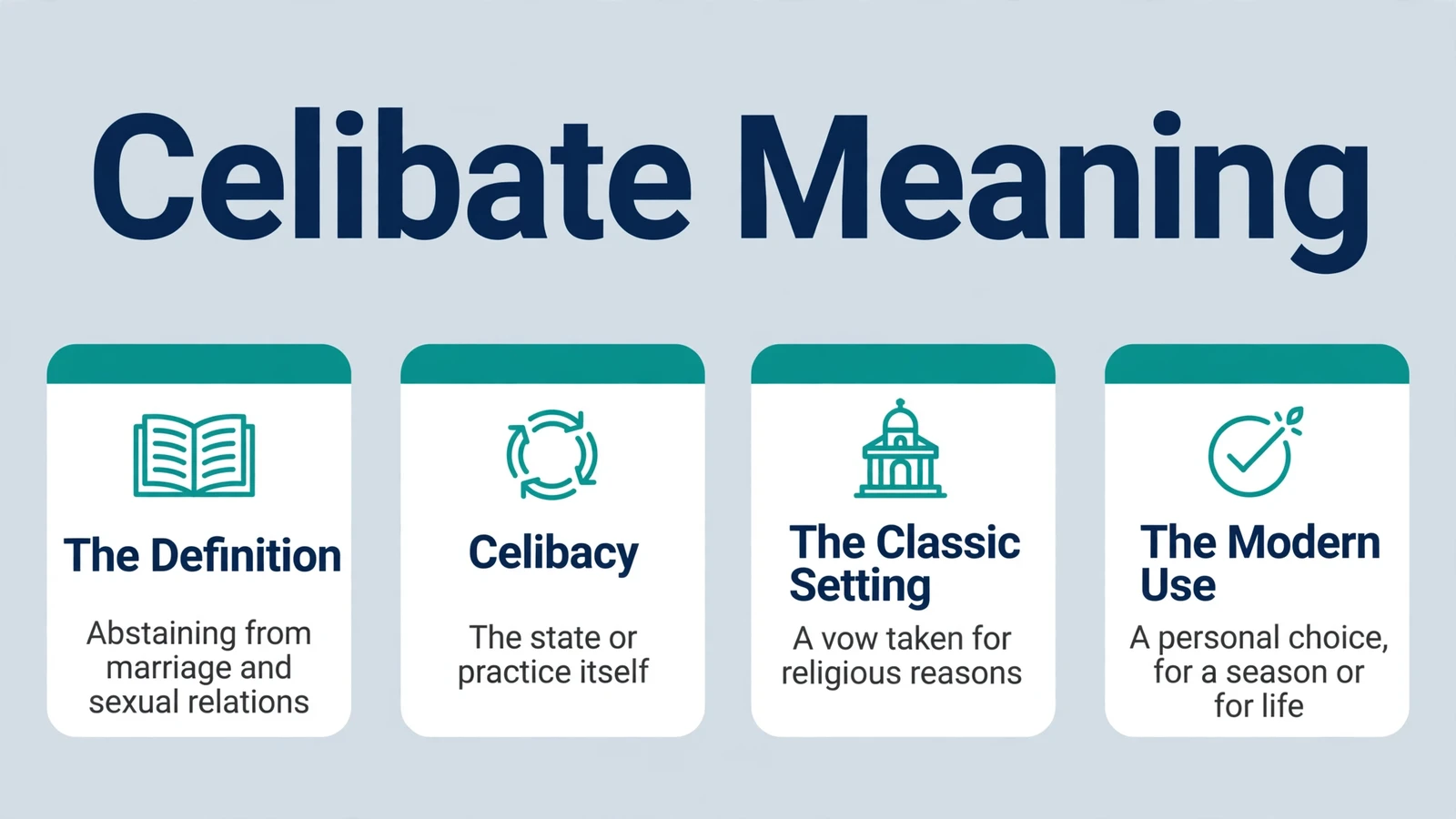
Celibate is one of those words people feel sure about until they have to define it. It turns up in stories about priests and monks, in vocabulary lists, and lately in posts about taking a break from dating. In plain terms, a celibate person abstains from sexual relations, and traditionally from marriage as well, often because of a religious vow. The state or practice itself is called celibacy.
That short answer hides a lot of history and a few common mix-ups. This guide pulls the word apart piece by piece. It covers the dictionary definition, the Latin root, and the difference between celibate, chaste, abstinent, and asexual. It also looks at where celibacy is required, why people choose it today, and how to use the word well.
What Does Celibate Mean?
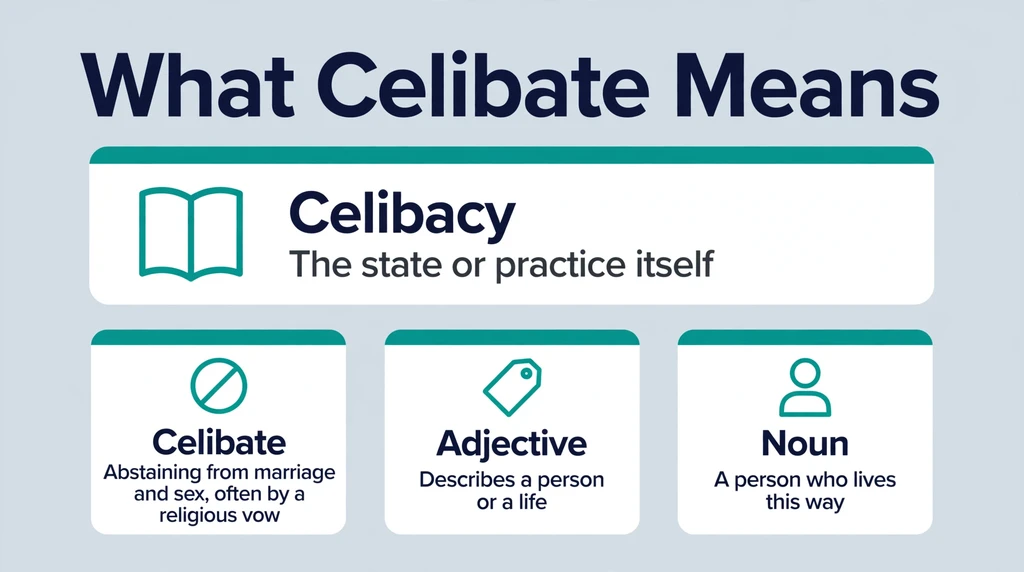
Merriam-Webster defines celibate, as an adjective, as abstaining from marriage and sex, especially because of a religious vow. The same entry adds a simpler sense: not engaging in sexual intercourse. Cambridge Dictionary puts it in everyday words: not having sexual activity, especially because you have made a religious promise not to.
Said aloud, the word sounds like SEL-uh-buht. It carries three syllables, with the stress resting on the first. You will meet it most often in phrases such as celibate priest, celibate life, and remained celibate.
Celibate as an Adjective and a Noun
As an adjective, celibate describes a person or a way of life. Think of a celibate monk, or a writer who stayed celibate for a decade. As a noun, a celibate is the person who lives this way. Merriam-Webster glosses the noun as an unmarried person, especially one who gives up marriage because of a religious vow. The same entry also covers any person who abstains from sexual intercourse.
Celibacy: The State Itself
Celibacy is the noun that names the state or the practice. Merriam-Webster lists three senses for it. First, the state of not being married. Second, abstention from sexual intercourse. Third, abstention by vow from marriage. Cambridge’s academic dictionary adds a useful modern word and calls it the state of intentionally not being married or having a sexual relationship.
The pair, then, works like private and privacy. Reach for celibate when you talk about the person. Reach for celibacy when you talk about the condition or the commitment itself.
Two Layers in One Word
In its full, traditional sense, celibate joins two layers together. The person is unmarried, and the person is not sexually active. Monks, nuns, and priests under vows live out both layers at once. Modern everyday use, by contrast, often keeps only the second layer. Someone in a self-described celibate phase usually means no sex for now, whatever their relationship status happens to be.
Dictionaries still record both layers, so context has to guide you. One more point is worth fixing early. The word by itself says nothing about desire, romance, or affection. Those topics belong to later sections of this guide.
Celibate and Celibacy in Everyday Speech
Listen to how the word actually travels through conversation. It pairs with a small set of verbs again and again. People remain celibate, stay celibate, live celibate lives, or take vows of celibacy. News reports reach for it when clergy rules make headlines. Wellness writers reach for it when they discuss dating breaks and personal resets.
Journalists often use the word loosely, as a short way of saying not sexually active at the moment. Dictionaries allow that reading, since the behavior sense is firmly established. Still, careful speakers add a time word when they mean the loose sense. Celibate for now, celibate this year, or celibate until marriage all land more precisely than the bare word alone.
A Near Miss Worth Avoiding
Celibate also suffers from an unhelpful near-twin: celebrate. The two words look and sound close, yet they share no meaning at all. One letter changes a vow of restraint into a party. Careful writers and speakers keep the pair apart, especially in formal or religious contexts.
The Origin of the Word Celibate
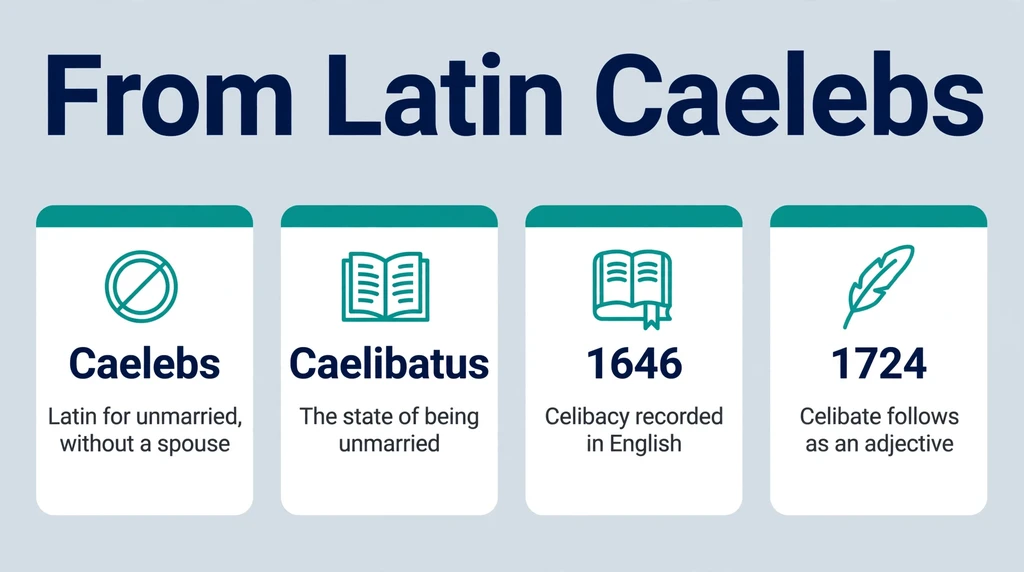
The trail starts in Latin. There, the word caelebs meant unmarried, or not having a spouse. English built celibate from that stem, caelib-, with the suffix -ate. The noun followed a parallel path. Latin caelibatus meant the state of being unmarried, and it stands directly behind the English word celibacy. So the family was born talking about marital status, not about behavior.
From Unmarried to Abstinent
The word family took shape in English across the 1600s and 1700s. Merriam-Webster records celibacy in 1646 and the adjective celibate in 1724. For a long time, writers treated celibacy mainly as the opposite of marriage. Etymonline notes that, outside a religious vow, the unmarried state was often viewed with suspicion well into the 1800s.
Etymonline adds a curious twist to the story. The noun celibate first named the state itself, in the 1610s, borrowed from the French word célibat. Only in 1838 did the noun settle into naming the person who lives in that state. Words often travel from condition to person in this way, and this one took two centuries over the trip.
Over time, the emphasis shifted. The behavior side of the meaning moved forward, and the marriage side slipped behind it. Today, most speakers hear celibate and think first of abstinence, not of marital status.
A Root Scholars Still Debate
Beyond Latin, the trail goes cold. The deeper origin of caelebs is honestly uncertain. One proposal splits it into roots meaning alone and living, giving a rough sense of living alone. Another proposal links it to an old Indo-European root meaning whole, which would make celibate a distant cousin of the word whole. Reference works treat both ideas as possibilities rather than settled fact. That is why careful dictionaries stop at Latin and say no more.
Celibate vs Chastity vs Abstinence
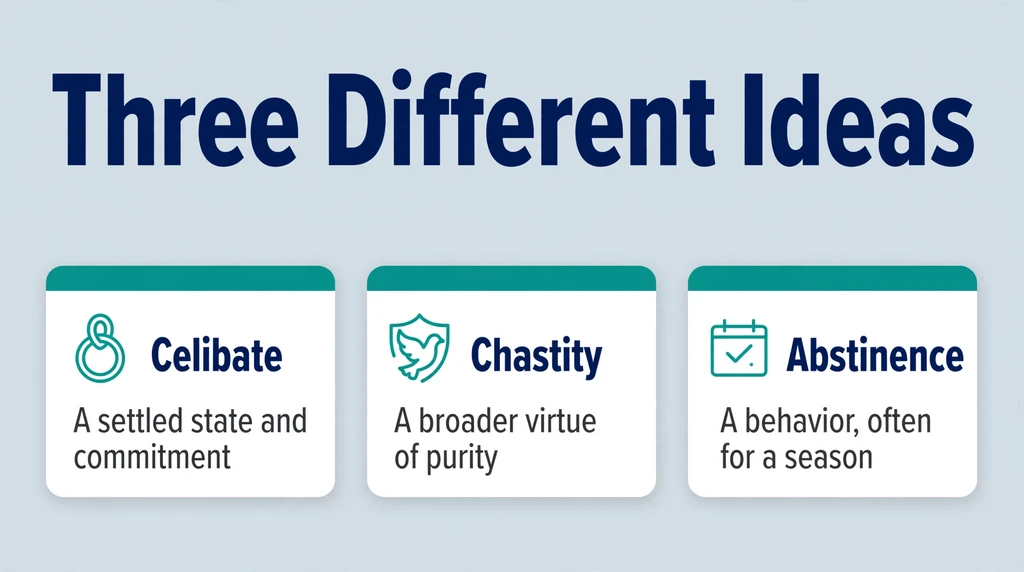
These three words appear together so often that many readers treat them as one. They even share a famous phrase: the vows of poverty, chastity, and obedience. Yet each word answers a different question. Celibate describes a person’s settled state. Chastity names a virtue. Abstinence describes a behavior.
Celibate: A Settled State
Celibate works at the level of identity and commitment. It usually points to an ongoing condition, not to a single skipped opportunity. In its full traditional sense, it covers both marriage and sex at once. A monk, for example, does not merely avoid sex this month. He has taken on a celibate life, with a structure and a reason behind it. That settled quality is why biographies reach for the word so often. A phrase like “he remained celibate” can sum up an entire adult life in three words.
Chastity: A Broader Virtue
Chastity is the wider word. Merriam-Webster defines it through purity in conduct and intention, alongside abstention from sexual intercourse. In moral and religious teaching, chastity means living out your sexuality in line with your state of life and your values. That is why a faithful married person can properly be called chaste, but never celibate. Under religious vows, chastity is the umbrella virtue. Celibacy is then one concrete way of living that virtue out.
Abstinence: A Behavior, Often for a Season
Abstinence is the plainest of the three. It means holding back from something you could otherwise do or enjoy. The something might be alcohol, sugar, or sex. Sexual abstinence therefore names a stretch of behavior rather than a state of life. It may last until marriage, cover a set number of months, or mark a pause after a breakup. It needs no vow, no title, and no religious frame at all.
The Three in One Glance
If you need one line for each word, try these questions. Celibate answers: what is this person’s settled state? Chastity answers: how do they live out their values? Abstinence answers: what are they not doing, for now? Keep those three questions in mind, and the words stop blurring into each other.
A single life can pass through all three words in turn. A student abstains from sex while finishing a degree, and that is abstinence. The same student lives by a clear moral code about relationships, and that is chastity. Years later, the same person enters religious life under a vow, and that is celibacy. The behavior can look identical from outside. The word changes because the frame around it changes.
Celibacy in Religious Traditions
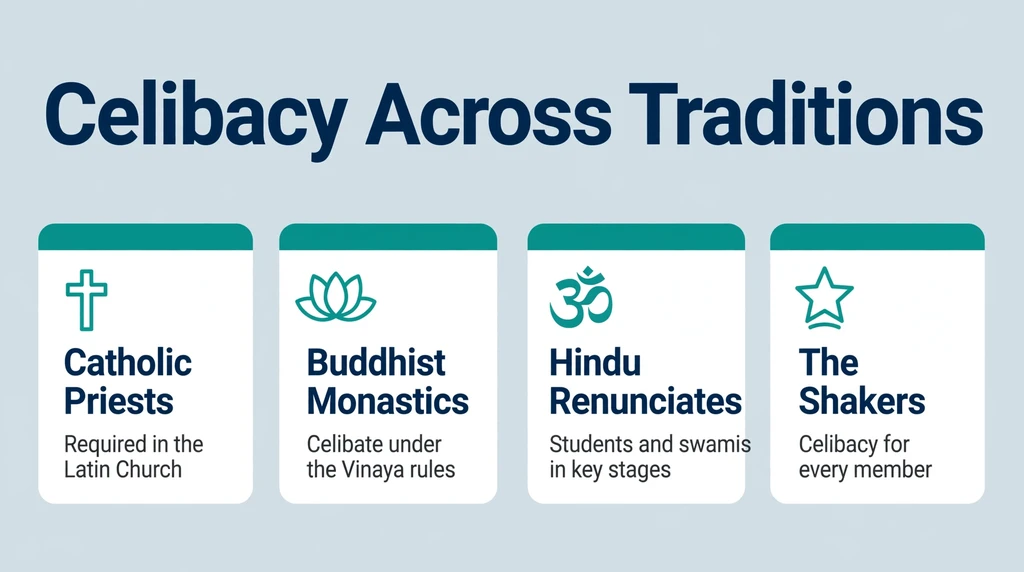
Britannica describes celibacy as deliberate abstinence from sexual activity, usually tied to a religious role or practice. Some form of it appears in most world religions. The motives repeat across cultures: ritual purity, single-minded devotion, and freedom from the claims of family life. The rules, though, differ sharply from one tradition to the next.
Roman Catholic Priests
In the early church, celibacy was widely honored but not yet a universal law for clergy. Married clergy were a normal sight in many regions during the first thousand years. Reformers of the 11th century, the Gregorian Reform movement, pushed to make celibacy binding. Then the First and Second Lateran Councils, in 1123 and 1139, abolished clerical marriage. Britannica notes that those councils set the official position the Roman Catholic Church still holds today.
Today, canon 277 of the Code of Canon Law binds clerics in the Latin Church to celibacy. The canon speaks of perfect and perpetual continence for the sake of the kingdom of heaven. Scholars and church sources class this rule as a discipline of the Latin Church rather than a doctrine of the faith. In principle, then, the Church could change it, however unlikely that may seem.
The rule also has edges worth knowing. Eastern Catholic Churches ordain married men as priests, although bishops are chosen from celibate men in both East and West. Married men can also serve as permanent deacons in the Latin Church. Protestant churches, for their part, rejected mandatory clerical celibacy at the Reformation.
Buddhist Monks and Nuns
Buddhism began as a celibate order, and its monastic code still assumes a celibate life. That code is the Vinaya, the discipline that governs monks and nuns. Fully ordained monks are called bhikkhus, and fully ordained nuns are called bhikkhunis. For monks, sexual intercourse is the first of the parajika, or defeat, offenses. Committing it ends a monk’s fully ordained status altogether.
Lay Buddhists live by a different standard. The third of the Five Precepts asks laypeople to avoid sexual misconduct, not to give up sex altogether. The line between monastic and lay life is therefore unusually clear. Britannica also notes that many Buddhist sects have since given up celibacy. As a result, practice today varies by school and by country.
The point of the rule is renunciation. Buddhist teaching treats desire and attachment as obstacles on the path to enlightenment. Monastic life therefore removes them by design, along with property, family claims, and most ordinary comforts. A monk or nun who no longer wishes to keep the discipline can disrobe and return to lay life honestly. What the code forbids is holding the ordination while secretly breaking its core rule.
Hindu Renunciates and Students
Hindu tradition builds celibacy into the classical map of life itself. In the ashrama system, the first stage is brahmacharya, the student stage. The young student lived with a teacher and practiced celibacy in order to focus on learning. Over time, the word brahmacharya also came to name self-control in a broader sense.
At the far end of the map stands sannyasa, the stage of renunciation. Those who take it up, including swamis, give up marriage and sex in pursuit of moksha, or liberation. Britannica sums the pattern up simply. Hindu holy men and women who leave ordinary secular life to seek final liberation are celibate. Jain monks, in a neighboring tradition, treat complete celibacy as essential as well. Most Hindus, though, live as householders. Celibacy there belongs to particular stages and callings, not to the religion as a whole.
Beyond the Big Three
Some communities extend the rule to every member. In the 18th century, Ann Lee, founder of the Shakers, made celibacy the standard for her whole church, not just its leaders. Taoist monastic life likewise includes celibate adepts. The map has gaps as well. Britannica notes that Islam has no institutional celibacy at all. Judaism, meanwhile, prescribes periods of abstinence, while long-term celibacy plays only a small role.
Celibate vs Asexual
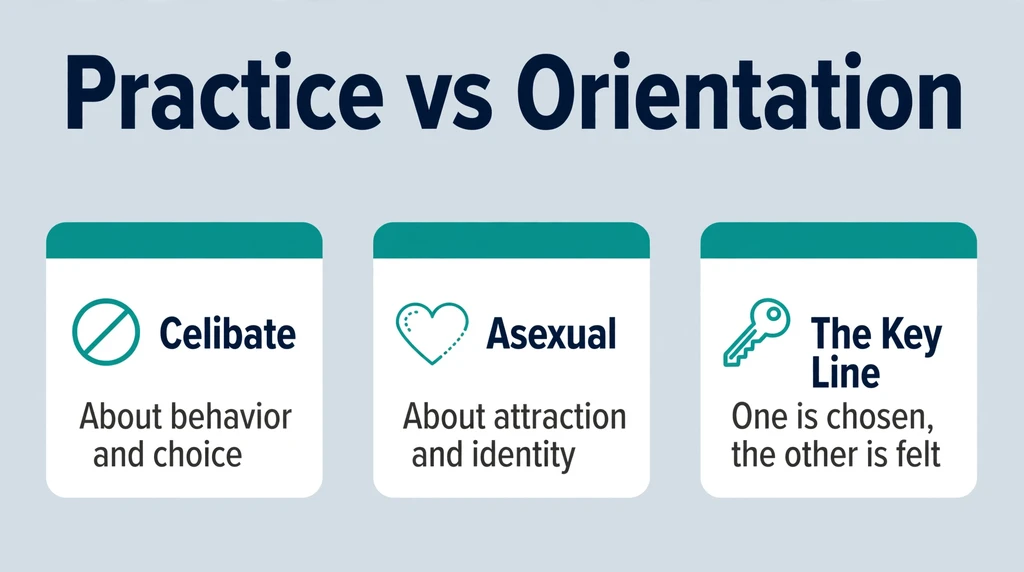
Of all the mix-ups around this word, the confusion with asexual causes the most trouble. The two words can describe the same outward life, yet they mean very different things. Celibate names a practice or a vow. Asexual names an orientation.
What Asexual Means
The Asexual Visibility and Education Network, known as AVEN, defines an asexual person in one clean line. An asexual person does not experience sexual attraction. Researchers generally treat asexuality as a sexual orientation, a lasting pattern of attraction, or here its lasting absence. Some asexual people still feel romantic attraction and form partnerships. Others feel attraction only rarely, or under specific conditions. Either way, the marker is attraction, not behavior.
Where the Two Words Part
A celibate person usually feels sexual attraction and chooses not to act on it. An asexual person may never feel that attraction in the first place. AVEN makes the distinction in its own FAQ. A sexual person who chooses not to have sex, it explains, is practicing celibacy or abstinence. And an asexual person who chooses to have sex is still asexual.
So all four combinations exist. A person can be sexual and celibate, sexual and active, asexual and celibate, or asexual and not celibate. Neither word can do the other word’s job. Using one in place of the other muddles both.
Romantic Attraction Is a Separate Axis
Attraction itself comes in more than one kind. Asexual communities draw a careful line between sexual attraction and romantic attraction. Many asexual people want partnership, affection, and shared life, just without the sexual pull. Labels such as gray-asexual cover people who feel sexual attraction only rarely or faintly. Demisexual describes people who feel it only after a strong emotional bond forms.
Celibate people sit on the same map, at a different point. A celibate person may feel both kinds of attraction at full strength. The vow or decision governs what they do with those feelings, not whether the feelings exist. Two people can therefore share a quiet, partner-free life for entirely different inner reasons.
A Quick Test
When you are unsure which word fits, ask one question. Is this about what the person feels, or about what the person does? Feelings and attractions point to orientation words like asexual. Actions, choices, and commitments point to practice words like celibate. The test takes two seconds, and it prevents most errors.
Why the Distinction Matters
Getting the words right is a small act of accuracy and respect. Calling an asexual person celibate treats an identity as if it were a decision. Calling a celibate person asexual treats a decision as if it were an identity. The distinction also keeps both words clear of health questions. The DSM-5, psychiatry’s standard manual, notes that asexuality itself is not a disorder and should not be diagnosed as one.
Why People Choose Celibacy Today
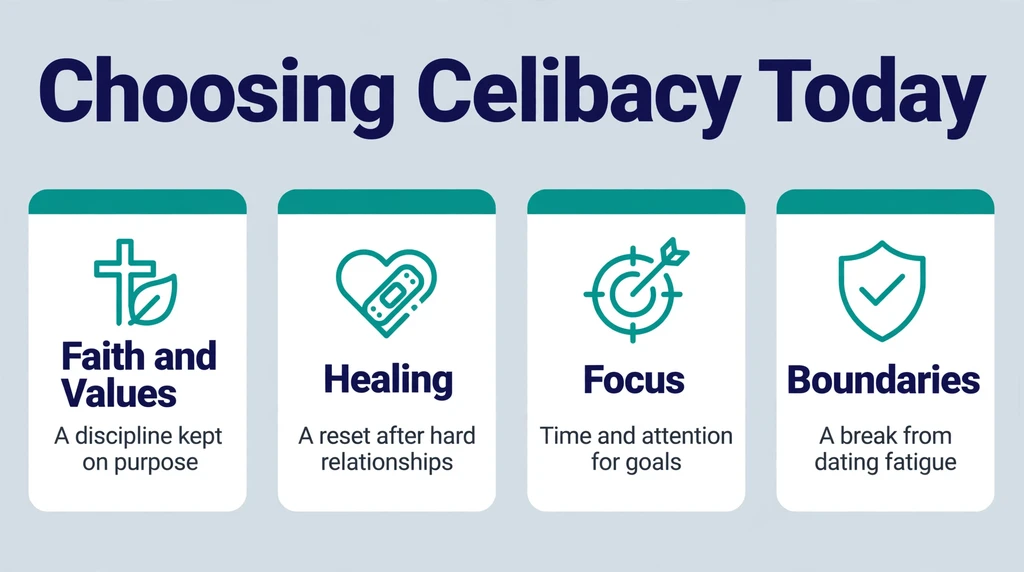
Step outside the monastery, and modern celibacy looks different. Reporting in recent years describes a visible minority of adults, many of them young, choosing a stretch of celibacy for personal reasons. A Kinsey Institute survey reported in 2025 found a striking pattern. About one in six women, and roughly one in ten men, described themselves as voluntarily celibate or single by choice and not currently sexually active. Their reasons cluster into a few familiar themes.
Faith and Personal Values
Plenty of laypeople adopt celibacy as part of a religious life, without any vow being imposed on them. Some wait for marriage, as many faith communities teach their young people to do. Others treat celibacy as a standing discipline that keeps their spiritual life near the center. For them, the practice feels less like a restriction than like a structure.
Healing and a Reset
Breakups, divorces, and draining relationships send many people looking for a pause. Taking sex and dating off the table gives them room to recover without new complications. Therapists quoted in recent coverage describe a chosen break in just these terms. It lets a person untangle desire from old wounds and rebuild trust in their own judgment.
Focus, Work, and Study
Dating takes time, money, and emotional bandwidth. People in demanding seasons often decide to spend all three somewhere else. Students protect a final year of study. Founders pour the hours into a young business. Athletes guard a heavy training block. In each case, the real subject is attention, the one resource nobody can refill.
Dating Fatigue and Boundaries
Modern dating carries its own exhaustions: apps, ghosting, mixed signals, and pressure to move fast. Some people step back because the process itself has stopped feeling good. For them, celibacy restores a sense of control over their time and their emotions. It also redraws a boundary around their worth. Their value stops rising and falling with being chosen.
Waiting for the Right Relationship
Some people are celibate for the simplest of reasons. They have not met anyone they actually want to be with. For them, sex belongs inside a committed relationship, and no such relationship is on offer right now. This outlook often has roots in personal values rather than formal religion. It also explains why much everyday celibacy never gets announced. There is no break, no vow, and no statement, just a standard being quietly kept.
A Season, Not Always a Sentence
For most people in this newer wave, the commitment has a soft edge. It might last a few months, a year, or until the right relationship appears. Some extend it and find that they prefer the calm. Either way, one thread runs through every reason on this list. The choice is theirs, and they can revisit it.
Common Misconceptions About Celibacy
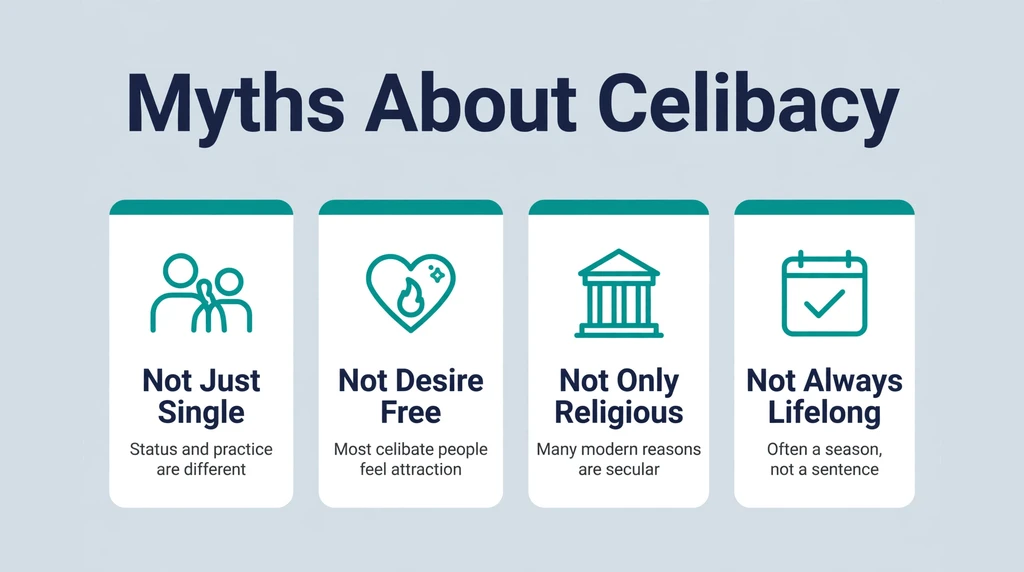
Few vocabulary words carry as many stray assumptions as this one. Here are the mix-ups that surface most often, together with what the word actually says.
Misconception 1: Celibate Just Means Single
The confusion has an honest history, because the word began with marital status. Today, though, the two terms answer different questions. Plenty of single people are sexually active, and they are not celibate. Plenty of dating also takes place entirely outside marriage. Single describes a relationship status. Celibate describes a practice layered on top of one.
Misconception 2: Celibate People Feel No Desire
That picture belongs to a different word. Most celibate people feel attraction much like anyone else. They have simply decided not to act on it. In fact, the discipline only makes sense because the desire exists. Where desire itself is absent, the accurate word is usually asexual. Even then, asexuality concerns attraction rather than behavior.
Misconception 3: Only Religious People Are Celibate
Priests and monks are the classic image, and religious celibacy is real and widespread. But the previous section shows the modern picture clearly enough. Students, founders, athletes, and people recovering from breakups all choose celibacy without any religious motive. The word belongs to the whole dictionary, not to any single faith.
Misconception 4: Celibacy Means Avoiding All Intimacy
Celibate people keep friendships, family bonds, mentors, and communities. Many live in communities built entirely on shared, nonsexual closeness. The boundary in celibacy is sexual, and in the strict sense marital, not emotional. Warmth, affection, and loyalty all survive the vow intact. A celibate life can be lonely, like any life can. Loneliness, however, is not part of the definition.
Misconception 5: It Is Always Lifelong, and Always Chosen
Vows can be lifelong, but much celibacy is temporary, as the modern examples show. There is also an involuntary side to this word’s wider family. The phrase involuntary celibacy describes people who want a partner yet cannot find one. In 2001, researchers led by Denise Donnelly gave that situation its first formal academic study, treating it as a life circumstance.
The short form of the phrase has a strange history of its own. It began in 1997 with Alana’s Involuntary Celibacy Project, a website created by a Toronto student known as Alana. As the BBC has reported, the site was a supportive space for lonely people of every gender. She first shortened the phrase to invcel, until a reader suggested that incel was easier to say. Online, the term later narrowed into a label for angry, mostly male subcultures. That later meaning is real, but it is not where the word started. Nor is it what celibacy itself means.
Misconception 6: The Word Itself Is a Health Verdict
People argue about celibacy as if the dictionary had taken sides on health. It has not. The word describes a practice, and it says nothing about whether that practice suits a given person. Therapists quoted in modern coverage make the same distinction in clinical terms. A freely chosen break, they note, is a different experience from unwanted isolation. What matters is the choice, the context, and the person’s wider life. Anyone struggling with desire or its absence deserves a real conversation, not a label.
Synonyms for Celibate and Related Words
A quick note on register before the list itself. Celibate is the neutral, dictionary-standard choice in nearly every context. It fits a medical article, a news report, and a casual conversation equally well. Some of its neighbors, by contrast, carry extra baggage that you may or may not want.
The closest synonym is chaste, though it carries a stronger flavor of moral purity. Abstinent stresses the behavior of holding back, and it applies to food and drink as well as sex. Continent is an older, formal synonym that means exercising self-restraint. Monastic and ascetic describe whole lifestyles built around discipline. They therefore sit near the word rather than squarely inside it.
Neighbors That Are Not Synonyms
Two common neighbors, meanwhile, are not true synonyms at all. Single and unmarried describe marital status only, as the misconception section showed. Virgin describes someone who has never had sex, which is a history rather than a practice. So a person can be celibate without being a virgin. A virgin, equally, is not necessarily practicing celibacy as a commitment. On the far side, the neutral opposite of the behavior sense is sexually active. Promiscuous, by contrast, is a loaded judgment rather than a clean antonym.
The noun side of the family has its own small cluster. Chastity, continence, and abstinence all appear in dictionaries as close terms for celibacy itself. Each one tilts the idea slightly. Chastity leans toward purity, continence toward self-command, and abstinence toward the simple act of going without. When a thesaurus offers all three, the best choice depends on which tilt your sentence needs. Formal writing still favors celibacy as the umbrella term, because it alone carries both the marriage and the behavior layers together.
Celibate in a Sentence
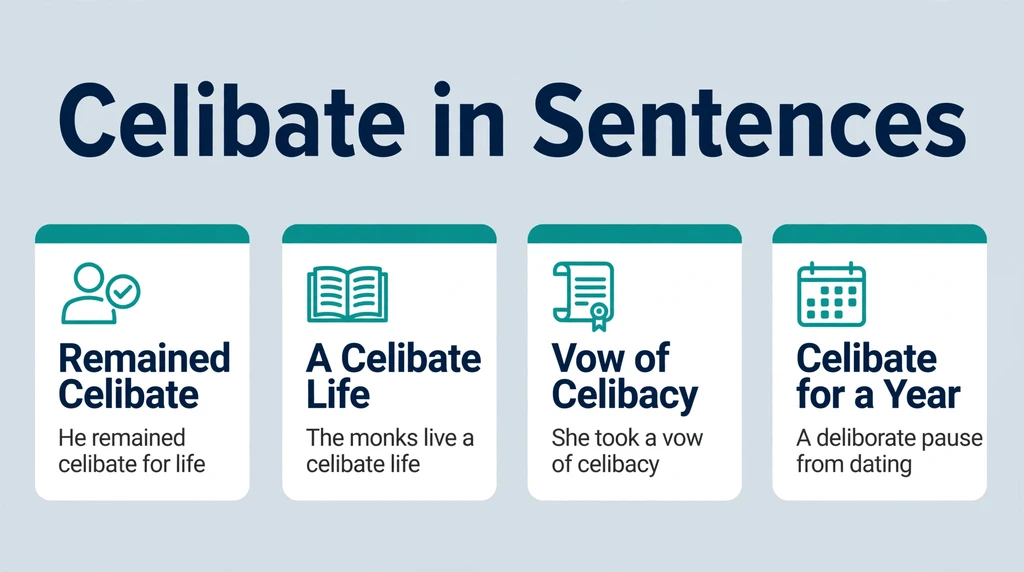
The word flexes easily across formal, religious, and everyday contexts. These examples show the main patterns. A few use the noun form, celibacy, where that form fits more naturally.
1. After his ordination, Daniel remained celibate for the rest of his life.
2. Every monk in the hilltop monastery lives a celibate life of prayer and work.
3. She has been celibate since her divorce, a choice she calls restful rather than lonely.
4. He took a vow of celibacy when he entered the seminary at nineteen. 5. For the final year of her training, the boxer stayed celibate and guarded her focus. 6. The novel’s hero is a celibate priest who runs a busy city parish. 7. They chose a celibate marriage, a decision they say suits them both.
More Patterns: Everyday, News, and Formal Uses
8. Being single does not make you celibate; the two words describe different things. 9. His celibate years at university were a deliberate pause, not an accident of shyness. 10. The sisters at the convent school live celibate lives devoted to teaching. 11. After years of dating apps, Maya announced a celibate year and deleted every profile. 12. The order expects its brothers to remain celibate, poor, and obedient. 13. News reports described a small community of celibate hermits living near the old desert monastery. 14. In the interview, the bishop reminded young priests that a celibate commitment is lifelong.
Notice how the examples lean on a few steady patterns. The word follows verbs like remain, stay, live, and be. It also settles comfortably in front of nouns like life, priest, and years. When a sentence needs the commitment rather than the person, celibacy steps in, as the seminary example shows. Mixing the two forms on purpose keeps longer passages from repeating one shape.
Frequently Asked Questions
What is the difference between celibate and celibacy?
Celibate describes the person, either as an adjective or as a noun. Celibacy names the state or practice that the person lives in. The pair works like private and privacy, or abstinent and abstinence. If you are talking about someone, reach for celibate. If you are talking about the condition or the commitment itself, reach for celibacy.
Can a married person be celibate?
In the strict, traditional sense, no, because the word includes remaining unmarried. In modern everyday use, though, people do speak of a celibate marriage or a celibate season inside a marriage. They mean that the couple is not having sex during that time. Dictionaries still lead with the unmarried sense. So a clarifying word or two will keep your meaning clear. In formal writing, the phrase sexless marriage is often the clearer term for that situation.
Is celibate the same as asexual?
No. Celibate describes a practice: not having sex, usually by choice or under a vow. Asexual describes an orientation: not experiencing sexual attraction. A person can be either one, both, or neither. AVEN, the main asexuality network, draws exactly this line in its own FAQ.
Do celibate people date or fall in love?
Many celibate people do feel romantic attraction. Those who are celibate for a season may keep dating, with the boundary stated early and honestly. Vowed religious celibates usually step away from romantic partnerships as well, because their commitment covers that ground too. In every case, affection and close friendship remain fully possible.
Is celibacy always about religion?
No. Religion gave the word its classic settings, and vows remain a major form of it. But people also choose celibacy to heal after a breakup, to focus on work or study, or to take a break from dating. The word simply describes the practice, whatever the motive behind it happens to be.
How long does celibacy last?
There is no standard length. A religious vow usually lasts for life, or for as long as the person remains in that state of life. Personal celibacy can run for a few months, a year, or until marriage. When you read the word in the wild, look for a time expression nearby. Writers often specify the span themselves.
Is celibacy the same as abstinence?
Not quite. Abstinence names a behavior: not having sex for a stretch of time, for any reason. Celibacy names a settled state or commitment, traditionally one that also includes staying unmarried. Every celibate person practices abstinence. But a teenager waiting for marriage, or an athlete in a training block, practices abstinence without living in celibacy.
What exactly is a vow of celibacy?
It is a formal promise, usually made in a religious setting, to give up marriage and sexual relations. Catholic priests in the Latin Church take on this commitment under canon law. Monks and nuns make it as part of their religious profession. A vow turns a private decision into a public and binding commitment.
Final Thoughts
Celibate is a small word with two layers, one about marriage and one about sex. Both layers rest on a Latin root that meant, simply, unmarried. Around it clusters a family of neighbors, each doing a narrower job: chaste for the virtue, abstinent for the behavior, asexual for the orientation, single for the status. Choosing the precise word keeps conversation about real lives honest. For a deeper historical tour, Britannica’s summary of celibacy traces the practice across the world’s religions.
Once you know the layers, you will start spotting the word everywhere. It appears in church debates, in dating columns, in novels, and in quiet personal decisions. Each time, ask which layer the writer means: the status, the behavior, or both. That one question turns a fuzzy word into a precise one, and it is the whole skill this guide set out to teach.