Have you ever received a message containing three letters that left you scratching your head? You’re not alone. Internet slang moves quickly, and abbreviations can make ordinary conversations surprisingly confusing.
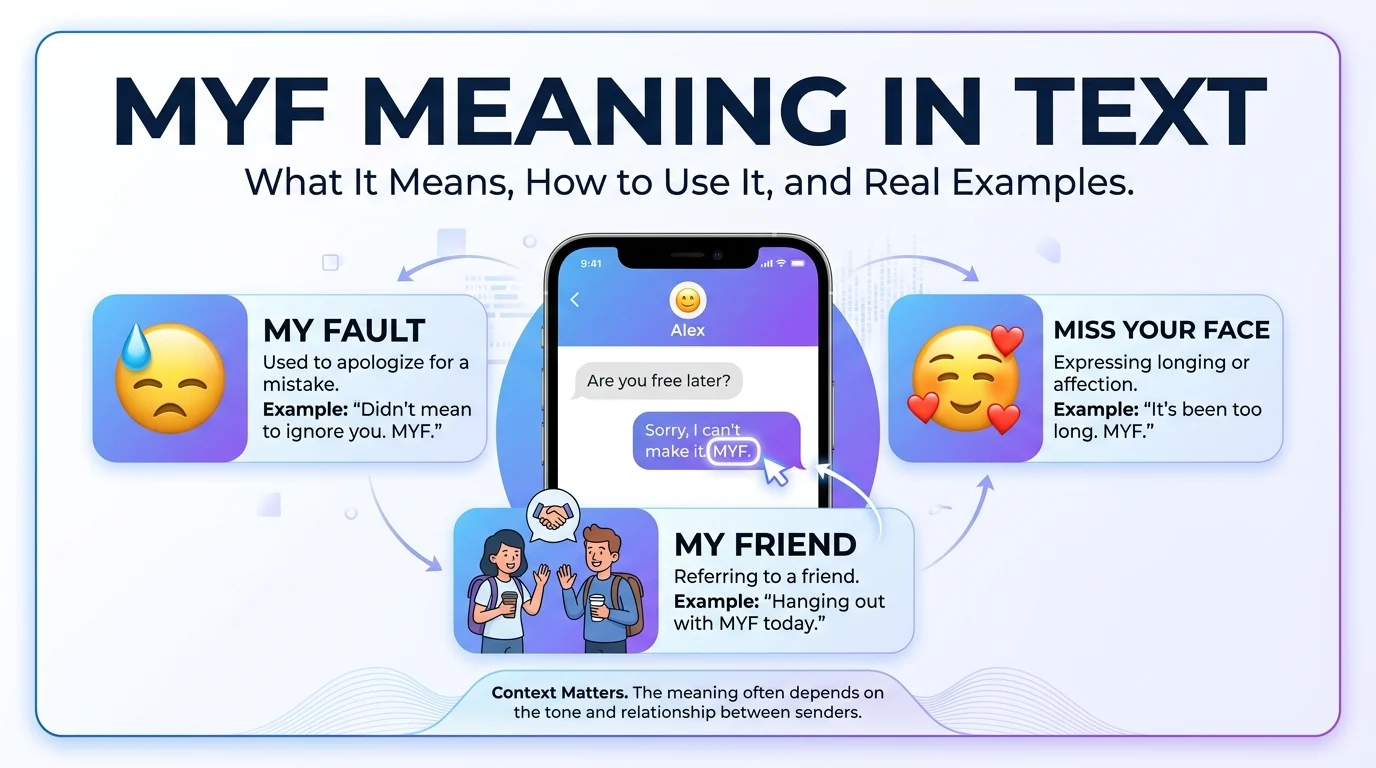
The MYF meaning in text depends on how someone uses it and what the conversation is about. In social media slang, particularly in TikTok-related explanations, MYF commonly stands for “My Fault,” a casual way to accept responsibility for a mistake.
Some online discussions also associate it with phrases such as “Miss Your Face” or “My Friend,” although those interpretations are less standardized.
For example, someone who forgets to reply to your message might write, “Sorry, MYF!” They could be admitting their mistake. However, if a friend sends MYF while talking about missing you, the intended meaning might be different.
The trick is to look beyond the abbreviation itself. The previous message, the relationship between the people chatting, and the overall tone can help you understand what the sender means.
In this guide, you’ll learn what MYF stands for, how people may use it in texts and social media conversations, how to interpret its different meanings, and how to reply naturally when someone sends it to you.
What Does MYF Mean in Text?
MYF most commonly means “My Fault” in the social media slang context documented by several online explainers. People use this shortened phrase to acknowledge an error, accept responsibility, or apologize for something that went wrong.
Think of it as a casual alternative to saying, “That was my mistake” or “I’m responsible for that.”
For example:
Alex: You sent me the wrong address.
Jordan: MYF! I copied the old one by mistake.
Here, MYF means “My Fault.” Jordan admits the error without writing a lengthy explanation.
People often shorten expressions in digital communication because quick messages favor brevity. Just as someone might type “my bad” instead of offering a formal apology, MYF can communicate responsibility in only three letters.
However, MYF isn’t a universally standardized abbreviation. Different people and online communities may assign their own meanings to it. You shouldn’t assume that every sender uses it the same way.
What Does MYF Stand For?
The primary interpretation to consider in a social media conversation is:
– MYF = My Fault: A casual admission of responsibility for a mistake.
Two other possible expansions appear in online explanations and informal usage:
- MYF = Miss Your Face: An affectionate expression that conveys missing someone’s company or physical presence.
- MYF = My Friend: A possible informal way to address a friend, although it isn’t a consistently established texting abbreviation.
These alternatives deserve more caution than the “My Fault” interpretation. Their presence in online explanations doesn’t establish how frequently people actually use them.
Consider the surrounding message before settling on a definition. An apology points toward “My Fault,” while an affectionate exchange might support “Miss Your Face.” If none of the interpretations fits, the sender may be using personal shorthand that only their friends understand.
Common MYF Meanings and Their Differences
Although three-letter abbreviations look straightforward, their meanings can change with context. Understanding the differences helps you avoid misreading a message.
| Possible meaning | Intended message | Likely context | Example |
|---|---|---|---|
| My Fault | I accept responsibility for my mistake. | Apologies, errors, misunderstandings | “MYF, I forgot to call you.” |
| Miss Your Face | I miss seeing you. | Affectionate or friendly conversations | “It’s been weeks since we met. MYF!” |
| My Friend | I’m referring to you as a friend. | Casual conversation or personal shorthand | “Thanks for helping me, myf.” |
The table summarizes possible interpretations, not three equally common or universally recognized definitions.
MYF Meaning: My Fault
“My Fault” is the strongest starting point when you encounter MYF in a context involving an error or apology.
The phrase expresses responsibility. It can acknowledge a small mistake without turning the conversation into a serious discussion.
Example 1: Forgetting a plan
Taylor: You were supposed to remind me about the movie.
Morgan: MYF! I got busy and forgot.
Morgan acknowledges the oversight and apologizes informally.
Example 2: Sending the wrong message
Taylor: That message wasn’t meant for our group chat.
Morgan: MYF 😭 Wrong chat!
The abbreviation helps Morgan admit the mistake while keeping the exchange lighthearted.
Example 3: Misunderstanding instructions
Taylor: I meant Friday, not Thursday.
Morgan: Oh, MYF. I misunderstood.
In this case, MYF signals that Morgan accepts responsibility for the confusion.
The phrase works best when the mistake is relatively minor and an informal tone feels appropriate. For a serious error, a fuller apology usually communicates more care and accountability.
MYF Meaning: Miss Your Face
“Miss Your Face” is another possible interpretation you might encounter in informal online explanations. It expresses that someone misses seeing another person, often because they haven’t spent time together recently.
Unlike “My Fault,” this interpretation communicates affection rather than responsibility. It may fit a conversation between close friends, romantic partners, or family members.
For example:
Jamie: We haven’t hung out in forever!
Riley: True. MYF ❤️
Riley might intend to say, “Miss Your Face,” expressing that they miss seeing Jamie.
Another example:
Jamie: Remember our summer road trip?
Riley: Of course! MYF. We need another one soon.
Here, the surrounding conversation makes an affectionate interpretation plausible.
Still, don’t automatically interpret MYF as a declaration of romantic interest. Even when someone means “Miss Your Face,” the message can express ordinary friendship rather than attraction.
Context matters more than the abbreviation alone. If the intended meaning remains unclear, asking a quick question is safer than assuming the sender’s feelings.
MYF Meaning: My Friend
Some online explanations also present MYF as shorthand for “My Friend.” This is possible in personal or community-specific usage, but it’s less standardized than familiar abbreviations such as BFF.
The phrase itself is ordinary English. The uncertainty lies in whether a particular sender actually intends those three letters to represent it.
For example, someone might write:
“Thanks for helping me out, myf!”
If that person regularly invents shortened expressions with friends, “My Friend” might make sense. However, another reader could find the same message confusing.
This distinction is important: a phrase can be a possible expansion of an abbreviation without being a widely recognized texting definition.
When writing to someone who may not know your shorthand, spell out “my friend” instead. You’ll avoid unnecessary confusion and keep the message natural.
How to Understand the MYF Meaning From Context
When you receive a message containing MYF, don’t focus on the three letters alone. Instead, use the surrounding conversation to work out what the sender likely means.
A few simple clues can make the interpretation much easier.
Look at the Previous Message
The message immediately before MYF often provides the strongest clue.
If someone has just pointed out a mistake, “My Fault” is a sensible interpretation. If you and a friend are discussing how long it’s been since you met, an affectionate meaning may fit better.
Compare these conversations:
Conversation A:
Sam: You gave me the wrong meeting time.
Chris: MYF! It’s at 3 p.m., not 2 p.m.
The apology points toward “My Fault.”
Conversation B:
Sam: I haven’t seen you since graduation.
Chris: MYF ❤️ Let’s catch up soon.
The affectionate tone makes “Miss Your Face” a possible interpretation.
Notice that neither example proves the meaning through the abbreviation alone. The surrounding words make one interpretation more likely.
Consider Your Relationship With the Sender
Your relationship with the other person can provide useful context.
A close friend might use an unusual abbreviation as an inside joke. A romantic partner might use shorthand to express affection. A classmate might use MYF after making a mistake in a group assignment.
However, relationships offer clues rather than definitive answers. Friends can apologize, romantic partners can make mistakes, and colleagues sometimes use casual slang.
Use your knowledge of the relationship alongside the actual message.
Pay Attention to Tone and Emojis
Emojis and punctuation can clarify the mood of a message, but they can’t reliably establish its meaning by themselves.
For instance:
- “MYF 😭” could accompany an embarrassing mistake.
- “MYF ❤️” could support an affectionate interpretation.
- “MYF lol” might appear in a lighthearted exchange about a mistake.
These examples illustrate how people combine text and emojis to convey tone. None is a fixed rule.
Also, remember that people use emojis differently. One person’s crying emoji might signal genuine sadness, while another uses it to mean they’re laughing uncontrollably.
Ask for Clarification When Necessary
Sometimes a message simply doesn’t contain enough information.
Imagine that a friend sends you only this:
MYF
There isn’t enough context to determine the intended expansion confidently.
Rather than guessing, you could reply:
- “What do you mean by MYF?”
- “Do you mean my fault?”
- “I’m not sure I understand. Can you explain?”
A quick question prevents misunderstandings, especially when a message could communicate either an apology or affection.
MYF Meaning on Snapchat, Instagram, and TikTok
You might encounter MYF in different social media environments. However, the platform doesn’t automatically determine what the abbreviation means. The conversation still matters most.
MYF Meaning on Snapchat
On Snapchat, people exchange short messages, photos, videos, and replies to stories. Informal abbreviations may appear in any of these conversations.
If someone sends MYF after forgetting to respond to your Snap, “My Fault” may be the intended meaning.
For example:
You: I sent you that Snap yesterday!
Friend: MYF 😭 I completely forgot to reply.
The sentence supports an apology because the sender acknowledges forgetting something.
Alternatively, a friend who is talking about missing you might use MYF to express affection. That’s a possible personal interpretation, not a special Snapchat definition.
When you receive MYF on Snapchat, read the message alongside the preceding conversation rather than assuming the app has its own fixed meaning.
MYF Meaning on Instagram
On Instagram, abbreviations can appear in direct messages, comments, captions, and replies to Stories.
The communication style varies by setting. A private message between friends may be more personal than a comment under a public video.
For example:
You: You tagged the wrong person in that post.
Friend: MYF! I’ll fix it.
Here, “My Fault” fits because the sender acknowledges an error.
If a friend uses MYF in a more affectionate conversation, another interpretation might apply. However, the fact that the abbreviation appears on Instagram doesn’t prove that the sender means “Miss Your Face.”
The best approach is to interpret the full message rather than the platform alone.
MYF Meaning on TikTok
TikTok is particularly relevant when discussing MYF because slang explainers published in 2024 identified “My Fault” as its usual meaning in TikTok-related contexts.
Someone might use it in a comment, reply, or caption to acknowledge an error.
For example:
Comment: You said the video was recorded in 2023, but it was recorded in 2024.
Creator: MYF, I mixed up the dates!
The creator accepts responsibility for the incorrect information.
MYF can also appear in casual conversations that have nothing to do with mistakes. In those situations, examine the wording before assigning a meaning.
Keep in mind that slang changes over time and varies among online communities. A definition reported in one TikTok context shouldn’t be treated as a universal rule for every TikTok user.
MYF Meaning on WhatsApp and Other Messaging Apps
On WhatsApp and similar messaging services, people use abbreviations to make everyday conversations quicker.
MYF may appear in private chats, family group messages, friend groups, or community discussions. Its interpretation depends on the sender’s habits and the topic being discussed.
For example:
You: Sorry, I sent the document to the wrong group.
Friend: No worries.
You: MYF 😅
The sender uses MYF to acknowledge the mistake.
In another group, the same letters might represent a phrase that members have agreed upon informally. If you’ve never seen the abbreviation before, don’t assume everyone uses it the same way.
How to Use MYF in a Text Message
Before using MYF yourself, make sure your recipient will understand what you mean. An abbreviation saves time only when both people recognize it.
If the other person has to stop and decode your message, spelling out the phrase may be more efficient.
Use MYF to Admit a Mistake
When you intend MYF to mean “My Fault,” use it in a conversation where you’re acknowledging responsibility for something.
Examples include:
- “MYF, I forgot to send you the notes.”
- “Oops, MYF! I read the instructions wrong.”
- “MYF for the late reply.”
- “That was MYF. I should’ve checked first.”
- “MYF 😅 I sent the old version.”
These examples use MYF as an informal apology or admission of responsibility.
Notice that the abbreviation doesn’t replace the need to explain or correct a mistake. If your error affected someone else, acknowledge what happened and take the necessary steps to fix it.
For example, “MYF, I missed the deadline. I’ve submitted the file now” communicates more than a bare “MYF.”
Use MYF for an Affectionate Message
If you and your recipient already use MYF to mean “Miss Your Face,” the abbreviation may fit a friendly, affectionate conversation.
For example:
- “It’s been too long. MYF!”
- “MYF ❤️ When are we meeting again?”
- “Those old pictures reminded me of you. MYF.”
- “We need a catch-up soon. MYF!”
These examples assume that both people recognize the intended meaning. They shouldn’t be treated as evidence that everyone will interpret MYF affectionately.
When you’re messaging someone new, spell out the phrase instead. A clear message such as “I miss seeing you!” avoids the ambiguity entirely.
Use MYF With Friends Who Understand Your Shorthand
Friends often develop their own ways of communicating. They shorten phrases, reuse jokes, and create expressions that make sense within their group.
MYF could become part of that private vocabulary if everyone understands it.
However, personal shorthand doesn’t automatically translate well to other audiences. A new friend might interpret your message differently or assume you’ve made a typo.
A useful rule: Use familiar abbreviations with people who understand them. Use clear, ordinary wording when the meaning matters.
When Not to Use MYF
MYF isn’t the best choice for every situation.
Avoid relying on it when:
- You’re writing a formal email or professional report.
- You’re apologizing for a serious mistake.
- You’re discussing a sensitive issue that requires clarity.
- You’re messaging someone unfamiliar with internet slang.
- Your intended meaning could easily be misunderstood.
For a professional apology, write something like, “I apologize for sending the incorrect file. I’ve attached the corrected version.”
That message takes a few more words, but it acknowledges the issue clearly and explains the next step.
How to Reply When Someone Says MYF
Your response should match the meaning the sender intended. Once you’ve identified the context, replying is usually straightforward.
If MYF Means My Fault
If someone uses MYF to admit a minor mistake, acknowledge the apology naturally.
Possible replies include:
- “No worries!”
- “It’s all good.”
- “Don’t worry about it.”
- “Thanks for letting me know.”
- “No problem. Thanks for fixing it.”
Choose a response that fits the situation. If the mistake caused a real problem, you can accept the apology while explaining what needs to happen next.
For example:
Friend: MYF, I forgot to bring the book.
You: It’s okay! Just bring it tomorrow.
This response accepts the apology and offers a practical solution.
If MYF Means Miss Your Face
If the sender intends an affectionate meaning, respond according to your relationship and how you feel.
You might say:
- “Miss seeing you too!”
- “We need to hang out soon.”
- “It’s been way too long!”
- “Let’s plan something this weekend.”
- “Aww, hope to see you soon!”
Don’t feel pressured to respond romantically just because someone expresses affection. A friendly message deserves a response that reflects your actual relationship with the sender.
For instance:
Friend: MYF ❤️
You: Same here! Let’s grab coffee soon.
The reply acknowledges the sentiment while keeping the conversation natural.
If MYF Means My Friend
If you’re confident that the sender is using MYF as “My Friend,” you can simply continue the conversation.
For example:
Friend: Thanks for helping me out, myf!
You: Anytime! Glad I could help.
You don’t need to imitate every abbreviation someone else uses. Respond in your usual style if that feels more natural.
If You Don’t Understand MYF
When the meaning remains unclear, ask directly.
For example:
Friend: MYF.
You: Wait, what do you mean by MYF?
This is a perfectly reasonable response. You don’t need to pretend to understand slang just to keep a conversation moving.
If you suspect the sender meant “My Fault,” you could ask, “Are you saying it was your mistake?”
A short clarification is often better than replying to a meaning the sender never intended.
Is MYF a Common Texting Abbreviation?
MYF appears in online slang explanations, but its use isn’t as standardized as many familiar texting abbreviations. That distinction matters when you’re trying to understand a message from someone you don’t know well.
Abbreviations such as LOL, BRB, IDK, and BTW have widely recognized meanings:
| Abbreviation | Full form | Typical use |
|---|---|---|
| LOL | Laughing Out Loud | Reacting to something funny |
| BRB | Be Right Back | Saying you’ll return shortly |
| IDK | I Don’t Know | Expressing uncertainty |
| BTW | By The Way | Introducing an additional point |
| MYF | Often reported as My Fault in social media slang | Acknowledging a mistake |
Unlike these familiar examples, MYF has less consistent usage. Some people may know it as “My Fault,” while others may recognize an alternative meaning or have never encountered it before.
This variation makes MYF more dependent on context. If someone uses it in a message, consider the wording and situation before deciding what it means.
Is MYF Slang or an Abbreviation?
MYF is best described as an informal abbreviation or initialism when its letters stand for a longer phrase.
An initialism uses the individual letters of a phrase, usually pronounced separately. For example, people generally say the letters in IDK rather than pronounce them as a conventional English word.
In casual texting, MYF also functions as internet slang because people use it informally in digital conversations.
It’s important to distinguish between an abbreviation and its underlying phrase. “My Fault” is an ordinary English expression. MYF is the shortened form people may use to represent it.
However, MYF doesn’t have one fixed expansion in every context. Treat it as informal shorthand rather than an official English word with a single universal definition.
Frequently Asked Questions
What Does MYF Mean in Text?
MYF most commonly means “My Fault” in the social media slang context described by online explainers. It expresses responsibility for a mistake. However, some people may use the same letters for other phrases, so read the surrounding conversation before deciding what the sender intended.
What Does MYF Stand For?
The primary interpretation to consider is “My Fault.” Other possible expansions include “Miss Your Face” and “My Friend,” although these aren’t equally established or universally recognized. The sender’s wording, tone, and conversational context can help you identify the intended meaning.
What Does MYF Mean When Someone Texts You?
When someone sends MYF after forgetting something, making an error, or misunderstanding your message, they may mean “My Fault.” If the conversation is affectionate, another interpretation might fit. When the abbreviation appears alone, ask the sender to clarify rather than guessing.
Is MYF a Slang Word or an Abbreviation?
MYF is informal texting shorthand. When it represents “My Fault,” it works as an abbreviation or initialism. Because people may assign different meanings to the same letters, MYF can also function as community-specific internet slang.
Does MYF Have Different Meanings?
Yes. “My Fault” is a prominent interpretation in TikTok-related slang explanations, while “Miss Your Face” and “My Friend” also appear as possible expansions online. These alternatives shouldn’t be treated as equally common or assumed to apply to every message.
What Does MYF Mean on Snapchat or Instagram?
MYF doesn’t have a universal Snapchat-specific or Instagram-specific definition. It may mean “My Fault” when someone acknowledges an error. Other interpretations are possible in personal conversations, so check the message before and after the abbreviation.
How Do You Reply When Someone Says MYF?
If the sender means “My Fault,” you can reply, “No worries!” or “It’s all good.” If they intend an affectionate meaning, you might say, “Miss seeing you too!” When you’re uncertain, ask, “What do you mean by MYF?”
Is MYF Appropriate for Professional Messages?
MYF generally isn’t the best choice for formal workplace communication because readers may not recognize it. Use a complete phrase such as “My mistake” or “I apologize for the error” instead. Clear wording is especially important when discussing deadlines, important documents, or responsibilities.
Conclusion
The MYF meaning in text depends on the sender and the conversation. In social media slang, “My Fault” is a prominent interpretation used to acknowledge an error or accept responsibility.
Other possible meanings, including “Miss Your Face” and “My Friend,” may appear in informal online explanations or individual conversations. However, you shouldn’t assume that everyone recognizes or uses those expansions.
When you receive MYF, look at the previous message, consider the tone, and think about your relationship with the sender. These clues usually help you narrow down the possibilities.
Most importantly, don’t overthink three letters. When the meaning isn’t clear, ask the sender what they mean. A quick question is often the simplest way to avoid a misunderstanding and keep the conversation flowing.