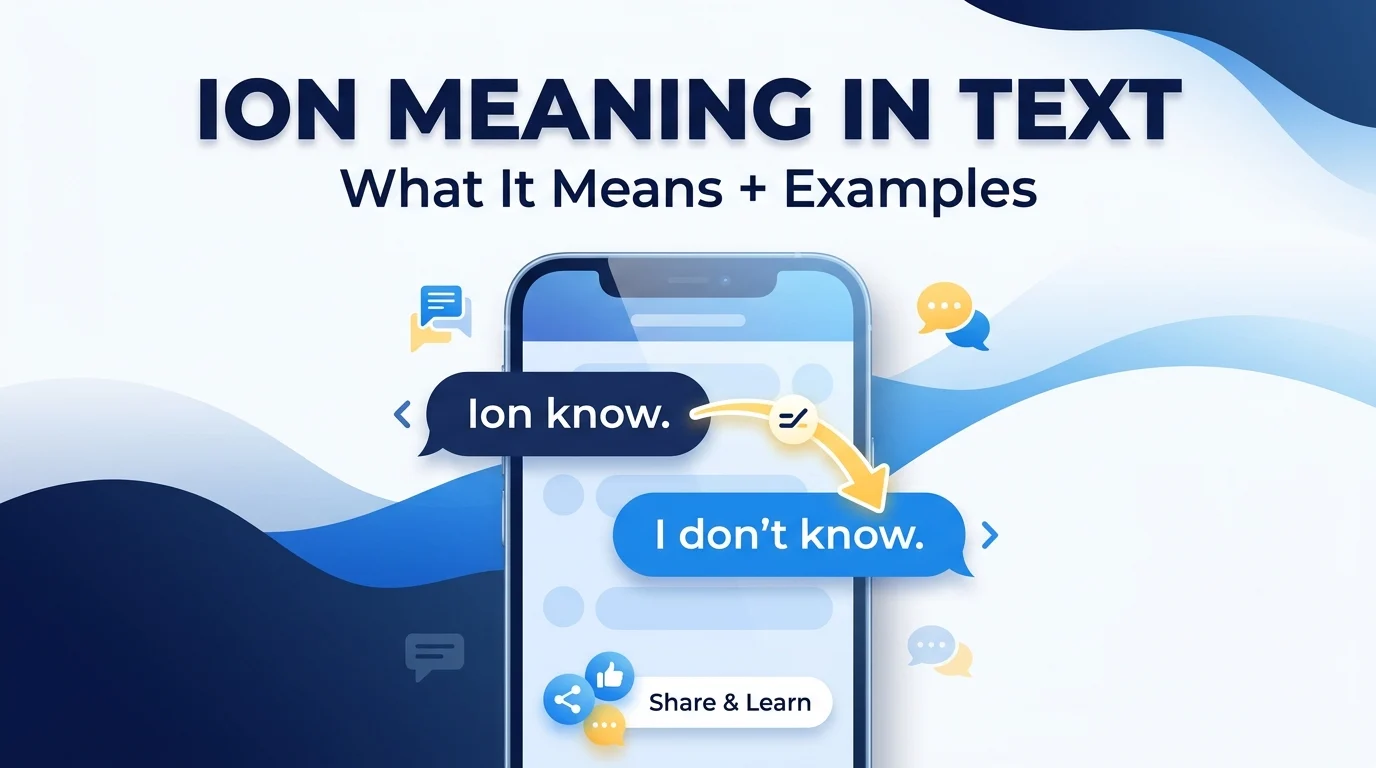
Have you ever received a message that said “ion know” or “ion even care” and wondered what the sender meant? At first glance, ion might look like a science term or an abbreviation with a hidden meaning. In casual texting, however, it usually means something much simpler.
The ion meaning in text is “I don’t.” People use this informal spelling in text messages, social media comments, direct messages, and everyday online conversations. For example, “ion know” means “I don’t know,” while “ion wanna go” means “I don’t want to go.”
The spelling reflects casual speech rather than a traditional abbreviation formed from the first letters of several words. Its meaning also depends on what follows it. Someone who writes “ion care” expresses something different from someone who writes “ion know.”
In this guide, you’ll learn what ion means in texting, how people use it across social media, what it can communicate in different situations, and how to respond when someone sends it to you.
What Does Ion Mean in Text?
In texting slang, ion commonly represents “I don’t.” It’s an informal, phonetic spelling that reflects how the phrase can sound when spoken quickly in casual conversation.
People often write it before a verb or another expression to communicate a negative statement. Instead of typing the full phrase, they use the shorter spelling to match their everyday speaking style.
Here are a few straightforward examples:
| Texting phrase | Standard English meaning |
|---|---|
| Ion know. | I don’t know. |
| Ion want that. | I don’t want that. |
| Ion care. | I don’t care. |
| Ion think so. | I don’t think so. |
| Ion feel like going. | I don’t feel like going. |
| Ion see it. | I don’t see it. |
Notice that ion doesn’t usually express a complete thought by itself. The words after it help explain what the sender doesn’t know, want, feel, or agree with.
For example, imagine asking your friend whether they want to attend a concert. They might reply, “Ion feel like going tonight.” They’re saying they don’t feel like attending, not necessarily that they dislike concerts altogether.
That distinction matters. A single informal phrase communicates a specific thought, but it doesn’t always reveal the sender’s deeper feelings or intentions.
What Does Ion Stand for in Texting?
Unlike abbreviations such as IDK or LOL, ion isn’t formed by combining the initial letters of a longer phrase. Instead, it functions as a phonetic spelling of “I don’t” in a particular style of informal English.
For that reason, describing ion as an abbreviation is common in everyday explanations, but calling it a phonetic reduction is more precise linguistically.
The spelling is associated with African American English, also known as African American Vernacular English (AAVE). It reflects a pattern of informal speech that appears in online writing as well as spoken conversation.
Although many people encounter the term through social media, it shouldn’t be described as a word invented by TikTok or by Gen Z. Social platforms can spread expressions to wider audiences without being where those expressions originated.
One more detail deserves attention: ion doesn’t always have the same meaning in every message. In another texting convention, uppercase ION stands for “in other news.” That expression introduces a new topic rather than expressing what someone doesn’t want or know.
The surrounding words usually make the distinction clear.
How to Use Ion in a Text Message
Using ion is relatively simple once you understand its role in a sentence. In most examples, it replaces “I don’t” while keeping the rest of the expression intact.
However, the best way to understand the spelling is to see how it works in different situations.
Ion Know
“Ion know” means “I don’t know.” People use it when they’re unsure about something, don’t have an answer, or haven’t made a decision.
Example:
Friend A: What time are we leaving tomorrow?
Friend B: Ion know yet. I’ll ask my brother.
Meaning: I don’t know yet. I’ll ask my brother.
In this example, the sender communicates uncertainty. The additional sentence also shows that they’re likely to find out later.
On the other hand, a reply that says only “ion know” may leave the conversation open or bring it to a temporary stop. The exact effect depends on what the other person asked and how the conversation has been going.
Ion Want To
“Ion want to” means “I don’t want to.” It’s useful for expressing a preference, declining an invitation, or explaining that you aren’t interested in doing something.
Example:
Friend A: Want to go shopping after school?
Friend B: Ion want to go today. Maybe Saturday?
Meaning: I don’t want to go today. Maybe Saturday?
Here, the sender declines the immediate invitation but suggests an alternative. That makes the message different from a firm refusal with no interest in making other plans.
You shouldn’t assume that someone is upset or annoyed simply because they use ion. Their complete sentence offers more useful information than the slang spelling alone.
Ion Care
“Ion care” means “I don’t care.” Depending on the situation, it can express genuine indifference, frustration, confidence, or a dismissive attitude.
Example:
Friend A: People might laugh at your outfit.
Friend B: Ion care. I like it.
Meaning: I don’t care. I like it.
In this conversation, the sender sounds confident about their choice. The phrase communicates that other people’s opinions won’t change their mind.
Now consider a different exchange:
Person A: I told everyone your secret.
Person B: Ion care anymore.
The second reply could express indifference or emotional frustration. Context helps explain its tone, so readers shouldn’t interpret the phrase in isolation.
Ion Think So
“Ion think so” means “I don’t think so.” People use it to disagree, express doubt, or give a negative answer without making an absolute statement.
Example:
Friend A: Do you think the restaurant is still open?
Friend B: Ion think so. It’s usually closed by now.
Meaning: I don’t think so. It’s usually closed by now.
The phrase suggests that the sender believes something is unlikely, but it doesn’t necessarily mean they’re completely certain.
Compare “No, it’s closed” with “Ion think so.” The first sounds more definite. The second leaves room for uncertainty.
Ion Even Know
“Ion even know” means “I don’t even know.” It can express confusion, disbelief, frustration, or surprise.
Example:
Friend A: Why did he suddenly leave the party?
Friend B: Ion even know. He didn’t say anything.
Meaning: I don’t even know. He didn’t say anything.
People often use this phrase when a situation doesn’t make sense to them. Depending on the conversation, it can also emphasize how little information they have.
Ion Wanna
“Ion wanna” means “I don’t want to.” Here, “wanna” is an informal spelling of “want to,” so the entire expression combines two casual forms.
Example:
Friend A: Are you coming to the game?
Friend B: Ion wanna go if it’s raining.
Meaning: I don’t want to go if it’s raining.
This wording expresses a preference rather than necessarily rejecting the invitation under every circumstance.
When interpreting phrases like this, translate the entire expression instead of assigning a separate, exaggerated meaning to each slang word.
Ion Text Examples in Realistic Conversations
The most effective way to learn internet slang is to see it in context. The following conversations show how people might naturally use ion in different situations.
These are illustrative examples rather than quotations from real private conversations.
Asking About Plans
Alex: Are you free this evening?
Jordan: Ion know yet. My family might have plans.
Meaning: Jordan doesn’t know whether they’re available because the plans haven’t been confirmed.
Declining an Invitation
Mia: We’re watching a movie tonight. Want to come?
Taylor: Ion feel like going out. Can we do something tomorrow?
Meaning: Taylor doesn’t feel like going out tonight and suggests another time.
Expressing Disinterest
Chris: Everyone’s arguing about that celebrity again.
Sam: Ion care about that drama.
Meaning: Sam isn’t interested in the discussion.
The sender’s wording communicates disinterest, but it doesn’t automatically mean they’re annoyed with Chris.
Showing Uncertainty
Riley: Is the assignment due on Monday?
Casey: Ion think so. Check the class page to be sure.
Meaning: Casey doubts that Monday is the deadline and recommends checking.
Reacting to Something Unexpected
Avery: They canceled the event five minutes before it started.
Morgan: Ion even know what to say.
Meaning: Morgan is surprised or unsure how to respond.
Talking About Food
Jamie: Do you want pizza for dinner?
Drew: Ion want pizza again. Let’s get tacos.
Meaning: Drew doesn’t want pizza again and suggests another meal.
Explaining a Personal Choice
Friend A: Why don’t you follow that trend?
Friend B: Ion like it, honestly.
Meaning: The sender doesn’t like the trend.
Responding to a Complicated Situation
Friend A: Everyone says something different about what happened.
Friend B: Ion know who to believe.
Meaning: The sender doesn’t know whom to trust.
These examples reveal an important pattern: ion keeps the basic meaning of “I don’t,” while the following words determine the message. The slang spelling doesn’t automatically indicate anger, humor, indifference, or any other specific emotion.
What Does Ion Mean on Snapchat, TikTok, and Instagram?
The meaning of ion generally stays the same across social media platforms. What changes is the setting in which someone uses it.
A private message between friends may call for a different response than a public comment under a video. Still, the surrounding sentence matters more than the platform itself.
Ion Meaning on Snapchat
On Snapchat, people may use ion in Snaps, private chats, and casual conversations with friends.
For example:
“ion know what we’re doing later 😭”
This means “I don’t know what we’re doing later.” The crying emoji may add humor, dramatize the uncertainty, or simply match the sender’s usual messaging style.
Another example is:
“ion wanna leave yet”
This means “I don’t want to leave yet.”
When someone sends you ion on Snapchat, look at the rest of the message before deciding how to respond. A short reply might indicate uncertainty, while a longer explanation may make the sender’s preference clearer.
Ion Meaning on TikTok
On TikTok, ion may appear in comments, captions, or discussions between users.
For example:
“ion know why this video is so funny”
The user means “I don’t know why this video is so funny.” Depending on the video, the comment might communicate genuine confusion or emphasize how unexpectedly funny the content is.
Someone might also write:
“ion agree with this take”
This means “I don’t agree with this opinion.”
The important point is that ion doesn’t have a special TikTok-only definition. Users can apply the same informal spelling to different subjects and conversations.
Ion Meaning on Instagram
On Instagram, ion can appear in direct messages, Stories, captions, and comments.
For example:
“ion wanna go out tonight”
This means “I don’t want to go out tonight.”
In a comment, someone might write:
“ion even know how you did that”
The meaning is “I don’t even know how you did that.” Depending on the post, it may express surprise, admiration, or genuine confusion.
Instagram’s private and public communication settings can influence how a message feels. However, a person’s relationship with the sender and the conversation itself usually provide more useful clues than the platform.
Does Ion Mean Something Different on Each Platform?
Usually, no. The common texting meaning remains “I don’t.”
| Platform or setting | Example | Meaning |
|---|---|---|
| Snapchat chat | Ion know yet. | I don’t know yet. |
| TikTok comment | Ion agree. | I don’t agree. |
| Instagram DM | Ion wanna go. | I don’t want to go. |
| Group chat | Ion care about it. | I don’t care about it. |
| Text message | Ion think so. | I don’t think so. |
Don’t assume that every instance means the same thing, though. Uppercase ION can also stand for “in other news,” especially when someone introduces a separate subject.
What Does Ion Mean in a Text From a Girl or a Guy?
People sometimes search for the meaning of ion based on whether a girl or a guy sent it. Usually, they’re trying to work out whether the message has a particular emotional or romantic meaning.
The key distinction is that the slang itself doesn’t change meaning based on the sender’s gender. Interpretation depends on the complete message, the relationship, and the situation.
Ion Meaning in Text From a Girl
Suppose a girl texts you:
“ion know what to say”
She means “I don’t know what to say.”
Depending on the conversation, she may feel uncertain, surprised, uncomfortable, or simply unsure how to answer. The expression alone doesn’t tell you which explanation is correct.
Consider another example:
“ion feel like talking rn”
This means “I don’t feel like talking right now.”
It may indicate that she wants some quiet time. It doesn’t automatically mean she’s angry with you or has lost interest in the relationship.
To interpret the message more accurately, consider what happened beforehand. If you had an argument, her words might relate to that disagreement. If she’s having a busy day, she may simply need a break.
Ion Meaning in Text From a Guy
If a guy writes:
“ion know bro”
He’s saying “I don’t know, bro.”
This could be an ordinary response to a question. There’s no reason to assign a hidden meaning unless the wider conversation provides one.
Another example is:
“ion wanna do that”
This means “I don’t want to do that.”
The message communicates a preference or refusal. It doesn’t necessarily indicate disrespect, irritation, or a change in feelings.
Can Ion Have a Hidden Meaning in Dating?
The word itself doesn’t establish attraction, rejection, jealousy, or romantic interest.
For example, “ion wanna lose you” means “I don’t want to lose you.” That sentence communicates a concern about losing someone, but its significance comes from the complete statement rather than from ion alone.
Similarly, “ion know if this will work” expresses uncertainty about whether something will work. The relationship context determines what that uncertainty concerns.
A useful rule: Interpret the complete sentence before trying to read between the lines. One slang spelling rarely provides enough information to explain someone’s deeper intentions.
Is Ion Rude or Disrespectful?
Ion isn’t inherently rude. It’s an informal way of writing “I don’t,” and its tone depends on the words around it.
Some messages sound neutral. Others may sound dismissive, depending on what the sender communicates and how the recipient interprets it.
Consider these examples:
| Message | Possible tone | Why |
|---|---|---|
| Ion know yet. | Neutral | The sender doesn’t have an answer. |
| Ion think so. | Uncertain | The sender doubts something. |
| Ion wanna go today. | Direct | The sender states a preference. |
| Ion care what they think. | Confident or dismissive | The sender rejects others’ opinions. |
| Ion wanna talk rn. | Reserved | The sender doesn’t want to talk right now. |
| Ion even know anymore. | Frustrated or confused | The sender may feel overwhelmed. |
Notice that the same basic expression can communicate several different attitudes.
“Ion care” might sound dismissive during an argument, but it can express confidence when someone refuses to worry about other people’s opinions. Meanwhile, “ion know” might be a perfectly ordinary answer to a difficult question.
How Can You Tell Whether Ion Sounds Rude?
Pay attention to three factors:
- The complete sentence: “Ion know” usually communicates uncertainty, while “ion care what you think” may sound confrontational.
- The conversation: A phrase sent during an argument may carry a different tone from the same words used among close friends.
- The sender’s usual style: Some people regularly use short, casual expressions. Others use them mainly when they’re upset.
Punctuation and emojis can provide additional clues, but neither offers a guaranteed interpretation.
If a message seems unusually cold or dismissive, don’t assume the spelling alone explains why. Ask a clear, calm question when the distinction matters.
Ion vs. I Don’t, IDK, and IDC
Ion, “I don’t,” IDK, and IDC are related expressions, but they aren’t interchangeable in every situation.
The main difference is that ion represents the phrase “I don’t,” while IDK and IDC each represent a specific longer expression.
| Term | Full meaning | Example | What it communicates |
|---|---|---|---|
| Ion | I don’t | Ion want that. | A general negative statement |
| I don’t | I do not | I don’t want that. | The standard written form |
| IDK | I don’t know | IDK what happened. | Lack of knowledge |
| IDC | I don’t care | IDC what they think. | Indifference or lack of concern |
| IDK yet | I don’t know yet | IDK yet. | Uncertainty that may be resolved |
| ION | In other news | ION, did you see the announcement? | A change of topic |
Ion vs. I Don’t
The difference is mainly spelling and register. Ion is an informal phonetic form, while “I don’t” is the conventional written expression.
For example:
- Informal: Ion want to leave.
- Standard: I don’t want to leave.
Both communicate the same basic idea. However, the standard form is more suitable for formal writing and professional communication.
Ion vs. IDK
IDK means “I don’t know.” Ion alone doesn’t usually mean the entire phrase.
For example:
- Ion know: I don’t know.
- Ion want: I don’t want.
- IDK: I don’t know.
The phrase “ion know” and the abbreviation IDK can communicate the same message. Their spelling and style differ.
Ion vs. IDC
IDC means “I don’t care.” Ion can be followed by “care” to express the same basic meaning.
For example:
- Ion care: I don’t care.
- IDC: I don’t care.
The choice between them depends on personal messaging habits, audience, and preferred style. Neither spelling guarantees that the sender feels angry or indifferent in every context.
Ion vs. ION Meaning “In Other News”
This is a different use of the same letters.
When someone writes ION before introducing an unrelated update, they may mean “in other news.” For example:
“ION, I finally passed my driving test!”
Here, the sender is changing the topic to share an update. They’re not saying “I don’t.”
Capitalization helps distinguish the two meanings, but it isn’t a perfect rule. Many people use lowercase and uppercase letters inconsistently in messages.
The surrounding sentence is the most reliable clue. If ion comes before a verb such as “know,” “want,” or “care,” the intended meaning is usually “I don’t.” If ION introduces an unrelated update, “in other news” may fit better.
How Should You Reply When Someone Says Ion?
Once you understand what ion means, responding becomes easier. The best reply addresses what the person actually said rather than focusing on the slang itself.
Here are practical responses to common situations.
When Someone Says “Ion Know”
If someone writes “ion know,” they don’t have an answer or aren’t sure what to do.
Example:
You: Do you know when the movie starts?
Them: Ion know yet.
You could reply:
- “No worries. Let me check.”
- “Okay, just let me know when you find out.”
- “Want me to look it up?”
Choose a response that fits the question. There’s no need to treat a simple expression of uncertainty as a problem.
When Someone Says “Ion Want To”
This phrase communicates a preference or refusal. A respectful response acknowledges that preference.
Example:
You: Want to come to the party?
Them: Ion wanna go.
You could reply:
- “That’s fine. Maybe next time.”
- “No problem. Want to hang out another day?”
- “All good. Have a relaxing night.”
If the person gives a clear refusal, respect it rather than pressuring them to change their mind.
When Someone Says “Ion Care”
The right reply depends on what they don’t care about.
Example:
You: They’re criticizing your new haircut.
Them: Ion care.
You could reply:
- “Fair enough. It’s your hair.”
- “As long as you like it.”
- “That’s what matters.”
However, if the conversation involves a serious issue, “ion care” may express frustration or disengagement. You might ask what they mean instead of assuming they’re being disrespectful.
When Someone Says “Ion Even Know”
This expression often signals confusion or uncertainty.
Example:
You: Why did the plan change?
Them: Ion even know.
You could reply:
- “Yeah, the whole thing is confusing.”
- “Let’s find out what happened.”
- “That’s okay. We’ll figure it out.”
A helpful response recognizes the uncertainty without turning it into an argument.
When You Can’t Understand the Meaning
Sometimes the sentence doesn’t provide enough information to tell what the sender means. In that case, a short clarification works best.
You could say:
- “What do you mean?”
- “Do you mean you don’t want to?”
- “Wait, what happened?”
You don’t need to memorize every slang expression to communicate effectively. Asking for clarification is often more reliable than guessing.
Is Ion Formal or Informal English?
Ion belongs to informal digital writing and conversational language. People may use it in messages with friends, casual social media posts, and online communities where the expression feels familiar.
However, you should generally use “I don’t” in formal or professional writing.
The standard form works better in school assignments, work emails, applications, business documents, and other situations where conventional spelling matters.
Compare these examples:
| Situation | Informal version | Recommended version |
|---|---|---|
| Texting a friend | Ion know yet. | I don’t know yet. |
| Emailing a manager | Ion think so. | I don’t think so. |
| Writing an assignment | Ion agree with this point. | I don’t agree with this point. |
| Messaging a close friend | Ion wanna go. | I don’t want to go. |
| Writing a business report | Ion see a problem. | I don’t see a problem. |
This distinction isn’t about declaring one way of speaking better than another. Different language styles serve different purposes.
Ion is meaningful as an informal phonetic spelling. Standard spelling simply offers a more widely accepted choice across formal settings and audiences.
Is Ion a Gen Z Slang Term?
Ion is often associated with younger social media users because it appears in casual online conversations. However, that association doesn’t mean Gen Z invented it or exclusively uses it.
The spelling is linked to spoken-language patterns associated with African American English. Online communication has helped informal expressions reach people beyond the communities where they’re familiar.
It’s more accurate to describe ion as informal internet slang associated with a broader linguistic tradition than as a slang word created by one generation.
Likewise, encountering ion on TikTok doesn’t establish that its meaning or origin is specific to that platform.
What Does ION Mean in Other Contexts?
Although “I don’t” is the main meaning addressed in this article, the letters ION can represent different things in other contexts.
Understanding these alternatives helps prevent confusion when the surrounding words don’t fit the usual texting definition.
ION Meaning “In Other News”
In informal messages, ION can stand for “in other news.” People use it to introduce another subject, often one that isn’t directly connected to what they were discussing.
For example:
“ION, I got a new job!”
This means “In other news, I got a new job!”
The sender is shifting the conversation toward a separate update. They aren’t using ion as a negative statement.
Ion in Chemistry
In chemistry, an ion is an atom or molecule with an electrical charge because it has lost or gained electrons.
For example, a sodium ion carries a positive charge after losing an electron. A chloride ion carries a negative charge after gaining an electron.
This scientific definition has nothing to do with the texting expression “I don’t.” The correct interpretation depends on the subject and surrounding words.
If someone sends “ion know what happened,” they’re almost certainly using informal texting language. If a chemistry textbook discusses positively and negatively charged particles, the scientific meaning applies.
How to Identify the Correct Meaning
Use these clues when you’re unsure:
- A phrase about knowing, wanting, or caring: Ion probably means “I don’t.”
- A sudden change of topic: ION may mean “in other news.”
- A discussion about atoms, electrons, or electrical charge: Ion refers to the scientific term.
- A name or brand written as ION: Check the surrounding subject rather than assuming it’s slang.
Capitalization can help, but context provides the stronger clue.
Frequently Asked Questions About Ion Meaning in Text
What does ion mean in text?
Ion usually means “I don’t” in informal texting and online conversations. For example, “ion know” means “I don’t know.” The intended meaning depends on the words that follow it.
Is ion short for I don’t?
Yes. In common texting slang, ion is an informal phonetic spelling of “I don’t.” It isn’t a conventional initialism made from the first letters of those words.
Does ion mean I don’t know?
Not by itself in the usual interpretation. Ion means “I don’t,” while “ion know” means “I don’t know.” The following word completes the expression.
What does ion mean on Snapchat?
On Snapchat, ion generally means “I don’t” when used in casual messages. For example, “ion wanna go” means “I don’t want to go.” The spelling doesn’t have a separate Snapchat-specific definition.
What does ion mean on TikTok comments?
In TikTok comments, ion usually represents “I don’t.” Someone might write “ion agree” to mean “I don’t agree.” The tone depends on the comment and the surrounding discussion.
What does ion mean on Instagram?
On Instagram, ion commonly means “I don’t” in DMs, captions, and comments. For instance, “ion know why” means “I don’t know why.”
What does ion mean from a girl?
When a girl uses ion in a message, it generally means “I don’t.” Her gender doesn’t change the definition. Read the full sentence and consider the conversation before interpreting her intentions.
What does ion mean from a guy?
When a guy writes ion, he usually means “I don’t” in the context of texting slang. The message might express uncertainty, refusal, or disinterest, depending on the words that follow.
How do you pronounce ion in texting?
The texting slang is commonly represented by a pronunciation similar to “eye-on” or “eye-own.” The spelling reflects the spoken phrase “I don’t” in informal speech, rather than the scientific term’s pronunciation being the intended reference.
Is ion the same as IDK?
No. Ion means “I don’t,” while IDK means “I don’t know.” However, “ion know” and IDK can communicate the same idea.
Is ion rude or offensive?
Ion isn’t inherently rude or offensive. It’s an informal spelling, and the meaning of the complete message determines how it may come across. Phrases such as “ion care” can sound dismissive in certain situations.
How do you reply when someone says ion?
Respond to the meaning of the message. If someone says “ion know,” you could reply, “No worries, let’s find out.” If they say “ion wanna go,” you could acknowledge their preference and suggest another plan.
Is ion an acronym?
Not when it means “I don’t.” In that use, ion is a phonetic spelling. However, ION can also function as an initialism for “in other news,” depending on the context.
Why do people use ion instead of I don’t?
People may use ion to reflect their casual speech, match the style of a conversation, or maintain an informal tone. The spelling is associated with African American English and has also spread through internet communication.
Conclusion: Understanding Ion Meaning in Text
The main ion meaning in text is “I don’t.” It’s an informal, phonetic spelling used in casual conversations, text messages, and social media.
Once you recognize the pattern, common phrases become easy to understand. “Ion know” means “I don’t know,” “ion care” means “I don’t care,” and “ion wanna go” means “I don’t want to go.”
Remember that the spelling doesn’t automatically reveal someone’s emotions or intentions. Context determines whether the message expresses uncertainty, a preference, disinterest, or something else.
Also, keep the alternative meaning in mind: uppercase ION can stand for “in other news” when someone introduces another topic.
For casual conversations, recognizing ion can help you follow online slang more naturally. In formal writing, stick with the standard spelling “I don’t.”