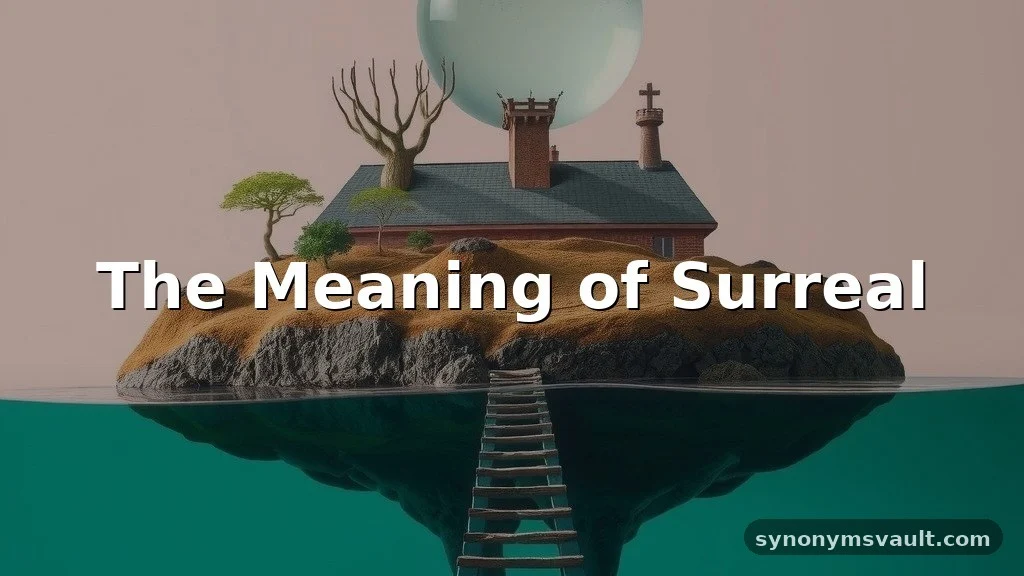
Have you ever seen something so strange, beautiful, or unexpected that you stopped and thought, “Is this actually real?” That feeling is often described with one powerful word: surreal.
The surreal meaning describes something that feels dreamlike, unreal, bizarre, or difficult to believe. People use the word when reality seems to break its normal rules. It can describe a strange moment, an unusual place, an incredible image, or even an emotional experience. You may hear someone say, “That was surreal,” after meeting a celebrity, witnessing an unbelievable event, or achieving a major life goal.
The word is also common in everyday conversations, social media posts, movies, photography, and art. Its meaning can change slightly depending on context, but the central idea stays the same: something feels strangely unreal or dreamlike.
This guide explains what surreal means, where the word comes from, how to use it naturally, and what people mean when they call a situation surreal in 2026.
Definition & Meaning
Surreal means strange, dreamlike, unreal, or completely different from ordinary reality.
In simple words, something is surreal when it feels so unusual that it almost seems like a dream.
Example:
“Standing on the stage in front of thousands of people felt surreal.”
Here, surreal means the experience felt unbelievable or dreamlike.
The word can describe both positive and negative experiences. A beautiful sunset may look surreal. A shocking event may also feel surreal.
Full Form and Meaning
Surreal does not have a full form. It is a complete English word, not an acronym or abbreviation.
The word comes from surreal, influenced by the French surréaliste, meaning “super-real” or beyond ordinary reality. It is closely associated with the Surrealist art movement, which explored dreams, imagination, and unusual combinations of ideas.
So, when someone asks for the surreal full form, there is no letter-by-letter expansion. The correct explanation is simply that surreal is a word describing something dreamlike, bizarre, or seemingly unreal.
Defining the Surreal Concept
At its core, the term acts as an adjective used to describe things that feel bizarre, dreamlike, or irrational. When you look at a dictionary, you will find that it refers to qualities that are incongruous or lacking in logical order. It’s the feeling that reality has shifted into a space that feels more like a fantasy.
It is not just about being weird or strange. It is about a specific type of strangeness where the boundaries between the waking world and the subconscious mind seem to blur.
Think about walking through a city street at three in the morning when it is completely empty. The silence, the flickering streetlights, and the lack of human presence can create a sensation that the world is not quite real.
That is a textbook example of a surreal moment. It is not necessarily scary, but it is deeply unsettling because it challenges your expectations of how the world should look and behave.
In literature and art, this term is used to describe scenes that combine unrelated elements to create a new, unsettling, or beautiful effect. For instance, if you describe a landscape where the sky is green and the trees are made of glass, you are using the word to paint a picture that exists outside of natural law.
It is a powerful tool for writers and creators because it allows them to bypass rational thought and speak directly to the emotions of the audience. By identifying these moments, you gain a better grasp of how humans perceive the divide between sanity and the imagination.
Origins and Historical Context
The history of the term is deeply rooted in the early 20th century, specifically within the artistic movement known as surrealism. This movement began in Paris in the 1920s as a reaction against the rationalism that many believed had led to the horrors of the First World War.
Artists and writers wanted to tap into the power of the unconscious mind. They believed that by ignoring logic, they could reach a deeper, more authentic truth about the human condition.
One of the most famous figures associated with this era is Salvador Dali. His work often features melting clocks and distorted figures, which are perfect examples of the visual language of the movement. These images were designed to challenge the viewer to look at the world differently.
Over time, the word migrated from art galleries into general usage. People started using it to describe not just paintings, but any experience that mirrored the strange, disjointed nature of those artworks.
As the term evolved, it moved away from being purely an artistic label and became a common part of our daily vocabulary. It transitioned from describing a specific school of thought to describing a universal human experience. Today, you will find it used in news reports, personal blogs, and everyday text messages.
The evolution reflects our changing relationship with reality. In an age where digital technology allows us to create impossible realities, the word has become more relevant than ever. You can learn more about the formal definition and its literary roots by visiting the Merriam-Webster dictionary entry for the term.
Usage in Various Contexts
You will hear this word in many different settings, ranging from casual texting to professional discussions about creative projects. In social media, it is often used to describe viral videos or photo edits that feature impossible situations.
For example, if someone shares a picture of a cat playing a piano in the middle of a desert, the comments section will almost certainly be filled with people calling the image surreal. It is a shorthand way of saying that the content is mind-bending or outside the norm.
In gaming, players often use the term to describe levels or environments that feature gravity-defying architecture or strange color palettes. If a game features a level where the ground is made of clouds and the enemies are giant geometric shapes, gamers will describe that experience as a trip into a surreal landscape. It helps communicate a sense of wonder and confusion simultaneously.
Consider this dialogue between two friends watching a weird movie:
“Did you understand that last scene? The characters were talking, but the walls were melting.”
“No, it was totally surreal.
I think the director wanted us to feel like we were inside a dream.”
“Yeah, it definitely felt that way. It was bizarre but kind of cool to look at.”
As you can see, the word functions as a bridge between the observer and the experience. It helps people share a common understanding of a moment that defies logic. Whether you are gaming, watching a film, or observing a strange event on the street, it provides the necessary language to express your shock or amazement at the unexpected.
Common Misconceptions and Clarifications
One of the most common mistakes people make is using this word to describe anything that is simply “bad” or “ugly.” It is not a synonym for unpleasant.
While something can be both unpleasant and surreal, the word itself refers to the quality of being dreamlike or irrational, not the quality of being good or bad. If you walk into a messy room, you might call it gross, but you would not call it surreal unless the mess was arranged in a way that defied the laws of physics.
Another misconception is that it must imply something supernatural. While ghosts or magic are often described as surreal, the term can just as easily apply to mundane situations.
A perfectly normal office meeting that suddenly becomes silent for five minutes could be described as having a surreal atmosphere. It is the context that matters, not the presence of spirits or magic.
Furthermore, some people confuse it with the word “abstract.” While both relate to art and concepts, abstract usually means that the object is not a direct representation of reality. Surreal, on the other hand, often uses realistic elements but places them in a context that makes no sense.
For example, a painting of a realistic apple floating in space is surreal. A painting of just circles and lines is abstract.
Understanding this distinction will help you use the word more accurately in your writing and speech. Always consider the intent behind your description before applying the label.
Similar Terms and Alternatives
If you feel that this word does not quite capture the feeling you are trying to describe, there are several alternatives you can explore. Depending on the specific nuance of the situation, you might find a better fit by using a different descriptor. Here is a breakdown of how these terms compare to one another.
* Bizarre: This is used for things that are extremely strange or unusual. It is a great alternative if you want to emphasize the oddity of a situation without necessarily implying a dreamlike quality.
* Ethereal: This refers to things that are delicate, light, and almost too perfect for this world. It’s a more positive, often beautiful way to describe something that feels otherworldly.
* Hallucinatory: This is a stronger term that implies the experience is so strange it feels like you are seeing things that are not there.
It is useful for describing intense or overwhelming experiences.
* Incongruous: This refers to things that do not fit together. It’s a more clinical and precise way to describe the lack of logic in a scene.
* Phantasmagorical: This is a more complex word that describes a sequence of real or imaginary images that are constantly changing, much like a dream or a fever.
| Term | Primary Usage | Emotional Tone |
|---|---|---|
| Surreal | Dreamlike/Irrational | Neutral/Awe |
| Bizarre | Very strange | Neutral/Negative |
| Ethereal | Delicate/Heavenly | Positive |
| Incongruous | Out of place | Neutral |
Using these variations will add depth to your vocabulary. It allows you to be more specific about the nature of the strangeness you are encountering.
How to Respond to This Term
When someone uses this word in conversation, your response should depend on the context and the level of formality. If a friend mentions a surreal experience, you should focus on validating their feeling of confusion or wonder. If you are in a professional environment, you might want to clarify what they mean by the term to ensure everyone is on the same page.
For a casual response, you could say: “That sounds like a wild experience. I know exactly what you mean by that feeling of being in a dream.” This acknowledges the emotion behind their statement.
If you want to be funny, you could add: “Sounds like a glitch in the matrix! Did you check if the world was still loading?” This plays on the popular idea that our reality is simulated, which aligns well with the modern usage of the word.
In a more professional or academic setting, you should ask for further detail. For example: “When you describe the project feedback as surreal, are you implying that the requests were disconnected from our original goals, or was the delivery just unexpected?”
This shows that you are listening carefully and want to understand the specific impact of the situation. Being able to pivot your response style shows that you have a high level of social intelligence and mastery over the nuances of language.
Regional and Cultural Differences
The usage of this word is remarkably consistent across many English-speaking cultures, but the way it is expressed can vary. In some regions, the word is used more frequently in casual conversation, while in others, it remains a slightly more formal descriptor. In the United States, it is common to hear it used to describe almost any unexpected event, from a weird celebrity scandal to a strange political development.
Other parts of the world, particularly in Europe where the surrealist art movement originated, the term may carry a slightly heavier intellectual weight. People might be more likely to associate it with the history of art and literature. If you are traveling or communicating with people from different backgrounds, it is helpful to be aware that their interpretation might be slightly colored by their own educational experiences.
Interestingly, the concept of the dreamlike or the irrational exists in almost every culture, even if the specific word used to describe it differs. Translating the term into other languages often reveals how different societies view the relationship between reality and the subconscious.
For instance, some languages have specific words for “dream-logic” that do not perfectly map onto our English word. When speaking with non-native speakers, it is often better to describe the feeling—”it felt like a dream”—rather than relying on a single, potentially misunderstood adjective.
Comparison with Similar Expressions
To truly master the use of this word, you must look at how it compares to other expressions that imply a similar feeling. We often use phrases like “unreal” or “out of body” to describe the same sensations. While these phrases are related, they are not always interchangeable.
* Unreal: This is often used to describe something that is too good to be true, or something that is so shocking it feels fake. Unlike the term we are discussing, “unreal” often carries an emotional weight of disbelief or extreme joy.
* Out of body: This refers to a specific psychological sensation where you feel detached from your physical self.
This is a much more personal and internal experience compared to the external observation of a strange scene.
* Disorienting: This is a functional description of how a situation makes you feel. It is less about the quality of the scene and more about the impact on your sense of direction or stability.
When choosing between these, think about the primary focus of your statement. Are you describing the scene itself? Use the term in question.
Are you describing your reaction to the scene? Use “disorienting.” Are you describing how hard it is to believe what you are seeing?
“Unreal” is likely your best bet. By refining your choices, you make your communication much more precise and effective.
Usage in Online Communities and Dating Apps
On platforms like Tinder or Bumble, you might see people describe their hobbies or their “ideal date” as surreal. This is usually a shorthand way of saying they enjoy experiences that are unconventional, artistic, or slightly weird. If you are trying to build a profile, using this word can signal that you are a creative person who appreciates the bizarre elements of life.
In gaming communities, especially on Discord or Reddit, the word is frequently used to describe “glitch art” or games that focus on psychological horror. When someone posts a video of a game behaving strangely, you will see comments like “This is so surreal, I love it.” It creates a sense of community around the appreciation of the strange.
If you are responding to someone who uses this term on a dating app, try to engage with their sense of curiosity. If they say they love surreal movies, ask them which ones. It is a great conversation starter because it leads to discussions about art, dreams, and the nature of reality.
It is a much more interesting path than talking about the weather or work. Always keep the tone light and inviting.
If you want to impress someone, mention a piece of art or a book that fits the description. It shows that you have a deeper understanding of the term beyond just its surface-level usage.
Hidden or Offensive Meanings
Generally, this word is considered neutral and safe for use in almost any context. It does not carry the baggage of offensive slang or derogatory labels.
However, as with any word, the context is what determines its impact. If you use it to describe a person’s behavior in a way that implies they are mentally unstable, it could be interpreted as insensitive.
Tone of voice is incredibly important here. If you are laughing while saying, “That behavior was so surreal,” it sounds like you are commenting on the absurdity of the situation. If you say it with a stern or cold tone, it might sound like you are judging the person.
Always be mindful of your audience. If you are talking about a sensitive topic, such as a mental health struggle, it is best to avoid using words that might be misinterpreted as trivializing the experience.
Furthermore, avoid using the word to dismiss someone’s genuine concerns. If a friend is telling you about a difficult situation and you call it “surreal,” they might feel like you are not taking them seriously.
In such cases, it is better to use empathetic language rather than descriptive labels. Save the word for when you want to highlight the bizarre or dreamlike nature of an event, rather than as a way to characterize people or their feelings.
Suitability for Professional Communication
Is this word appropriate for a formal report or a business email? Generally, it is best to avoid it in high-stakes professional documents.
Business communication thrives on clarity, logic, and precision. Because the word implies a lack of logic or a dreamlike state, it can be counterproductive when you are trying to be clear and grounded.
However, there are exceptions. If you are working in a creative industry—such as marketing, design, or film—the word is perfectly acceptable.
It can be a very effective way to pitch a bold, unconventional idea. “I think we should aim for a surreal aesthetic in this campaign,” conveys a clear vision for an artistic direction that is meant to stand out and capture attention.
If you find yourself needing to describe a strange situation in a professional setting, try to use more precise alternatives. Instead of saying, “The market fluctuations were surreal,” you could say, “The market fluctuations were highly irregular and difficult to predict.”
This maintains your professional credibility while still communicating the severity of the situation. Always weigh the creative potential of the word against the need for professional clarity before hitting send.
FAQs
1. Does the term always imply something negative?
No, it is a neutral term. It describes the dreamlike quality of an experience, which can be beautiful, strange, or even funny, depending on the context.
2. Is there a difference between surreal and bizarre?
Yes. While both describe strange things, the word in question implies a dreamlike, irrational, or subconscious quality, whereas bizarre simply means very unusual or out of the ordinary.
3. Can I use this word in a formal essay?
You can, but it is best used when discussing art, literature, or philosophy. In scientific or technical writing, it is usually too subjective for formal use.
4. Is it offensive to describe a person as surreal?
It is not inherently offensive, but it can be confusing. It is better to describe a person’s actions or their art as having that quality rather than labeling the person themselves.
5. Where did the word originate?
It originated in the 1920s from the surrealist movement in France, which sought to bridge the gap between dreams and reality through art and writing.
6. How do I know if I am using it correctly?
Ask yourself if the situation feels like a dream or if it defies logical explanation. If the answer is yes, you are likely using it correctly.
7. Are there any synonyms I should use instead?
Depending on your intent, words like “ethereal,” “bizarre,” or “hallucinatory” can be great alternatives if you want to be more specific about the type of strangeness you are observing.
Conclusion
Understanding the meaning of this word is about more than just checking a dictionary. It is about recognizing the moments in life that refuse to fit into our tidy, logical boxes. Whether you are analyzing a piece of art or trying to explain a strange coincidence to a friend, having this word in your vocabulary allows you to capture the magic and the mystery of the world.
It reminds us that reality is not always as straightforward as it seems. By embracing the dreamlike, the bizarre, and the unexpected, we can better appreciate the complex, often chaotic, and always fascinating tapestry of human experience.
So, the next time you find yourself in a moment that feels just a little bit off, or a little bit like a dream, you will know exactly how to describe it. Keep observing, keep questioning, and keep finding the right words to share your perspective with the world.
2 thoughts on “Surreal Meaning: The Fascinating Word Behind Those “Is This Real?” Moments | 2026”