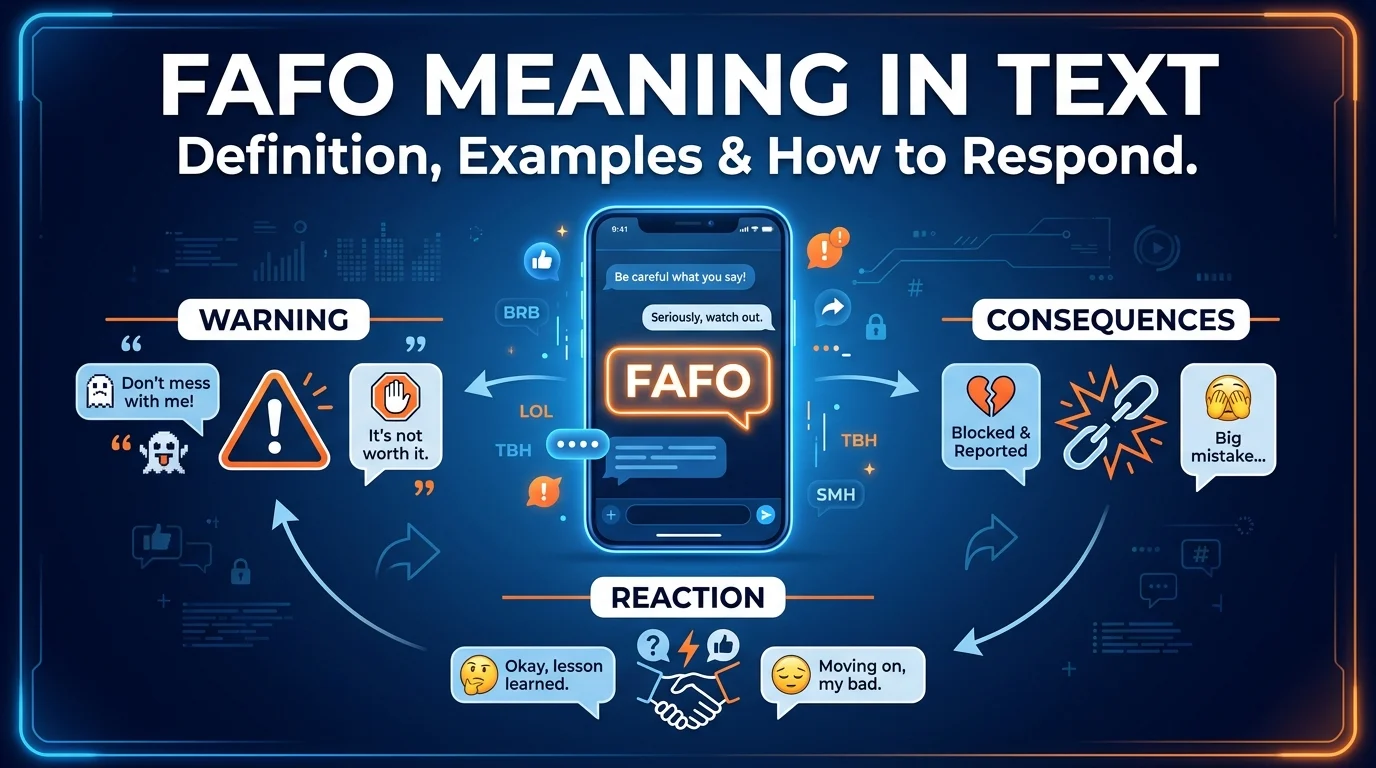
The FAFO meaning in text is “Fuck Around and Find Out.” This popular slang expression warns someone that reckless behavior, unnecessary risks, or provoking others can lead to consequences. People use FAFO in text messages, social media comments, memes, and everyday conversations to express a warning, challenge, joke, or reaction to someone’s actions.
For example, a friend might text, “Keep ignoring the warning signs and FAFO.” In this message, FAFO means that someone will eventually experience the consequences of their choices.
However, FAFO doesn’t always sound aggressive. Friends may use it humorously when someone tries something risky or makes an obvious mistake. Its meaning depends on the situation, the relationship between the people involved, and the tone of the conversation.
Whether you’ve seen FAFO in a text message, TikTok comment, Instagram caption, or online argument, understanding its meaning will help you interpret the message correctly.
What Does FAFO Mean in Text?
FAFO means “Fuck Around and Find Out.” In texting, people use this abbreviation to suggest that someone will discover the consequences of their behavior, especially after ignoring advice, crossing boundaries, or taking unnecessary risks.
The expression combines a blunt warning with the idea of learning through experience. Rather than explaining what might happen, the speaker implies that the other person will discover the outcome for themselves.
Consider this conversation:
Alex: I’m going to keep bothering him until he gets angry.
Jordan: Go ahead, but don’t complain when you FAFO.
Jordan is warning Alex that provoking someone could lead to an unpleasant result.
People also use FAFO when commenting on situations that have already happened. For instance, someone who ignores a safety warning and suffers the predictable consequences might inspire the comment, “He ignored every warning. FAFO.”
In this case, the expression communicates that the outcome resulted from the person’s own choices.
What Is the Simple Meaning of FAFO?
In everyday English, FAFO can mean:
- Face the consequences: Deal with the results of your decisions.
- Learn the hard way: Discover why an action was a bad idea.
- Don’t test your limits: Stop before your behavior creates trouble.
- You were warned: Accept the outcome after ignoring advice.
- Find out for yourself: Experience the result rather than relying on someone else’s warning.
These interpretations share one central idea: what you do can have consequences.
However, FAFO is more forceful than a neutral statement such as “actions have consequences.” Its profanity gives it a blunt, sometimes confrontational edge.
What Does FAFO Stand For?
FAFO is an initialism formed from the first letters of “Fuck Around and Find Out.” People commonly refer to it as an acronym in everyday conversation, although technically an initialism is pronounced letter by letter rather than as a single word.
Here’s how the phrase works:
| Word or phrase | Meaning in context |
|---|---|
| Fuck around | Act carelessly, take unnecessary risks, provoke someone, or ignore boundaries |
| And | Connects the behavior to its result |
| Find out | Discover or experience the consequences |
The expression doesn’t necessarily refer to literal experimentation. In slang, “fuck around” often means behaving recklessly, messing with someone, pushing limits, or doing something despite a clear warning.
Similarly, “find out” means experiencing the outcome of that behavior. The result might be embarrassment, a failed experiment, an argument, a practical lesson, or another consequence.
For example:
“She kept touching the wet paint after being told not to. FAFO.”
The implied message is that she chose to ignore the warning and experienced the predictable result.
Important: FAFO contains profanity even when written as four letters. Someone unfamiliar with the abbreviation might miss its full meaning, but people who know the expression generally understand its blunt tone.
FAFO Meaning in Texting and Chat
In texting, FAFO communicates an idea quickly without spelling out the full phrase. Its interpretation usually falls into a few common categories.
FAFO as a Warning
A warning is one of the most common uses of FAFO. The sender wants someone to understand that continued behavior could have unpleasant consequences.
For example:
“Keep sharing my private messages and FAFO.”
The sender is warning the recipient to stop. Depending on the surrounding conversation, this could be a firm boundary or an aggressive threat.
Another example:
“Don’t skip the safety instructions. FAFO isn’t worth it.”
Here, the phrase emphasizes the potential consequences of carelessness.
FAFO as a Challenge
Sometimes, people use FAFO to challenge someone who seems overly confident or refuses to listen.
For example:
“You think you can beat the game without reading the rules? FAFO 😂”
The sender is effectively saying, “Try it and see what happens.”
A challenge like this may be harmless when friends are discussing a game or a minor risk. However, if the conversation involves a personal conflict, the same expression could sound intimidating.
FAFO as Humor
FAFO also appears in jokes about predictable mistakes, failed experiments, and impulsive decisions.
For example:
“He ate the entire bag of extra-hot chips after I warned him. FAFO.”
The speaker is laughing at the outcome rather than issuing a serious warning.
Emojis, friendly teasing, and the nature of the situation can help signal humor. Still, you shouldn’t rely on an emoji alone to decide whether a message is harmless.
FAFO as a Reaction to Consequences
People often use FAFO after someone experiences a result that follows directly from their behavior.
For example:
“He lied to his friends and got caught. FAFO.”
The phrase expresses the opinion that the person brought the outcome upon themselves.
This use commonly appears in online discussions about public behavior, personal disputes, risky decisions, and avoidable mistakes.
FAFO Meaning in Text Messages: Realistic Examples
The best way to understand FAFO is to examine how the expression works in different conversations. Although the wording stays the same, the intended meaning can change significantly.
| Text message example | Meaning | Likely tone |
|---|---|---|
| “Keep pushing your luck and FAFO.” | Your behavior may lead to consequences. | Warning |
| “You ignored the instructions. FAFO.” | You experienced the result of your decision. | Blunt or sarcastic |
| “I told him not to touch the stove. FAFO 😂” | He learned through experience. | Humorous |
| “You wanted to race without practicing. FAFO.” | Your decision led to the result. | Teasing |
| “Try that stunt again and FAFO.” | The sender is warning against repeating an action. | Confrontational |
| “They ignored every safety rule, and now look what happened. FAFO.” | The consequences followed from their choices. | Critical |
| “FAFO, I guess I deserved that.” | The speaker accepts responsibility for a mistake. | Self-deprecating |
| “Keep spreading rumors about me and FAFO.” | The sender warns someone to stop. | Potentially threatening |
These examples illustrate the expression’s range. A playful message about spicy food has a different purpose from a direct message sent during a heated argument.
To interpret FAFO correctly, pay attention to what happened before the message, who sent it, and what consequences the sender appears to suggest.
Short FAFO Conversation Examples
Example: Friends joking
Mia: I tried to cut my own bangs five minutes before the party.
Emma: Girl, FAFO 😭
Emma is teasing Mia about a predictable beauty mistake. The message isn’t necessarily hostile.
Example: Ignoring advice
Chris: I thought I could finish the assignment without studying.
Sam: And now you failed the quiz. FAFO.
Sam means that Chris experienced the result of not preparing.
Example: Setting a boundary
Taylor: Stop making jokes about my family.
Morgan: You’re being too sensitive.
Taylor: Keep going and FAFO.
Taylor’s final message sounds confrontational. The preceding messages help explain why the expression carries a sharper tone.
What Does FAFO Mean on Social Media?
On social media, FAFO often appears in comments, captions, memes, and reactions to videos or public events. Users employ it to criticize reckless behavior, joke about avoidable mistakes, or suggest that someone deserves the consequences of their actions.
The expression works particularly well in short-form online communication because it conveys a strong reaction with very few characters.
For example, someone might post a video of a person ignoring a warning and making a mess. A commenter could respond with “FAFO” to express the view that the outcome was predictable.
However, social media comments don’t always reflect the full story. A short clip may omit important details, so the use of FAFO doesn’t prove that the person involved actually deserved the outcome.
FAFO Meaning on TikTok
On TikTok, FAFO can appear in video captions, reaction clips, text overlays, and comment sections.
Common contexts include:
- Someone ignores advice and experiences an avoidable result.
- A person attempts a risky stunt that goes wrong.
- A creator comments on someone testing another person’s patience.
- A video shows a failed experiment or a humorous mistake.
For example, a caption might read:
“He said the warning label was unnecessary. FAFO.”
The caption suggests that the person learned why the warning mattered.
Some creators use FAFO for entertainment, while others use it to criticize behavior. The meaning depends on the video and the surrounding discussion rather than the platform itself.
FAFO Meaning on Instagram and Facebook
On Instagram and Facebook, people may use FAFO in Reels comments, meme captions, posts, and discussions about personal experiences.
A meme showing someone ignoring clear instructions might include the phrase to emphasize the predictable result. In a more serious discussion, a commenter might use it to criticize someone who repeatedly violates boundaries.
For example:
“She kept lying to everyone and eventually lost their trust. FAFO.”
The commenter is connecting the person’s behavior with its consequences.
Because these platforms host both casual conversations and heated debates, FAFO can sound playful in one thread and hostile in another.
FAFO Meaning on Snapchat and in Private Chats
In Snapchat conversations and other private messages, FAFO often serves as a quick warning or joking response.
Friends might use it after someone takes a dare, ignores advice, or makes an impulsive decision. Someone might also send it during a disagreement to suggest that the recipient will regret continuing their behavior.
Private messages can be harder to interpret because outsiders don’t know the relationship between the people involved.
If a friend regularly jokes with you using blunt language, the expression may be playful. If someone sends it after repeated arguments or aggressive messages, you should pay closer attention to the surrounding context.
Is FAFO a Bad Word or Offensive?
Yes, FAFO contains profanity, so it can be considered vulgar or offensive. Its acceptability depends on the audience, setting, and reason for using it.
Some people use the abbreviation casually because it has become familiar internet slang. Others still regard it as inappropriate because they recognize the original swear word.
The fact that someone writes FAFO instead of spelling out the phrase doesn’t remove its underlying meaning.
When FAFO May Be Acceptable
FAFO may be acceptable in informal situations such as:
- Joking with friends who understand your sense of humor.
- Reacting to a harmless mistake in a private group chat.
- Discussing internet memes or familiar slang.
- Using casual language in an online community where profanity is common.
Even in these settings, consider whether the recipient enjoys blunt humor. Familiarity with a phrase doesn’t mean everyone will appreciate it.
When You Should Avoid Using FAFO
Avoid the expression when the situation calls for polite, professional, or neutral language.
For example, don’t use FAFO casually in a formal email to a manager, an academic assignment, a customer service conversation, or a sensitive discussion with someone you don’t know well.
Instead of writing:
“Ignore the instructions and FAFO.”
You could write:
“Ignoring the instructions may lead to unwanted consequences.”
The second version communicates the same general idea without profanity or a confrontational tone.
A useful rule: If you wouldn’t feel comfortable spelling out the full phrase in front of your audience, choose a more neutral expression.
Is FAFO a Threat or Just a Warning?
FAFO can be a warning, a challenge, a joke, or a potentially threatening statement. The abbreviation alone doesn’t tell you which interpretation is correct.
The distinction depends on the surrounding language, the relationship between the people involved, and the specific outcome being suggested.
| Context | Example | How to interpret it |
|---|---|---|
| Friendly joke | “Touch my fries again and FAFO 😂” | Playful teasing, depending on the relationship |
| General warning | “Ignore the safety rules and FAFO.” | A warning about the likely consequences |
| Personal boundary | “Keep sharing my secrets and FAFO.” | A forceful demand to stop |
| Aggressive confrontation | “Come near me again and FAFO.” | Potentially threatening language that deserves attention |
A message becomes more concerning when the sender refers to harming someone, repeatedly targets the recipient, makes specific threats, or follows the message with intimidating behavior.
Don’t assume every use of FAFO predicts violence. At the same time, don’t dismiss a credible threat simply because the sender used internet slang.
If a message makes you feel unsafe, avoid escalating the argument. Preserve relevant messages, consider blocking the sender, and seek help from a trusted person or appropriate authorities if necessary.
How to Respond When Someone Texts FAFO
Your response should reflect what the sender appears to mean. A playful joke calls for a different reply than a serious warning or an intimidating message.
If Someone Uses FAFO as a Joke
When the message is clearly friendly, you can respond with humor or acknowledge the mistake.
Examples include:
- “Okay, lesson learned 😂”
- “You were right. I should’ve listened.”
- “Well, that backfired quickly.”
- “I really did find out the hard way.”
- “Fair enough. Never doing that again.”
These responses show that you understand the joke without making the conversation unnecessarily serious.
If Someone Uses FAFO as a Warning
If someone is telling you to stop a particular behavior, respond calmly. You don’t have to agree with every part of their message, but acknowledging a reasonable boundary can prevent further conflict.
You could say:
- “I understand. I’ll stop.”
- “I hear you. Let’s settle this calmly.”
- “I didn’t realize it bothered you that much.”
- “Let’s talk about this without threats.”
- “What exactly do you want me to stop doing?”
Choose a reply that fits the circumstances. A direct question may help clarify a misunderstanding, while a simple acknowledgment may be better when the situation is already tense.
If Someone Uses FAFO Aggressively
When the message sounds hostile, avoid responding with another threat or an insult. Escalating the exchange can make the situation worse.
Consider these responses:
- “I’m not interested in arguing. Let’s leave it here.”
- “Please communicate with me respectfully.”
- “I won’t continue this conversation if you’re threatening me.”
- “I understand your message. I’m stepping away now.”
If the sender makes a credible threat, prioritize your safety rather than trying to win the argument. Save the messages and seek support when appropriate.
If You Don’t Understand What the Sender Means
Sometimes the abbreviation appears without enough context to tell whether the sender is joking or serious.
A simple clarification can help:
“Do you mean that as a joke or a serious warning?”
This gives the sender a chance to explain. Their response, along with the rest of the conversation, can help you understand their intent.
How to Use FAFO in a Sentence
FAFO is informal slang, so it works best in casual conversations, private messages, memes, and social media discussions.
People commonly use it as a standalone reaction, a warning, or a comment about someone’s experience.
Use FAFO as a Standalone Reaction
A person might write “FAFO” after someone makes an avoidable mistake.
Example: “He ignored the instructions and ruined the project. FAFO.”
Here, the expression summarizes the speaker’s judgment about the outcome.
Use FAFO to Warn Someone
The abbreviation can also appear in a sentence that warns someone against continuing their behavior.
Example: “Keep breaking the rules and you’ll FAFO.”
The message suggests that further misconduct could produce consequences.
Use FAFO to Describe Learning Through Experience
People sometimes use the expression after they experience the outcome of their own decisions.
Example: “I thought I could finish everything at the last minute. FAFO.”
In this case, the speaker admits that their decision led to an unpleasant result.
Use FAFO in Humorous Conversations
The expression can make a blunt reaction sound playful when the context supports that interpretation.
Example: “She challenged her brother to a cooking contest and burned the cookies. FAFO 😂”
The joke centers on the result of taking on a challenge without being prepared.
Grammar and Usage Tips
When using FAFO, remember these points:
- Keep the context clear. The reader should understand which action led to the consequences.
- Match the tone to the audience. A joke between friends may not work in a professional conversation.
- Don’t assume everyone knows the abbreviation. Spell it out or explain it when the audience may be unfamiliar with internet slang.
- Understand its intensity. FAFO is stronger than a neutral phrase such as “learn from your mistakes.”
- Use punctuation naturally. People write it as “FAFO,” “FAFO!” or simply “FAFO” at the end of a sentence.
The abbreviation is not a good fit for every situation. In formal writing, use clearer alternatives such as “face the consequences,” “learn from experience,” or “actions have consequences.”
FAFO Synonyms and Similar Slang Expressions
Several English expressions communicate ideas similar to FAFO. However, their meanings and emotional intensity differ.
| Expression | Meaning | Difference from FAFO |
|---|---|---|
| Play stupid games, win stupid prizes | Reckless behavior can produce undesirable outcomes. | Often sarcastic and judgmental |
| Learn the hard way | Discover something through an unpleasant experience. | Usually less aggressive |
| Actions have consequences | Choices produce results. | More neutral and formal |
| Don’t push your luck | Stop before a situation turns against you. | Emphasizes avoiding unnecessary risk |
| You reap what you sow | Your actions eventually influence what happens to you. | Often carries a moral lesson |
| Find out the hard way | Experience an unpleasant result firsthand. | Focuses on learning through experience |
| You asked for it | Your own behavior brought about the outcome. | Can sound accusatory |
| Don’t mess with me | Stop provoking or challenging me. | More directly confrontational |
| Mess around and find out | Take risks and discover the consequences. | Closely mirrors FAFO’s meaning |
| What goes around comes around | Actions may eventually come back to affect you. | Often suggests fairness or retaliation |
Which Expression Is Closest to FAFO?
“Mess around and find out” is the closest alternative because it retains nearly the same meaning and structure.
“Play stupid games, win stupid prizes” is another close match when someone makes reckless decisions and experiences predictable consequences.
If you need a more professional alternative, use “actions have consequences.” It communicates the central message without profanity or the confrontational edge associated with FAFO.
Where Did FAFO Come From?
FAFO comes from the slang expression “Fuck Around and Find Out.” Its meaning draws on a familiar idea: people sometimes learn the consequences of their actions only after they take a risk or ignore a warning.
The phrase belongs to informal English rather than formal writing. Its short form makes it convenient for text messages, online discussions, and image-based jokes.
Over time, FAFO became recognizable in internet culture as a compact way to react to reckless behavior, conflict, and avoidable mistakes. Online users can communicate a strong judgment with four letters instead of writing an entire sentence.
However, it’s important to distinguish the phrase’s general use from claims about its exact origin. Without reliable historical evidence, it would be misleading to identify one person, platform, or specific year as the sole source of FAFO.
The expression’s meaning is easier to establish than its precise starting point: FAFO expresses the idea that someone may discover the consequences of their actions by experiencing them firsthand.
Frequently Asked Questions About FAFO Meaning in Text
What does FAFO mean in texting?
FAFO means “Fuck Around and Find Out.” People use it in texts to warn someone about consequences, challenge risky behavior, or joke about an avoidable mistake.
What is the full form of FAFO?
The full form of FAFO is “Fuck Around and Find Out.” The phrase suggests that people may experience the consequences of reckless behavior, provocation, or ignored warnings.
Is FAFO an acronym or slang?
FAFO is internet slang formed from the initial letters of a longer phrase. Technically, it is an initialism because people generally pronounce the individual letters rather than saying them as a single word.
Is FAFO rude or offensive?
FAFO can be rude or offensive because its full form contains profanity. Friends may use it casually, but it may be inappropriate in professional, formal, or sensitive situations.
Does FAFO always mean a threat?
No. FAFO can express humor, sarcasm, defiance, or a general warning about consequences. However, it may sound threatening when directed at someone during a serious confrontation.
What does FAFO mean from a guy or girl?
The meaning doesn’t change based on the sender’s gender. A guy or girl may use FAFO as a joke, warning, challenge, or reaction to someone’s behavior. The conversation provides more useful clues than gender alone.
Can you use FAFO in a professional message?
It’s generally better to avoid FAFO in professional messages because it contains profanity and can sound confrontational. Use expressions such as “please consider the consequences” or “actions have consequences” instead.
What is another way to say FAFO?
Common alternatives include “learn the hard way,” “face the consequences,” “actions have consequences,” and “play stupid games, win stupid prizes.” Choose the one that matches the tone and situation.
What does FAFO mean in a meme?
In a meme, FAFO usually suggests that someone ignored a warning, took a foolish risk, or experienced a predictable consequence. It often adds sarcasm or humor to the image or situation.
How should you respond to FAFO in a text?
If the sender is joking, respond playfully. If they’re setting a boundary, acknowledge the issue and stay calm. If the message sounds threatening, avoid escalating the conversation and prioritize your safety.
Final Thoughts on FAFO Meaning in Text
The FAFO meaning in text is “Fuck Around and Find Out,” an informal expression that connects someone’s behavior with its consequences. People use it to warn others, challenge risky decisions, joke about mistakes, or comment on situations in which someone appears to have brought trouble upon themselves.
Its tone can range from playful to aggressive. A friend teasing you about a failed cooking experiment may use FAFO harmlessly, while someone sending it during a heated argument may be expressing a serious warning.
To understand the expression, consider the surrounding conversation, the relationship between the sender and recipient, and the consequences being discussed. Remember, too, that FAFO contains profanity and isn’t suitable for every audience.
Ultimately, the phrase delivers a blunt message: your actions can have consequences, and sometimes you have to experience them to understand why.